The usual mid-summer lull of lumber sales slow-down arrived as the calendar
turned to August..
Raging, indeed explosive, wildfires in many regions of the continent caused
great concerns. Conditions in the forests across North America were prime
for fire activity, as droughts were ongoing for several years.
Evacuation orders and emergency responses were scattered all around large
parts of Canada and the US. Volatile weather, especially lightening strikes,
added new fires.
In the north at least, the waning summer daylight hours helped with this; as
the sun starts to dip lower in the horizon and the nights get
longer, cooler temperatures at least after sunset helps fire crew efforts.
The amount of merchantable timber loss will be calculated once the fires are
put out.
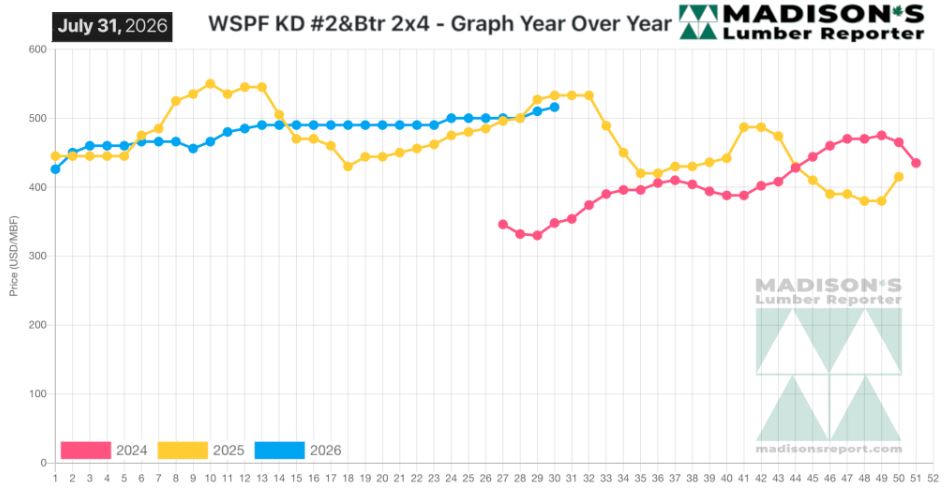
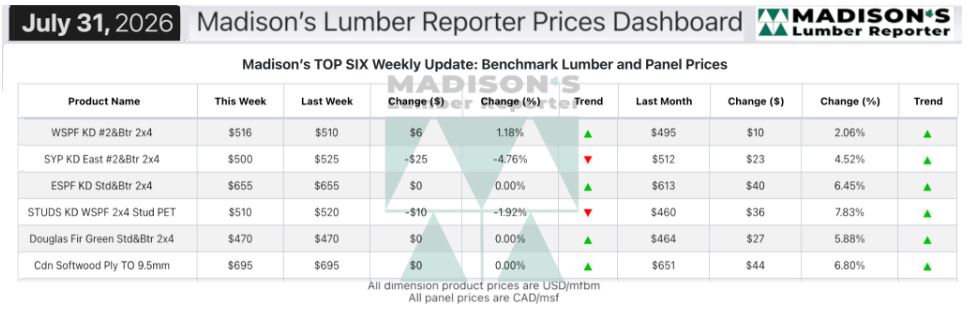
In the week ending July 31, 2026 the price of Western Spruce-Pine-Fir 2×4
#2&Btr KD (RL) was US$516 mfbm, which was up +$6, or +1% from the previous
week when it was $510, said weekly forest products industry price guide
newsletter Madison’s Lumber Reporter.
That week’s price was up +$21, or +4%, from one month ago when it was $495.
Compared to the same week last year, when it was US$527 mfbm, the price of
Western Spruce-Pine-Fir 2×4 #2&Btr KD (RL) for the week ending July 24, 2026
was down -$17, or -3%.
Compared to two years ago when it was $330, that week’s price was up +$180,
or +55%.
Plywood experienced shocking reversals which suddenly pushed those mill
order files into early September; while most other segment prices remained
flat.
 KEY TAKE-AWAYS:
• Western-SPF sawmills in the US maintained lead times as far out as the
week of August 17th, with not much inventory for August 10th shipment.
• Buyers remained loathe to take anything resembling a long position.
• Sales of Western-SPF in Canada appeared to lose more momentum as summer
vacations took precedence over booking new orders.
• Tight supply continued to drive firm or upward pricing in standard and
premium grades.
• Price levels for Eastern-SPF were elusive to pin down since Eastern
producers were in the midst of summer shutdowns.
• In most regions of North America, the ongoing situation of fewer
large-diameter logs meant wides were only more scarce.
• Several sources referred to Southern Yellow Pine sales as “sloppy”.
• Sensing weakness, retail customers and other buyers felt they had
leverage, thus pushed steep counter-offers.
• On the US northeastern seaboard, holes in buyers’ inventories were
undeniable and growing.
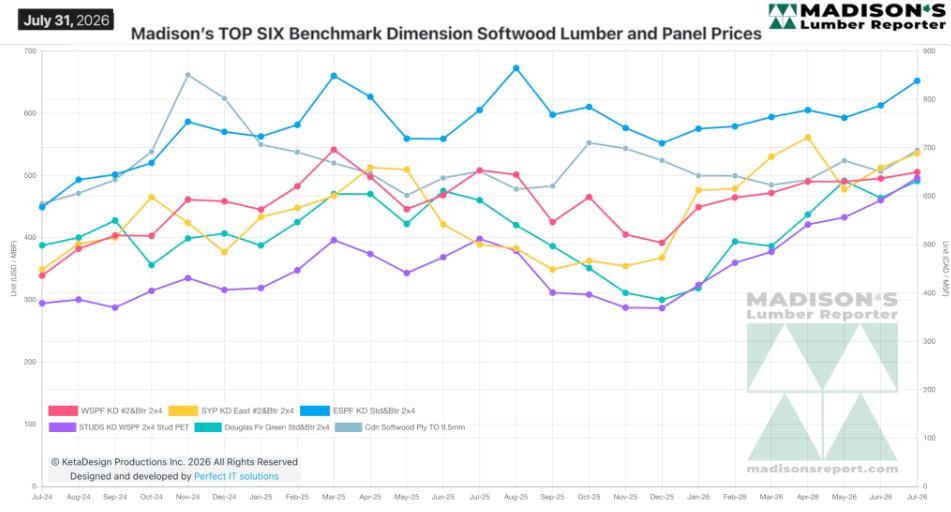
MADISON’S BENCHMARK TOP-SIX SOFTWOOD LUMBER AND PANEL PRICES: MONTHLY
AVERAGES
Source: madisonsreport.com
More Reports:


