As lumber sales and construction activity went into true summer slow-down,
the ongoing situation of lack of solid wood inventory throughout the supply
chain served to keep lumber prices firm.
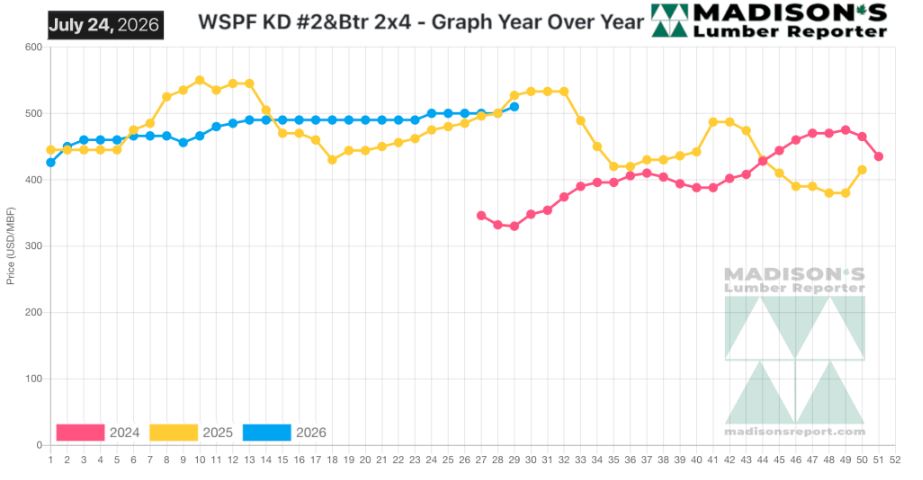
In a good consistency from the past year, benchmark lumber item Western
S-P-F 2×4 prices matched exactly that of one year ago. Given that sawmills
across North America were operating at lower manufacturing rates, this
tenuous supply-demand balance so far teetered at a equilibrium.
As August continued and much of Canada and US were occupied with fires in
forested areas, attention was often on the loss of timber and access to
fibre.
Logistically, operators were spending more time sourcing trucks and rail
cars as well as tracking down lumber already in delivery, than they were on
selling more wood.
Many sawmills started looking toward September, after Labour Day, which is
often a slight pop in sales and home renovation in advance of looming winter
weather.
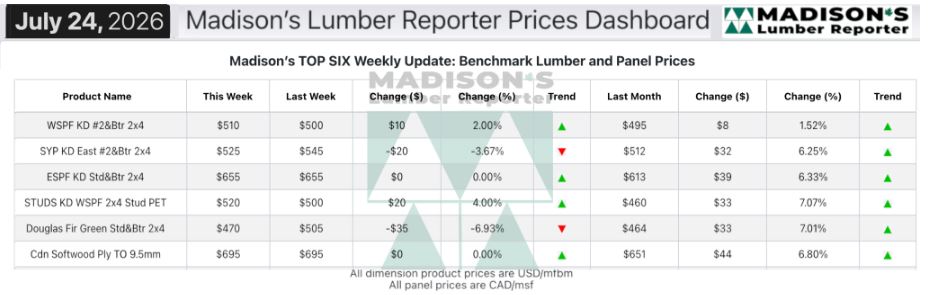
In the week ending July 24, 2026, the price of benchmark softwood lumber
item Western Spruce-Pine-Fir 2×4 #2&Btr KD (RL) was US$510 mfbm. This was up
+$10, or +2%, from the previous week when it was $500, said weekly forest
products industry price guide newsletter Madison’s Lumber Reporter.
That week’s price was up +$15, or +3%, from one month ago when it was $495.
Compared to the same week last year, when it was us$527 mfbm, the price of
western spruce-pine-fir 2×4 #2&btr kd (rl) for the week ending July 24, 2026
was down -$17, or -3%.
Compared to two years ago when it was $330, that week’s price was up +$180,
or +55%.
As the dog days of summer arrived, many players felt there was a
supply-driven undercurrent keeping commodity prices firm.
 KEY TAKE-AWAYS:
• For Western-SPF suppliers in the US the apparent summer slowdown was
belied by strong commodity prices and ongoing limited supply.
• Many builders in key regions quietly admitted they were much busier than
they expected for the time of year.
• Demand for Western-SPF in Canada decreased.
• Producers kept their inventories tightly controlled.
• Variable production schedules helped maintain healthy order files roughly
in the range of two- to three-weeks.
• Eastern-SPF players pointed to climbing sawmill prices.
• Prompt options few and far between, as sawmill order files in the
northeast were as far as four weeks in some cases.
• Demand for Southern Yellow Pine felt disconnected.
• Sawmill asking prices in the south slid on a weakening summer market.
• Eastern stocking wholesalers reported retail customers in the tri-state
area stuck to their hand-to-mouth buying strategies.
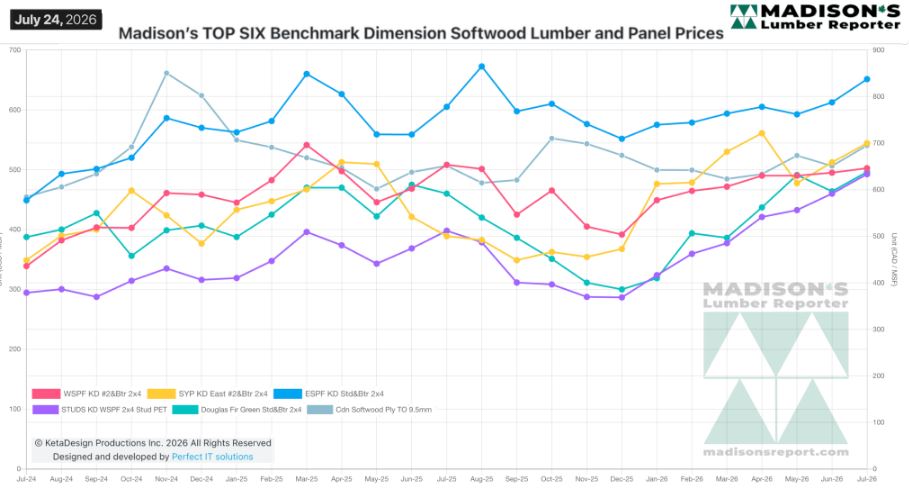
MADISON’S BENCHMARK TOP-SIX SOFTWOOD LUMBER AND PANEL PRICES: MONTHLY
AVERAGES
Source: madisonsreport.com
More Reports:


