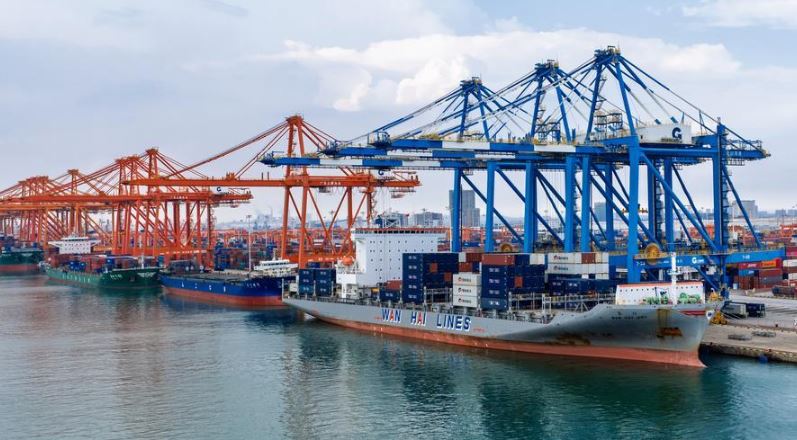
Cargo ships loading at the Qinzhou Port in Qinzhou, south
China's Guangxi Zhuang Autonomous Region.
At Tieshan Port in Beihai, a coastal city in south China's
Guangxi Zhuang Autonomous Region, a conveyor belt stretches
several kilometers from the quayside to a mill run by Nine
Dragons Paper (Holdings) Limited, carrying wood chips from ASEAN
countries.
Inside, automated production lines turn these chips into heavy
rolls of white paperboard for folding cartons before being
loaded and shipped to buyers worldwide.
This direct link between port and plant illustrates how Guangxi
is pairing its forestry resources with coastal logistics to
scale up papermaking and serve global customers, particularly in
Southeast Asia, where expanding factories and e-commerce are
fueling demand for packaging.
The industry's expansion was in focus as delegates gathered in
Nanning, the regional capital, for the 2026 Forestry Industry
Conference from Nov. 20 to 22.
Output of paper and paperboard from Guangxi's major producers
jumped 37.2 percent in 2025 to nearly 12 million tonnes,
according to official data. The region aims to more than double
annual production to 27 million tonnes by 2030.
Growing demand in neighboring Southeast Asian markets offers
opportunities for Guangxi's expanding industry. Vietnam's paper
consumption rose an estimated 10.8 percent in 2025 to 7.77
million tonnes, with packaging and wrapping paper accounting for
roughly four-fifths of the total, according to Hoang Trung Son,
chairman of the Vietnam Pulp and Paper Association.
The growth has largely been "driven by the expansion of
e-commerce, growing logistics volumes and consumer preferences
for plastic-free packaging," Son said.
For Guangxi's mills, such markets offer steady demand for
products ranging from paperboard for folding cartons to
linerboard used in corrugated shipping boxes.
Leading domestic and international papermakers have established
integrated pulp and paper plants across nine of Guangxi's 14
prefecture-level cities, lifting demand for both locally grown
timber and imported raw materials.
This expansion is part of a broader push to add greater value
from Guangxi's forests. The region holds about 5 percent of
China's forestland yet supplies roughly 40 percent of the
country's timber, according to the Guangxi Forestry Bureau.
Liao Jiahuai, head of the bureau's industry division, said the
sector had long relied on raw timber and basic wood panels with
limited processing and added value. Integrating forestry,
pulping and papermaking has become central to the region's push
to climb the value chain and develop its coastal economy, he
explained.
Improved transport links are also giving inland producers more
direct access to the coast. The 134.2-kilometer Pinglu Canal,
which opened in September, offers inland manufacturing hubs a
shorter route to the coast than the traditional waterway through
the Pearl River Delta in neighboring Guangdong Province.
Major producers are scaling up across the interior. Sun Paper
commissioned a packaging-paper line with an annual capacity of 1
million tonnes at its Nanning mill in the fourth quarter of
2025, a company disclosure this year noted, while Lee & Man
Paper in Guigang and Xianhe in Laibin are building new pulp
mills and expanding specialty paper lines.
Higher-margin niches are also gaining ground. In Guigang,
Guangxi Qifeng New Materials Co., Ltd. focuses on high-grade
decorative base paper. Zhang Weijin, a company executive, said
the firm has leveraged southbound shipping routes and the
region's proximity to ASEAN markets to drive steady growth in
overseas sales.
Across Guangxi, forestry-product exports are also growing. In
the first nine months of 2026, export volumes of wood products
rose 32.3 percent year on year, while those of pulp and paper
products increased 20.8 percent, according to official figures.
As mills ramp up capacity, securing reliable timber supplies has
become increasingly critical.
Shifting demand from wood-panel and furniture manufacturers has
temporarily "freed up a large share of the wood market for pulp
mills," said Li Gang, deputy general manager of Guangxi Sun
Paper Co., Ltd. Its Beihai mill has sourced 70 percent of its
timber locally this year, up from the usual even split between
domestic supply and imports.
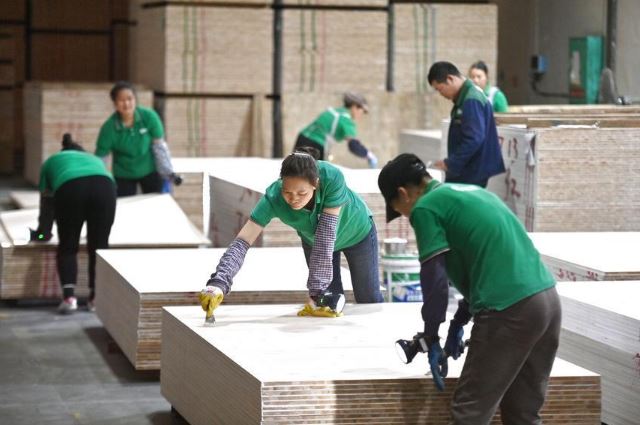
Workers operate on a production line at a board production
factory in Rong'an County of Liuzhou City, south China's Guangxi
Zhuang Autonomous Region
Over the longer term, however, local supplies will need to be
supplemented if all the projects announced across Guangxi begin
operating over the next five years, Li said.
To secure its supply of raw materials, Guangxi plans to add 1
million hectares of national reserve forests and fast-growing
timber plantations over the five years to 2030. By then, the
region aims to supply 48 million cubic meters of timber annually
and raise its standing forest stock volume above 1.1 billion
cubic meters, according to the regional forestry bureau.
The region is developing higher-yielding varieties and improving
cultivation methods. In trials, Jinggui No. 1, a eucalyptus
variety bred specifically for pulp, yielded an estimated 30
percent more wood per hectare over five years than two commonly
planted varieties.
Companies are also linking forest management directly with mill
operations. European forestry group Stora Enso leases and
manages around 53,300 hectares across six Guangxi cities,
harvesting roughly 700,000 cubic meters of timber annually.
"From forest management and planting to harvesting, our
operations are highly mechanized, with debarked timber supplied
directly to our Beihai mill," said Liu Wei, manager of the
forestry company serving Stora Enso's integrated forest, pulp
and paper project in Guangxi.
Looking ahead, Liao said Guangxi would further support forestry
firms in reaching overseas buyers and capitalizing on lower
tariffs and streamlined customs rules under the Regional
Comprehensive Economic Partnership (RCEP).
"By tapping RCEP's trade benefits, we aim to expand into ASEAN
and other emerging markets," he said.
Source:
english.news.cn


