
Market overview
European sawn timber prices held broadly stable through August,
but market participants say the calm is unlikely to last,
reporting “an emerging shift.” One European trader said that
while Nordic mills claim stock is low, “in reality stock is high
and offers are appearing in the market, pointing to a coming
price decrease.”
Some producers see the recent stable price situation as a
partial win, helping them keep their heads above water, saying
that increased costs and lack of demand have created a difficult
situation. However, comments were also heard that despite
producers’ need for stable prices, the quiet market is putting
the pressure on, with increased competition seen especially in
spot markets.
Shortfalls against housebuilding targets have also become the
norm across regions. In the Dutch market, industry contacts said
housebuilding is declining, with targets of around 100,000 units
running closer to 60,000 actual completions, demonstrating a
persistent annual shortfall. However, they also said that, in
the longer term, this could mean a deficit of available housing,
possibly leading to a shortage when the real estate market
starts moving again.
In the UK, construction industry forecasts point to a 10% drop
in repair, maintenance and improvement (RMI) activity, with
new-build activity down 8%. One UK-based source said, “UK stocks
are low,” with the market running very “hand to mouth.”
The demand picture across export markets remains fragmented,
with some regions performing better than others. One market
source said, “demand was weaker than usual but picked up
significantly in the last two weeks, especially in the
Netherlands.” Belgium is also seeing demand, the source added,
though fierce competition among major players for even small
orders is keeping Belgian prices substantially below Dutch
levels. “To get orders from the [Belgian] market, you need to
lower your prices,” they said.
A market source said the lack of sawlogs on the German market is
keeping those producers’ volumes below their usual maximum
production capacity and balancing the supply-demand situation.
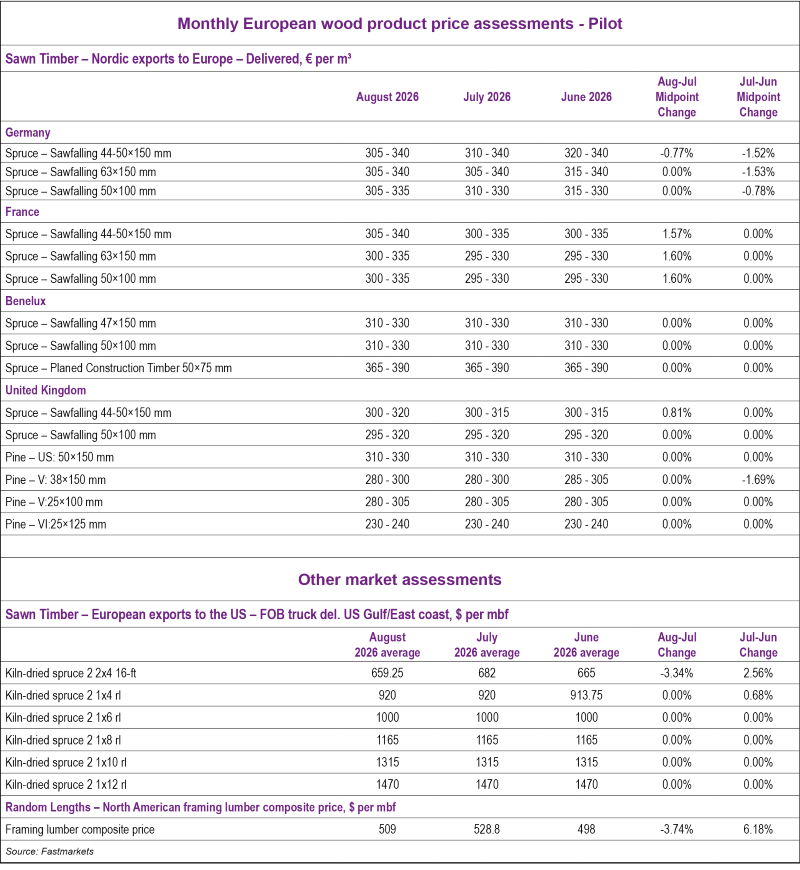
In Germany, one spruce sawfalling assessment showed limited
movement in August. The midpoint for the 44-50×150 mm grade
edged down by 0.8% month on month, while the 63×150 mm and
50×100 mm grades remained stable. In France, all tracked spruce
sawfalling grades strengthened compared with July, with midpoint
values increasing by around 1.6% after assessed ranges moved €5
($7) per cubic meter higher at both ends. Meanwhile, prices in
Benelux were unchanged, with all monitored spruce grades
continuing to trade within the same ranges as in previous
months.
In the UK, the spruce sawfalling 44-50×150 mm assessment
recorded a modest increase, lifting the midpoint by 0.8% from
July, while the 50×100 mm grade was unchanged. Pine assessments
remained broadly stable across the market. Pine V 38×150 mm held
at July levels after declining in the previous month, while Pine
US 50×150 mm, Pine V 25×100 mm and Pine VI 25×125 mm also showed
no month-on-month change.
Freight costs and truck shortages add
pressure
Fuel costs in Finland are continuing to push up transport and
production expenses, while emerging logistics risks have also
come into focus as freight companies begin rerouting via the Red
Sea, said one European supplier.
The source said that due to the ongoing geopolitical tension “we
are seeing higher insurance premiums” for vessels using the Red
Sea corridor.
A second source said that in central Europe the logistics risk
also remains, with sawmillers growing increasingly frustrated by
freight costs, while truck availability remains an issue for
certain regions. It was reported that container availability
remains tight, with surcharges persisting.
That pressure is playing out differently across export markets.
In Germany, the national rail operator, Deutsche Bahn has closed
some rail lines for reconstruction, causing logistical
bottlenecks, sources said. Truck driver availability also
remains an issue, at least through September-October, while
return-delivery constraints to some destinations may further
limit truck availability in certain regions.
Even though there would be enough availability of trucks for
most of the markets, a market source said that “my contacts
still complain about the costs of logistics.”
In France, freight pricing remains a structural factor in the
market, with one participant noting the delivered price of goods
can vary by €25 between the northern and southern parts of the
country.
Stora Enso moves forward with
Veitsiluoto closure; Moelven to shut down Årjäng sawmill
Stora Enso announced on September 16 that it had completed
negotiations on the permanent closure of its
200,000-cubic-meter-per-year Veitsiluoto sawmill in northern
Finland.
The decision forms part of the company’s plan to improve the
profitability and competitiveness of its sawmill operations in
Northern Finland, with the producer saying it plans to further
centralize production.
According to Stora, profitability across its sawmill portfolio
will continue to be “challenging” owing to high raw material
costs in the region.
Scandinavian sawn timber manufacturer Moelven announced on
September 8 that it will discontinue sawmill operations at its
Årjäng sawmill in Sweden.
The Årjäng Såg closure will reduce market supply by 110,000
cubic meters. The producer said that the move is a consequence
of challenging market conditions and the need to utilize timber
resources as efficiently as possible.
Moelven added that geopolitical uncertainty and high raw
material costs have weighed on profitability across the sector,
and that focusing timber consumption at its other facilities
will help the group remain competitive.
Finnish sawlog trade volumes show a
small recovery from Jul, prices rather stable
Following the main holiday season in Finland in July, roundwood
trading recovered slightly in August. Total sawlog trading
increased by just over 8% from July, with spruce volumes rising
by around 10% and pine volumes by 3%. Despite the monthly
improvement, total sawlog trading remained nearly 16% below the
level seen in August 2025, with pine volumes down by more than
21% and spruce volumes by around 12%.
Standing-sale prices for softwood sawlogs in Finland were
relatively stable in August, according to Natural Resources
Institute Finland (Luke) data. The average price for pine
sawlogs decreased slightly to €77.35 per cubic meter, while
spruce sawlogs edged up to €83.25 per cubic meter. Compared with
July, pine prices fell by 0.7%, while spruce prices increased by
0.1%.
Despite the mixed monthly development, prices remained well
above the lows seen at the beginning of the year. Compared with
January, average pine sawlog prices were still 5.7% higher in
August, while spruce prices were 7.8% above their January level.
Compared with August 2025, pine sawlog prices were 3.4% lower,
while spruce sawlogs were 1.4% higher than a year earlier.
Market participants will now be watching whether the seasonal
recovery in trading activity gathers pace during the autumn
purchasing season.
A Finnish market contact said that, according to their
estimates, sawlog prices in Finland will remain either stable or
slightly higher for the rest of the year. The difference between
pine and spruce sawlogs is expected to remain at about the same
level as now.
Swedish sawlog prices fall in the
second quarter
In Sweden, sawlog prices have reportedly been declining, with
windfalls from the Christmas storms still affecting pine supply,
market sources said.
The Swedish sawlog price statistics published by the Swedish
Forest Agency (Skogsstyrelsen) covering the second quarter of
2026 show preliminary prices moving down both quarter on quarter
and year on year. Compared with the first quarter of this year,
prices moved down by 12% for Scots pine and by 9% for Norway
spruce, to SEK 855 ($87) per cubic meter and SEK 1059 per cubic
meter, respectively. Compared with the same period last year,
the prices were down by 17% for pine and by 14% for spruce.
However, many market contacts still consider the Swedish prices
to be high and to be limiting the profitability of sawn timber
production in the country. A market analyst told Fastmarkets
that “I would not say that the prices have normalized, though
there has been some decline,” adding that the price situation is
still putting pressure on the industry.
Market outlook
One Nordic supplier told Fastmarkets that Q4 spruce demand looks
stable, though this varies by country, with customer stock
levels generally running below normal, adding that restocking
will be needed heading into the new quarter.
This was echoed by a Finnish source, who said stock levels
across Swedish and Finnish sawmills are lower than usual, adding
that while pine faces pressure from oversupply relative to
demand, spruce is expected to remain comparatively stable. The
source added that, “spruce sales remain easier than pine sales
overall”.
In the Netherlands, suppliers are aiming to hold Q3 pricing
levels into Q4, with most customers said to be accepting this
approach. Sawmills took heavy losses in the first half of the
year, and further price cuts would only worsen their position,
one European trader said, though smaller mills are reportedly
still making offers below market.
In the UK, heading into Q4, prices have likely dropped by around
£30 ($40) per cubic meter on C24 carcassing, a shift one source
said was being driven by importers rather than customers. The
source also flagged that UK buyers hear “storm-damaged logs” and
assume there are lower-priced deals to be had, when in reality
“savvy [saw]mills would recognize this shouldn’t affect
pricing”.
Despite persistent shortfalls against housebuilding targets,
several sources pointed to structural reasons for longer-term
optimism on timber demand. Environmental constraints mean
buildings can no longer rely solely on concrete and steel,
pushing demand toward alternatives like wood, so even with
underbuilding, timber demand should grow as construction methods
shift, one source said.
This was reinforced by comments from a UK-based contact, who
said that government housebuilding targets are unlikely to be
met due to a shortage of skilled labour, though the underlying
structural shift toward timber construction remains intact.
Summing up the broader outlook one Swedish industry analyst told
Fastmarkets that “conditions are improving but still fall short
of where they need to be, and companies are still operating at a
loss. The analyst cautioned that raw material costs, while down
from earlier highs, remain elevated enough that producers are
still operating at a loss on every cubic meter produced. The
analyst described the situation as unsustainable in the longer
term if not corrected.
Source:
fastmarkets.com


