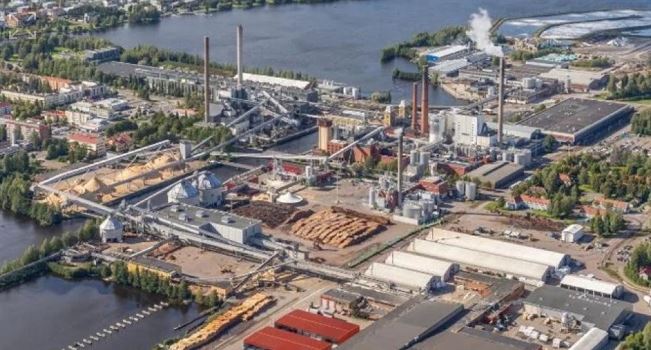
Stora Enso’s industrial site in Varkaus includes a board mill, a
sawmill and a laminated veneer lumber plant. New packaging board
is produced from both recovered packaging and virgin wood fibre.
Photo: Stora Enso.
At Stora Enso’s mill in Varkaus, Finland, recovered cardboard
packaging is converted into new fibre raw material. The same
fibre can be recycled up to 7 times before it becomes too short
and weak for further use.
The site contains Finland’s largest recycled-fibre processing
facility. Covering approximately 3 hectares, it receives used
packaging from households, retailers and packaging
manufacturers.
More than 95 per cent of paperboard and cardboard packaging is
recycled in Finland. However, domestic collections do not
provide enough material for the mill, which also imports
recovered packaging from Sweden and the Baltic countries.
Approximately 20 truckloads of recovered material arrive at the
site each day. The compressed bales contain products such as
milk cartons, pizza boxes and cereal packages.
Unwanted materials are removed
Metal wires are removed from the bales before the packaging
enters a shredder. The material is broken into smaller pieces
and mixed with water inside a rotating drum.
This mechanical treatment separates the fibres from the
packaging. Plastic caps, aluminium layers, expanded polystyrene
and other unwanted materials are removed from the pulp during
the process.
Operators occasionally find unusual objects among the collected
packaging. According to mill employees, even a leaf blower has
passed through the shredder. Such incidents demonstrate the
importance of sorting and continuously monitoring the process.
The recovered pulp is cleaned in several stages and pumped into
storage towers before being transferred to the board machine.
– The material passes through several processing stages before
the finished pulp is sent to the storage towers and used in the
board machine, says Marko Laitinen, who is responsible for
recycled-fibre sourcing at the mill.
Virgin fibre remains necessary
The board machine produces material measuring 7.8 metres in
width. It is used as a surface layer in fruit boxes, food
packaging and pizza boxes. A single finished reel can contain
several tens of kilometres of board.
Most of the output is exported, primarily to Europe and Central
America. The reels are mainly transported by road to the Port of
Kotka and then shipped to international customers.
Production in Varkaus relies on both recycled and virgin wood
fibre. According to Stora Enso, its containerboard contains
slightly more virgin fibre than recycled material.
Virgin fibre is needed to maintain the strength of the board
because fibres gradually become shorter and weaker during
repeated recycling. Introducing new wood fibre therefore also
supports the continued circulation of recovered material.
The industrial site uses approximately 2 million cubic metres of
wood annually. Around 1.2 million cubic metres is used in board
production, while 0.8 million cubic metres goes to the sawmill
and laminated veneer lumber production.
Operating mill receives European recognition
The Varkaus industrial site received the European Heritage Label
in spring 2026. Unlike many recognised industrial heritage
sites, the complex remains in operation and continues to develop
through modern board production and more efficient raw-material
use.
The mill is located in the centre of Varkaus and is crossed by
both a railway and Ahlströminkatu street. Because production
continues around the clock, Stora Enso cannot receive all the
individuals and groups wishing to visit the site.
The nearby Konsti Museum Centre instead presents the history of
industry in Varkaus alongside information about present-day
production.
Source:
pulpapernews.com


