Scots pine supports European electricity grids – the green
transition boosts demand for wooden utility poles
Europe's rapid electrification is boosting demand for a very
traditional forestry product – wooden utility poles.
As Europe expands its electricity grids to integrate renewable
energy, withstand rising industrial loads and connect new data
centres, wooden poles have become highly sought after.
“Europe’s growing demand for electricity requires more power
grids. As new grids are built and old ones are renovated, this
drives the demand for wooden utility poles,” says Janne Partanen,
Forestry Director at Scanpole Oy , Europe's largest manufacturer
of treated utility poles.
The drivers for growth are well known: the expansion of wind and
solar energy generation and use, increasing electricity
consumption in industry and digital infrastructure, and the
electrification of transport. All this requires new transmission
capacity and more robust distribution networks.
The European Commission's target is to double the share of
electricity in final energy consumption by 2040 – from the
current 23% to 46%. This change will require massive investment
in network infrastructure. Although underground cable networks
are expanding, overhead lines remain essential in most of
Europe, and wooden poles continue to play a “leading role”.
Demand is growing across Europe
As wind farms, solar parks and data centres begin operating, the
electricity they produce must be transported to consumption
hubs. According to Janne Partanen, this is already reflected in
the rising demand for wooden poles in many European countries.
Research by the market intelligence company IndexBox suggests
that the EU market for wooden utility poles will grow by
approximately 2-4% annually between 2026 and 2035. The main
drivers in this field are the modernisation of ageing networks
and the integration of renewable energy into the grid. The study
suggests that the EU requires approximately 2-2.8 million new
wooden poles each year, while the total number of poles
installed could exceed 190 million. Replacing ageing
infrastructure accounts for about two-thirds of the annual
demand.
“A large part of Eastern Europe's electricity grids were built
in the 1960s-80s, and these grids are approaching the end of
their technical service life. Modernisation is especially needed
for overhead line networks, which have not been moved
underground as rapidly as in Western Europe,” emphasises J.
Partanen.
Demand has been particularly high in the UK and Ireland, where
wooden poles remain an integral part of electricity
distribution. In Central Europe, growth is being driven by the
renewal of ageing networks and investments related to renewable
energy. “For example, Germany continues to use wooden poles for
overhead power lines and telecommunications networks,” adds J.
Partanen.
New alternatives to creosote
The IndexBox study highlights changes in wood impregnation
technology. It is expected that the share of alternative
treatment methods, such as copper-containing preservatives, will
rise to over 30% of the volume of new poles by 2030. In 2020,
their share was less than 15%.
Creosote has been used to protect utility poles for more than a
century, shielding the wood from moisture, fungi and insects.
Its use is increasingly restricted due to health and
environmental concerns. Since 30 April 2023, creosote-treated
utility poles may only be placed on the market in European
countries that permit their use.
For example, in October 2023, Norway was removed from the
European Chemicals Agency’s list of countries that allow the use
of creosote-treated electricity and telecommunications poles.
Growing demand for larger diameter poles
The choice of wood is influenced by changing weather patterns.
“Many clients have started to show interest in larger diameter
utility poles, which is partly explained by more extreme weather
and the need to improve the resilience of power lines, for
example during storms,” explains J. Partanen.
Finnish forests can provide suitable timber, but more raw
material is needed.
“We are constantly looking for more suitable materials. This
opens up a less well-known opportunity for forest owners: a
large, high-quality Scots pine can become a utility pole instead
of being used as ordinary sawlogs,” stresses Janne Partanen.
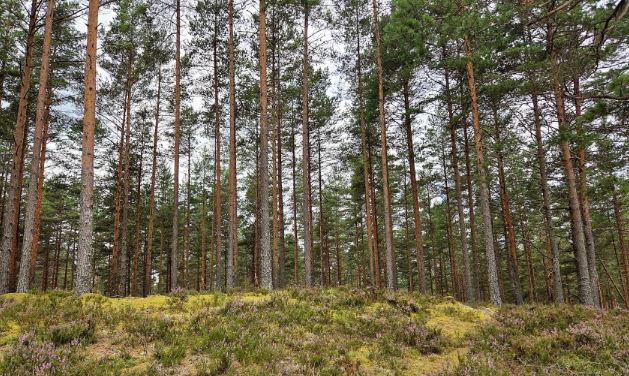
Scots pine suitable for utility poles grows in standard managed
forests – often in the same stands where high-quality sawlogs
are obtained. “Where there are high-quality pine sawlogs, you
can usually find good quality timber for poles as well,” notes
J. Partanen.
Only straight, high-quality trunks that meet strict dimensional
and quality criteria are suitable. The poles range from 8 to 24
metres in length. The requirements are largely similar to those
for sawlogs: trees can be rejected for large curves, cracks,
sweep, root rot and large knots.
Growing conditions play a major role. In nutrient-poor soils,
Scots pine develops slowly, producing thin branches and
naturally straight trunks – the characteristics needed for
poles. In more fertile soils, trees grow faster and produce
thicker branches, which, naturally, limits their suitability for
the quality requirements of utility poles.
“Some of the best so-called pole-wood forests are located in
Central Finland, North Karelia and the Kainuu region in
northeastern Finland,” says J. Partanen.
From forest to export – even two years
Wood for utility poles is usually harvested in winter. After
felling, the trees are transported to a processing facility
where they are debarked and shaped. This is followed by a long
drying stage, mainly by air-drying them for about a year in
well-ventilated stacks. Once dry, they are inspected, processed
according to client specifications and impregnated with
protective agents.
“The entire process from the forest to the finished export
product usually takes one to two years,” explains J. Partanen.
Treatment with protective agents is crucial. The substance must
penetrate deeply enough to ensure durability in harsh weather.
“The service life of a correctly treated wooden utility pole can
exceed 50 years,” adds Janne Partanen.
Millions of euros of investment in Finland to meet growing
demand
Rising demand is reflected in Scanpole production volumes. The
company operates five facilities: two in Norway, one in Wales,
one in Ireland and the largest factory in Finland, located in
the village of Höljäkkä (Höljäkkä) in Nurmes. Recently, Scanpole
invested approximately 10 million euros in the Höljäkkä
processing plant, including a new drying kiln completed this
year and a modern processing line.
“The goal of the investment is to remove production bottlenecks
and increase the number of poles produced in Finland. As a
result, our production capacity in Finland will increase
significantly,” says J. Partanen.
Wood competes with concrete and steel
Utility poles are not always made of wood – steel and concrete
are also used. The choice of material depends on costs, service
life and local conditions.
One of the advantages of wooden utility poles is their
competitive price. Findings from a European study published in
2023 show that concrete poles cost about twice as much as wooden
poles. Including full delivery to the installation site,
concrete poles were about 70-100% more expensive than wooden
poles.
“Wooden poles remain the most cost-effective solution for
overhead power lines. Taking the overall picture into account,
the environmental and climate impact of wooden poles is
significantly lower than that of concrete and steel poles,”
notes J. Partanen.
Life cycle assessments also show clear differences between
materials. In a study published in 2017, the climate impact of a
wooden pole was estimated at 138 kilograms of CO₂ equivalent,
compared to 143 kilograms for a steel pole and 221 kilograms for
a concrete pole. Researchers note that the comparison is not
straightforward – the service life of the pole, maintenance
needs, transport distances and local conditions – all affect the
overall environmental footprint. Another advantage of wooden
utility poles is their availability. In Finland, pine suitable
for pole production grows in standard managed forests.
“There is great demand for our top-quality Finnish pine pole
timber, and we are actively looking for additional volumes,”
stresses Janne Partanen.
Source:
zemeunvalsts.lv


