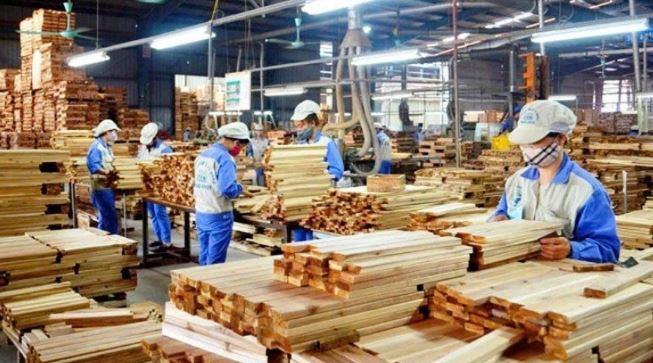
Vietnam’s exports of timber and wood products reached nearly
US$12 billion in the first eight months of 2026, with the United
States remaining the biggest market while shipments to China
surged 46%, according to the Ministry of Agriculture and
Environment.
In August alone, exports were estimated at US$1.48 billion,
bringing the eight-month total to US$11.69 billion, up 5% from a
year earlier. Timber and wood products were the country’s
biggest agricultural export earner during the period.
The United States accounted for 49.9% of Vietnam’s timber and
wood product exports through July, with shipments worth US$5.09
billion, down 5.8% from the same period last year.
Exports to China, meanwhile, jumped 46.4% to US$1.54 billion in
the first seven months. China’s share of Vietnam’s wood exports
rose to 15%, up 4.2% from a year earlier, making it the
country’s second largest market after overtaking Japan.
Exports to Japan, Malaysia, the Netherlands, Germany and the
United Kingdom also posted solid growth, pointing to improving
demand in some Asian and European markets and giving Vietnamese
exporters more room to diversify their customer base.
The decline in shipments to the United States came as Washington
stepped up trade-remedy measures, according to the Import-Export
Department under the Ministry of Industry and Trade.
On July 16, the US Department of Commerce issued final
determinations in an anti-dumping and countervailing duty
investigation into hardwood plywood and decorative plywood from
Vietnam, setting a general anti-dumping duty rate of 84.95%.
While the final rate was well below the preliminary range of
196.14% to 199.69%, it still poses a significant hurdle for
Vietnamese exporters, the department said.
US tariffs and trade-remedy measures could cost Vietnam’s wood
industry some orders and weigh on overall export revenue.
The nearly 6% decline in exports to the US is a development
worth watching, but it does not yet point to a loss of
competitiveness for Vietnamese furniture in the market, an
industry expert said.
Vietnam’s wood industry has already established a strong
foothold in the US and has become an important supplier as
American importers seek to diversify their furniture supply
chains.
But tariff policies are beginning to change buying behaviour.
Importers are becoming more cautious about signing long-term
contracts, placing shorter-term orders and asking suppliers to
absorb a larger share of tariff costs. That is likely to put
further pressure on exporters’ profit margins.
The bigger risk is that Vietnamese suppliers could gradually
lose their place in US importers’ supply chains. Once buyers
switch to alternative suppliers and set up new inspection,
logistics and product-compliance systems, winning back market
share could become much harder.
For Vietnam’s wood industry, preserving customer confidence in
the US market is therefore more important than trying to retain
orders at any cost, the expert said.
The Ministry of Agriculture and Environment is currently working
with industry associations to help exporters respond to US
anti-dumping and countervailing duty investigations involving
hardwood plywood and to participate in hearings related to a
Section 301 investigation.
The ministry is also proposing measures to resolve VAT-related
issues affecting wood exporters, with the aim of providing
timely support to businesses.
Source:
english.vov.vn


