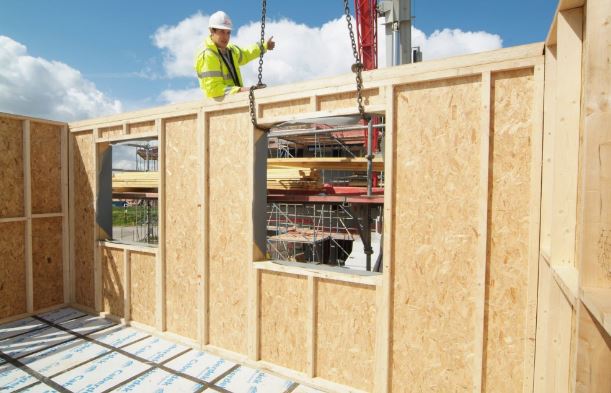
The EU needs over two million new homes a year, and timber
construction is gaining ground as a cheaper, greener
alternative. But scaling up sustainably is the challenge.
Europe is facing a housing crunch of historic proportions. The
European Commission estimates that over two million new homes
are needed every year across the bloc to meet current demand — a
25% increase on current construction rates. At the same time,
the construction sector is responsible for more than 35% of the
EU's total waste, and material extraction and building
activities contribute 5-12% of national greenhouse gas
emissions. The question is whether timber, long overshadowed by
concrete and steel, can offer a sustainable path forward.
Dr. Subhra Bhattacharjee, director general of the Forest
Stewardship Council (FSC), joined Angela Barnes on The Big
Question to discuss whether Europe can scale up its timber
industry without compromising environmental goals. "The global
construction sector has doubled its carbon footprint in the last
three decades and is set to double it again by 2050," she
warned, underscoring the urgency of rethinking building
materials.
Safety and quality: no compromise needed
Historically, European builders have preferred concrete, steel,
and brick, unlike their North American counterparts. But modern
engineered wood is changing perceptions. "There need not be a
quality compromise, because recent innovations in engineered
wood create stronger and more versatile structures,"
Bhattacharjee explained. These new materials are
weather-resistant, fire-resistant, lighter, and yet stronger
than traditional options. As wildfires become more frequent
across the continent, fire safety is a natural concern, but
Bhattacharjee insists that engineered timber can hold up against
fire risks when properly designed.
Innovation is ongoing, and Bhattacharjee is confident that
performance will only improve. "It gives you a material that is
both weather resistant, fire resistant, lighter, and yet
stronger," she said, pointing to advances in cross-laminated
timber and other products that are already being used in
high-rise buildings from Vienna to Stockholm.
Cost savings and insurance hurdles
One of the most compelling arguments for timber is cost.
Construction processes using timber are significantly cheaper
than traditional methods, with potential savings of up to 25%
for buyers. "The cost differential comes because first, the
transportation costs are lower - it's lighter to handle. Your
on-site labour costs are lowered because you can bring in
prefabricated structures," Bhattacharjee noted. Faster
construction also reduces insurance costs during the building
phase.
However, homeowners' insurance is slower to adapt. "The insurers
need to be educated about the new timber products - the
engineered timber products which are fire resistant and which
can hold up against fire risks," she said. That education is
underway, with closer collaboration between constructors,
producers, and insurers. In regions with lower fire risk,
premiums are already stabilising. "It is only a matter of time
before the insurance industry catches up," Bhattacharjee
predicted.
Economic impact: complementing, not replacing
Concerns about job losses in traditional industries like steel
are understandable. According to Eurofer, the steel sector
generated around €152 billion in gross value added and employed
293,000 people in 2025. But Bhattacharjee sees a complementary
future rather than a zero-sum game. "Given that housing needs
are growing very fast I don't see the potential for a full out
downturn," she said. "What would be an ideal scenario would be
low-carbon cement, recycled steel and construction timber
complementing in bringing down the carbon footprint of the
entire sector and contributing to low-cost housing that is
needed."
The growth potential for timber is substantial. "North America
and Europe are the two markets where timber construction is
growing faster than anywhere else in the world. It is a $5
billion (€4.32bn) market that's growing at 10% on average per
year," she noted. The green economy is expected to create around
1.5 million new jobs, including replacements for retiring
workers. In the timber construction sector specifically, there
will be a need for increased skilled labour, which means higher
wages and better employment prospects.
Beyond the construction site, the benefits ripple through rural
economies. "Once you trace it down the supply chain, in terms of
the manufacturing of engineered wood, in terms of the needs for
more responsible forest management, rural economies are likely
to get revitalised," Bhattacharjee concluded. "There's potential
across the entire supply chain from the forest floor all the way
up to the building."
As Europe grapples with housing affordability and climate
commitments, timber offers a rare win-win. But scaling up
sustainably requires careful forest management, investment in
innovation, and a shift in mindset among insurers, builders, and
policymakers. The potential is there — the question is whether
Europe can seize it.
Source:
europeanpulse.com


