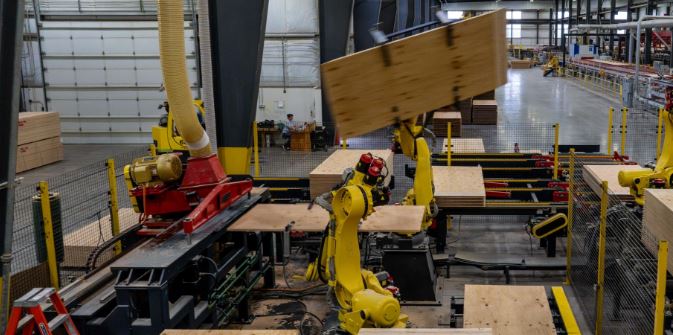
An automated production line in the Freres Engineered Wood
facility in Woodburn.
A study by Oregon State University and the Oregon Department of
Forestry has modelled the potential economic contribution of
mass timber-related activity in the US state under different
demand scenarios.
Mass timber is becoming a growing part of Oregon’s forest
products sector, but its economic contribution has been
difficult to measure because it is not tracked separately in
standard economic data, according to Oregon State University.
The term covers engineered wood products used in large
structural applications, including cross-laminated timber (CLT),
mass plywood panels and glue-laminated timber (glulam).
Researchers from Oregon State University’s College of Forestry
and the Oregon Department of Forestry have estimated the
sector’s market value and potential contribution to jobs, labour
income, value added and economic output in the state.
The study was led by Gang Lu and Andres Susaeta of Oregon State
University’s department of forest engineering, resources and
management, alongside Marcus Kauffman, Brandon Kaetzel and John
Tokarczyk of the Oregon Department of Forestry.
Different approaches show a range of values
Funded by the Oregon Department of Forestry and published in the
journal Forests, the study used production- and demand-based
approaches to estimate the size of Oregon’s mass timber market.
The production-based analysis examined Oregon’s role as a
manufacturing state, using factors including facility capacity,
market share and product revenue. The demand-based approach
assessed market activity from the use side, including harvest
routing, building floor area and projected US demand.
The researchers then used economic modelling to assess how mass
timber-related activity could contribute to the state’s economy.
The results suggest that Oregon’s mass timber market value is
better represented as a range than as a single figure.
Between 2018 and 2023, production-based estimates ranged from
$17.1m in 2018 to $102.1m in 2019, before reaching $21.1m in
2023.
Demand-based estimates were lower and more stable, ranging from
$8.2m to $12.3m over the same period.
The researchers also found that the wider economic benefit
depends partly on how much mass timber activity is retained
within Oregon’s supply chain. This includes spending on lumber,
adhesives, transport, machinery and wholesale services.
Scenarios point to potential growth
The study modelled several scenarios to examine how the sector
could develop in the future.
Under a high-demand scenario, mass timber-related activity in
Oregon could support up to 14,110 jobs and generate $4.56bn in
total economic output by 2035.
These figures are scenarios rather than forecasts. The results
depend on assumptions about US demand growth, Oregon’s market
share, Canadian supply, product prices, regional purchasing and
spending patterns, as well as output per worker.
The findings are intended to provide policymakers and economic
development leaders with a basis for assessing public
investment, identifying supply-chain opportunities and
considering how Oregon could capture more economic value from
mass timber.
Source: ourimpact.oregonstate.edu


