The latest customs data shows that in July 2026, China’s
cumulative imports of logs and sawn timber totaled 4.705 million
cubic meters, marking a slight year-over-year increase of 1.1%
but a 7.5% month-over-month decline from June; the import value
reached $1.05 billion, up 8.6% year-over-year. Overall, the
trend was characterized by “a slight increase in total volume
and a rise in average prices.”
Market Trends: Log Imports Decline Month-Over-Month,
While Lumber Imports Continue to Expand
Among these, logs accounted for 56.3% of total imports. Imports
of logs increased by 6.2% year-over-year to 2.651 million cubic
meters, but decreased by 15.8% compared to June; the import
value rose by 17.9% year-over-year to $45,600, with the average
price up 11% year-over-year.
Sawn timber imports totaled 2.054 million cubic meters, down
4.8% year-over-year but up 6% from June, marking the second
consecutive month of month-over-month growth. The import value
rose 2.4% year-over-year to $595 million, a slight increase of
2.4%, while the average price rose 7.5% year-over-year.
Supply Landscape: Steady Growth in New Zealand and the
United States
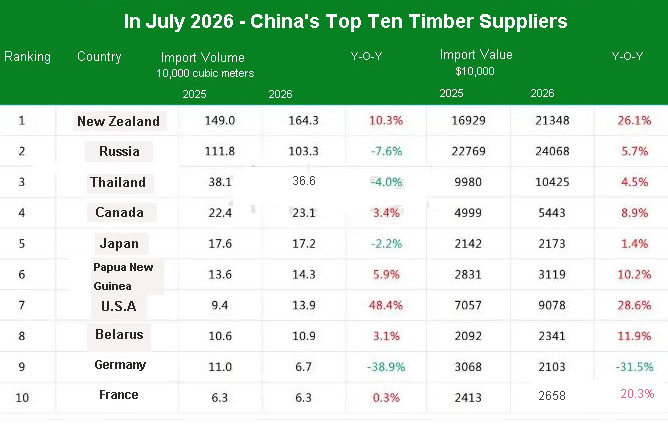
In July 2026, China’s top ten timber suppliers collectively
accounted for approximately 95% of total imports, reflecting an
extremely high level of concentration. The main changes are as
follows:
New Zealand: Imports totaled 1.643 million cubic meters, up
10.3% year-over-year, with the value increasing by 26.1%. With
growth in both volume and value, New Zealand firmly held the top
spot.
Russia: Imports totaled 1.033 million cubic meters, down 7.6%
year-over-year, while the value increased by 5.7%.
United States: Import volume surged from 94,000 cubic meters to
139,000 cubic meters, a year-over-year increase of 48.4%, while
the value rose by 28.6%, ranking among the highest growth rates.
With the current temporary easing of U.S.-China trade tensions,
domestic demand for high-end hardwoods—particularly logs—has
rebounded.
Germany and France: Germany’s import volume plummeted by 38.9%,
and the value decreased by 31.5%, primarily due to the removal
of insect-infested timber in Europe, as well as reduced
production and tighter export controls; France remained largely
unchanged (+0.3%), but the average price rose significantly.
Thailand and Japan: Import volumes declined slightly by 4% and
2.2%, respectively.
By Wood Species: Coniferous Wood Prices Rise Slightly by
2%; Import Trends Diverge for Logs and Lumber
In July, coniferous wood accounted for approximately 70.4% of
China’s total timber imports. The combined volume of log and
lumber imports totaled 3.31 million cubic meters, a 2% increase
year-over-year; the import value reached approximately $557
million, up 13.5% year-over-year, with the increase in value far
outpacing the increase in volume.
Specifically, imports of coniferous logs totaled 2.09 million
cubic meters, up 7.1% year-over-year, with the average price
rising 13.5% year-over-year; imports of sawn lumber fell 5.6%
year-over-year, while the average price rose 12.9%
year-over-year.
Exports of Wood and Wood Products in July
In July, China’s exports of timber and timber products showed a
downward trend, falling 1.3% year-over-year to 1.44 million
metric tons; cumulative exports from January through July rose
10.8% year-over-year.
By product category, exports of plywood and similar multilayer
panels fell 14.9% year-on-year in July; cumulative exports from
January through July rose 9% year-on-year. Exports of wood
products for household and decorative use increased 1.9%
year-on-year in July; cumulative exports from January through
July rose slightly by 0.6%. Exports of furniture and furniture
parts rose 5.7% year-on-year in July, while cumulative exports
from January through July remained flat compared with the same
period last year.
Overall, from January through July 2026, China’s total timber
imports amounted to 31.239 million cubic meters, a 6.7%
year-over-year decrease; the value of imports remained largely
unchanged from the same period last year, at approximately
$4.626 billion. Of this total, roundwood imports amounted to
18.527 million cubic meters, down 3.9% year-over-year, while
sawn timber imports totaled 12.711 million cubic meters, down
10.4% year-over-year.


