
At first glance, the European furniture industry appears to have
recovered from the pandemic, with an expected total turnover of
€123.9 billion in 2025. However, behind these figures lies a
different reality. A new analysis by data analyst Furnilytics
reveals that physical furniture production has fallen sharply.
The rising sector turnover is driven almost entirely by
persistent price inflation rather than higher volumes.
The report by Furnilytics, based on data from 28 European
countries, shows that inflation-adjusted furniture production
has fallen below the 2018 level.
Apparent growth driven by rising producer prices
On paper, the production value of furniture in Europe rose from
€100.7 billion in the disastrous year of 2020 to a record high
of €130.3 billion in 2022. Although the market has stabilized
slightly since then, the nominal production value in 2025, at
€123.9 billion, is still approximately 15% higher than in 2018.
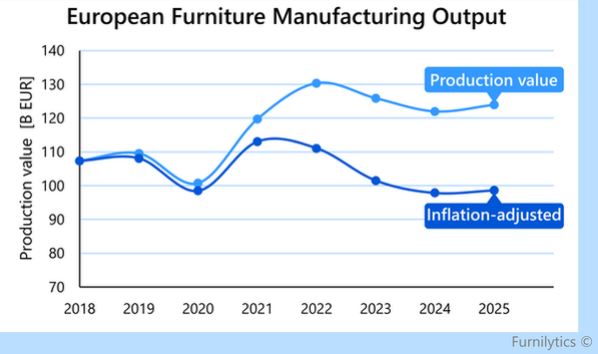
Adjusted for inflation, however, the index paints a sharp
contrast:
- After a real industrial peak of €111 billion in 2022, actual
production declined for three consecutive years.
- In 2025, the adjusted production value stood at €98.6 billion.
This means that actual physical production in Europe is
currently about 8% lower than before the outbreak of COVID-19.
Manufacturers have therefore maintained their sales figures
primarily by passing on necessary price increases to the trade,
not by producing more units.
Three countries dominate half of the European market
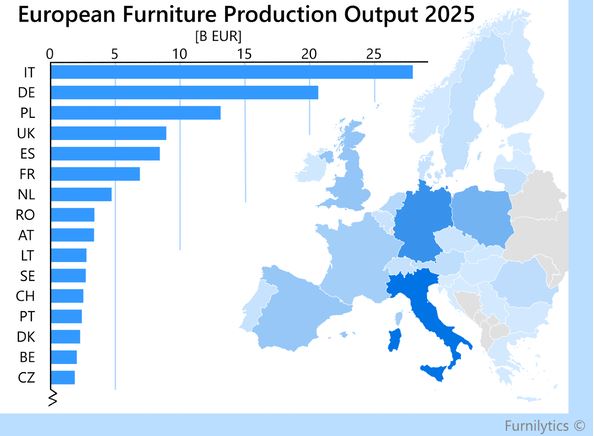
European furniture production remains highly concentrated. Italy
leads the ranking with an estimated production of €27.9 billion
in 2025, followed by Germany (€20.7 billion) and Poland (€13.1
billion).
Together, these top three represent 49.8% of total furniture
production in Europe. The ten largest producing countries even
account for more than 80% of the entire market, meaning that
cost increases in these specific regions have a direct impact on
the entire European market.
New cost increases threaten in 2026.
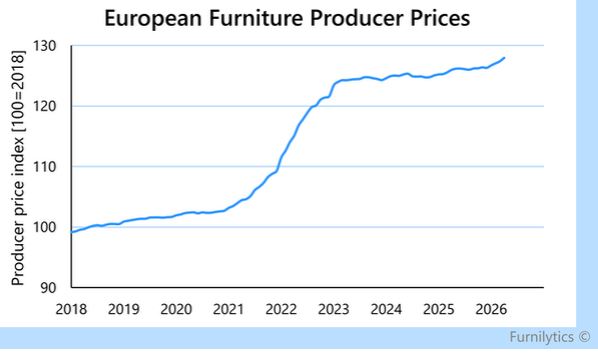
Between January 2021 and March 2023, producer prices in the
furniture sector rose by no less than 20.5%, one of the sharpest
increases in decades. Causes included exploding energy prices,
expensive raw materials, and rising logistics costs.
Although prices stabilized somewhat after 2023, they never fell
back to pre-2022 levels. Moreover, the producer price index has
recently shown a striking upward trend again: between December
2025 and April 2026, prices rose by 1.3%, the strongest increase
in over two years.
Furnilytics warns that furniture manufacturers should expect new
cost increases in 2026. Geopolitical tensions are keeping the
energy market volatile, and shortages of raw materials such as
methanol are driving up the prices of resins and board materials
(such as particleboard and MDF). Whether manufacturers will be
able to pass on these rising costs again will depend heavily on
consumer confidence and the financial capacity of the retail
sector.
Furnilytics is a specialised data and analytics platform that
provides market insights, production trends, and economic
indicators for the international furniture and interior design
industry.
Source:
furnilytics.com


