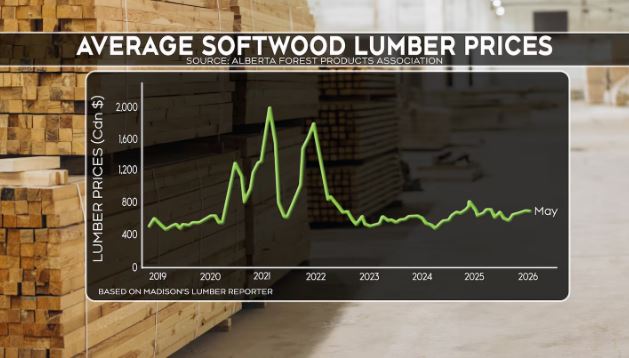
The Canadian lumber industry saw enormous price spikes during
the pandemic years of 2020-2022, with costs close to triple what
they are today for some products.
Prices peaked in 2021 at $2,000 CAD per thousand board
feet,while today that sits at $700, a 65 per cent drop.
“We saw prices skyrocket during COVID, but so too did the cost
to operate,” said Aspen Dudzic, the Alberta Forest Products
Assocation’s communications director. “And interestingly, post-COVID,
we saw the market prices for lumber go down, but the costs to
operate have not come down in the same way.”
One small business owner says costs are slowly levelling off.
“(I’m seeing) prices slowly creeping up, just the lumber prices,
the input costs on those, and the fuel costs have been going up.
So we’re seeing all of that kind of creeping up every year. It’s
leveling out now, we’re seeing generally this year to next year,
fewer increases,” said Mat Bouma, who owns Bramari Saunas.
Prices vary from year to year
Some lumber shop employees say lumber prices year over year
vary, although they certainly are nowhere near the astronomical
highs that were reached in 2021 and 2022.
“We have noticed a decrease (in cost) in pressure treated for
sure. Cedar has gone up a little bit, more of the specialty
items roughly increased 10 to 15 per cent,” said the Cedar
Shop’s sales manager Alex Palko.
Even though lumber costs have seen a huge drop in prices in a
vacuum, why haven’t these cost savings been passed on to the
consumer?
Dudzic says it comes down to a variety of factors relating to
the global market and operating costs.
“The supply chain is really complex,” Dudzic said. “Nothing we
do operates in a vacuum, so there’s a lot of other compounding
costs that we have to look at, like inflationary pressures,
upticks in fuel and energy prices.
“Fuel is something I think all of us can really see the impact
of, especially given the ongoing war (in Iran) right now,” she
added. “Transportation challenges are a really big one,
“There’s a lot of costs that are accumulated just getting the
product from the mill where it’s produced to then the customer
afterwards,” she continued.
Trade war
Top of mind is the ongoing trade war with the U.S, where
cumulative trade barriers have added significant stressors.
“(Right now) the price is $700 per 1,000 board feet, but we also
know that producers aren’t going to see a return on about 45 per
cent of that,” Dudzic said. “The combined softwood lumber trade
barrier to the U.S. right now is sitting at about 35 per cent,
and that’s in addition to the Section 232 tariffs, which are
applied to lumber, are 10 per cent. So that puts us at a 45 per
cent trade barrier to the U.S.”
However, even when facing these challenges and steady price
increases for some products, the Cedar Shop says business has
been steadily picking up year over year since the pandemic,
noting stability has led to more consumer confidence.
“We’ve just gone up and up and up and up. For the trends we see
less foot traffic, more phone-in orders from contractors,” Palko
said.
“It helps with predictability, just forecasting into the future
a little bit. […] I think generally if we give an estimate out,
we can’t sit on that for too long. 30 days is the most we could
sit on it before, and then we would have to re-quote it again,
whereas now we’re starting to be able to hold some of those
quotes, so we can hold an estimate out to 60 days or maybe even
90 here in the next few months hopefully,” Bouma added, speaking
on stability for both him and his customers.
Even with operating cost challenges, Bouma, alongside other
contractors, say 2026 so far has been a great year for work,
saying it’s been a consistently busy year as costs appear to be
steadying amid multiple challenges.
Source:
ctvnews.ca


