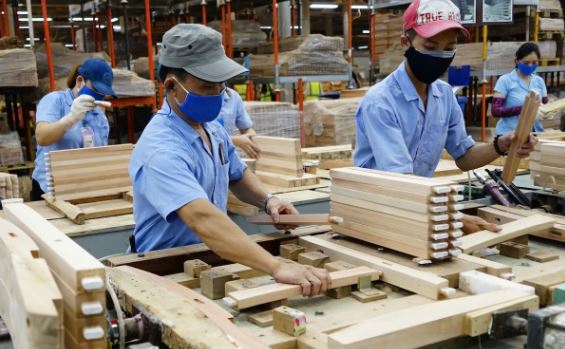
Vietnam’s wood product exports maintained their growth momentum
in the early months of 2026, bolstered by a strong performance
in Asian markets, particularly China.
However, the industry is simultaneously grappling with
significant challenges, ranging from trade defense measures and
increasingly rigorous EU "greening" requirements to the urgent
need for digital and green transformation to maintain
competitiveness.
According to the Ministry of Agriculture and Environment, the
export value of wood and wood products in May 2026 was estimated
at $1.55 billion. This brings the total export turnover for the
first five months of the year to $7.12 billion, a 4.4% increase
compared to the same period in 2025.
The US remains the largest consumer of Vietnamese wood products,
accounting for 49.2% of the total export turnover in the
five-month period. China and Japan follow as the second and
third largest markets, with market shares of 15.2% and 13.1%,
respectively.
Despite the overall growth, there is a clear divergence across
export markets. In the first five months of 2026, exports to the
US declined by 6.5% year-on-year. In contrast, exports to China
surged by 48.3%, while the Japanese market saw a 6% increase.
Among the 15 largest export markets, the Netherlands recorded
the highest growth, with turnover increasing 2.3 times, whereas
South Korea experienced the sharpest decline at 19.2%.
In addition to competitive pressure, the industry is facing a
rise in trade defense measures. On March 11, 2026, the Office of
the United States Trade Representative (USTR) initiated a
Section 301 investigation into imported wooden furniture,
including products from Vietnam, regarding allegations related
to trade surpluses and currency manipulation.
The Vietnam Timber and Forest Product Association (VIFOREST)
noted that the industry stands at a crossroads as importing
markets tighten environmental standards, carbon emission
regulations, and raw material traceability requirements.
The EU is currently leading the global green consumption trend,
making criteria for sustainability, transparency, and
environmental responsibility mandatory for imported wood
products. Although the EU accounts for only about 4.8% to 5.2%
of Vietnam’s total wood export turnover, it remains the market
that defines the highest standards. Businesses must meet these
benchmarks to maintain their global standing.
Beyond external factors, domestic wood enterprises are also
struggling with internal regulations. Most notably, obstacles
persist regarding the management of Value Added Tax (VAT) for
ordinary semi-processed wood products, adding further strain to
the industry’s operations.
Source: vneconomy.vn


