The 2026 State Prize for Wood Construction was awarded for the
first time to projects that make exemplary use of wood as a
building material from architectural, ecological, and structural
perspectives. Three grand prizes and two honorable mentions were
awarded to buildings in Lower Austria, Vorarlberg, Tyrol, and
Salzburg.
The 2026 Austrian State Prize for Timber Construction was
awarded for the first time. According to the organizers, the
prize recognized projects that set new standards for
high-quality and resource-efficient construction. A total of 41
nominated projects from all federal states were in the running.
The award ceremony took place on May 28 at the Sofiensäle in
Vienna.
The State Prize is sponsored by the Federal Ministry of
Agriculture, Forestry, Climate and Environmental Protection,
Regions, and Water Management in collaboration with proHolz
Austria and is supported by funds from the Austrian Forest Fund.
In addition, an Innovation Prize for Wood was awarded for the
first time.
Wood Construction as a Contribution to Climate-Resilient
Building Culture
The international expert jury awarded three main prizes and two
honorable mentions. Criteria evaluated included architectural
quality, the appropriate use of wood, resource-efficient
designs, and contributions to CO2 reduction and the circular
economy.
“The buildings honored with the State Prize for Wood
Construction exemplify the potential of modern wood construction
in an exemplary manner: They combine high architectural quality
with the ecological, resource-conserving, and innovative use of
wood,” explain Nicole Kerstin Berganski, architect and professor
at TU Berlin; Annette Hafner, architect and professor at Ruhr
University Bochum; and structural engineer Pirmin Jung, members
of the jury for the 2026 State Prize for Timber Construction.
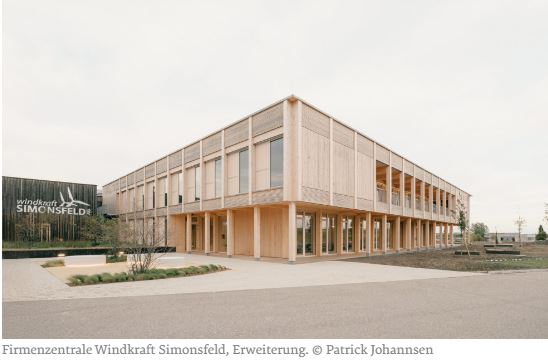
Among the main prize winners is the expansion of the Windkraft
Simonsfeld headquarters in Ernstbrunn. The timber and earthen
structure complements an existing plus-energy office building
and features component-activated rammed earth cores as well as a
timber structure with cross-laminated timber ceilings.
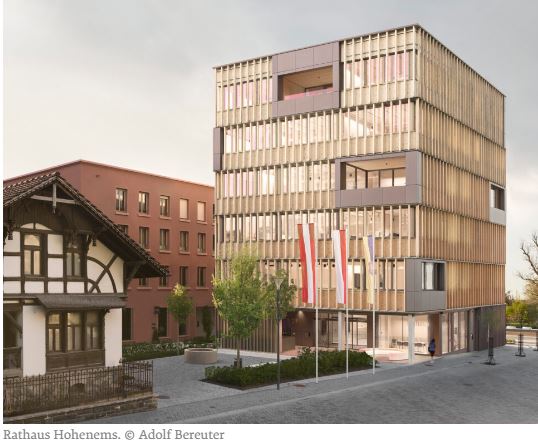
The new town hall in Hohenems also received an award. The jury
particularly highlighted the building’s reversible design, its
flexible functionality, and the consistent integration of the
“Cradle to Cradle” principle. The building was constructed by
the City of Hohenems as the project owner.
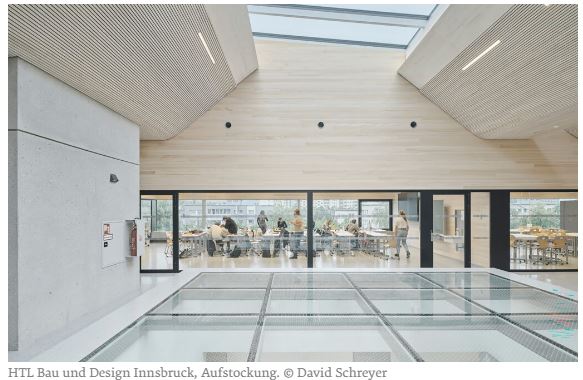
The third grand prize went to the expansion of the HTL Bau und
Design in Innsbruck. The project adds additional classrooms
constructed using a hybrid wood-frame method to a school
building dating from the 1970s. According to the jury, the
project serves as an exemplary demonstration of how existing
buildings can be expanded and upgraded using wood.
Awards for Residential and Educational Buildings
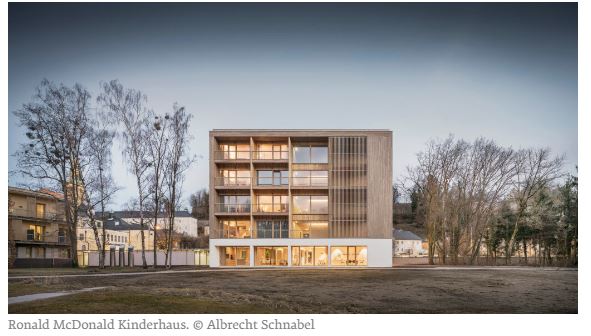
The Ronald McDonald House in Salzburg received an award. The
hybrid wood-frame building, which features 16 residential units
for families with sick children, was recognized in particular
for its cozy atmosphere and spatial quality.
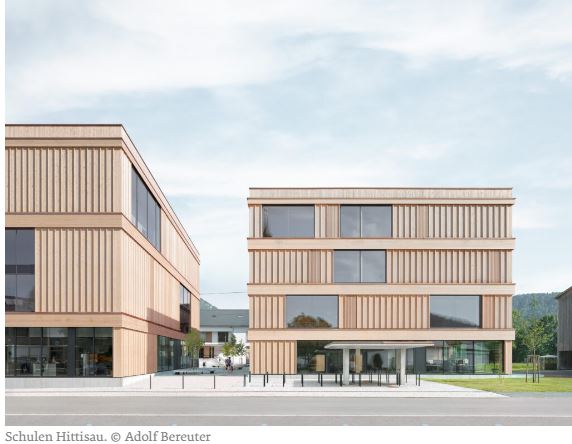
Another award went to the Hittisau School Campus in Vorarlberg.
The jury highlighted the innovative structural design, which
allows for a stacked arrangement of the auditorium and
gymnasiums.
“The State Prize for Wood Construction highlights the high
standard of wood construction in Austria,” says Richard Stralz,
chairman of proHolz Austria in Vienna. Wood is a key factor in
the transformation of the building sector.
According to current data from Statistics Austria, the
share of timber construction in Austria currently stands at 11.6
percent. In multi-story residential construction, the share is
only 4.4 percent, according to the organizers.
Wood Innovation Award Presented for the First Time
Alongside the State Prize, the Wood Innovation Award was
presented for the first time. Three projects focusing on
materials technology developments and the circular economy were
honored.
First prize went to the project “Electrically Conductive Wood
Surfaces Using Atmospheric Pressure Plasma” by Jürgen M. Lackner
and the project team at Joanneum Research Materials. A process
was developed that makes wood surfaces electrically conductive
without the use of metallic conductive tracks.
Second prize went to the “Wood Vision Lab” in Weiz. The project
focuses on the development of high-performance materials made
from hardwood and, according to the submission, aims to enable
new industrial applications.
Third prize was awarded to “Glulam2NewProduct.” The project
develops methods for recycling dismantled wooden structures into
new timber construction products and pursues a circular economy
approach.
“Those who build with wood protect the climate and, by
sequestering CO2, create a second forest, so to speak,” says
Norbert Totschnig, Federal Minister of Agriculture and Forestry,
Climate and Environmental Protection, Regions, and Water
Management in Vienna.
Source:
handwerkundbau.at


