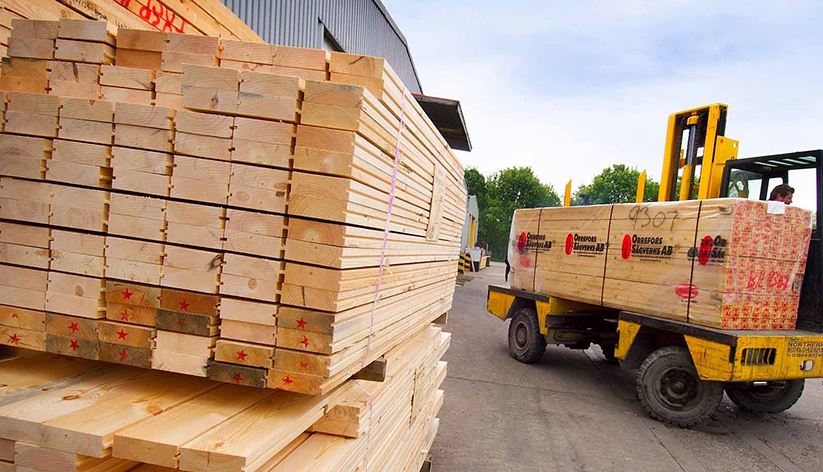
Australia spent more than $3 billion last year on importing wood
products with China alone responsible for supplying $1.318
billion, 43.8 per cent of all products, a figure that is more
than the next four countries combined and 9.1 per cent higher
than the year before. That is according to new data obtained by
the Australian Bureau of Statistics and analysed by IndustryEdge,
whose country-by-country and product-by-product breakdown
measures every figure on an AUD cif basis, reflecting the landed
cost in Australia inclusive of freight and insurance.
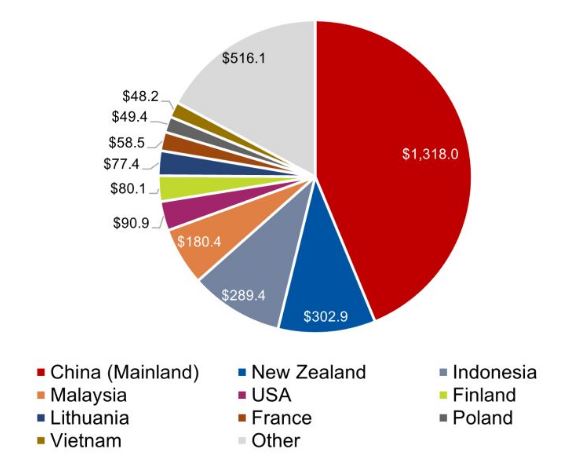
Australia's $3.011 billion wood products import bill in
calendar year 2025 . Source: ABS; analysis by IndustryEdge.
Plywood, LVL and glulam was the single largest product category
at $792.8 million, accounting for 26.3 per cent of total
imports, followed by builders joinery at $562.4 million and
sawnwood at $556.4 million, with those three groupings alone
accounting for close to 64 per cent of Australia's entire wood
products import spend for the year and each representing a
category that Australian plantation fibre has the raw capacity
to produce domestically.
New Zealand was the second-largest source nation at $302.9
million, followed by Indonesia at $289.4 million and Malaysia at
$180.4 million, though Finland recorded the sharpest
year-on-year growth of any top-ten supplier, lifting 38 per cent
on the prior calendar year to reach $80.1 million.
Across both the country distribution and the product breakdown,
the ABS data reinforces a pattern Woods has documented across
multiple import categories, with Australia's 12-month plywood
import volume crossing 500,000 cubic metres for the first time
in January 2026, a 21.8 per cent uplift on the prior
corresponding period, with January itself recording the highest
single-month volume ever measured despite sitting among the
quietest months in the Australian trade calendar.
Source:
ABS, IndustryEdge


