Soaring winter temperatures. An atmospheric river that washed
out bridges and roads. A massive windstorm that scattered trees
like pick-up sticks. Each week in December 2025 seemed to bring
new challenges for Northwest Montana’s timber industry.
“This is the weirdest winter I’ve ever seen,” said Cameron
Wohlschlegel, the lands and resources manager at F.H. Stoltze
Land and Lumber Company. “It definitely impacted our operations,
our ability to harvest. We were actually really concerned we
weren’t going to meet our demand.”
He breathed a sigh of relief when cooler temperatures finally
arrived in January. By March, Wohlschlegel said the lumber mill
was on track to make up the early-season deficit.
He hoped the rash of warm, wet winter weather was a one-year
fluke.
Climate scientists warn that it could be the new norm.
Average annual temperatures across western Montana are expected
to rise somewhere between 3 and 8 degrees Fahrenheit in the
coming decades, according to projections from the Montana
Climate Office. Winters will become wetter, while summers dry
up, and climate “surprises” like floods and extreme
thunderstorms will become more frequent, variable and extreme.
The bottom line for loggers, foresters and the lands they work,
is greater uncertainty.
SOME FOREST plots can be logged at any time of year. In others,
crews have to wait for a specific combination of weather before
they can begin operations.
“We need to have enough moisture in the soil. It needs to be
cold enough that [the moisture] freeze[s], and usually there’s a
minimum snow depth that’s required just to be able to operate,”
said Beth Dodson, the chair of the forest management program at
the University of Montana.
Those mandates protect sensitive soils from compaction and
erosion caused by the heavy machinery used in logging
operations. In an era of warming winters, they also mean many
logging crews are able to work fewer days. Even when crews can
safely fell trees, they may not be able to haul logs out of the
forest due to weight restrictions on dirt logging roads.
Warmer winter temperatures can also open the door to what Dodson
characterized as “unintended oopsies.”
“A log truck with very good intentions goes in the morning when
it’s frozen, but by the time they get back out, it’s not frozen,
and that’s when there’s problems,” she said, as an example. “We
probably can’t just tell the log truck and the driver to stay
where they are for another few days until it freezes again. It’s
got to get out and get home.”
Both Flathead and Lincoln counties are expected to gain about 40
freeze-free days by the end of the century, according to
projections from the Montana Climate Office.
Steven Struck, the owner of Momentum Logging in Kalispell, said
near-record levels of rainfall in December 2025 further
contributed to delays in winter harvest operations this season.
More than 9 inches of precipitation fell in the Flathead River
Basin in December, mostly as rain that soaked into the ground,
churning formerly dry soils into pits of mud.
“We try to keep everything as low-impact as possible,” said
Struck. “When the ground gets saturated, it makes keeping things
at its natural state harder.”
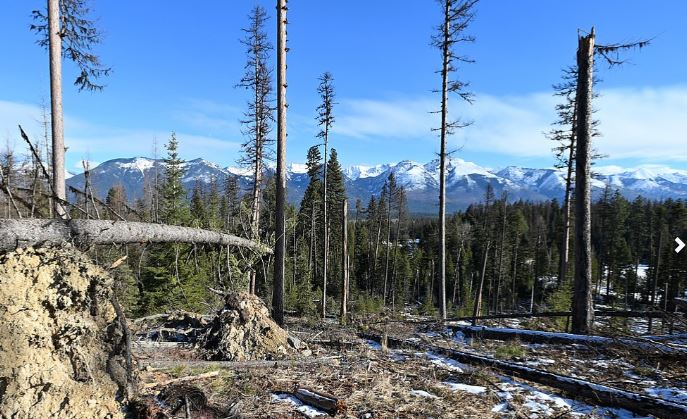
That point was proven when a windstorm blew through Northwest
Montana in mid-December. The 60 mph gusts uprooted trees
throughout the region, including the section of forest Struck
was contracted to thin.
“There were days we couldn’t be up there because it was so
violent,” said Struck. “There were trees coming down all around
us.”
He kept his crew off the mountain for two days. When they
returned, the lot was covered with windthrow.
While blowdowns can provide new opportunities for salvage
logging, the erratic positioning of the felled trees can also
slow down active forestry operations. Trees not marked for
removal are often among the wreckage, requiring foresters to
adapt prescriptions to ensure there are enough trees to provide
wildlife habitat and other ecosystem services.
In one unit about 10 miles northwest of Condon, at least half of
the trees left standing at the end of a recent logging operation
were downed by the December windstorm. Mark Benedict, a resident
whose property backed up to this section of the Flathead
National Forest, surveyed the damage from the crest of hill in
late January.
A retired forester and environmental scientist with decades of
experience, Benedict had been visiting units logged in the Cold
Jim Fuels Reduction and Forest Health Management Project for
years to ensure the Forest Service left ample snags for a gray
owl family that nested nearby. While he expressed
dissatisfaction with some of the other units, he said this one,
Unit 9, appeared to be well-thinned when crews wrapped up work
in spring of 2024.
“Look at it now,” he said. “Look at all these trees down, my
god. This is a very large percentage of the trees that were left
that we’re standing in the middle of.”
One of the main objectives of the Cold Jim project was to reduce
fuel loads in the forest, but, with so much debris now on the
ground, Benedict worried that the area’s fire risk was higher
than ever. He doubted the Forest Service had the resources to
clean up the unit before summer.
Kira Powell, the public affairs officer for Flathead National
Forest, confirmed that several areas of the forest under active
management experienced high levels of windthrow in the December
storm.
“Areas across the forest are still being assessed for the extent
of wind damaged trees, if the results of the windstorm have
changed the condition of the forest stands and whether the
active management objectives can still be met or if a change in
silvicultural prescriptions are needed,” she wrote in an email
to the Inter Lake.
The relationship between climate change and wind is not well
understood, but Benedict said the windstorm wasn’t the only
factor in the large amounts of windthrow in the Swan Valley
“The reason we’re seeing so many [trees] uprooting here is
because we had all that heavy rain immediately before the
windstorm,” he said. “And the reason we had all that heavy rain
and it wasn’t snow and the ground wasn’t frozen was because of
climate change.”
The recent timber operations may have also played a role. Trees
in thinned units were less sheltered from the wind gusts. Now,
with even less of a windscreen to protect them, Benedict worries
the trees that survived the December 2025 windstorm would prove
especially susceptible to any future weather events.
“The issue is the cumulative nature of these windstorms and the
damage that they do to these exposed units,” said Benedict. “And
it’s not just the storm we just had characterized as a winter
storm. We also get thunderstorms coming through in the summer.”
For Benedict, the results of the December windstorm are a reason
to reassess the way the national forest approaches timber cuts.
Beth Dodson, the University of Montana professor, said
contractors and managers are already adopting strategies to
reduce the impact that climate change events have on forest
ecosystems. Timber management plans tend to prioritize keeping
drought-resistant and fire-resilient species, including
ponderosa pine and western larch, on the landscape, while
removing less adaptable species like Douglas fir. In those
cases, Dodson said thinning can result in healthier albeit fewer
trees.
“If we have fewer trees out there that are able to take
advantage of the resources on the site, then they are going to
be better able to defend themselves against any disease or
insect that comes in, and they are most likely better able to
survive a fire that comes through,” she said.
Many logging contracts already extend across several years,
providing crews with flexibility to navigate unexpected weather
events.
Dodson said more adaptations may be necessary in the coming
decades, as managers see more impacts from changing weather
patterns. Logging roads, for example, are typically constructed
with drainage systems that slough off excess water, but the
capacity of those systems may need to increase to accommodate
more extreme storm events.
“A lot of the job is paying attention to what’s working and
what’s not and adapting over time,” she said. “And so, I think
I’m not seeing any big leaps in adaptation. I think it’s just a
continual process that we’re all doing just in terms of watching
what worked, what’s not.”
Steve Struck said he currently has no plans to change his own
operations. While he believes the climate is becoming more
erratic, he said loggers have always had to deal with
uncooperative weather. In his own experience, the best thing to
do is roll with the punches, however they come.
“The weather has changed so much over the past 20 years,” said
Struck. “You have to stay ahead of the game. You’ve got to be
prepared.”
Source:
cdapress.com


