Key takeaways:
-
Our 2026 North American lumber market outlook predicts that
demand for wood products will stabilize, supported by
falling interest rates and renewed home improvement
activity.
-
We expect overall consumption for wood products in the North
American market to remain flat.
-
According to our North American lumber forecast, we expect
softwood lumber capacity to decline by over 1.3 billion
board feet (BBF) due to ongoing mill closures in British
Columbia and the US South.
-
Market trends suggest that lumber duties may fall to 15-20%,
while reduced Brazilian panel imports and continued tariffs
are likely to drive modest price increases across most wood
product categories.
Another challenging year is in the books for the North American
wood products industry. To recap, demand disappointed as
affordability challenges festered with inflation and interest
rates remaining sticky. Compounding this, uncertainty surged
with the onset of a trade war and a prolonged government
shutdown. Mill asset closures continued in response to sustained
weakness, though not at the same clip we saw in 2024. Confidence
across the building materials and broader forest products
complex is probably the lowest we have seen since the Global
Financial Crisis.
Forecasting in this policy-driven environment has been
challenging to say the least. And while the dust seems to be
settling on many fronts, much remains in question given ongoing
trade negotiations, elevated recession concerns, a push by the
current administration to reignite home building, and pronounced
pessimism in the lumber and panel markets.
So, what does our wood products team at Fastmarkets expect for
the North American wood products market in 2026? Below are five
key predictions that we believe will drive the market this year.
1. Demand will stabilize across most wood products
One of our key forecast misses in last year’s “Predictions”
piece was the call for a demand turnaround in North American
wood products that did not materialize. While interest rates
continued to fall as predicted and the US did avoid a recession
despite much speculation, affordability challenges paired with
the explosion of uncertainty due to the trade war amplified the
drags on home buying and construction activity.
The good news is some of this trade related uncertainty should
subside in 2026 as more trade deals are inked and the
administration walks back some of the most onerous tariffs, as
we saw on December 31 with the postponement of further increases
on furniture, cabinets and vanities.
Interest rates, while descending at a slower pace than we
expected, should continue to fall as inflation cools and the
Federal Reserve pivots further to address labor market
uncertainty. The first half of the year should also get a fiscal
boost from Congress passing the One Big Beautiful Bill (OBBB)
last year as substantial tax refunds hit household bank
accounts. Just recently, the White House also announced a plan
to purchase mortgage back securities to help push mortgage rates
lower. Other plans to support builders seem in the cards as
well.
Residential construction, which accounts for about 70-80% of
wood products demand in North America, should see some modest,
albeit unspectacular, improvements under these macroeconomic
conditions. Even marginal improvements in affordability should
at least help stabilize the crucial single-family market, which
saw an estimated drop in starts of 8-10% last year. Although
slowing off its current pace, we also anticipate more
multifamily projects will pencil out as rates continue to ease
and upzoning efforts in many jurisdictions across the country
help drive more affordable housing construction.
Finally, home improvement activity, which based on our
Fastmarkets Repair & Remodeling Index has shown signs of
reacceleration, should continue to gain momentum as real
disposable income remains steady and drops in short-term
interest rates stimulate more HELOCs to drive home improvement
projects. Pent-up project demand is also substantial in the
space, and should be unlocked by more certainty on inflation and
the jobs front later this year.
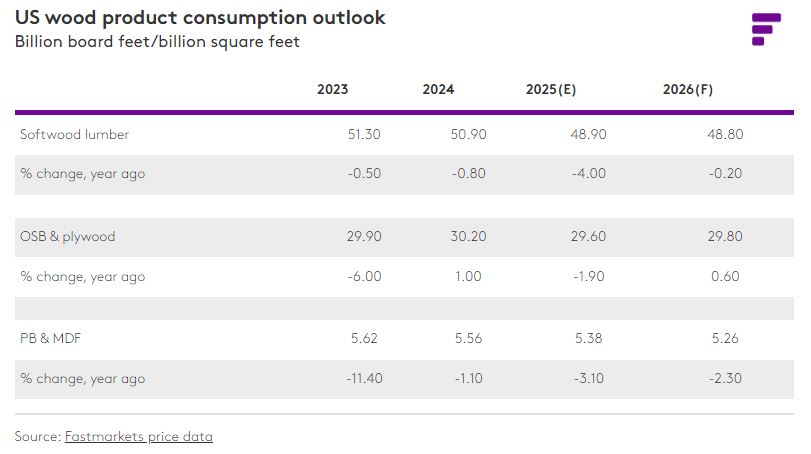
Demand will vary by product, but we expect wood products
consumption in the US to remain flat in 2026, with structural
panel markets performing the strongest, while nonstructural
panels will experience greater weakness as those products are
still feeling the downshift in home completions and domestic
furniture and cabinet production. While downside risk to the
outlook exists, Fastmarkets believes the significant losses from
last year should pause again in 2026 as the wood products market
transitions to a reacceleration phase later in the year that
sets up solid growth in 2027. However, in the meantime, demand
will still remain challenging as near-term headwinds continue to
be pronounced.
2. Softwood lumber capacity losses will accelerate to over 1
BBF
Shuttering of industry capacity has been an ongoing theme in
the softwood lumber market for the past several years. Average
annualized operable capacity in 2024 and our preliminary
estimates for 2025 show a similar drop in operable capacity
(-0.7 billion board feet (BBF)). While losses since 2017 have
focused on the struggling British Columbia market, we have seen
a pronounced surge in southern yellow pine (SYP) closures in the
US South in response to weak market conditions and historic
discounts for SYP compared with competing species.
Of course, industry rationalization reflects a number of
factors, including declining demand since 2021, compressed
margins from prices correcting back to pre-pandemic levels for
many key items and pronounced stress in Canada from longer-term
structural fiber challenges in BC, steadily rising lumber duties
on Canadian supply and now 10% tariffs stacked on top of that.
------
------
------
>>>
For the full information
Source:
fastmarkets.com


