On the German timber market, prices for spruce and pine in
2026 are higher than ever before. Timber is currently so scarce
that the timber industry has once again raised timber prices
significantly at the beginning of 2026. Forest farmers are
receiving higher revenues for coniferous roundwood than ever
before. At the same time, sawmills are facing empty warehouses,
skyrocketing costs, and an acute “raw material shortage.” In any
case, the rising prices indicate an extremely tight market
supply. Lower-quality wood, industrial wood, and energy wood are
now also benefiting from the shortage.
The ongoing and, in some cases, extreme shortage of wood has
prompted the sawmill industry to raise wood prices significantly
once again for the first quarter of 2026, according to forest
owner associations. The price increases for the leading spruce B
2b+ range are between 5 and 10 euros per solid cubic meter.
Pine wood is also benefiting from this extraordinary price
rally. At the beginning of 2026, new record prices will be
reached for both spruce and pine wood. For the leading spruce B
2b+ grade, net prices at the beginning of January will average
between 129 and 132 euros per solid cubic meter, and in some
cases even higher. Due to very strong demand for the 2b+
assortment in grade B/C, an average of 95 to 98 euros per cubic
meter is being paid for pine wood.
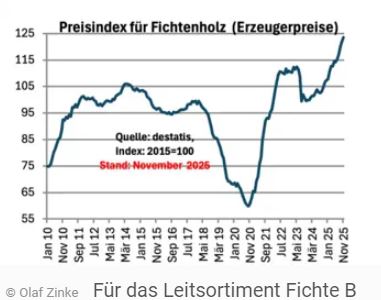
This means that forest owners along the “Waldstraße” are being
paid around €25 to €30 more than last year. In sawmills that
need and process fresh logs, warehouses in many places are empty
because very little fresh wood is still being delivered,
according to forest owners.
The German Federal Association of the Wood Industry describes
the current market development as a “raw material shortage.” If
more wood does not come onto the market in the coming weeks, the
situation will escalate into an “existential crisis for the
sawmill and timber industry,” according to the timber industry.
The extreme shortage has apparently been caused by the very low
supply of so-called damaged wood, which, according to the
Bavarian State Institute for Forestry and Forest Management,
accounts for a good half of the timber harvested and thus also
covers half of the supply. This wood is now missing from the
market, which hardly distinguishes between
beetle-damaged/damaged wood and undamaged wood in terms of
price.
Source:
agrarheute.com


