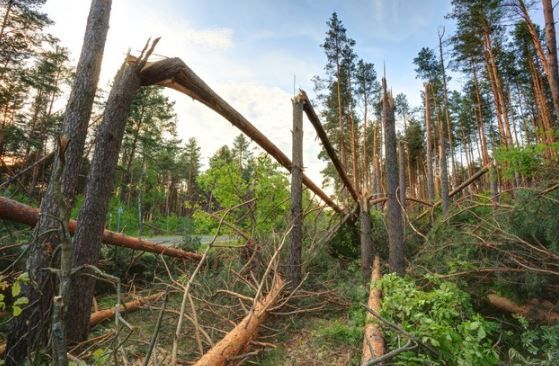
On December 27 to 28, a winter storm, known as “Johannes” in
Sweden and “Hannes” in Finland, caused damage to an extent that
is relevant to the timber market in both countries.
Storm Johannes, which swept across Sweden, Norway, and Finland
in December, has caused widespread destruction, with preliminary
estimates indicating that around ten million cubic metres of
wood were felled in Sweden alone. The Swedish Forest Agency
described Johannes as "probably the most extensive storm to hit
the country in the past ten years" and the fourth most
destructive since the 1930s.
The hardest-hit areas include Dalarna and Gävleborgs län, just
under 300 km north of Stockholm, with significant damage
extending from Uppland to Norrbotten County on the Finnish
border. Fredrik Munter, CEO of Mellanskog's Forest Owners'
Association, noted that billions of Swedish kronor worth of
trees have been felled, though salvage is possible depending on
processing conditions. Timber quality will deteriorate as
temperatures rise.
Three fatalities were reported in Sweden, while Finland and
Norway reported none. Forest coordinator Magnus Martinsson
emphasised the difficulty of precise assessments due to ongoing
harsh weather. The Swedish Forestry Agency cautioned that the
final estimate could still change.
The storm follows a decade of volatile weather events affecting
forestry, underscoring the vulnerability of timber resources and
the challenges faced by the Nordic forest industry in disaster
management and recovery.


