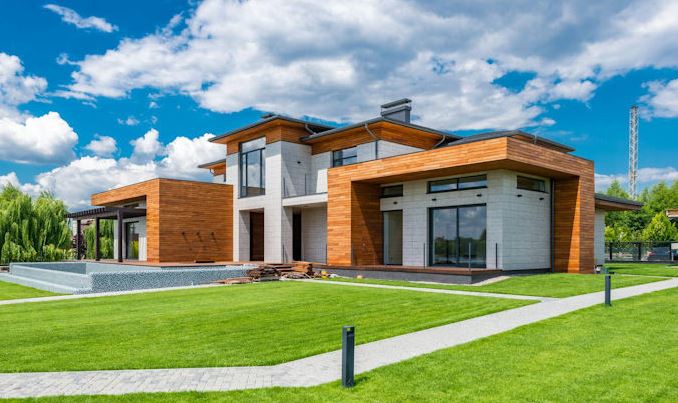
Luxury architecture does not usually announce when it is
changing direction. Materials move in and out of favor slowly,
almost quietly. One detail appears on a drawing. A façade choice
turns up on a site visit. Then, after a few years, something
that once felt unusual becomes normal. Timber cladding has been
following that path for some time now.
It first appeared on private residential projects, often as a
contrast to heavier materials. Then it moved into small
hospitality schemes, garden buildings, and low-rise
developments. Today, it is increasingly specified on high-value
villas, boutique hotels, wellness retreats, and mixed-use
projects. Not as a feature, and not as a statement, but as a
reliable part of the building envelope.
What makes timber work in these contexts is not novelty. It is
behavior. Timber reacts to light differently than most façade
materials. It softens edges. It changes through the day. It
allows buildings to sit within a landscape rather than dominate
it. In luxury architecture, that sense of restraint matters more
than bold gestures.
There was a period when timber was considered a risk. Architects
worried about movement. Clients worried about maintenance.
Contractors worried about long-term performance. In many cases,
those concerns were justified. Earlier cladding systems relied
heavily on surface coatings and assumptions about exposure that
did not always hold up in real conditions.
That perception has changed, largely because the material itself
has changed. Modern processing methods focus on how timber
behaves, not just how it looks when first installed. Moisture
uptake is reduced. Dimensional stability improves. Service life
becomes more predictable. These changes are technical, but their
impact on design decisions is significant.
This shift is one reason materials such as ThermoWood cladding
are now specified on projects where timber would once have been
ruled out entirely. Heat modification alters the internal
structure of the wood, making it more stable and more resistant
to environmental stress. For architects, this reduces
uncertainty. For clients, it reduces long-term risk.
Once that confidence is established, timber stops being treated
as decorative. It becomes a legitimate façade system. Profiles
are simplified. Junctions are cleaner. The material is allowed
to sit quietly alongside glass, steel, and masonry without
competing for attention.
Sustainability plays a role in this shift, but not always in the
way marketing language suggests. In many high-end projects,
environmental performance is not a headline feature. It is
simply expected. Clients assume responsible sourcing. Planners
expect reduced carbon impact. Designers are required to address
both without compromising quality.
Timber fits into this expectation naturally. Responsibly sourced
wood stores carbon rather than emitting it. It avoids
energy-intensive manufacturing processes. When detailed
correctly, it lasts long enough to justify its environmental
footprint. That balance is difficult to achieve with many façade
materials that rely on complex composites or high-temperature
production.
This becomes particularly important in hospitality and retreat
architecture. Hotels and lodges operate continuously. Materials
are exposed year-round to weather, use, and maintenance cycles.
A façade that weathers evenly and does not demand constant
intervention becomes an operational advantage, not just an
aesthetic one.
Another influence worth noting is the steady impact of Nordic
architecture. Not as a style to be copied, but as an attitude
toward materials. Fewer finishes. Honest surfaces. Letting
proportion and detail carry the design rather than decoration.
Within that approach, Nordic Spruce cladding appears frequently.
It is lighter in tone, relatively uniform, and easy to work with
when clean detailing is required. Architects tend to choose it
when they want precision without coldness, clarity without
severity.
Nordic Spruce is often used on smaller residential schemes,
extensions, garden rooms, and low-rise hospitality buildings.
These are projects where the building is meant to feel settled
within its surroundings rather than announced. The material
supports that goal quietly, without drawing attention to itself.
There has also been a noticeable shift in how ageing is treated
in luxury architecture. The idea that a building must look new
indefinitely has softened. Timber supports this change. As it
weathers, color evens out. Surfaces calm down. The building
begins to feel established rather than finished.
This does not mean details can be ignored. Timber is forgiving
only when the basics are respected. Ventilation gaps matter.
Fixings matter. Installation matters. When these fundamentals
are overlooked, failure is quick and obvious. When they are
respected, performance is remarkably consistent.
What has changed most is not the material itself, but how
confidently it is understood. Timber is no longer specified to
achieve a particular look. It is specified because its behavior
is predictable, its performance is understood, and its presence
makes sense within the broader architectural intent.
That is why timber cladding has moved from being a stylistic
risk to a practical choice in high-end architecture. It is not
loud. It is not fashionable. It simply works. Increasingly, that
is exactly what architects and clients are looking for.
Source:
luxurytravelmagazine.com


