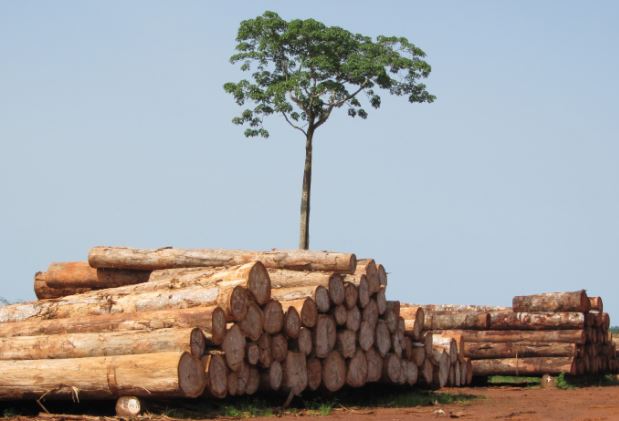
Global international trade in wood and paper products regained
momentum, with modest growth recorded across most major product
groups, according to FAO.
- The upswing comes after a 14 per cent drop overall in trade
of wood and paper products in 2023.
- Industrial roundwood removals, referring to the total volume
of wood harvested for uses other than energy, rose by two per
cent in 2024, although its global trade declined by one per
cent.
- Global production of sawnwood such as planks, beams and other
manufactured timber products, remained nearly unchanged but
varied regionally. Trade in sawnwood recorded no overall change
compared to 2023.
- Wood-based panels grew for a second consecutive year. Global
production expanded by 5 per cent.
- Wood pulp production climbed three per cent to reach 189
million tonnes, while international trade expanded two per cent
to an all-time high of 73 million tonnes.
- Wood pellets have seen extraordinary growth in recent decades,
mainly driven by bioenergy targets in Europe, the
Republic of Korea and Japan. After a slight dip in 2023, global
production returned to 48 million tonnes in 2024, equal to the
2022 level.
After a sharp decline in 2023, the global forest products sector
saw signs of stabilization in 2024, according to Global forest
products facts and figures 2024 , released today by the Food and
Agriculture Organization of the United Nations (FAO).
The report highlights that global international trade in wood
and paper products has regained momentum, with modest growth
recorded across most major product groups.
The upswing comes after a 14 percent drop overall in trade of
wood and paper products in 2023.
Global exports of wood and paper products increased only
slightly by $7 billion, or 1.4 percent, to reach $486 billion in
2024 – but still surpassing all levels recorded before 2021.
Exports of non-wood forest products also grew to reach $25
billion, underscoring the forest sector’s broadening economic
importance.
“Forests support millions of livelihoods worldwide, and the
number is set to rise as forests offer more economic
opportunities in a growing range of industries, including
sustainable wood production,” said FAO Director-General QU
Dongyu.
Production increases across most wood-based product
categories
The 2024 results reflect gradual market recovery in several
regions, supported by increased production in most major product
groups. Gains ranged from 2 percent for industrial roundwood,
wood pellets and wood pulp, to between 4 and 5 percent for
wood-based panels, paper and paperboard.
Industrial roundwood removals - Industrial roundwood
removals – the total volume of wood harvested for uses other
than energy – rose by 2 percent to 1.96 billion cubic metres in
2024, although its global trade declined by 1 percent to 96
million cubic metres.
Sawnwood - While global sawnwood production remained
nearly unchanged, the picture varied regionally. Output fell by
2 percent in North America but remained stable in Europe and the
Asia-Pacific, while climbing 2 percent in Latin America and the
Caribbean. Trade in sawnwood recorded no overall change compared
to 2023.
Wood-based panels - Wood-based panels continued to build
on the recovery seen in 2023, growing for a second consecutive
year. Global production expanded by 5 percent to 393 million
cubic metres, with increases reported in all five regions. Trade
in panels rose even faster, up 6 percent to 90 million cubic
metres.
Wood pulp and recovered paper - Wood pulp production
climbed 3 percent to reach 189 million tonnes, while
international trade expanded 2 percent to an all-time high of 73
million tonnes. Much of the additional supply originated in
China and South America – particularly Brazil, Chile and Uruguay
– reflecting the region’s growing competitiveness in pulp.
Global consumption of recovered paper also edged up by 1 percent
to 243 million tonnes worldwide.
Wood pellets - Wood pellets have seen extraordinary
growth in recent decades, mainly driven by bioenergy targets in
Europe, the Republic of Korea and Japan. After a slight dip in
2023, global production returned to 48 million tonnes in 2024,
equal to the 2022 level, and almost two-thirds – 31 million
tonnes – entered global trade. Europe and North America remained
the main producing regions, accounting for 47 percent and 28
percent of global output respectively, though the Asia-Pacific
region increased its share from 14 percent in 2020 to 22 percent
in 2024. When it came to consumption, Europe accounted for 70
percent, while the Asia-Pacific region accounted for 28 percent.
Source: news.un.org


