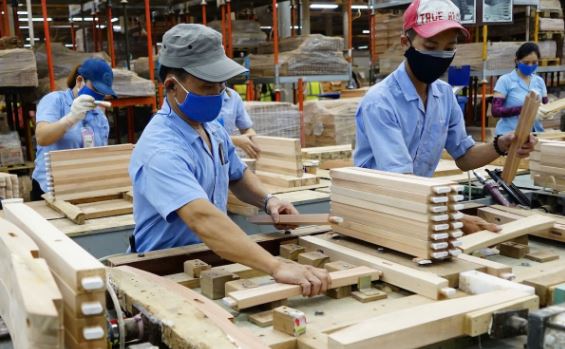
Facing U.S. countervailing duties on wood products,
Vietnam’s $15 billion wood industry is finding creative and
adaptive ways to move forward.
The US government’s countervailing tariffs on Vietnamese wood
products have posed significant challenges for exporters. Yet,
Vietnam’s wood industry is demonstrating notable resilience,
with businesses actively adapting and charting new directions.
Adaptability is key
Do Thi Kim Loan, CEO of Sao Nam Trading and Manufacturing Co.,
Ltd., shared that her company responded to shifting market
demands by adjusting product specifications - reducing wood
plank thickness from 21mm to 19mm, 15mm, or even 9mm.
This move lowered input material costs and made products more
affordable for consumers. It also helped the company win
multiple domestic project bids in 2025, leading to a 15% revenue
growth. Export turnover remained steady compared to the previous
year.
“Adaptability is what matters most,” Loan told VietNamNet at the
First National Congress (2025–2028 term) of the Handicraft and
Wood Industry Association of Ho Chi Minh City (HAWA), held on
December 18.
While the 20% U.S. countervailing tariff could have hindered
business, the sector instead showcased its ability to pivot
swiftly.
According to HAWA, wood and forest product exports in 2025 are
projected to exceed $17.3 billion - up 5.4% from 2024. Data from
the Ministry of Industry and Trade shows that wood and wood
products alone account for about $15.5 billion, reaffirming
Vietnam’s lead in Southeast Asia and its position as Asia’s
second-largest wood exporter.
From zero to $400 million in four years
A standout example is Huynh Le Dai Thang, Director of Nghia Son
Wood Company. Four years ago, his firm began exploring
e-commerce channels such as Amazon, Walmart, and Wayfair. This
digital transition quickly broadened market access and boosted
sales.
In 2025, Nghia Son’s export revenue rose 40%. The company
shipped over 1,000 containers to the U.S., and orders are
already booked through May 2026.
Thang noted that most Vietnamese wood businesses operate in the
B2B space. However, global B2B buyers are increasingly squeezing
manufacturers on price, reducing them to subcontractors without
brand control.
“But if Vietnamese businesses take e-commerce seriously, there’s
massive room to scale and succeed,” Thang said. He cited a
Chinese wood company that scaled its e-commerce revenue from
zero to $400 million in just four years.
At the Wayfair Asia Supplier Conference in Shanghai, Thang
observed that many e-commerce furniture vendors now generate
over $100 million annually - something nearly impossible through
B2B alone.
Back home, he noted that Vietnamese businesses have strong
production capacity but lack direction in e-commerce. “They
don’t know where to start or how,” he said.
To stand out among millions of listings, design is essential.
Vietnam’s key competitor - China - has a dominant edge in
product design.
To compete, Vietnamese manufacturers must prioritize original
design and proactive marketing, rather than passively waiting
for OEM orders. With well-designed products, profit margins can
increase two to three times over contract manufacturing.
His company now has a team of 10 product designers and releases
at least 30 new designs each year.
Building design capacity and distribution networks
Thang emphasized that relying solely on individual efforts will
limit Vietnam’s wood sector. Domestic companies need access to
international design experts to create trend-relevant products.
HAWA Vice President Nguyen Chanh Phuong agreed, stating that
strong branding and design are essential for e-commerce success.
Copying designs or merely offering OEM services is no longer
viable in the digital marketplace.
He added that the industry must unite to build robust
international distribution channels. In the future, specialized
companies may emerge to handle e-commerce operations and supply
chain management for domestic producers.
Currently, only about 10–15% of Vietnamese wood businesses have
the capacity to develop their own designs. For years,
international buyers have controlled design because they
understand local consumer trends.
“For HAWA, the dream is to see Vietnamese producers supplied
with designs from professional agencies, enabling them to
manufacture trend-forward products,” Phuong said.
A new $8 billion export alliance
On December 18, HAWA held its first congress after merging with
the Binh Duong Furniture Association (BIFA). Phung Quoc Man, CEO
of A&M Flooring, was elected as the new President.
The merged association now represents nearly 1,000 member
businesses with a combined annual export value exceeding $8
billion - almost half of Vietnam’s total wood and wood product
exports.
HAWA aims to hit $15 billion in exports by 2035, with 80% of
products meeting green standards.
Source:
vietnamnet.vn


