Builder confidence inched higher to end the year but still
remains well into negative territory as builders continue to
grapple with rising construction costs, tariff and economic
uncertainty, and many potential buyers remaining on the
sidelines due to affordability concerns.
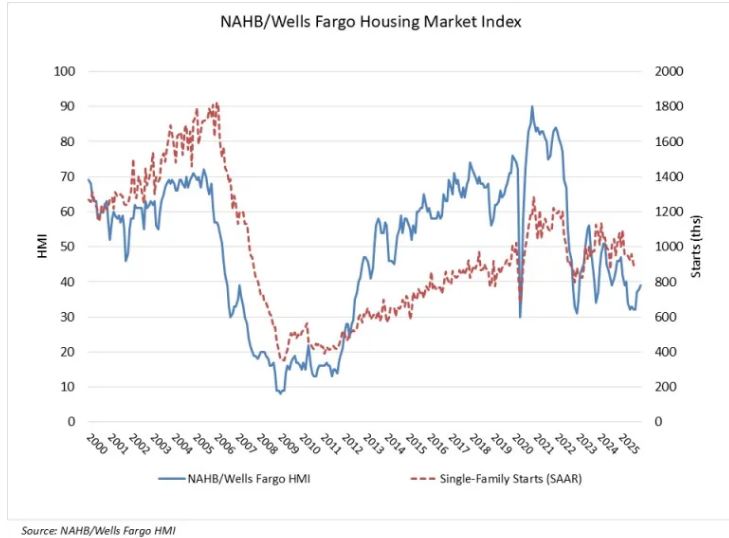
Builder confidence in the market for newly built single-family
homes rose one point to 39 in December, according to the
National Association of Home Builders (NAHB)/Wells Fargo Housing
Market Index (HMI). Sentiment levels were below the breakeven
point of 50 every month in 2025 and ranged in the high 30s in
the final quarter of the year.
Market conditions remain challenging with two-thirds of builders
reporting they are offering incentives to move buyers off the
fence.
In positive signs for the market, builders report that future
sales expectations have been above the key breakeven level of 50
for the past three months and the recent easing of monetary
policy should help builder loan conditions at the start of 2026.
However, builders continue to face supply-side headwinds, as
regulatory costs and material prices remain stubbornly high.
Rising inventory also has increased competition for newly built
homes.
In a further sign of ongoing challenges for the housing market,
the latest HMI survey also revealed that 40% of builders
reported cutting prices in December, marking the second
consecutive month the share has been at 40% or higher since May
2020. It was 41% in November. Meanwhile, the average price
reduction was 5% in December, down from the 6% rate in November.
The use of sales incentives was 67% in December, the highest
percentage in the post-Covid period.
Derived from a monthly survey that NAHB has been conducting for
more than 40 years, the NAHB/Wells Fargo HMI gauges builder
perceptions of current single-family home sales and sales
expectations for the next six months as “good,” “fair” or
“poor.” The survey also asks builders to rate traffic of
prospective buyers as “high to very high,” “average” or “low to
very low.” Scores for each component are then used to calculate
a seasonally adjusted index where any number over 50 indicates
that more builders view conditions as good than poor.
The HMI index gauging current sales conditions increased one
point to 42, the index measuring future sales rose one point to
52 and the gauge charting traffic of prospective buyers held
steady at 26.
Looking at the three-month moving averages for regional HMI
scores, the Northeast fell one point to 47, the Midwest rose two
points to 43, the South increased two points to 36 and the West
gained four points to 34.
The HMI tables can be found at
nahb.org/hmi
Source:
eyeonhousing.org


