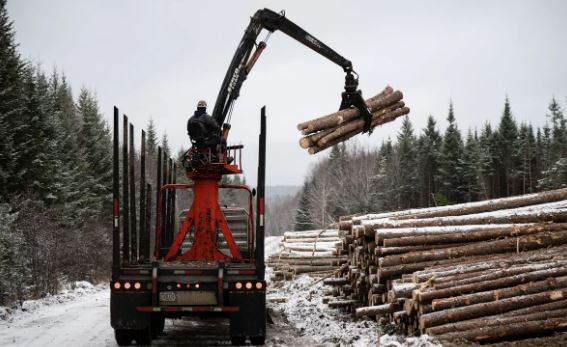
As the important winter logging season begins, people are
seeing the values for their timber fall, while their costs to
operate are going up.
The dirt roads in the northern corner of Oxford County froze
early this year, marking the unofficial start of the winter
logging season in Maine.
The hardened roads make it possible for loggers such as Andy
Irish and his Rumford-based company, Irish Family Logging, to
drive a fleet of semi-trucks and heavy machinery into the woods
without disturbing the underlying soil as much as in the summer.
Today’s loggers are far more reliant on these hulking pieces of
equipment that make logging safer and quicker than when Irish
entered the industry in the 1970s.
That efficiency comes at a premium, however. Each machine is
often imported from Canada or Scandinavia, and can cost more
than $500,000, a price that Irish absorbs by selling timber to
local sawmills and ND Paper’s mill in Rumford.
But as Irish prepares to pass the business down to his children,
demand for pulpwood — the scrawny, low-quality wood sold to
mills — is falling due to the Trump administration’s latest
tariffs on Canadian timber and poor market conditions.
Add to that the federal administration’s steeper tariffs on
foreign parts and equipment needed for logging, and Irish’s
operation costs threaten to dip into his reserves.
“An old guy told me a long time ago, ‘If you’re in this
business, there are going to be some years that you just gotta
eat [the costs],’” Irish recalled. “But I’m not sure how this is
going to go.”
From loggers such as Irish to the woodlot owners who open their
land to timber harvests, almost every link of New England’s
forest products supply chain has been hit hard by a perfect
storm of tariffs and falling market values, loggers, researchers
and industry officials told The Maine Monitor.
That financial pain only intensifies when industry linchpins,
such as paper or pulp mills, limit or halt purchases from other
links of the supply chain. After the administration slapped a 10
percent tariff on Canadian timber in October, Woodland Pulp in
Baileyville stopped buying wood not just from Canadian loggers
but Maine loggers, too.
The company then laid off 144 employees in mid-November and
plans to reinstate them next week. Before it resumes buying
timber, however, it will have to process the wood it’s
stockpiled.
“If some of that fiber has to come from Canada, and now the mill
can’t afford that fiber, there starts to be a reduced demand for
wood at these mills,” said Krysta West, executive director of
the Maine Forest Products Council, an industry advocacy group.
“That trickles throughout the entire industry whenever there’s a
curtailment or a shutdown of a mill.”
Maine’s forest products sector provided $4.9 billion in direct
economic output in 2024 and more than 29,000 direct jobs,
according to a recent analysis by the University of Maine.
Although the sector has been in overall decline since 2019,
there is underlying hope among industry players that investments
in more specialized paper product manufacturing and the
innovation of new wood products will keep businesses across
Maine humming.
But the tariffs complicate that outlook and will hamper domestic
forest products manufacturing, contrary to the Trump
administration’s stated purpose, said Dana Doran, executive
director of Maine Professional Logging Contractors, an advocacy
group.
The White House has said that the tariffs will spur the sales of
domestic timber and, in turn, generate more manufacturing of
paper and other wood products.
“The Secretary [of Commerce] also found that the United States
possesses ample raw materials and industrial capacity to meet
domestic wood products demand, while wood production in the
United States remains underdeveloped,” stated a White House
press release announcing the tariffs on Canadian timber.
New England forestry leaders, however, said that manufacturing
productivity is more heavily linked to market prices for pulp
and paper, not cheap Canadian timber, and tariffs will only hurt
the supply chain.
“If tariffs are increasing the cost of products coming into the
United States, and you’re not boosting American manufacturing at
the same time, it’s antithetical,” Doran said.
“You can’t do one without the other. You’ve got to do both.”
‘We’ve basically stopped importing the machines’
Many of the forest products industry’s modern challenges were
evident at Irish’s logging operation northeast of the Umbagog
National Wildlife Refuge recently.
The process started at the forest’s edge, where a crew member
guided a machine with the large, yellow body of an excavator,
called a “feller buncher,” into a dense thicket of evergreen
trees. When he got close enough, he extended the machine’s arm,
grasped a few trunks and cut them all at once, placing the
bundle to the side like a Paul Bunyan-sized pile of kindling.
Shortly after that someone in a longer-armed “processor” grabbed
each tree, trimmed its limbs, then smoothed it down to a bare
log with a mechanical head similar to a giant pencil sharpener.
What happened next is where market forces come into play.
The logs were transported to a crew member in a second
“cut-to-length” processor, who sorted and sawed the logs to a
certain length depending on size and species. High-quality
softwood logs were designated for sawmills, where they would be
cut into two-by-fours and other building products, while scrappy
hardwood species like birch would be ground into pulp at ND
Paper’s Rumford mill for paper production.
Few American logging operations use the same specialized
cut-to-length processor that Irish does, which gets him more
value out of the finished products he sells to the local
sawmills.
Because of low domestic demand, these machines are manufactured
in Canada, Finland or Sweden, where the practice is more common,
then imported to the U.S. by forestry equipment retailers.
“It’s a small market,” said Jack Bell, general manager and
co-owner of the Vermont-based retailer Long View Forest
Machines. “There’s two or three hundred new machines sold in all
of the United States in a year.”
A year ago, Bell’s company might pay about $3,000 in duties
to import a new cut-to-length processor from Sweden or Finland,
paying $525,000 for the machine in total.
Under the Trump administration’s tariffs on the European Union,
that price has now ballooned up to $90,000 per machine, Bell
said, costing him a total of $600,000 to import just one
processor.
“We’ve basically stopped importing the machines … because I
don’t think loggers can absorb that much price increase,” Bell
said. “We don’t want to pay those tariffs and be stuck with the
machines when people can’t afford to buy them.”
That means Irish might choose to hang on to his current
cut-to-length processor a bit longer when the time comes to
replace it, though he won’t be able to bypass the tariffs
altogether by doing so: machine parts and electronics are also
tariffed.
Irish’s sales are in a crunch like Bell’s. He has an agreement
with ND Paper that sets a quota for the amount of pulpwood he
sells to the mill each year, which also allows Irish to sell
beyond that when the mills are in open market and buying up all
the pulpwood they can get.
But Woodland Pulp’s closure means the pulpwood market is
oversaturated. Loggers up in Aroostook County have to sell their
pulpwood to the Sappi Somerset mill in Skowhegan or ND Paper’s
mill in Rumford, driving down prices all around.
“The pulp market is terrible,” Irish said. “We normally have
wide open [markets], but this week, they aren’t taking any pulp,
and it’s been pretty slow.”
---
---
---
Facilities such as TimberHP’s can also give Irish and Pelletier
a market to sell the lower-value timber residuals they harvest
during forest-thinning operations.
Although a bulk of timber sales come from the larger logs sold
to sawmills, Maine woodlot owners and loggers alike need buyers
for these thin, scraggly trees to remain profitable and open up
forest canopies to sunlight.
“In order to have a healthy industry and to practice good forest
management, you need markets for everything on a wood lot,” West
said. “That means harvesting all trees — both valuable, softwood
species marketable as construction materials and smaller.”
Even Woodland Pulp has spent big recently, putting $500,000 into
a piece of pulp processing equipment. That and the success of
Woodland’s tissue manufacturing facility — which didn’t
temporarily shut down — are all signs that there’s promise in
Maine’s wood products.
And as long as there’s a market to sell to, Pelletier said
there’s a workforce ready to supply it.
“We’ve got all the harvesting power needed to cut wood and truck
wood,” he said. “I feel that if we can ride this out for the
next year or so, that we will rebound.”
Source:
themainemonitor.org


