Aggregate residential building material prices rose at their
fastest pace since January 2023 in the latest Producer Price
Index release from the Bureau of Labor Statistics. Input energy
prices increased for the first time in over a year, while
service price growth remained lower than goods.
The Producer Price Index for final demand increased 0.3% in
September, after falling 0.1% in August. The index for final
demand goods increased 0.9% in September, the largest monthly
increase since February 2024. Final demand energy prices were
responsible for most of the goods index increase, as they rose
3.5% in September. This index for final demand for services was
unchanged in September.
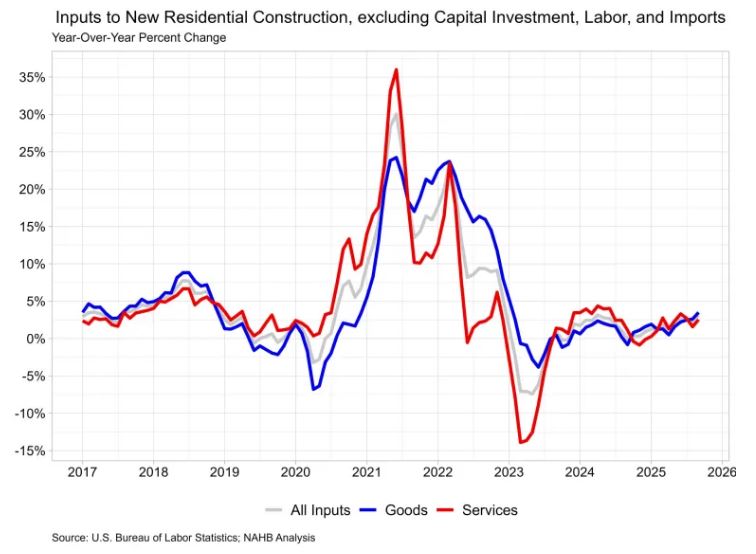
The price index for inputs to new residential construction
rose 0.2% in September and was up 3.1% from last year. The price
of goods inputs was up 0.1% over the month and 3.5% from last
year, while prices for services were up 0.3% over the month and
2.5% from last year.
Input Goods
The goods component has a larger importance to the inputs to
residential construction price index, representing around 60%.
On a monthly basis, the price of input goods to new residential
construction was up 0.1% in September.
The input goods to residential construction index can be further
broken down into two separate components, one measuring energy
inputs with the other measuring remaining goods. The latter of
these two components simply represents building materials used
in residential construction, which makes up around 93% of the
goods index.
Energy input prices rose 1.0% in September and were 3.0% higher
than one year ago. Building material prices were up 0.1% in
September and up 3.5% compared to one year ago. The 3.5%
year-over-year increase is the largest increase since the 4.9%
experienced back in January 2023. Residential building material
price inflation slowly accelerated over the year, after starting
around 2.0%.
The largest year-over-year price changes continue to be parts
for construction machinery and equipment, sold separately, up
41.3% compared to September of last year. Metal molding and trim
prices are up 31.0% from last year. Ready-mix concrete, a key
input to new residential construction, has shown little price
growth in 2025, up only 0.4% from last year. Additionally,
softwood lumber prices were down 2.3% in September from last
year. Lumber prices have experienced declines over the past few
months despite higher tariffs now in place. Ongoing weaknesses
during 2025 in new residential construction have led to an acute
oversupply of lumber on the market, with demand below
expectations.
Input Services
Prices for service inputs to residential construction reported
an increase of 0.3% in September. On a year-over-year basis,
service input prices were up 2.5%. The price index for service
inputs to residential construction can be broken out into three
separate components: a trade services component, a
transportation and warehousing services component, and a
services excluding trade, transportation and warehousing
component (other services).
The most significant component is trade services (around 60%),
followed by other services (around 29%), and finally
transportation and warehousing services (around 11%). The
largest component, trade services, was up 3.1% from a year ago.
The other services component was up 1.3% over the year. Lastly,
prices for transportation and warehousing services rose 2.6%
compared to August of last year.
Source:
eyeonhousing.org


