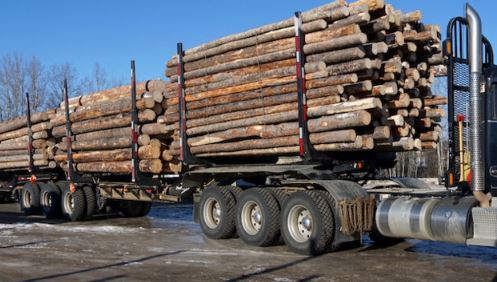
Three mills in North Central B.C. are cutting production by
40%.
Three sawmills in North Central B.C. are seeing significant
curtailments.
Sinclar Group Forest Products Ltd. announced Thursday it is
reducing production at its mills in Prince George, Vanderhoof
and Fort St. James by 40 per cent effective Monday, Oct. 27.
That means 350 workers across the three plants will see their
hours reduced.
“The significance of this action should not be underestimated,”
said the company in a news release. “These production
curtailments are equivalent to the closure of one full mill.”
The company blamed the closures on an “unsustainable provincial
policy landscape and persistent uncertainty around fibre supply”
and “deepening economic challenges.”
“All made worse by punitive duties and additional tariffs on
Canadian lumber entering the United States.”
In response to the curtailments, president of the BC Council of
Forest Industries Kim Haakstad said the federal government must
make resolving the softwood lumber dispute a national priority.
“At the same time, the provincial government must act decisively
to stabilize the sector in BC—ensuring mills stay open, people
stay employed, and forestry continues to anchor rural, urban and
First Nations communities across the province,” Haakstad said.
A crisis a long time coming
The contraction of the forestry sector in the region has been
expected for at least a decade in the wake of the mountain pine
beetle epidemic.
In 2004, the annual allowable cut in the Prince George timber
supply area was 14.9 million cubic metres, a figure it peaked at
while loggers rushed to harvest beetle-killed timber while it
was still valuable. Prior to the epidemic, the annual allowable
cut was 9.2 million cubic metres. It now sits at 6.9 million.
"The mountain pine beetle epidemic was an unprecedented event,"
said Dianne Nicholls, B.C. chief forester in 2017, when harvest
levels for the next decade were being determined. "I am
concerned regarding the possible risks to biodiversity and other
non-timber values that have resulted from the infestation and
from salvage harvesting of [beetle] impacted stands."
"As we reach the end of mountain pine beetle salvage harvesting,
it is time to shift the stewardship focus to recovery and
rehabilitation of non-timber values," Nicholls said
At the time, Nicholls mandated a phased decline to the annual
allowable cut, keeping in mind the socio-economic impact a
reduction in the cut would have on forestry communities. But,
she noted that a significant and longterm reduction in
harvesting levels was needed to "achieve timber supply
sustainability."
Source:
castanet.net


