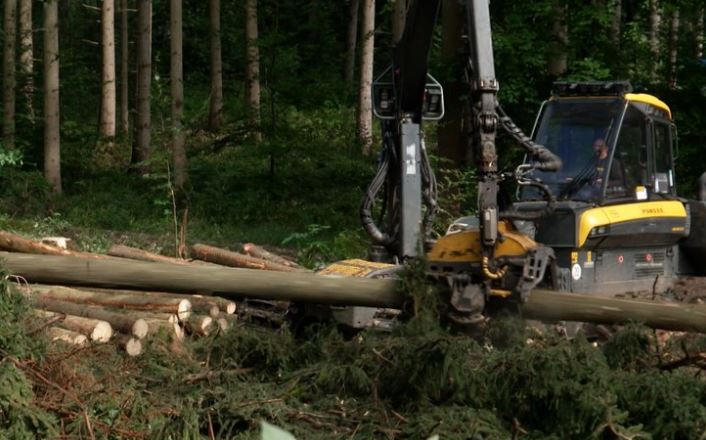
A decline in damaged timber causes wood prices to rise
significantly
Sawmills are experiencing a shortage of fresh timber. This has
led to extremely high timber prices in some cases, particularly
for spruce logs. What is the reason for this, and who is feeling
the impact of these timber prices?
The heating season is beginning—and with it the peak season for
wood dealer Matthias Birnkammer from Ebersberg in Upper Bavaria.
These days, he supplies customers with firewood, wood pellets,
and briquettes on a daily basis. However, the wood market is
currently extremely tight. Prices are at record levels,
especially for spruce and pine wood. This does not worry him.
“To be honest, it's chaos every year in the fall,” says the wood
dealer. He already bought his wood in the first half of the
year, and his warehouses are full. The situation is different at
the sawmills, however.
Wood industry apparently facing existential crisis
In many places, sawmills that want to process fresh logs now
have empty warehouses because hardly any fresh wood is being
delivered. The German Federal Association of the Wood Industry
refers to this as a “raw material shortage” in an open letter.
If more wood is not felled in the coming weeks, the situation
will “escalate into an existential crisis for the sawmill and
wood industry” by the beginning of 2026, the letter states.
Hardly any wood supply: How it came about
The bottleneck is due to the wet and cool summer that has just
passed, explains Herbert Borchert from the State Institute for
Forestry and Forest Management. Precipitation and cool
temperatures made life difficult for bark beetles. Their
populations were surprisingly small and caused little damage. In
addition, there were no major storms. As a result, fewer trees
had to be felled due to bark beetle infestation or storm damage.
However, the timber market is dependent on so-called damaged
wood—according to the State Institute for Forestry and Forest
Management, this accounts for half of all timber harvested in
Bavaria. And this is now lacking on the market, which hardly
distinguishes between beetle-damaged wood and undamaged wood.
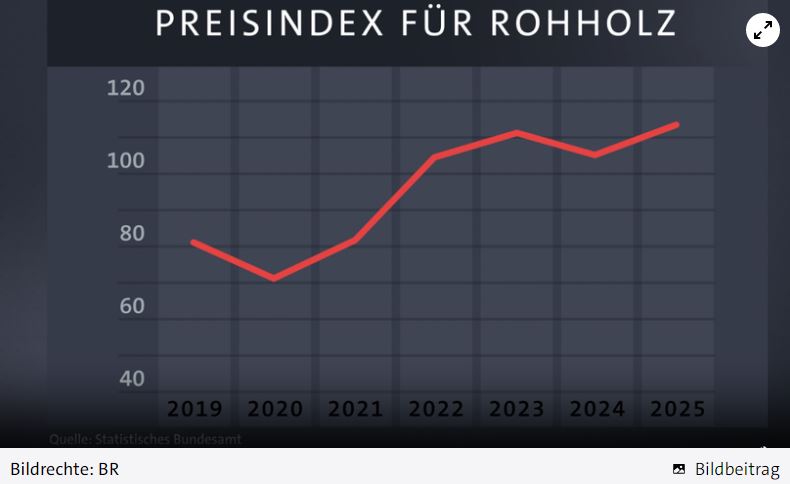
The price index is calculated based on the base
period 2015:100 and indicates the price development in relation
to this.
What could cause the price of wood to fall
If an autumn storm hits now, the situation could change
abruptly. Meanwhile, the German Sawmill Industry Association is
appealing to forest owners to fell pine and spruce trees in
order to meet demand from sawmills.
Wood market expert Herbert Borchert from the State Institute for
Forestry and Forest Management also believes that now is a good
time to push ahead with forest conversion—in other words, to
fell spruce trees, sell them at a profit, and invest in more
climate-resistant mixed forests.
Hardly any price changes for firewood
Prices for logs are currently at their highest in 35 years,
according to the Forest Farmers' Association in Deggendorf BR24.
Buyers are currently paying just under 130 euros per cubic
meter.
Firewood customers, however, need not worry too much about
expensive wood: according to the Technology and Support Center
in Straubing, prices are stable and in some cases even below
last year's levels. The main reason for this is the longer lead
time: some of the firewood currently being sold was already cut
last winter.
The bark beetle has caused comparatively little damage to
forests this year. This is now having an impact on timber
prices.
Source: br.de


