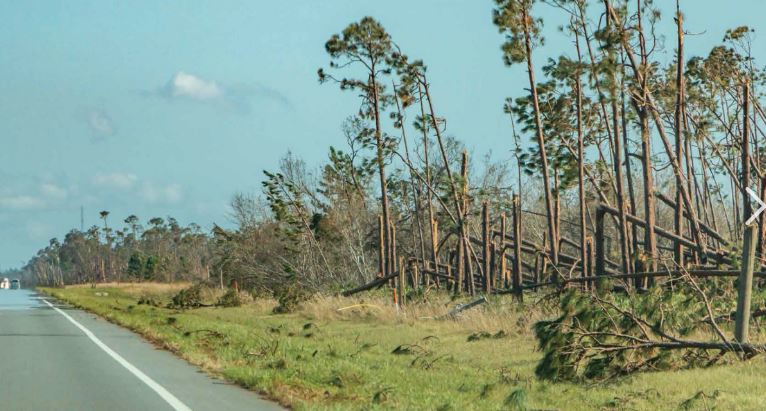
Mexico Beach, FL., Oct. 14, 2018 Hurricane Michael made landfall
on the Florida Panhandle October 10th, with 155 mile per hour
winds establishing it as the strongest storm to hit the
continental U.S. since 2004. With winds as high as 155 mph, the
Categor.
As hurricanes intensify across the Southeastern U.S., timber
markets are becoming increasingly vulnerable to sudden price
shocks. New research on Hurricane Michael reveals that stumpage
prices dropped sharply in the storm’s aftermath—falling 9% for
pine sawtimber and plunging 77% for hardwood sawtimber in the
most severely affected areas of Florida and Georgia. A broader
regional analysis found a 6% decline in pine pulpwood prices
across all timber micro-markets, driven largely by oversupply
from salvage logging and disruptions to mill operations.
The study, titled Evaluating Hurricane Impacts on Timber
Markets in the Southeastern United States: A Case of
Hurricane Michael, was conducted by Austin Lamica and Rajan
Parajuli of North Carolina State University and Consuelo
Brandeis of the USDA Forest Service. Using a regression
discontinuity in time (RDiT) model, the authors isolated the
hurricane’s causal effects on timber prices following its
landfall on October 10, 2018. Their findings highlight how major
storms like Michael can create sudden, product-specific price
collapses—especially in regions already vulnerable to
climate-driven extreme weather events.
The 77% drop in hardwood sawtimber prices was recorded in the
zone with the most severe timber damage, where the forest
inventory fell to 22.7% of pre-storm levels. Researchers
attribute this extreme decline in part to limited mill
infrastructure, noting that only 10 hardwood sawmills operated
in the affected areas of Florida, Georgia, and Alabama. Pine
sawtimber prices in the same zone dropped 9%, with salvage
harvests accounting for up to 50.5% of remaining live pine
volume.
In surrounding areas—such as southwest Georgia and southeastern
Alabama—prices for pine sawtimber fell by 13% in some markets
and 7% in others, while pine pulpwood declined by 13% and 16%
depending on location. Pine chip-n-saw prices dropped 95% in one
adjacent region. These markets are within the procurement radius
of mills that began sourcing cheaper salvage timber from
hurricane-damaged zones.
Not all markets responded the same way. In certain locations,
stumpage prices rose due to increased wood demand for
reconstruction. Hardwood sawtimber prices rose 4% in parts of
Georgia, while hardwood pulpwood increased 11% in nearby South
Carolina. These localized gains likely reflect mills unaffected
by the hurricane ramping up output to meet rebuilding demand.
Only statistically significant results were reported in the
study. In several markets, price changes were observed but did
not meet the threshold for statistical significance and are
therefore not included in the impact estimates.
In total, Hurricane Michael damaged 6.17 million acres of
timberland and led to the salvage of 1.66 billion cubic feet of
wood. An additional 1.5 billion cubic feet of dead standing
timber remained inaccessible due to damaged roads and wet soils.
In Florida alone, 40,000 homes were destroyed and $25 billion in
total damages were recorded.
The study emphasizes that hurricanes can trigger both immediate
timber oversupply from salvage harvests and price volatility
across local markets. Timberland owners and mill operators are
encouraged to account for these localized dynamics in future
forest management and risk mitigation strategies.
Please
click here for the full study report.
Source: sciencedirect.com


