Key takeaways
-- Economic uncertainty has clouded the pallet market outlook,
as July’s job report revealed weaker-than-expected job growth
-- The elimination of the de minimis tariff exemption for
low-value shipments is expected to improve pallet demand
-- Anticipated interest rate cuts will have a knock-on effect on
housing affordability, stimulating the construction sector which
in turn impacts lumber prices
-- Higher softwood lumber prices could lead to increased demand
for hardwood pallets
How has economic uncertainty impacted pallet demand in the
US?
In our most recent commentary, which we finished writing up on
July 31st, we alluded towards the end that despite a few months
of uncertainty and turmoil, the US economy had weathered much of
the storm. Higher input costs hadn’t yet been fully passed onto
consumers, hiring was holding up, and now that much of the
tariff uncertainty seemed to be behind us – this Economic Policy
Uncertainty chart for trade policy gives some sense of that
notion – we could look forward to stronger customer demand, and
in turn, pallet demand.
Unfortunately, that cautiously optimistic outlook was blunted
the following day by some dire numbers in the July jobs report,
so in this viewpoint we’ll be examining the outlook for the US
pallet market through this slightly altered lens.
July’s nonfarm payroll report showed just 73,000 jobs were
added, well below the 115,000 consensus forecast, and the two
prior months were revised down by a staggering 258,000 jobs
combined. Meanwhile, core personal consumption expenditure
inflation – the Fed’s preferred inflation gauge as it strips out
the more volatile food and energy components – remained stuck at
2.8%, above the Fed’s 2% target. This combination of persistent
inflation and a softening labor market has revived murmurs of
stagflation risks.
While unemployment remains relatively low at 4.2%, the labor
force participation rate has now declined for three straight
months, hitting its lowest level since late 2022. Critically for
the market, short-term Treasury yields fell sharply after the
jobs report, indicating that they expect Federal Reserve
interest rates to fall, and CME FedWatch now shows a 93% chance
(at the time of writing) of a 25 basis point rate cut at the
Fed’s next meeting, up from just 40% prior to the release.
What policy changes encouraging pallet usage?
Yet even as the macro picture clouds, there are glimmers of
opportunity for the pallet industry.
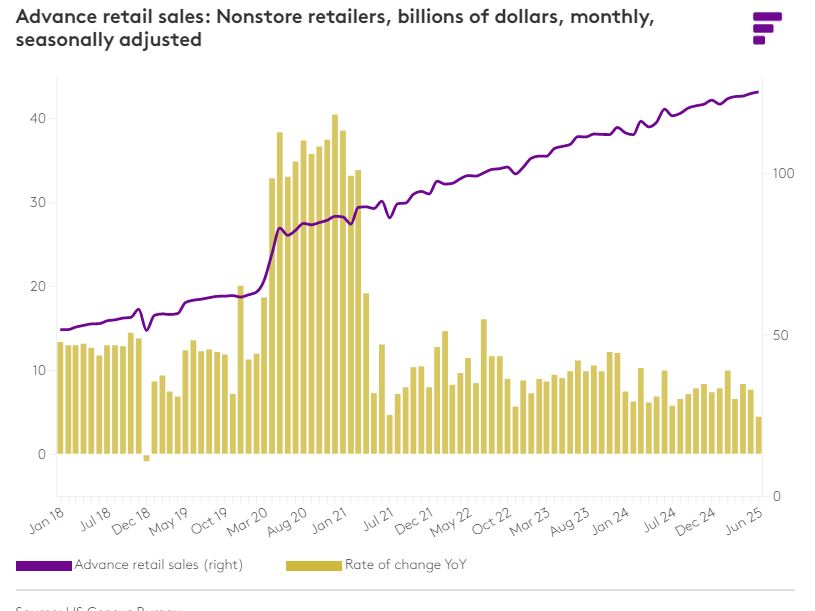
Non-store retail sales remain resilient, continuing to expand at
an impressive rate despite the broader deceleration. While
growth rates understandably tailed off slightly in the last
couple of months, it’s still putting up incredibly strong
figures over the last 5 years. This trend, coupled with recent
developments around the de minimis tariff exemption, has the
potential to reshape US import logistics in favor of pallet
usage. With Trump’s executive order eliminating the de minimis
exemption for low-value commercial shipments effective August
29, 2025, and full enforcement by mid-2026, we may soon see a
structural shift away from small-parcel imports toward bulkier,
palletized container shipments as exporters from Asia (the main
beneficiaries of this exemption) look for ways to save costs on
shipping.
For pallet demand, this is a meaningful pivot. As parcel air
freight gives way to containerized ocean freight, warehouse
throughput increases and palletized supply chains gain traction.
Especially as direct-to-consumer brands pivot to avoid new
tariff burdens, bulk shipping will likely boost demand for
pallets used in cross-border intermodal freight and warehousing.
While this policy shift is a potential tailwind, the broader
economy’s weakening signals also warrant attention. With
goods-producing sectors shedding 37,000 jobs over the past three
months, there are clear signs that industrial activity is
cooling. A portion of the blame for this can be attributed to
the uncertainty around tariff permanence discouraging capital
investment in domestic manufacturing, with firms wary of
committing to US production capacity that could be undercut by
future policy reversals.
How have tariffs impacted the US pallet market?
Moreover, the levels that tariffs have been placed at haven’t
had their intended effects, and in some cases, hurt domestic
producers. Currently, a finished car imported from Japan faces a
15% tariff. In contrast, building that same car in the US would
incur far steeper costs: a 50% tariff on steel, aluminum, and
copper; 55% on Chinese components like batteries and rare
earths; 25% on electronics from South Korea; 25% on parts from
Mexico; and 35% on components from Canada, and all of this on
top of higher US labor costs.
In effect, tariffs have been set at a level that discourages
domestic production without fully deterring imports. That
imbalance will ultimately filter through to consumers in the
form of higher prices, adding pressure to inflation and
complicating the path forward for interest rates.
As interest rate cuts grow more likely, housing affordability
could begin to improve, reviving demand in residential
construction. This would be a positive medium-term catalyst for
pallet producers that would see higher demand and higher prices
from the knock-on effects of more residential construction, as
the prices of low-grade lumber used to build pallets always
follow the price used for framing lumber, something we discussed
in more detail in our June newsletter.
The impact on lumber prices
We’ve put together some analysis compiling Fastmarkets data,
alongside Virginia Tech estimates for historic pallet
production, to give a sense of how this would affect the pallet
industry.
In 2024, US pallet producers used about 8.45 BBF of softwood
lumber. Given that last year 24% of total softwood was imported
from Canada – and recognizing that the more lucrative framing
lumber will see a higher amount imported, as it has a higher
value proposition than the low-grade lumber used for pallets –
we’re assuming a figure of 10% of low-grade lumber used for
pallets comes from Canada, leaving the US with a shortfall of
0.845 BBF.
For the reasons given above, we would see immediate upward price
pressure once Canadian supply tightens.
This does, however, raise the prospect of hardwood regaining
some market share. Since the duties focus exclusively on
softwood, higher softwood prices could prompt some pallet buyers
to switch to the more expensive, yet far more durable, hardwood
pallets once softwood loses its relative price advantage.
As shown in the graph above, as pallet usage has grown, softwood
has become the dominant material used in pallet manufacturing
due to its abundance and cost-effectiveness. Hardwood mills were
hit hard, and many saw closures, after the Chinese property
market collapsed as that was its biggest end-use market. This
Canadian softwood lumber supply shock does certainly leave the
door open for the hardwood pallet to regain some market share.
In conclusion, supply and demand indicators are certainly
pointing to higher prices towards the end of 2025 and into 2026,
after what’s been a largely uneventful 2 and a half years for
this sector. If you’d like to stay abreast of movements in the
pallet market to avoid shocks to your supply chain, sign up for
our pallet commentary here.
Source:
fastmarkets.com


