Japan
Wood Products Prices
Dollar Exchange Rates of 10th
November
2026
Japan Yen 159.69
Reports From Japan
The weak yen a complex economic challenge
The depreciation of the Japanese yen, trading around the
159–160 per dollar level, has shifted from a traditional
tailwind for exporters into a complex economic challenge
known as the "bad yen depreciation". Because Japan relies
heavily on imported energy, raw materials and food, the
weak currency dramatically raises domestic yen-based
import prices (which have jumped nearly 25% year on
year).
While large multinational exporters benefit from
repatriated overseas profits, small domestic manufacturers
and local businesses struggle to pass higher material and
fuel costs onto consumers. SMEs represent about 99% of
all companies in Japan (over 3.36 million businesses) and
they provide jobs for roughly 70% of the national
workforce (around 33.1 million workers).
Because international timber contracts are typically priced
in US dollars or foreign currencies, a weak yen makes
imported wood products drastically more expensive in
domestic currency terms. Japan's sawn softwood imports
dropped 19% year on year in the first nine months of
2026, with shipments from the EU, Canada and Nordic
countries contracting. A weak Japanese yen significantly
increases the local landed cost of imported tropical wood,
reducing import volumes, squeezing importer profit
margins and accelerating Japan's structural shift toward
domestic timber.
On the plus side, the cheap yen acts as a massive discount
for inbound foreign visitors, driving record tourism
numbers and spending, while simultaneously boosting the
yen-denominated value of Japan's massive external assets
and overseas investment portfolios.
See: https://www.weforum.org/stories/jobs-and-the-future-of-
work/japan-small-businesses-economic-resilience
and
https://news.cgtn.com/news/2026-08-
19/VHJhbnNjcmlwdDkxOTQ3/index.html
Currency traders reminded of previous intervention
As the yen weakened past the psychologically key 160-
per-dollar threshold in mid-November 2026, falling to its
lowest level since early September after coming under
sustained selling pressure. The slide prompted Japanese
authorities to issue warnings of potential foreign exchange
market intervention.
Finance Minister, Satsuki Katayama, stated that Japanese
officials would maintain close coordination with their US
counterparts and take appropriate measures if necessary to
address excessive and rapid movements in the currency
market. A spokespersons reminded currency traders to
remember when Japanese and US authorities jointly
intervened in the market to support the yen.
The currency’s latest decline was largely driven by broad-
based US dollar strength amid growing expectations of
more aggressive Federal Reserve interest rate hikes,
following stronger-than-expected US inflation data.
See: https://aa.com.tr/en/economy/japanese-yen-weakens-past-
160-per-dollar/4123646
Yen rebalancing
Japanese companies that spent years investing offshore
and converting yen into foreign currencies have reached a
point where cumulative overseas investment returns cover
roughly 103% of their new annual overseas investments,
reducing the necessity to sell yen.
This along with the normalisation of Japanese yen bond
yields and rising interest rates by the Bank of Japan are
reversing a 15-year capital flight trend and driving the
great yen rebalancing, drawing Japanese money back into
domestic assets. Japanese banks and institutional investors
have turned net sellers of foreign bonds, pivoting back into
higher-yielding domestic government bonds.
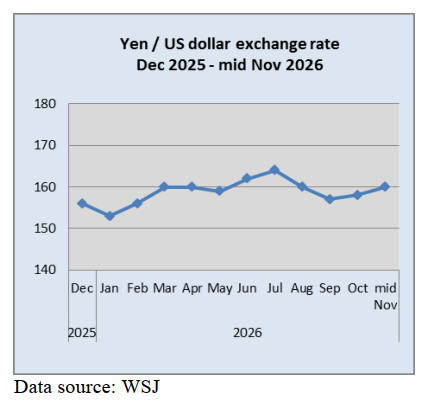
Household spending slumps most since pandemic
The latest government survey has reported Japan’s
household spending unexpectedly fell by the most since
2020, highlighting persistent weakness in consumption,
even as the Bank of Japan grows more confident that
inflation has become entrenched enough to warrant further
interest rate increases.
According to the Internal Affairs and Communications
Ministry report, outlays by households, adjusted for
inflation, declined close to 7% in September from a year
earlier led by transport, education and entertainment.
The sharp decline poses a dilemma for the BoJ as it
continues to support for the economy with interest rate
hikes. Weak consumption points to the need to cool
inflation to help households but higher borrowing costs
can also hurt households through mortgages and other loan
expenses.
See:
https://www.japantimes.co.jp/business/2026/11/10/economy/japa
n-household-spending-sept-plunge/
Cut in consumption tax hotly debated
Japan is currently locked in a major political and economic
debate over a proposed two-year reduction in the
consumption tax on food. The aim is to reduce the
consumption tax rate on food and non-alcoholic beverages
from 8% down to 1% for two year, starting in April 2027.
To further assist lower and middle income families, the
government also plans a cash-benefit system. Critics, warn
that cutting the tax on food will cost an estimated 10
trillion yen over two years, damaging public finances,
further weakening the yen and risking higher interest rates.
Opposition parties have questioned the proposed income
thresholds (such as upper limits around 3.5 million yen)
for cash handouts, arguing it leaves out strained middle-
income earners. This prompted the government to pledge
a broader reach.
See: https://www.asahi.com/ajw/articles/17030301
and
https://japantoday.com/category/politics/update1-japan's-senate-
takes-up-food-tax-cut-bill-amid-opposition-scrutiny
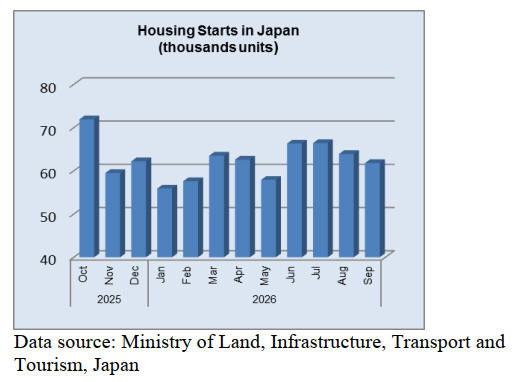
Cost of imported building materials surge
The weak yen significantly increases production and
material expenses for house builders in Japan while
altering how major builders allocate capital overseas.
Japan relies on global imports for critical building
commodities including structural steel, copper, chemicals,
plastics, resins and wood productst. A weak yen drives up
the import cost of these raw materials.
Cumulative construction costs have climbed roughly 30%
over a five-year span, forcing builders to pass elevated
production and logistics expenses onto consumers through
higher home prices which dampens demand for wood
products. Because domestic operations in Japan have
generated stronger relative performance construction
companies in Japan are increasingly focusing on capital
efficiency, reducing leverage and rebalancing investment
away from aggressive overseas expansion.
See: https://www.housingwire.com/articles/japanese-owned-
builders-capital-efficiency/
Massive timber reserves underpin exports
Japan's timber exports have grown significantly, making it
a rare case where log exports are rising while in most other
countries raw material exports are falling. Japan's log
exports reached 1.912 million cubic metres in 2025,
outpacing imports for a second consecutive year.
The total wood export value rose to yen 32.044 billion in
the first half of 2026 (up 4.1% year-on-year). Post-WWII
reforestation programs left Japan with massive domestic
timber reserves (roughly 5 billion cubic metres), while
updated Chinese building codes and the popularity of
Japanese cedar (sugi) and cypress (hinoki) have boosted
foreign demand. This growth also helps offset a rising
domestic construction costs.
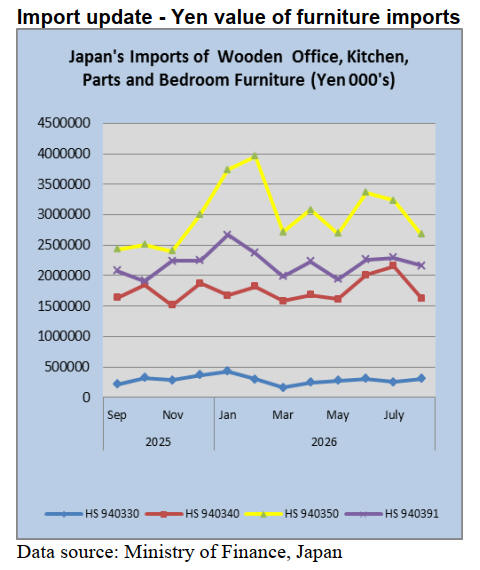
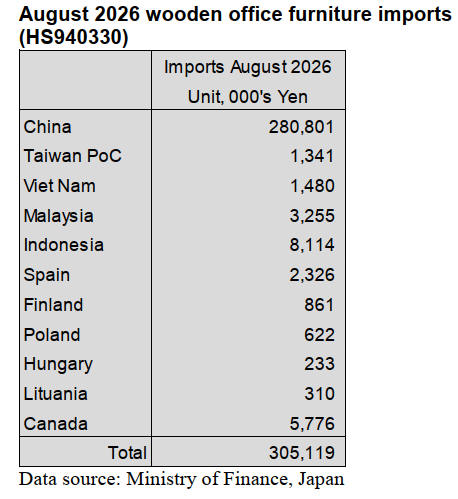
August 2026 wooden office furniture imports
(HS940330)
In August 2026, the value of Japan’s imports of wooden
office furniture (HS940330) was around 20% higher than
in July reviving the upward trend seen since March. Year
on year, the value of wooden furniture imports in August
2026 rose a modest 3%.
The value of August imports of wooden office furniture
from the top shipper, China rose by almost 40% reversing
the drop seen in July. Manufacturers in China increased
their major market share to 92% from the approx. 80% in
July.
The only other shippers that secured a significant market
share in August were Indonesia (3%) and Canada (2%).
Exporters in Malaysia saw an almost doubling of the value
of their exports of HS940330 to Japan in July but this was
not sustained into August.
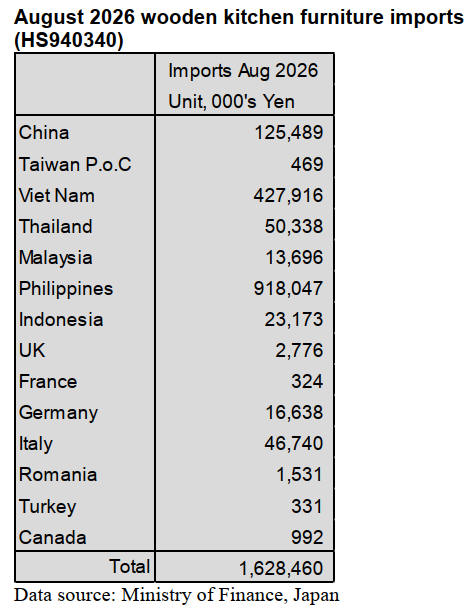
August 2026 wooden kitchen furniture imports
(HS940340)
Japan's imports of wooden kitchen furniture include
modular cabinetry, sideboards, storage units and smaller
accent pieces largely sourced from Southeast Asian and
East Asian manufacturers. Japanese Customs data shows
that in August 2026 the value of arrivals from top three
shippers of wooden kitchen furniture (HS940340) to Japan
fell.
The top three suppliers accounted for 96% of the value of
August arrivals with the Philippines being top shipper
accounting for around 56% of the total for the month but
the value of shipments from the Philippines dropped 16%
month on month.
Arrivals from the second largest supplier in August, Viet
Nam, were around the same level as in July. Shipments
from manufacturers in China, the third largest supplier in
August were down around 14%.
Year on year, the value of August 2026 wooden kitchen
furniture imports was up 14% compared to the value of
July imports while month on month there was a 24%
decline.
August 2026 wooden bedroom furniture imports
(HS940350)
Some 97% of Japan’s August imports of wooden bedroom
furniture (HS940350) were shipped from just three
countries, China 62%, Viet Nam 31% and Malaysia 4%.
In August the value of arrivals from China and Viet Nam
were below that of the previous month whiles August
arrivals from Malaysia were around 25% higher than in
July.
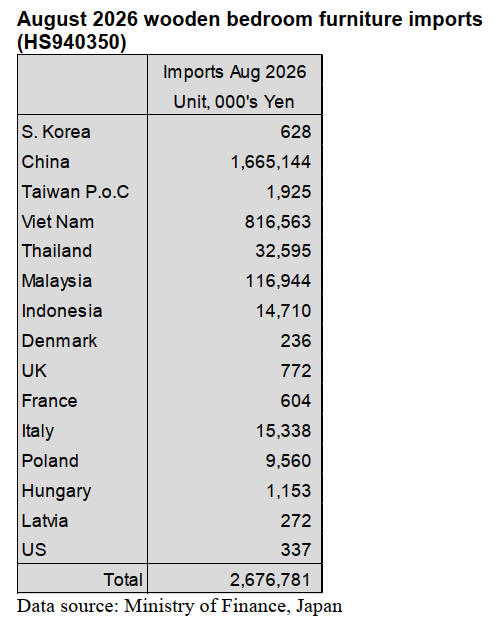
Thailand ranked forth as a supplier of wooden bedroom
furniture in August followed by Italy ranked fifth in terms
of the value of imports. The total value of imports of
wooden bedroom furniture in August 2026 was down 17%
month on month but around 3 higher than in August 2025.
The most common styles of wooden bedroom furniture
imported into Japan tend to be minimalist with natural
materials and low-profile design honoring traditional
Japanese ‘low-living’ traditions while adapting to
Western-style mattresses.
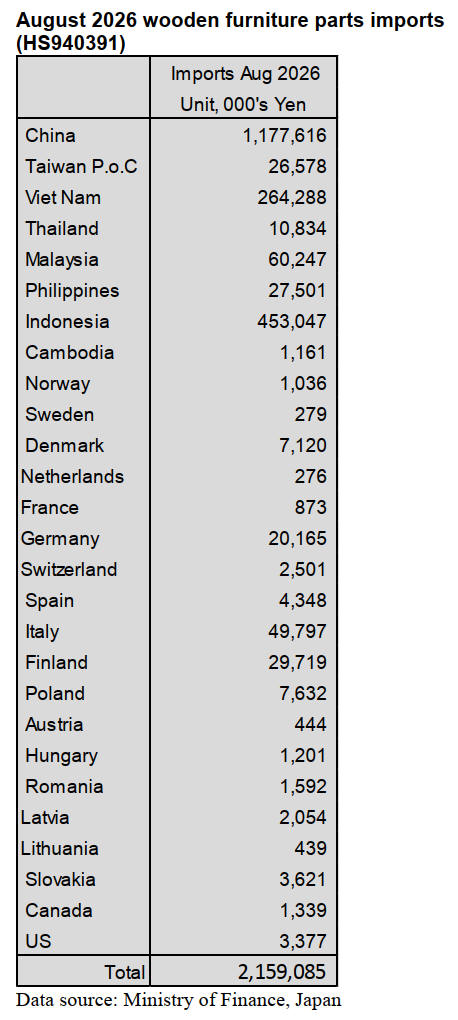
August 2026 wooden furniture parts imports (HS
940391)
Japan’s wooden furniture parts market (HS940391) relies
heavily on regional manufacturing hubs while opening
doors for international small and medium sized
enterprises. Foreign SMEs can succeed by targeting niche
markets, custom craftsmanship or specialised components
needed by Japanese manufacturers.
Organisations like the Japan Furniture Industry
Development Association actively assist foreign
manufacturers and public agencies with market research,
trade matchmaking and business inquiries.
See: https://jfa-kagu.jp/en/about_en/
In August, as in previous months, shippers in China and
three SE Asian countries, Indonesia Viet Nam and
Malaysia accounted for most (79%) of Japan’s imports of
wooden furniture parts (HS940391). The main shipper of
wooden furniture parts to Japan in August was China at
55% (53% in July) followed by Indonesia at 21% (18% in
July), Viet Nam 12% (13% in July) and Malaysia 3% (5%
in July). There was a sharp drop in the total value of
arrivals from Malaysia.
The value of imports from China in August 2026 was
around the same level as in July. Imports from Indonesia
were up 9% compared to July but imports from Viet Nam
were almost the same as in July. The downturn in the
value of imports from Malaysia in August extended the
downward trend seen in July.
Trade news from the Japan Lumber Reports (JLR)
The Japan Lumber Reports (JLR), a subscription trade
journal published every two weeks in English, is
generously allowing the ITTO Tropical Timber Market
Report to reproduce news on the Japanese market
precisely as it appears in the JLR. For the JLR report
please see: https://jfpj.jp/japan_lumber_reports/
Wood material imports fall 10%
Amid Weak Demand, Yen Depreciation wood-based
panels and structural glued laminated timber, fell 10%
year on year through August, according to data compiled
by the Japan Lumber Importers' Association.
Excluding wood-based panels and structural glulam,
imports of the five major foreign timber categories --
North American, European, New Zealand/Chile, Russian
and tropical timber – declined 16% from a year earlier.
Most product categories posted year on year decreases,
reflecting weaker domestic demand for building materials,
higher import costs caused by the yen's depreciation, and a
growing shift toward the use of domestic timber.
Imports of the five major foreign timber categories totaled
1.0 million cubic meters for logs and 2.3 million cbms for
lumber. North American timber accounted for 840,000
cbms of log imports, while European timber represented
1.19 million cbms of lumber imports, with both categories
making up more than half of their respective markets.
One of the most notable trends in the data was the sharp
decline in U.S. lumber imports and Canadian log imports.
In addition to weaker buying interest from Japan, suppliers
in the producing regions have been prioritizing domestic
demand. For Russian lumber, a stronger ruble has also
significantly reduced its competitiveness and supply
capacity for the Japanese market.
Wood-based panel imports increased year on year, led by
plywood as well as particleboard (PB) and oriented strand
board (OSB). While plywood imports from Malaysia
declined by 49,000 cbms, imports from Indonesia rose by
40,000 cbms, resulting in a net increase of only 9,000
cbms from the two major suppliers.
However, imports from Vietnam climbed by 52,000 cbms
and those from China by 36,000 cbms. In addition,
plywood imports from Russia, which effectively emerged
as a new supply source this year, increased by 17,000
cbms. These gains indicate that plywood made from
species other than traditional tropical hardwoods is
expanding its share of Japan's import market.
Plywood
Japan's domestic softwood plywood market remained
sluggish, with sales through traditional lumber and
building-material distribution channels weaker than a year
earlier despite relatively firm demand from direct users.
October and November are typically peak autumn demand
months, but both manufacturers and trading firms reported
softer market activity.
Domestic plywood producers kept October shipment
prices unchanged, although weak demand has made it
increasingly difficult to maintain the industry's target price
of ¥1,450 per sheet. Lower-priced transactions have
become more common, with some deals reportedly falling
below ¥1,400 per sheet.
Construction delays caused by prolonged rainfall and
discount sales ahead of interim financial reporting have
also weighed on the market. In response, producers have
reduced output to improve the demand balance while
continuing to resist price cuts, citing high adhesive,
auxiliary material and transportation costs.
Market participants are closely watching whether demand
will recover in November. The imported plywood market
also remained subdued, particularly for film-faced
concrete form plywood, as condominium and non-
residential construction projects continued to start slowly.
Manufacturers in Malaysia and Indonesia are facing
increasing profitability pressure from high production
costs and raw material constraints. In Sarawak, Malaysia,
log production has fallen sharply, while Indonesian
plywood exports to the U.S. have weakened following
antidumping measures.
Export and domestic plywood prices were largely
unchanged from the previous month. Although Indonesian
suppliers are seeking to expand sales to Japan, price levels
remain unattractive for many importers. With inventories
at Japanese ports still near full capacity, imports of
tropical hardwood plywood are expected to decline in the
months ahead.
Domestic lumber and logs
Domestic lumber prices in Japan have risen steadily since
summer as sawmills sought to pass higher production
costs on to the market. Price increases of around ¥1,000-
2,000 per cbm have been reported across many regions,
particularly for framing and non-structural products, amid
rising log, material and transportation costs.
Cedar post prices have seen the sharpest gains. Kiln-dried
premium grade cedar posts are currently trading at around
¥63,000-65,000 per cbm, up ¥3,000-5,000 from a month
earlier, as sawmills struggle to secure sufficient log
supplies and wholesalers pay higher procurement costs to
maintain inventories. Cedar stud prices have also
increased, though at a more moderate pace, reflecting
comparatively less supply tightness.
Cedar log prices, which surged following prolonged
rainfall in September, have begun to stabilize as weather
conditions improved and log shipments recovered.
However, prices remain elevated, particularly in northern
Kanto, and are expected to stay firm through year-end due
to steady lumber demand and continued supply
constraints.
Cypress log prices continue to trend upward amid limited
supply, as logging operators have shifted production
toward cedar in response to stronger prices. Procurement
costs for Japanese cypress sill plates have also risen as
shortages become more apparent.
Interest in domestic hardwood logs has strengthened as
imports of foreign hardwood species decline. Prices for
high-grade hardwood logs have already increased in
producing regions such as Iwate Prefecture, reflecting
tightening supply and firm demand. Market participants
generally expect lumber and log prices to remain firm in
the coming months.
Association Strengthens Environmental
Appeal with Industry-wide EPDs The Japan Fiberboard
and Particleboard Manufacturers Association has obtained
industry-wide Environmental Product Declarations (EPDs)
for medium-density fiberboard (MDF) and particleboard
under the Sustainable Management Promotion
Organization's (SuMPO) Environmental Label Program.
Published in October, the declarations quantify CO
emissions throughout the production process, covering raw
material procurement, transportation to manufacturing
facilities and manufacturing. The data will enable the
products to be included in Life Cycle Assessment (LCA)
calculations for buildings, helping meet growing demand
for environmental performance evaluations in the
construction sector.
|


