|
Report from
Europe
Uneven recovery in UK tropical wood imports as balsa
shipments from Spain surge
UK imports of tropical wood and wooden furniture
products recovered some ground after a slow start to 2026
but the improvement remains uneven. Import value
increased while overall tonnage declined slightly in the
first eight months. Growth was concentrated in furniture
from Vietnam, several smaller product groups and tropical
sawnwood shipped through Spain. Imports of tropical
plywood continued to contract, while weak construction
activity constrained prospects for a broader recovery.
In the first eight months of this year, UK imports of
tropical wood and wooden furniture products totalled
252,000 tonnes, 1% less than in the same period in 2025.
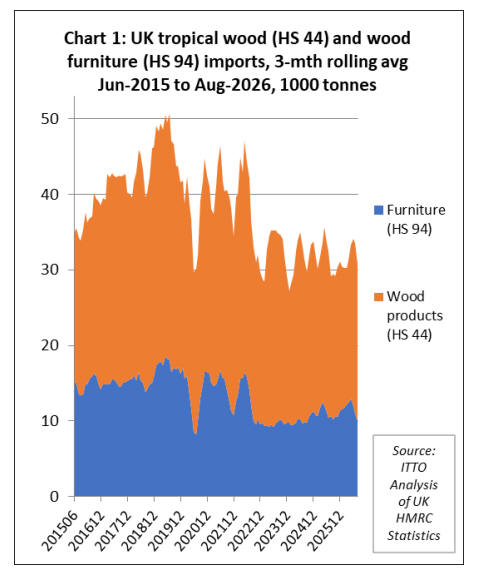
Import value increased 3% to US$704 million in nominal
terms. The tonnage decline eased compared with the first
quarter, when imports were around 5% below a year
earlier. Second-quarter tonnage was around 1% higher
than in the same quarter last year (Chart 1).
Furniture imports increased 2% to 91,600 tonnes in the
first eight months. There were stronger percentage gains in
mouldings and decking, up 18% to 7,300 tonnes, flooring,
up 29% to 2,700 tonnes and kitchenware, up 39% to 2,200
tonnes. These gains were offset by lower imports of
plywood, down 13% to 50,800 tonnes and joinery, down
3% to 47,500 tonnes. Sawnwood tonnage was almost
unchanged at 39,400 tonnes.
Tropical imports remain well below their pre pandemic
level
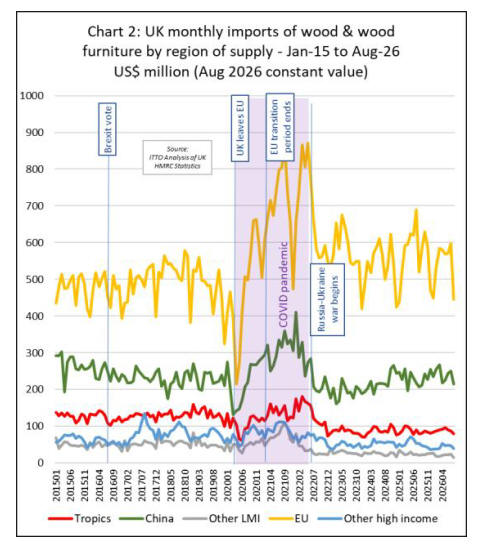
Chart 2 sets tropical imports in the wider context of UK
wood and wooden furniture trade. In constant August 2026
dollar terms, the value of tropical imports was almost
unchanged in the first eight months compared with the
same period last year, at around US$710 million. It
remained 37% below the equivalent period in 2019.
Import tonnage was also 36% below the first eight months
of 2019, indicating the scale of the longer-term contraction
in this market.
The inflation-adjusted value of UK wood and wooden
furniture imports from all supply regions fell 4% to
US$7.47 billion in the first eight months. Imports from the
EU declined 6% to US$4.33 billion, while imports from
China increased 4% to US$1.91 billion. The EU
nevertheless remained by far the largest supplier,
accounting for 58% of the total, followed by China with
26% and tropical suppliers with 9.5%. Tropical suppliers
accounted for 9.1% in the same period in 2025 and 14.0%
in 2019.
Construction remains a constraint despite stronger
GDP growth
The wider UK economy has performed better than the
construction sector. According to the Office for National
Statistics, UK GDP increased 0.7% in the three months to
August 2026 compared with the previous three months,
led by growth in services. Construction output, however,
fell 1.0% over the same period, its second consecutive
three-month decline.
Both new work and repair and maintenance contracted in
the three months to August, by 1.4% and 0.3%
respectively. Private new housing was the main drag,
falling 3.2%. Construction output also declined 0.2% in
August alone, the fourth successive monthly fall. Repair
and maintenance provided some relief in August, rising
0.4% but new work fell 0.7%.
These conditions provide little support for a rapid, broadly
based recovery in timber demand. Timber Development
UK reports that import volumes of the main timber and
panel products fell 3.9% in the first half of 2026. Overall
hardwood imports declined 1.5%, although tropical
hardwood volume increased 3.5%. TDUK also cites a
Construction Products Association forecast of a 9%
reduction in UK housing starts this year.
Builders’ merchants’ sales provide further evidence of the
pressure on physical demand. According to the Builders
Merchant Building Index, total sales volumes fell 6.6% in
the second quarter compared with the same period in
2025, while average prices increased 5.8%, limiting the
decline in sales value to 1.2%. Timber and joinery sales
value was unchanged, performing better than the wider
market.
This suggests some resilience in timber-related
expenditure, although the published summary does not
give a separate volume change for timber and joinery.
Vietnam drives growth in UK imports of tropical
wooden furniture
UK import value of wooden furniture from tropical
countries increased 4% to US$355 million in the first eight
months of 2026, while tonnage increased 2% to 91,600
tonnes. Vietnam accounted for all the net value growth and
more, with shipments rising 11% to US$212 million. Its
share of the total increased from 56% to 60% (Chart 3).
Imports declined from all the other leading suppliers of
wooden furniture in the first eight months of this year.
Import value from Malaysia fell 7% to US$69.5 million,
while imports from India were almost unchanged at
US$35.4 million. Imports from Indonesia decreased 10%
to US$28.2 million, Thailand fell 11% to US$4.5 million
and Singapore declined 5% to US$3.2 million. Furniture
from tropical countries continued to enter the UK at a
much lower level than before the pandemic, with tonnage
36% below the first eight months of 2019.

Indonesian joinery shipments recover while Malaysia
loses ground
UK imports of tropical wood joinery declined 3% in both
value and tonnage in the first eight months, to US$135
million and 47,500 tonnes. The aggregate decline
concealed a recovery in shipments from Indonesia, the
largest supplier, which increased 4% to US$66.0 million.
Indonesia accounted for nearly half the total import value
(Chart 4).
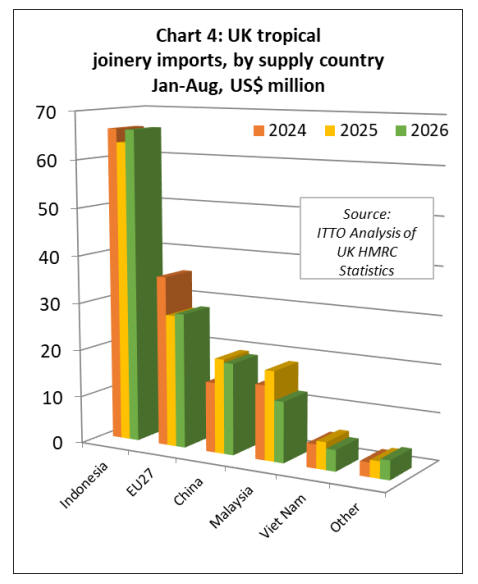
UK imports of tropical joinery products from the EU27
increased 2% to US$28.4 million in the first eight months
this year, supported by a 31% rise in shipments from
Poland to US$11.5 million. Imports from Ireland increased
1% to US$8.9 million.
In contrast, imports from Malaysia fell 32% to US$12.8
million and Vietnam declined 22% to US$4.4 million.
Imports from China decreased 3% to US$19.3 million.
Tropical plywood supply shifts as Chinese shipments
contract
UK imports of tropical plywood fell 15% to 95,300 cu.m
in the first eight months of 2026. Shipments from China
declined 69% to 6,700 cu.m, continuing the sharp
contraction already evident earlier in the year. Imports
from Malaysia, still the largest supplier, fell 27% to
33,400 cu.m. Together these two suppliers lost around
27,200 cu.m compared with the first eight months last year
(Chart 5).
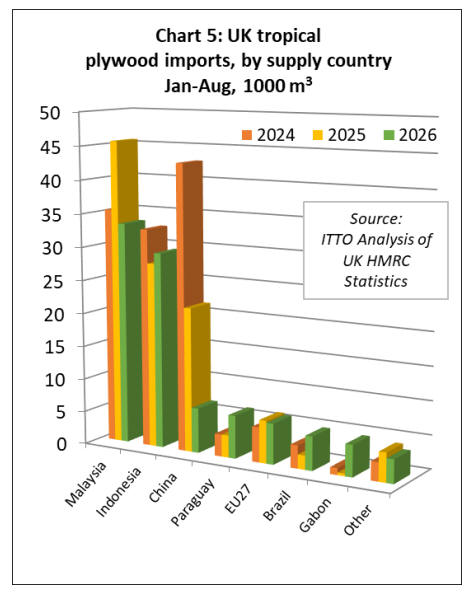
Other suppliers of tropical plywood gained ground in the
UK during the eight month period. Imports from Indonesia
increased 6% to 29,400 cu.m, while Paraguay rose 93% to
6,400 cu.m and Brazil increased 140% to 5,100 cu.m.
Shipments from Gabon rose from only 400 cu.m to 4,700
cu.m. Imports from the EU27 decreased 4% to 6,100 cu.m.
Direct shipments from tropical countries were down only
2% to 81,500 cu.m, highlighting the extent to which the
overall decline was concentrated in tropical plywood
supplied from China.
TDUK reports a 7.4% decline in the much broader
hardwood plywood category in the first half of this year, to
477,000 cu.m. Most of that reduction came from China
and Malaysia, partly offset by gains from Latvia, Finland
and Paraguay.
Increased competition from European birch plywood in
the UK market
European birch plywood producers are increasing supply,
adding to competition for tropical plywood in the UK.
UPM’s total plywood deliveries across all markets rose
23% to 269,000 cu.m in the first half of 2026.
These figures include both hardwood and softwood
plywood and the comparison reflects recovery from strikes
that disrupted production last year. However, UPM also
reported good demand for birch plywood in panel trading
and industrial applications.
Latvijas Finieris opened its €100 million VEREMS mill
expansion in Latvia in April. The investment is intended to
increase capacity to 85,000 cu.m, compared with existing
production of around 45,000 cu.m, with output rising
gradually and an emphasis on large-format plywood.
Competition with tropical plywood is particularly direct in
smooth phenolic-film-faced panels for concrete formwork,
where European birch competes with Indonesian and other
Asian products. Buyers assess strength, concrete finish,
expected reuse and cost per pour, allowing higher-priced
panels to compete where they provide longer service life.
There is additional overlap in selected transport flooring,
industrial and general construction applications, although
substitution depends on product specifications.
Spanish shipments account for the increase in tropical
sawnwood imports
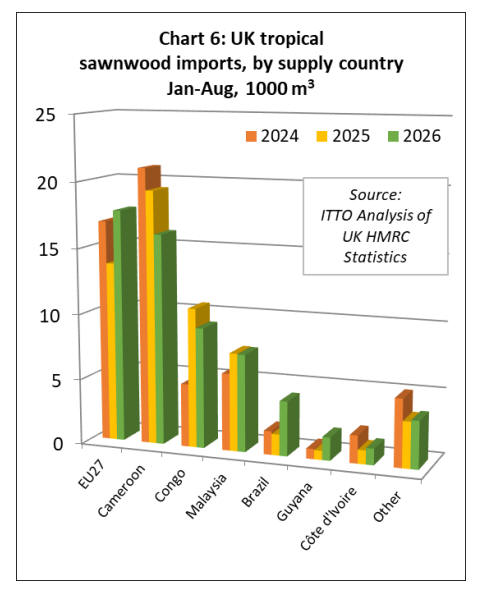
UK imports of tropical sawnwood increased 6% to 61,200
cu.m in the first eight months of 2026. Imports from the
EU27 rose 30% to 17,700 cu.m, maintaining its position as
the largest supply region ahead of Cameroon. The EU
increase was entirely attributable to Spain, where
shipments rose nearly sixfold from 1,169 to 6,781 cu.m.
Excluding Spain, imports from the EU fell 13% (Chart 6).
The increase in UK tropical sawnwood imports from
Spain also exceeded the net gain in UK tropical sawnwood
imports from all sources. Excluding Spain, total imports
fell 4% to 54,400 cu.m. The headline growth therefore
provides limited evidence of a general improvement in
demand for tropical hardwoods traditionally used in UK
joinery and construction.
Imports from Cameroon fell 17% to 16,100 cu.m and the
Republic of Congo declined 14% to 9,200 cu.m.
Shipments from Malaysia were almost unchanged at 7,400
cu.m. There were strong gains from Brazil, up 159% to
4,200 cu.m and Guyana, up 151% to 1,800 cu.m. Imports
from Côte d’Ivoire increased 19% to 1,200 cu.m. Within
the EU, the Netherlands supplied 5,000 cu.m, down 7%,
while Belgium increased 32% to 3,800 cu.m.
Weak demand explains part of the decline in imports from
African suppliers but availability and production costs are
also influencing trade. UK importers interviewed by the
Timber Trades Journal, as reported in the September MIS,
identified gaps in availability at individual African
suppliers. Fuel costs were a particular concern, affecting
kiln drying, power generation and freight, although selling
prices were described as stable.
Traders also reported growing supply of engineered
products, particularly sapele scantlings, indicating that
changes in conventional sawnwood imports may partly
reflect a shift towards products with more processing at
origin.
Balsa highlights the role of wind energy supply chains
The rapid increase in UK tropical sawnwood imports from
Spain is understood to consist primarily of balsa for wind
turbine blades. Balsa provides a light but strong core
within composite blade structures. Spain’s role in this
trade reflects processing and distribution within the wind
energy supply chain, rather than the origin of the timber.
This specialised trade is subject to different demand
drivers from decorative and construction hardwoods. It
also faces growing competition from synthetic core
materials, particularly recycled PET foam. Research
published in Composite Structures in June 2026 examined
blade designs incorporating PET in place of balsa. It
demonstrated that suitable structural designs could meet
performance requirements, while also explaining why
substitution requires changes in blade design rather than a
simple exchange of materials.
EUDR may add to the incentive to substitute where balsa
sourcing involves costly or difficult collection of origin
data. That is a potential additional pressure alongside
material cost, supply reliability and technical performance.
Some suppliers are responding by improving their data
provision.
In November 2025, 3A Composites announced EUDR
readiness for its BALTEK balsa materials, including
access to geolocation and supporting documentation. The
effect of regulation on material choices will therefore
depend partly on the sourcing arrangements available to
individual manufacturers.
Malaysia leads continued growth in tropical decking
and mouldings
UK imports of tropical decking and mouldings increased
18% to 7,300 tonnes in the first eight months of 2026.
Malaysia accounted for most of the increase, with
shipments rising 52% to 2,700 tonnes.
Imports from Brazil increased 62% to 600 tonnes and
Vietnam rose 16% to 600 tonnes. Imports from Indonesia
fell 4% to 1,600 tonnes (Chart 7).
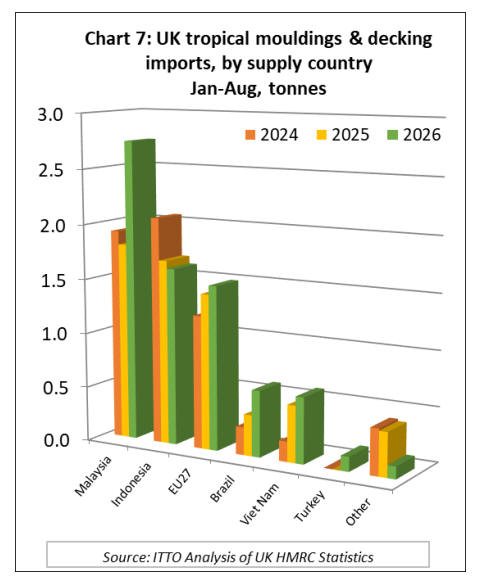
UK imports of tropical decking/mouldings from the EU27
increased 6% to 1,500 tonnes in the first eight months of
this year. The Netherlands remained the dominant EU
supplier, although its shipments declined 3% to 1,300
tonnes. Denmark supplied around 100 tonnes after
negligible trade last year. Imports from Turkey also
emerged from a zero base to reach 134 tonnes.
Awaiting detailed deforestation policy proposals
The UK government’s plans to strengthen timber due
diligence remain a source of uncertainty for tropical
suppliers. Defra’s policy paper, updated on 2 September
2026, confirms the intention to require businesses in Great
Britain with annual turnover above £1 million using wood
and other forest-risk commodities to undertake due
diligence, report on their activity and collect origin
geolocation information. These remain proposals subject
to consultation. Legislation is expected in 2027.
The government aims for commodity coverage and the
information businesses must hold to be broadly consistent
with EUDR, supporting trade between Great Britain,
Northern Ireland and the EU.
However, the proposed GB regime would initially focus
on compliance with relevant producer-country laws. A
subsequent move towards a deforestation-free standard
remains an ambition, without a specified timetable.
The legislative approach is anticipated to combine
regulations, including under the Environment Act 2021,
with legislation strengthening the existing UK Timber
Regulation. The government’s June statement promised
consultation later in 2026.
As of 21 October, no published launch of that consultation
was identified, leaving the detailed requirements and
transition arrangements unsettled.
For tropical timber suppliers, the commercial implication
is that Great Britain could retain a legality-based market-
access standard while adopting much of the origin
information burden associated with EUDR. This could
reduce the practical distinction between the two markets,
even before any change to a deforestation-free standard.
The extent of that convergence will depend on the detailed
proposals and the arrangements ultimately adopted. Some
larger UK hardwood importers are already aligning with
EUDR, particularly as they prepare for the 30 December
start to enforcement in Northern Ireland, that part of the
UK that remains inside the EU single market.
|


