|
1.
CENTRAL AND WEST AFRICA
Latest developments
The Central African timber trade remained quiet at the end
of October with economic conditions in the principal
producing countries continuing to deteriorate. Businesses
and consumers are facing increasing financial pressure
from taxation, higher operating costs and rising fuel
prices. For forestry operators, these pressures are
particularly difficult to absorb because international timber
markets remain weak and opportunities to pass additional
costs on to customers are limited.
The combination of higher production costs and very low
international demand is creating the risk that some
operators may temporarily reduce or suspend operations.
Fuel costs increasing pressure on producers
Fuel prices have become a significant concern for forestry
and transport companies. Trucks purchasing diesel directly
from filling stations are reportedly paying around
FCFA575 per litre. However, industrial operators
requiring bulk deliveries to forest concessions and
production sites are reportedly facing prices as high as
FCFA 1,200 per litre.
This substantial difference is creating serious difficulties
for forestry companies, which depend heavily on diesel for
harvesting equipment, generators and long-distance timber
transportation. If these higher industrial fuel costs continue
while timber prices remain under pressure, production
margins will become increasingly difficult to sustain.
China – major weakness in demand for Okoumé
The weakening demand in China remains the greatest
concern for producers in Gabon and the Republic of the
Congo. The Okoumé trade has fallen to an exceptionally
low level, creating serious difficulties for both harvesting
companies and processing mills. China has historically
provided one of the largest outlets for Okoumé so the
current low level of demand is having a particularly severe
impact in Gabon and southern Congo.
European demand not compensating
European demand is not strong enough to compensate for
the deterioration in the Chinese market. Purchasing
remains cautious, while producers continue to face
increasingly demanding documentation, traceability and
regulatory requirements when supplying European
destinations. As a result, Europe is currently not in a
position to absorb the volumes previously directed to
China. This is forcing producers to reconsider both
production levels and their choice of export destinations.
New export destinations
With China, Europe and the Middle East offering limited
opportunities, timber companies are accelerating their
search for alternative markets. Operators are developing
contracts in South America, while interest is also emerging
in Pacific Island destinations.
Some products are also being exported to the United States
which is beginning to provide opportunities for specialised
products rather than simply conventional sawn timber.
This diversification is becoming increasingly important for
the industry.
United States – market for timber mats
An interesting development is emerging in the US market
for heavy-duty timber mats. A Chinese-operated sawmill
in the region is currently investing in production capacity
specifically for this market. The products include large
industrial mats manufactured from heavy tropical
hardwood species such as Azobé, Okan and Dabema.
These mats are used as temporary working platforms and
access surfaces for heavy machinery, including dragline
equipment and operations associated with oilfield
development and wind-energy installations.The United
States is reportedly developing into an increasingly
important market for these products.
For producers, this represents an attractive example of
higher-value processing and market diversification at a
time when conventional tropical hardwood demand
remains weak.
The growth in demand for industrial mats demonstrates
how producers are beginning to adapt to changing
international markets. Rather than relying exclusively on
traditional sawn timber, veneer and peeling markets, mills
are increasingly exploring specialised products that make
use of the strength and durability of African hardwoods.
Species such as Azobé, Okan and Dabema are particularly
suitable for heavy industrial applications because of their
density, strength and durability. If US demand continues
to expand, this could provide an increasingly important
outlet for species that are facing weaker demand
elsewhere.
Gabon
Harvesting and log supply deteriorates as heavy
rainfall returns
Forestry operations in Gabon are facing renewed
difficulties following a further period of heavy rainfall
across the country. The brief improvement in forest access
reported earlier in October has proved temporary, with
deteriorating bush roads once again restricting the
extraction and transportation of logs.
The situation is particularly difficult in the Okondja and
Makokou regions, where operators are struggling to move
felled timber from forest concessions to sawmills. Azobé
supplies remain especially affected.
Industry contacts indicate that the renewed rainfall has
brought some extraction operations close to a standstill. In
the Makokou region, four Chinese-operated sawmills are
reportedly at risk of closure by December if log
availability and market conditions fail to improve (not yet
independently confirmed).
The difficult trading environment is consistent with
concerns raised by Gabon's government about weakening
demand in international markets, particularly Asia. In
August, the presidency held discussions with forestry
operators on measures to support recovery in the industry
and has recently provided details of the discussion in a
press release, some key points are provided below.
During the discussions, the Head of State focused
specifically on the conditions required for the sustainable
revitalisation of this strategic sector of the national
economy. Key topics included improving the business
climate, safeguarding jobs, strengthening local processing
and consumption and diversifying commercial outlets.
In this regard, the President issued instructions to settle a
significant portion of the VAT-related claims owed to
operators in the sector—totaling 20 billion CFA francs—
as part of a broader effort to clear a portion of the State’s
domestic debt. The Head of State subscribes to the adage
that "he who pays his debts, enriches himself." This
measure is intended to help the affected companies restore
their financial capacity and secure the resources
necessary to resume and expand their operations.
As a major pillar of the national economy, the forestry and
timber sector accounts for over 15,000 direct and indirect
jobs and serves as a key driver for the diversification of
the Gabonese economy. It stands as the largest private-
sector employer in Gabon. Consequently, its revitalisation
is of critical importance for economic growth, job
preservation and the development of new value chains.
See: https://presidence.ga/2026/08/10/le-president-oligui-
nguema-donne-des-orientations-pour-la-relance-de-la-filiere-
foret-bois-et-ordonne-le-reglement-de-la-dette-a-hauteur-20-
milliards-de-fcfa/
Rising diesel costs add further pressure to sawmills
Operating costs have become an increasingly serious
concern for timber producers. According to local industry
information, diesel supplied to commercial operators is
now being charged at approximately FCFA1,200 per litre.
This reported commercial rate has not been independently
verified and should not be confused with regulated retail
pump prices.
The higher costs come at a particularly difficult time, as
weak export demand limits the ability of producers to pass
additional expenditure on to customers.
See: https://gouvernement.ga/2026/10/08/communique-du-
ministere-du-petrole-et-du-gaz-relatif-a-lapprovisionnement-en-
carburant-dans-le-grand-libreville/
and
https://gabonmediatime.com/gabon-le-gouvernement-table-sur-
un-plan-strategique-pour-securiser-lapprovisionnement-en-
carburant/
CITES administration said to be creating extended
delays
Timber exporters are reporting a significant deterioration
in the processing of CITES documentation required for
certain regulated species entering European markets. In
early October, operators indicated that European CITES
approvals were generally being processed within
approximately two weeks. The latest industry information
suggests that processing times have increased to as much
as two months. If sustained, these delays could restrict
shipments, extend the period during which timber remains
in storage and increase working-capital requirements for
exporters.
Industrial production continues to face power
disruptions
Despite the return of the rains which should boost water
levels in hydroelectric reservoirs significant electricity
disruptions continue to affect Gabon's industrial
environment. The problem is compounded by weaknesses
in electricity transmission infrastructure and fuel supply
for thermal generation. Earlier in October, the national
electricity and water utility SEEG confirmed that diesel
shortages were affecting power generation resulting in
rotating power cuts in several areas.
See: https://gabonactu.com/blog/2026/10/02/penurie-de-gasoil-
la-seeg-annonce-des-perturbations-dans-la-fourniture-
delectricite-et-deau-potable/
Nkok Special Economic Zone – government clarifies
tax exemptions
Following concerns raised by investors over the
government's earlier decision to suspend certain fiscal
concessions, correspondence dated 9 October 2026 from
the Ministry of Economy and Finance, reference 7613,
reportedly provides clarification on the legal position of
exemptions established under Gabonese legislation.
According to the correspondence, fiscal and customs
advantages granted under Law No. 10/2011 and Law No.
036/2018 cannot be withdrawn, suspended or repealed
through an administrative or regulatory decision. Any
amendment to benefits established by legislation must
follow the appropriate legislative procedures.
The clarification offers some reassurance that existing
statutory benefits cannot automatically be cancelled by an
administrative announcement. However, it does not
represent a complete reversal of the government's wider
review of tax concessions. An audit of previously granted
exemptions and the associated investment commitments
remains underway. At the same time, the government's
proposed fiscal reforms include minimum taxation
requirements and a reassessment of incentives through the
legislative process.
For timber processors, the distinction between statutory
exemptions and individually negotiated concessions is
particularly important. Operators are already facing weak
international demand, rising production costs and reduced
profitability.
They point out that additional tax liabilities could further
weaken the competitiveness of Gabonese timber products
against supplies from neighbouring countries.
The clarification from the authorities will help restore
confidence among existing investors but the longer-term
position will depend on the outcome of the government's
review and any subsequent legislative changes.
See: https://journal-officiel.ga/4917-036-2018/
and
https://presidence.ga/2026/09/19/communique-final-du-conseil-
des-ministres-du-18-septembre-2026/
and
https://www.union.sonapresse.com/index.php/fr/exonerations-
fiscales-nkok-des-entreprises-veulent-des-eclaircissements
Trade outlook
The immediate outlook for Gabon's tropical timber sector
has weakened further during the second half of October.
The most significant deterioration concerns Okoumé
demand from China, where purchasing activity has
reportedly fallen sharply. At the same time, heavy rainfall
is once again restricting access to forest concessions, while
higher industrial diesel costs and continuing electricity
disruptions are reducing operating margins.
The reported increase in European CITES processing
times introduces another potential obstacle for exporters
already facing subdued international demand.
Within the Nkok Special Economic Zone, the
government's reported clarification concerning legally
established tax exemptions provides some reassurance for
existing investors. Nevertheless, the continuing review of
fiscal incentives and the prospect of future legislative
changes leave uncertainty surrounding operating costs and
investment conditions.
With limited prospects for a significant recovery in
Chinese purchasing before the end of the year, sawmills
are expected to remain cautious, concentrating production
on confirmed orders and species for which viable export
markets remain available.
Overall, the combination of weakening demand, reduced
log availability and increasing production costs is placing
further pressure on Gabon's sawmilling industry. The
sector continues to face considerable commercial and
operational challenges, with the risk of additional
temporary closures if conditions do not improve.
Cameroon
Chinese operated sawmills seek alternative export
markets
Cameroon's timber-processing industry is showing further
signs of adapting to weak demand in traditional Asian
destinations, with Chinese-operated sawmills increasingly
seeking business outside their established markets.
According to Cameroon industry contacts, Chinese
operators are now pursuing contracts in South America,
while also identifying opportunities for heavier tropical
hardwood species in major port and infrastructure
developments in Saudi Arabia and Qatar.
This development represents a further stage in the
diversification of Cameroon's export markets. Rather than
relying primarily on China and established European
buyers, producers are increasingly examining destinations
where demand for durable construction hardwoods may
provide additional opportunities. However, the extent to
which these enquiries are translating into confirmed orders
and shipments remains unclear. Competition from
alternative timber-producing regions and rising container
freight costs may also limit the commercial attractiveness
of more distant markets.
Kribi Port – timber handling facilities approaching
completion
Progress has been reported on the development of
additional timber-handling facilities at Kribi Port. Earlier
information indicated that plans were being developed to
establish a dedicated log storage area and additional
facilities for sawn timber. The latest industry reports
suggest that these works are now approaching completion.
If confirmed, this would represent an important
development for Cameroon's timber-export infrastructure,
potentially allowing a greater proportion of conventional
timber cargo to be handled through Kribi rather than
relying on Douala. The expansion of timber-handling
capacity would be particularly beneficial for producers in
southern Cameroon and northern Congo, where access to
Kribi could provide an alternative route for export
shipments.
Separately, Kribi Container Terminal has commenced an
eight-hectare expansion of its handling facilities,
representing an investment of approximately FCFA21.5
billion. The project is expected to increase container
capacity by approximately 30%, with completion currently
scheduled for the final quarter of 2027. The continued
expansion of Kribi strengthens its longer-term position as
an alternative export gateway for timber producers
operating in Cameroon and neighbouring countries.
See: https://www.investiraucameroun.com/infrastructures/0810-
23934-port-de-kribi-21-5-milliards-de-fcfa-pour-accroitre-de-30-
les-capacites-du-terminal-a-conteneurs
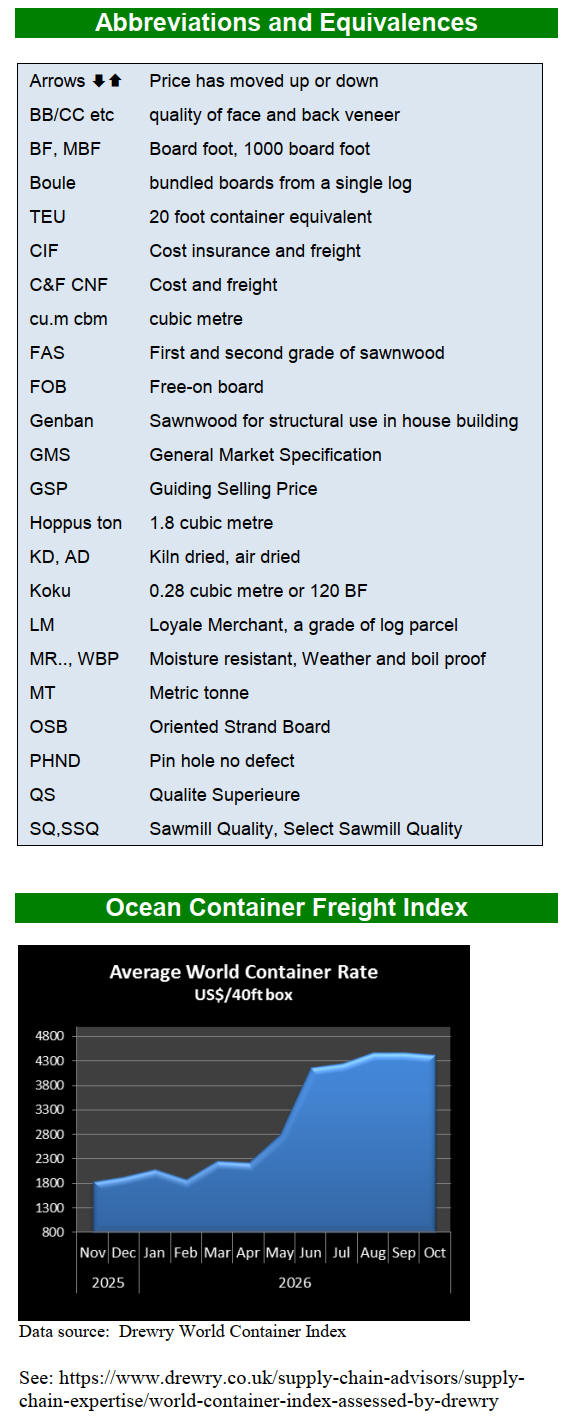
International container freight costs increase further
International shipping costs are becoming an increasingly
important concern for timber exporters. The latest industry
information indicates that freight charges have risen
considerably on routes serving Europe, Asia and the
Middle East, adding further pressure to export
competitiveness.
The increase is particularly problematic for lower-value
sawn timber where transport costs represent a significant
proportion of the delivered price.
With international buyers remaining cautious, exporters
have limited scope to recover higher shipping costs
through increased selling prices.
Recent announcements by major container carriers provide
further evidence of increasing freight-related charges on
African trade routes. CMA CGM announced that its peak
season surcharge on shipments from China to Cameroon
and other southern West African destinations would
increase from US$400 to US$550 per twenty-foot
equivalent unit, effective 22 October 2026 for relevant
short-term contracts.
Hapag-Lloyd has also announced a surcharge of US$800
per twenty-foot equivalent unit for shipments from Asia
and Oceania to several Southwest African destinations,
including Douala and Kribi, applicable from 25 October
2026.
For producers already facing weak demand and restricted
operating margins, sustained high freight costs could make
certain export destinations increasingly difficult to serve
profitably.
See: https://monitor.cma-cgm.com/news/5629/pss-from-china-to-
west-africa
and
https://www.hapag-lloyd.com/de/services-
information/news/2026/10/shipping-from-asia-and-oceania-to-
southwest-africa--a-pss-update.html
Government plans further restrictions on log exports
A further development has emerged concerning
Cameroon's policy of restricting unprocessed timber
exports. In a circular issued on 12 October concerning
preparation of the 2027 national budget, President Paul
Biya instructed the government to continue expanding the
list of timber species prohibited from export in log form.
Cameroon already restricts the export of 91 timber species,
following an April 2026 decision which added another 15
species to the previous list of 76.
A further 23 species classified as promotion species
remain eligible for export as unprocessed logs, subject to
additional export taxation. The latest instruction indicates
the government's continued intention to encourage greater
domestic processing before timber is exported. However,
no details have yet been provided regarding the additional
species that may be affected, the number to be included or
the timetable for implementation.
The proposed expansion could have important
consequences for operators whose existing export business
depends on species that remain eligible for shipment as
logs. While the policy is intended to strengthen domestic
timber processing and encourage investment in sawmills
and secondary transformation, the immediate commercial
environment remains difficult.
Restrictions on additional log exports may increase the
requirement for local processing capacity at a time when
many producers are already operating below full
production levels because of weak international demand.
The effect on export volumes, investment and government
revenue will therefore depend on both the scope of any
future restrictions and the ability of domestic processors to
secure additional orders.
See: https://www.businessincameroon.com/public-
management/1310-16967-cameroon-plans-more-log-export-
bans-after-restricting-91-timber-species
Cameroon and Viet Nam strengthen cooperation on
legal timber trade
According to information published by TRAFFIC,
representatives from Cameroon's Ministry of Forestry and
Wildlife met their Vietnamese counterparts in Hanoi to
strengthen cooperation on the legal and sustainable timber
trade. Discussions included the development of a bilateral
memorandum of understanding designed to improve
information sharing, timber legality verification and
cooperation against illegal timber trafficking.
For Cameroonian producers, closer cooperation between
the authorities in the country of origin and the country of
destination could lead to more consistent documentation
and traceability requirements. The proposed arrangement
could also help legitimate exporters demonstrate the
legality of their timber supplies, particularly as
international scrutiny of tropical timber sourcing continues
to increase.
See: https://www.traffic.org/news/traffic-brings-cameroon-and-
viet-nam-together-to-build-a-shared-approach-to-legal-timber-
trade/
Trade outlook
The latest developments suggest that Cameroon's timber
sector is increasingly concentrating on market
diversification and improvements in export infrastructure
rather than expecting a rapid recovery in traditional
destinations.
Chinese-operated sawmills are examining opportunities in
South America and major Middle Eastern infrastructure
projects, reflecting the need to secure additional orders
outside the established Asian market. At the same time,
reported progress in timber-handling facilities at Kribi
could provide greater logistical flexibility, although the
status of these facilities requires confirmation.
The outlook is complicated by increasing international
freight costs, which may offset some of the commercial
benefits associated with entering new export markets.
Government plans to expand restrictions on raw log
exports introduce another consideration for producers,
particularly those dependent on species that may become
subject to additional controls.
Closer cooperation with Vietnam on timber legality
provides a potentially positive development for longer-
term trade relations but will require practical
implementation before its commercial benefits become
clear.
Overall, the end-of-October picture is one of continued
market weakness accompanied by a more active search for
alternative export destinations. Kribi's infrastructure
development and potential new business in South America
and the Middle East offer opportunities but higher freight
costs and further regulatory restrictions remain important
challenges for Cameroon's timber industry.
Republic of the Congo
Harvesting declines as international demand weakens
Forestry activity in the Republic of the Congo slowed
further during the second half of October, with
information from local forestry sources indicating that
harvesting volumes have fallen by approximately 30%.
This represents a significant change from the relatively
stable operating levels reported earlier in the month, when
producers were maintaining harvesting activities despite
subdued demand from international markets.
The combination of reduced international purchasing and
deteriorating forest accessibility is increasing pressure on
sawmills, particularly those dependent on regular log
deliveries from remote concessions.
Government approves plan for new timber export
control agency
An important regulatory development emerged following
the Congolese Council of Ministers meeting on 14
October 2026. The government approved a draft law
establishing a new agency responsible for controlling the
import and export of forest products.
The proposed ‘Agence de contrôle des produits forestiers à
l'exportation et à l'importation’ (ACPFEI) would replace
the existing forestry export-control service, which was
established under the country's earlier forestry legislation.
The government considers the existing arrangements
insufficient to meet the requirements introduced under the
2020 Forestry Code, particularly regarding timber legality,
traceability, sustainable forest management and
restrictions on unprocessed log exports. The new agency is
intended to strengthen oversight of timber movements and
improve compliance with national forestry legislation and
international forest governance commitments.
For timber operators, the proposed reforms could lead to
closer examination of export documentation, product
classification and the legal origin of timber presented for
shipment. The changes may be particularly important for
exporters operating under special authorisations to ship
unprocessed logs, as the government continues to
emphasise its policy of encouraging domestic timber
transformation.
The draft law must still be examined and adopted by
Parliament before the new agency can be formally
established. Consequently, no immediate change in export
procedures has yet been confirmed. Nevertheless, the
proposal represents a significant indication of the
government's intention to strengthen control over the
international timber trade.
See: https://www.aci.cg/compte-rendu-du-conseil-des-ministres-
du-mercredi-14-octobre-2026/
New forestry concession rules strengthen government
oversight
At the Council of Ministers meeting mentioned above, the
government adopted a decree establishing revised
requirements for the allocation and management of
forestry concessions and operating permits.
The decree is intended to implement provisions of the
2020 Forestry Code by introducing more formal
procedures for awarding forestry agreements and assessing
the financial, technical and environmental capabilities of
applicants.
Under the arrangements outlined by the government,
forestry concessions are to be awarded through publicly
advertised competitive procedures. Applicants will
generally have three months to submit their proposals,
which will then be examined by a forestry commission
chaired by the minister responsible for forests. The
requirements also place greater emphasis on forest
management plans, environmental protection, sustainable
harvesting and contributions to local community
development.
For existing operators and companies considering new
forestry investments, the changes could increase the
importance of demonstrating financial capacity,
operational compliance and long-term commitments to
responsible forest management.
The revised arrangements may also influence how new
forestry areas are allocated and how agreements are
renewed or renegotiated. Although the measures are
intended to improve transparency and strengthen forest
governance, their practical effect will depend on how
consistently the new requirements are implemented and
whether administrative procedures can operate without
creating additional delays for legitimate businesses.
See: https://www.aci.cg/compte-rendu-du-conseil-des-ministres-
du-mercredi-14-octobre-2026/
Continued log exports attract scrutiny
The proposed creation of the new forestry export-control
agency has renewed attention to the continued shipment of
unprocessed logs from Congo. Although the government
introduced a prohibition on raw log exports from January
2023, shipments have continued under existing
authorisation arrangements and other provisions applied
by the forestry authorities.
Official export statistics for 2025 indicate that
approximately 445,718 cubic metres of unprocessed logs
were exported, representing 58% of the country's recorded
timber export volume. This highlights the continuing
importance of raw log exports despite the government's
objective of increasing domestic timber processing.
The issue attracted further attention on 19 October when
the Congolese civil society organisation ‘Centre d'Actions
pour le Développement’ welcomed the proposed creation
of the new agency but called for the existing restrictions
on raw log exports to be enforced arguing that establishing
another administrative body should not become a reason to
postpone the implementation of forestry legislation
already in force.
For timber companies, the distinction between the official
restrictions and the authorisations currently permitting
some exports remains commercially important.
A significant tightening of enforcement could affect
operators supplying raw logs to Asian markets,
particularly those whose existing business models depend
on exports through Douala or Pointe-Noire. Conversely,
greater emphasis on domestic processing could provide
additional opportunities for sawmills and timber
transformation businesses, provided sufficient investment
and international demand are available.
The situation will require careful observation as the new
legislation progresses and the government clarifies its
approach to existing export authorisations.
See: https://www.cad-cg.org/principal/interdiction-dexportation-
de-grumes-une-reforme-a-saluer-mais-la-loi-doit-sappliquer-
sans-attendre/
and
https://fliphtml5.com/ccdte/Bulletin-Statistique-2025_IA/
Trade outlook
The outlook for the Republic of the Congo's timber
industry bacame more challenging during the second half
of October. The most significant immediate development
is the reported 30% reduction in harvesting activity,
reflecting the combined effects of weakening international
demand and increasingly difficult operating conditions
during the rainy season.
At the same time, the government is moving towards
tighter regulation of forestry concessions and greater
control over timber exports. The proposed creation of a
new import/export control agency, together with revised
forestry concession requirements, could represent an
important change in how timber production and
international trade are administered.
However, greater regulatory oversight is emerging at a
difficult time for the industry, when many producers are
already struggling with subdued purchasing, high
operating costs and limited opportunities to increase
production.
The continuation of raw log exports despite existing
restrictions is likely to remain an important issue,
particularly as the government seeks to encourage
domestic transformation and increase the value generated
from its forest resources.
Overall, Congo's timber industry is facing a difficult
commercial environment, with falling harvesting activity
now accompanied by the prospect of tighter forestry
regulation. The immediate priority for producers remains
securing sufficient export orders while maintaining
operating capacity, with future investment increasingly
dependent on predictable forestry rules and improved
international market conditions.
2.
GHANA
Galamsey fight – military to stay in forests reserves
President John Dramani Mahama has instructed that
soldiers remain stationed in those forest reserves once
cleared of illegal mining to prevent operators from
returning to the sites.
‘Galamsey’ is illegal, small-scale gold mining in Ghana, a
term derived from the phrase "gather them and sell"
The decision was to ensure all nine forest reserves
previously cleared of illegal mining operators and
classified as red zones will now have the military stationed
there to protect the areas. He said previous attempts to
clear some forest reserves had failed because illegal
miners returned shortly after soldiers withdrew and forest
guards resumed responsibility for protecting the areas.
President Mahama has called on Chiefs to back
government's anti-galamsey efforts, especially where
youth and some traditional leaders resisted operations of
the National Inter-Ministerial Coordinating Committee on
Illegal Mining (NAIMOS operations). He tasked the local
Chiefs as custodians of the communities to curb illegal
mining to protect the country’s forests and water bodies.
President commended Ghana Gold Board plan to partner
with the military to reclaim degraded mining lands using
bulldozers and replant economic trees. He said the
Forestry Commission will collaborate with the military on
levelling, reclamation and reforestation to restore degraded
areas.
The President also announced that the Finance Minister
had provided GH¢400 million in the 2027 Budget to
intensify efforts to eliminate illegal mining activities,
stressing that the government’s response must go beyond
enforcement to addressing the economic circumstances
pushing young people into illegal mining.
See: https://www.citinewsroom.com/2026/10/galamsey-soldiers-
to-remain-in-nine-cleared-forest-reserves-mahama/
and
https://goldbod.gov.gh/news/president-mahama-commends-
goldbod-for-engaging-ghana-armed-forces-to-reclaim-253-acres-
of-tano-nimri-forest
Primary product export decline
Ghana exported a total of about 116,355 cu.m of wood
products between January and July 2026 according to data
from the Research and Statistic unit of the Timber Industry
Development Division (TIDD) of the Forestry
Commission (FC).
The figure was composed of primary products (6),
secondary wood products (9) and tertiary wood products
(4).
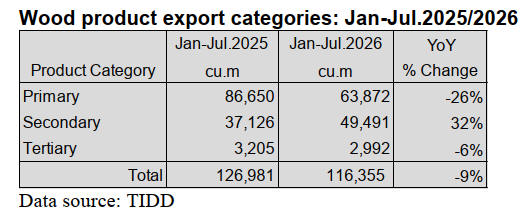
The above analysis shows that for the period January to
July 2026 there were declines in the volumes of the
primary (-26%) and tertiary (-8%) wood products
categories except the secondary wood product (+32%)
during the quarter under review when compared to the
same period in 2025.
Primary products such as AD sawnwood, billets, kindling
and AD boules decreased. However, pole exports recorded
a 31% increase in volume in the first 7 months compared
to the same period in 2025. These declines contributed to
the sharp drop in exports from 86,650cu.m, valued at
Eur32.48 million in 2025 to 63,872cu.m valued at
Eur21.18 million 2026.
Secondary wood products, which included plywood to the
neighbouring countries (Togo, Burkina Faso and Bennin)
topped the list, increasing by 32% as compared to the
previous year’s figure to achieve a volume of 12,623 cu.m.
Overseas plywood export also increased to 13,263 cu.m. in
2026 while briquettes and KD boule exports also recorded
increased volumes. Exports of this category of products
were valued at Eur27.01 million, representing 53% of total
export value (Eur50.95 million) to become the highest
foreign exchange earner contributing over half of all wood
export revenue.
Of the tertiary wood products, there were no exports of
furniture parts or flooring in the previous year but this year
some small volumes were reported. Notwithstanding, the
overall total export volume dropped from 3,205cu.m
(Eur2.89 million) in 2025 to 2,992cu.m. (Eur2.78 million)
in 2026.
The TIDD report revealed that Ghana is moving away
from exporting raw/low-processed wood, as primary
products. Major destinations for primary products were
India and Vietnam. Secondary and tertiary wood products
were shipped to Italy, Germany, Belgium, United
Kingdom and the US.
ISSER calls on government to focus on manufacturing
for economic growth
The Institute of Statistical, Social and Economic Research
(ISSER), has called for the government to put
manufacturing, agriculture productivity and better
financing options for the private sector at the centre of
economic policy if growth is to improve jobs and living
standards. The Director of ISSER, Professor Robert Darko
Osei, said Ghana must focus on economic growth that
generates employment and delivers tangible benefits to
households.
Speaking at the launch of the 2025 State of the Ghanaian
Economy Report at the University of Ghana, he noted that
stronger and well-directed growth could translate faster
into higher incomes and more economic opportunities for
Ghanaians.
See: https://thebftonline.com/article/turn-economic-stability-into-
jobs-and-industrial-growth-isser
and
https://www.citinewsroom.com/2026/10/ghana-reference-rate-
falls-to-10-04-set-to-ease-borrowing-costs/
Ghana re-establishes ECOWAS National Office to
boost regional integration
Ghana has re-established its ECOWAS National Office
within the Ministry of Foreign Affairs in line with
Community Regulation C/REG.11/21 and Article 6.1 of
the ECOWAS Operational Manual.
Speaking at the inauguration of the ECOWAS Community
Levy and Finance Committee in Accra, the Chief Director
of the Ministry, Ambassador Khadija Iddrisu, said the
move will help Ghana meet its ECOWAS obligations and
improve coordination of regional integration programmes.
The Head of the Office, Ahmed Abubakari Tijani,
expressed confidence in his team, adding that two more
committees will be inaugurated to deepen Ghana’s
engagement with ECOWAS. He said the office will
address longstanding gaps in coordinating regional
integration activities, as part of broader efforts to
strengthen Ghana’s institutional framework for
implementing ECOWAS programmes.
Ghana is the Secretariat for the African Continental Free
Trade Area (AfCFTA), providing a platform for
negotiating trade protocols across 54 African nations to a
market of 1.4 billion people with 400 million ECOWAS
single market.
See: https://www.citinewsroom.com/2026/10/ghana-re-
establishes-ecowas-national-office-to-boost-regional-integration/
and
https://www.imf.org/external/datamapper/NGDPD@WEO/GHA
3. MALAYSIA
Logging companies required to restore forest
Deputy Natural Resources and Environmental
Sustainability Minister, Syed Ibrahim Syed Noh, said the
government requires logging companies to provide bonds
or deposits to ensure they fulfil their obligations to restore
licensed forest areas. This measure is intended to ensure
compliance with forest conservation requirements.
On the selection of tree species, the Deputy Minister said
replanting is carried out based on the suitability of the
forest ecosystem with the involvement of local
communities, including the Orang Asli.
Among the high-value forest tree species planted are
kapur, merawan kancing, kelat, tembusu and merbau. Syed
Ibrahim said forest restoration initiatives had also helped
improve the livelihoods of Orang Asli communities by
creating employment and income-generating
opportunities.
In Pahang, there is a buy-back guarantee scheme for
seedlings involving Orang Asli and communities in Tasik
Chini, Cameron Highlands, Janda Baik, Pekan and
Rompin.
See:
https://theborneopost.pressreader.com/article/281646787100905
PEFC trademark rules update
The Malaysian Timber Certification Council (MTCC) has
informed stakeholders of recent updates from PEFC
International concerning the PEFC Trademarks Rules.
New requirements under the EU Empowering Consumers
for the Green Transition Directive (EmpCo) strengthen the
rules governing environmental claims and sustainability
labels. Environmental claims are required to be specific
and substantiated, while sustainability labels must meet
defined requirements.
In response, PEFC has updated its Trademarks Rules and
is introducing additional guidance and resources to support
PEFC-related communications that are clear, specific and
closely aligned with what can be substantiated.
For Malaysian organisations using PEFC trademarks in
communications relating to the EU market, the changes
may require close attention on how environmental claims,
labels and sustainability messages are presented. Relevant
claims and marketing materials should remain clear,
verifiable and consistent with the updated PEFC
Trademarks Rules.
See: https://pefc.org/news/amended-pefc-trademarks-rules-
published-to-align-with-empco
and
https://mtcc.com.my/announcements-pefc-trademarks-rules-
update-and-upcoming-webinars-on-empco-and-eudr/
Trade pact with EU
It is reported that Johari Abdul Ghani, Investment, Trade
and Industry Minister, said negotiations between Malaysia
and the European Union on a free trade agreement will
likely be finalised by June next year as there are still “a
few unresolved issues” requiring further discussion.
The Malaysia-EU Free Trade Agreement (MEUFTA) is a
proposed trade pact between Malaysia and the EU’s 27
member states, designed to streamline trade, investment
and market access for businesses on both sides.
See: https://www.thestar.com.my/news/nation/2026/10/14/june-
target-to-seal-free-trade-pact
Trade surplus doubles
Malaysia’s total trade rose 30% year-on-year to RM2.91
trillion in the first nine months of 2026, with exports,
imports and the trade surplus all recording their highest
levels. The Ministry of Investment, Trade and Industry
(MITI) said exports increased 34% to RM1.571 trillion,
while imports grew 26%t to RM1.339 trillion. The trade
surplus more than doubled compared with the
corresponding period last year.
MITI said export growth in the first nine months was
supported by broad-based gains in the manufacturing and
mining sectors, both of which recorded double-digit
growth. Electrical and electronic (E&E) products remained
a key contributor, with exports increasing by almost
RM254 billion amid sustained global semiconductor
demand, rising investment in artificial intelligence (AI)
and wider adoption of digital technologies.
See:
https://theborneopost.pressreader.com/article/282243787573554
Carbon projects can deliver incentives for
conservation
Sarawak has issued two new Forest Carbon Licences
(FCL) covering a total area of 31,141.2 hectares in
Tanjung Manis, Kuala Rajang and Ulu Baram as part of
efforts to strengthen forest conservation and the state’s
green economy development. To date, 11 entities have
received approval to carry out forest carbon activities in
Sarawak, covering a total area of 278,280 hectares, with
three entities holding Forest Carbon Licences involving a
combined area of 56,816.2 hectares.
Forest carbon projects could provide additional incentives
for forest conservation and restoration, protect biodiversity
and ecosystem services, attract green investment and
create opportunities for local communities. He said the
issuance of the licences allows the holders to develop and
implement their approved projects, subject to the relevant
legal and regulatory requirements.
However, licences do not automatically entitle the projects
to issue or trade carbon credits, as they must first meet the
stipulated carbon standards, including undergoing
validation and verification by recognised validation and
verification bodies.
See:
https://theborneopost.pressreader.com/article/281612427372134
Maximising the value of biomass resources
With increasing global emphasis on decarbonisation and
the circular economy, researchers and industries are
exploring innovative bio-refinery technologies that
maximise the value of biomass resources while
minimising waste.
Bamboo has emerged as a promising feedstock, capable of
supporting the production of renewable solid, liquid and
gaseous fuels as well as carbon based materials and other
high value products. Its unique characteristics position
bamboo as a strategic resource for driving sustainable
development, enhancing resource efficiency and
contributing to a low-carbon future.
See:
https://theborneopost.pressreader.com/article/281904485153000
4.
INDONESIA
A stronger furniture and
craft sector will boost value
The Industry Minister, Muhammad Sarmuji, has called for
stronger support and protection for Indonesia’s furniture
and handicraft industry, particularly rattan-based
businesses to increase the added value of natural resources
and improve global competitiveness.
He noted that Indonesia supplies approximately 85% of
the world’s raw rattan, giving the country a significant
comparative advantage. He stressed that this resource
potential should be leveraged to develop domestic
processing industries, enabling Indonesia to move beyond
exporting raw materials and become a producer of high-
value furniture and handicraft products.
Indonesian Furniture Industry and Craft Association
(HIMKI) Chairman Abdul Sobur emphasised the need for
integrated government policies to develop the rattan
industry through stronger manufacturing capabilities,
design, branding and international market access.
The furniture and handicraft sectors play an important role
in supporting local resource-based businesses, micro,
small and medium enterprises (MSMEs), artisans and
employment, he said.
See: https://en.antaranews.com/amp/news/436117/minister-
seeks-stronger-furniture-craft-industry-to-boost-value
Rupiah weakness a concern for furniture industries
dependent on imports
The weakening of the rupiah against the US dollar is
increasing cost pressures on Indonesia’s furniture and
handicraft industry, particularly for businesses that rely on
imported raw materials, components and machinery.
Indonesian Furniture Industry and Craft Association
(HIMKI) Chairman, Abdul Sobur, said the impact varies
depending on each company’s import dependence,
inventory, purchasing contracts and ability to manage
foreign exchange risks. Higher import costs can squeeze
profit margins when selling prices have already been
agreed upon with buyers, especially for products requiring
imported furniture hardware, finishing materials,
adhesives and production equipment.
However, the rupiah depreciation may benefit exporters
whose US dollar earnings exceed their dollar-denominated
expenses, particularly companies that use a high
proportion of locally sourced materials.
To maintain profitability, businesses should reassess costs
for each order, improve production efficiency and reduce
reliance on imported inputs. In the medium term,
expanding the use of sustainably supplied domestic raw
materials could help minimise exposure to exchange rate
volatility, strengthen local supply chains and improve the
furniture industry’s resilience and competitiveness.
In related news, the Indonesian Furniture Industry and
Craft Association (HIMKI) is seeking to expand
Indonesia’s furniture and handicraft exports to the United
States by improving product competitiveness,
strengthening long-term trade relationships and enhancing
logistics efficiency.
HIMKI Chairman, Abdul Sobur, said the US remains a
strategic market but greater market penetration depends on
consistent product quality, attractive designs, reliable
deliveries, compliance with market regulations and
competitive logistics costs.
He emphasised that stronger supply chains, improved
trade connectivity, predictable costs and timely shipments
are essential to making Indonesian products more
competitive internationally.
The HIMKI is encouraging the furniture and handicraft
industry to improve design capabilities, adopt more
advanced technologies and use responsibly sourced raw
materials. The Association is also seeking to strengthen
the capacity of micro, small and medium-sized enterprises
(MSMEs) to help them compete more effectively in
international markets, particularly in the United States.
See:
https://money.kompas.com/read/2026/10/19/130403426/rupiah-
melemah-pengusaha-mebel-dampaknya-terasa-jika-bahan-baku-
masih-impor.
and
berita/5804797/himki-pacu-pasar-industri-kerajinan-ri-ke-as-
lewat-efisiensi-logistik
and
See: https://investor.id/business/459071/himki-bidik-pasar-as-
efisiensi-logistik-jadi-kunci
Calls to strengthen research and innovation in the
furniture and craft industries
HIMKI has partnered with Universiti Teknologi MARA
(UiTM) Malaysia to strengthen research, innovation and
talent development to improve the competitiveness of the
furniture and handicraft industry. Formalised through a
memorandum of understanding (MoU) signed at Trade
Expo Indonesia 2026 in Tangerang on 15 October, the
partnership aims to connect academic expertise with
industry needs, particularly in value-added product
development, design innovation, technological
advancement and workforce competency improvement.
Potential initiatives include applied research, training,
student internships, industrial visits and joint research and
development in materials, production processes, design,
circular economy, sustainability, digital technology and
market development.
See:
https://money.kompas.com/read/2026/10/16/094540026/himki-
buka-kolaborasi-kembangkan-industri-mebel-indonesia-
malaysia.
Trade deals to boost exports
Indonesia is targeting approximately US$15 billion in
additional exports through three international trade
agreements: the Indonesia-European Union CEPA,
Indonesia-Canada CEPA and Indonesia-Eurasian
Economic Union FTA.
Coordinating Minister for Economic Affairs, Airlangga
Hartarto, estimates that the Agreements could generate up
to US$10 billion in additional exports to the EU, US$1.6
billion to Canada and US$2-3 billion to the EU by
expanding market access, reducing or eliminating tariffs
and improving trade reliability.
The government has identified export opportunities in
commodities including palm oil and its derivatives, motor
vehicles, coffee, cocoa, rubber products, iron and steel,
wood products, fishery products, chemicals, minerals,
machinery, electronics, footwear and handicrafts. It plans
to prioritise products with strong domestic production
capacity and significant demand in target markets to
maximise the benefits of these Agreements and strengthen
Indonesia’s export performance.
See: https://www.cnbcindonesia.com/news/20261014074904-4-
775911/ri-bidik-tambahan-ekspor-us-154-miliar-dari-3-
perjanjian-dagang/amp
Boosting investment through Multi-Business models
The Association of Indonesian Forest Concession Holders
(APHI) is promoting multi-business forestry (MUK) to
expand investment and export opportunities by optimising
timber, non-timber forest products and environmental
services. APHI emphasised that policy support, incentives
and business certainty are essential to encouraging holders
of Forest Utilization Business Licenses (PBPH) to
integrate MUK into their core operations.
Through collaboration with various stakeholders,
including the Kadin Regenerative Forestry Business
(Kadin RFB) programme, APHI is facilitating knowledge-
sharing, dialogue, business-matching meetings and pilot
projects to identify potential commodities, market
opportunities and partnerships across the forestry value
chain.
APHI identified five key prerequisites for successful MUK
implementation: policy discretion, regulatory flexibility,
recognition and appreciation, policy incentives and
government facilitation.
Addressing these requirements is expected to increase the
economic value of forest resources, boost forest-product
exports, create employment opportunities and improve
incomes for communities around forest areas while
maintaining ecological sustainability.
See: https://forestinsights.id/aphi-dorong-investasi-dan-ekspor-
melalui-multiusaha-kehutanan/
Companies sanctioned over forest fires
Indonesia’s Forestry Ministry has imposed administrative
sanctions on 32 companies linked to forest and land fires
that burned 12,926.74 hectares across seven provinces.
The measures include suspending permits for 19
companies, which must restore forest ecosystems across
9,546.42 hectares of burned land; requiring eight other
entities to restore 2,211.19 hectares and revoking the
permits of the remaining five companies.
See: https://en.antaranews.com/news/436581/indonesia-
sanctions-32-companies-for-forest-fires
5.
MYANMAR
Review of teak plantations
Recent official inspections in Mandalay Region reviewed
229 acres of young commercial teak plantations
established in 2024 and 2026, together with a 21-acre seed
production area. While the inspections reflect continued
efforts toward plantation development, the commercial
potential of these young stands remains dependent on
survival rates, stocking density, growth performance,
silvicultural management, and rotation planning.
Detailed performance data have not yet been publicly
verified, making it premature to assess their future
contribution to industrial timber supply. Private plantation
development also faces challenges involving regulatory
procedures, investment conditions, timber traceability and
access to international markets.
International sanctions targeting the state-owned Myanma
Timber Enterprise (MTE) continue to restrict Myanmar
timber trade with major western markets. Timber
originating from independently operated private
plantations is not automatically subject to the same entity-
based sanctions, although individual transactions remain
subject to applicable sanctions rules, ownership checks
and other regulatory requirements.
In practice, private-sector exporters continue to face
difficulties, not only in the area of market penetration for
the products from the plantation forest but also in
demonstrating independently verifiable supply-chain
documentation.
Timber legality, traceability, Chain of Custody (CoC) and
buyer due diligence requirements remain important
considerations for international trade.
See- https://www.myanmaritv.com/news/greening-activities-
deputy-minister-makes-inspections-yamethin-and-
meiktila?utm_source
Macroeconomic pressures and overseas inward
remittance flows
Myanmar's economic environment remains fragile amid
persistent financial and operational challenges. According
to World Bank assessments, the economy contracted by
approximately 2% in FY2025/26, while year-on-year
inflation reached 24.6% in April 2026. Although growth
of 2% is projected for FY2026/27, ongoing conflict,
electricity shortages, rising fuel costs and weak household
purchasing power continue to constrain economic activity.
Migrant worker remittances remain an important source of
foreign exchange and household income. Bloomberg
reported inflows of approximately US$5.6 billion in 2025,
while official statements indicate similarly substantial
volumes in 2026.
Under Notification No. 108/2024, overseas workers are
required to remit at least 25% of their earnings through
official channels. However, substantial remittance inflows
do not necessarily translate into readily available foreign
exchange for commercial banks and importers, leaving
persistent pressures on Myanmar's financial system.
See- : https://www.worldbank.org/en/publication/macro-
poverty-outlook,
and
https://www.worldbank.org/en/country/myanmar/publicati
on/myanmar-economic-monitor
UNDP reports forest loss near Yangon
A recent UNDP satellite-based assessment reports
substantial forest-cover loss in the northern Yangon
Region, particularly in Hlegu, Taikkyi, and Hmawbi
townships. The study indicates that approximately 464
square kilometres of forest cover, representing 87% of the
assessed baseline, have been lost since 2000.
The annual rate of forest loss reportedly tripled after 2021
compared with the preceding two decades. Identified
pressures include agricultural expansion, settlement
development, and fuelwood demand. The assessment also
reports localized temperature increases of up to 1.7°C and
growing concerns over water security.
The findings highlight mounting pressures on forest
resources and the importance of forest monitoring, land-
use management, and effective forest governance.
See- https://myanmar.un.org/en/324021-yangon-expands-
its-forests-are-disappearing?utm_source
6.
INDIA
New Zealand eliminates import tariffs on
Indian
merchandise exports
The India–New Zealand Free Trade Agreement (FTA)
entered into force on 20 October 2026. Under the deal
New Zealand eliminated 100% of import tariffs on all
Indian merchandise exports. India offered tariff reductions
or elimination on 95% of New Zealand's exports
(immediate duty-free access for 57% of exports including
sheep meat, wool, coal and most forest products) rising to
over 82% over time.
The deal removes a 5% tariff on logs and pulp and the
10% tariff on processed wood products. This is expected
to generate over NZ$10 million annually in immediate
cost savings and new revenue streams. Tariffs on almost
all remaining wood trade will be completely phased out
over the next seven years.
Indian Customs are required to release imported goods
within 48 hours of arrival, dramatically improving supply
chain efficiency. Industry bodies point out that gaining a
stronger foothold in one of the world's fastest-growing
economies will help New Zealand diversify its market
dependency, which has heavily leaned toward China in
recent years, according to Wood Central.
New Zealand's private sector has pledged US$20 billion in
investment into India over the next 15 years. According to
the Wood Processors and Manufacturers Association of
New Zealand (WPMA) and industry representatives, the
Agreement delivers immediate and long-term financial
opportunities.
See: https://www.mfat.govt.nz/assets/Trade-agreements/NZ-
India-FTA/New-Zealand-India-Free-Trade-Agreement-
Summary.pdf
India/US trade agreement close
India and the United States have been negotiating a
bilateral trade arrangement aimed at expanding market
access and addressing longstanding differences over
tariffs, agricultural products, industrial goods and
regulatory barriers.
A trade agreement between India and the United States
which has been under negotiation for more than a year and
a half is “pretty close“ to conclusion and the US President
indicated the final arrangement between the two nations
could differ significantly from any earlier trade
Agreements.
The US Secretary of State, Marco Rubio, recently visited
India and held discussions with Foreign Minister, S.
Jaishankar, on further strengthening bilateral relations
focusing on sectors such as trade, energy, technology,
defence and people-to-people ties.
For India, the negotiations carry implications for major
export sectors, including pharmaceuticals, engineering
goods, textiles, electronics and information technology-
related services.
American companies have also sought greater
opportunities in India’s expanding consumer market and
manufacturing sectors.
See: https://economictimes.indiatimes.com/news/short-
videos/india-us-trade-deal-pretty-close-will-be-very-different-
from-earlier-pacts-trump/videoshow/135087626.cms?from=mdr
Jodhpur’s exporters ‘Furniture Express’
Exporters in Rajasthan are benefitting from a ‘Furniture
Express‘, a dedicated rail service for handicraft and
furniture export transport. Reports state the freight service
connecting Jodhpur to Mundra Port has moved over 2,100
containers as of september.
This initiative plays an important role in providing more
accessible, reliable and competitive export logistics
facilities, particularly for Jodhpur’s furniture, handicraft,
guar gum and other export industries.
This helps Jodhpur-based wooden furniture exporters
minimise delays caused by container shortages and reduce
additional logistical costs. The availability of empty
containers at Jodhpur and the subsequent movement of
loaded containers to Mundra Port via regular rail services
provide exporters with integrated logistics solutions.
The “Furniture Express” was launched on in February this
year by the State government-owned enterprise, Rajasthan
Small Industries Corporation Limited (RAJSICO) in
collaboration with Doon Logistics Limited.
This service is being operated in collaboration with major
shipping partners and enables Jodhpur-based exporters to
access a wide range of shipping options and provides them
with greater flexibility regarding container availability.
See: https://www.business-standard.com/industry/news/jodhpur-
s-export-logistics-gains-speed-with-furniture-express-
126092100872_1.html
Surge in domestic log prices
Log prices in the southern region of the country have
jumped notably over the last couple of months according
to Plyreporter. The surge in prices is reportedly due to
limited availability during the monsoon season and this
has impacted plywood manufacturers in the State of
Karnataka and Kerala.
Commenting on the rise in the log prices a plywood
factory owner is reported as saying, the price of rubber
wood and silver oak has increased by 10% and 20%
respectively and prices for other logs has jumped by 15-
20% in Perumbavoor, Kannur and also in Karnataka. The
disruptoig to log supplies is a feature of the monsoon
season but high log costs combined with the rise in other
production inputs could drive manufacturers to source
alternative species such as Melia dubia from neighbouring
states or imported logs.
See: https://www.plyreporter.com/article/154383/timber-prices-
rise-in-southern-india-takes-its-toll-on-panel-sector
7.
VIETNAM
According to statistics from the
Customs Department the
exports of wood and wood products in September 2026
will reach US$1.5 billion, down 5% compared to August
2026 but up 9.5% compared to September 2025. In the
first 9 months of 2026, exports of wood and wood
products could reach US$13.43 billion, up 6% over the
same period in 2025 of which exports of wood products
could reach US$8.6 billion, up 1% over the same period in
2025.
Exports of living and dining room furniture in September
2026 totalled US231.0 million, up 16% compared to
September 2025. In the first 9 months of 2026, exports of
living and dining room furniture is estimated at US$1.9
billion, down 0.2% over the same period in 2025.
Imports of raw wood (logs and sawnwood) from the
European Union in September 2026 are estimated at
85,000 cu.m, with a value of US$25.7 million, down 6%
in volume and 3% in value compared to August 2026 but
up 10% in volume and 14% in value over the same period
in 2025. In the first 9 months of 2026, imports of raw
wood from the EU are estimated at 786,800 cu.m, with a
value of US$237.8 million, up 12% in volume and 14% in
value over the same period in 2025.
According to preliminary statistics, exports of wood and
wood products to the EU in September 2026 will reach
US$70.3 million, down 6% compared to August 2026 but
up 36% compared to September 2025. In the first 9
months of 2026, exports of wood and wood products to the
EU may reach US$689 million, up 54% over the same
period in 2025.
According to statistics from the Customs Department,
exports of wood and wood products to Canada in
September 2026 will reach US$26.6 million, down 14%
compared to August 2026 but up 11% compared to
September 2025. In the first 9 months of 2026, exports of
wood and wood products to Canada will reach US$233.7
million, up 12% over the same period in 2025.
According to preliminary statistics, Vietnam's kitchen
furniture exports in September 2026 will reach US$105
million, down 5% compared to September 2025. In the
first 9 months of 2026, exports of kitchen furniture will
reach US$919 million, down 14% over the same period in
2025.
Wood industry urged to seek stronger foothold in
domestic market
While export markets have helped Viet Nam’s wood
industry build its production capacity and establish a
global position, a stronger domestic market could provide
an important foundation for more stable and sustainable
long-term growth, industry representatives have said.
Speaking at a seminar on building a legal, quality-driven
and sustainable domestic wood market, Nguyễn Hoài Bảo,
vice chairman and general secretary of the Handicraft and
Wood Industry Association of HCM City (HAWA), said
that in 2025, Viet Nam’s exports of wood and wood
products were worth US$17.2 billion, with exports to the
US accounting for nearly US$9.5 billion.
The figures demonstrate Vietnamese wood and furniture
enterprises possess robust manufacturing capabilities,
effective corporate governance and the ability to meet
strict requirements in high-standard international markets,
he said.
But having developed the ability to take its products to
global markets, the industry should also focus on building
a sufficiently strong market at home, he said.
“With a population of more than 100 million, rapid
urbanisation and growing demand for housing,
construction and living spaces, the domestic market is a
fertile space that the wood industry needs to take seriously
and approach with a long-term strategy.
“However, sustainable development requires not only
good products but also clear standards on timber origin,
legality, quality and product safety.”
Echoing this view, Ngô Sỹ Hoài, secretary general of the
Việt Nam Timber and Forest Products Association
(VIFOREST), said the country’s population of more than
100 million and growing by around 1% annually, offers
considerable potential for the domestic wood market.
For years, however, the domestic market had largely been
regarded as a supplementary sales channel or a “lifeline”
when exports faced difficulties, while most businesses
continued to focus their resources on overseas markets.
Hoài said: “This approach needs to change. The domestic
market is large enough to become a genuine growth driver,
rather than merely a supplementary sales channel.”
He said if the economy maintains steady growth of more
than 10% annually, domestic demand for wood products
could expand by 7–9% annually, surpassing the global
average growth rate of around 6%.
Then it could grow from its current US$5 billion valuation
to nearly US$8 billion by 2030.
This domestic demand spans far beyond residential
furniture, encompassing housing, public works, hospitality
services, e-commerce packaging, paper, logistics and
biomass energy.
Hoài particularly highlighted the transformative potential
of public procurement.
If government projects and public facilities strictly
mandate the use of legal, traceable timber sourced from
sustainably managed forests, the public sector could
establish benchmark standards for the broader consumer
market.
Market lacks common standards
Its potential notwithstanding, the domestic wood and
furniture market faces several constraints, including
fragmented supply chains and a lack of common standards
and transparent product information, according to Hoài
and businesses at the seminar.
Market data is another weakness. While import and export
statistics are relatively comprehensive, information on the
size, structure and consumption trends of the domestic
wood market remains limited.
This makes it difficult for businesses to forecast demand
or develop appropriate market strategies. Businesses
attending the seminar also pointed to the lack of standards
and technical regulations specifically applicable to the
domestic wood market, calling for clearer Government
frameworks to help protect consumers and establish a
more transparent market.
Competition is also intensifying as a large and diverse
range of Chinese products reaches Vietnamese consumers
through online sales and domestic distribution channels.
Vietnamese businesses therefore need to take a more
proactive approach to developing the domestic market,
said Nguyễn Vĩnh Nam, vice president of operations of
USofa.
He said this requires stronger collaboration among
relevant associations and organisations to create
opportunities for businesses to network, share best
practices and build partnerships. The Government should
also play a leading role by developing common standards
and establishing a transparent framework for product
quality and origin. This would help businesses improve
quality while giving consumers more information when
making purchasing decisions.
Hoài said a transparent market ecosystem based on clear
standards is needed.
Legal timber, traceability and sustainable forest
management should become minimum requirements not
only for export products but also for the domestic market.
Businesses should also develop dedicated models for the
domestic market rather than treat it as an outlet for surplus
products.
Nguyễn Minh Cương, general director of Minh Long
Wood Joint Stock Company and chairman of the HAWA
Northern Club, said firms should make greater use of Việt
Nam’s cultural identity and heritage when developing
products for domestic consumers, creating designs that
reflect local tastes and values.
Võ Quang Hà, chairman of the HCM City Structure
Architecture Wood Association (SAWA) and chairman of
Tavico Group, said: “We have the capacity to produce
high-quality products for demanding international
markets. The same standards should also be applied to
products serving Vietnamese consumers.”
The seminar was organised by HAWA as part of the
Vietnam Interior and Build Expo being held at the Saigon
Exhibition and Convention Centre in HCM City.
See: https://vietnamnews.vn/economy/1801144/wood-industry-
urged-to-seek-stronger-foothold-in-domestic-
market.html?utm_source=chatgpt.com
Viet Nam advances forest restoration towards higher
quality and value - a journey to restore forest cover
According to the Ministry of Agriculture and
Environment, Viet Nam had about 14.3 million hectares of
forest in 1943, with forest cover standing at 43%. By
1995, the figure had fallen to just over 9.3 million
hectares, while forest cover dropped to 28%.
The loss of 5 million hectares of forest over five decades
posed serious risks to the environment, natural disaster
resilience and people’s quality of life.
During years of economic hardship, timber
exploitation
for domestic use and economic development severely
damaged primary forests and valuable timber forests.
Forest clearing for shifting cultivation, natural disasters
and unexploded ordnance left over from wartime also
contributed to the rapid decline in forest area.
Following the launch of the Doi Moi (Renewal) process, a
shift in management thinking and the approach to forests
from exploitation towards conservation and development
gradually halted the decline. Forests were no longer
viewed simply as resources to be exploited but
increasingly as strategic assets for socio-economic
development, national defense and security and
environmental protection.
The loss of 5 million hectares of forest over five decades
posed serious risks to the environment, natural disaster
resilience and people’s quality of life. In 1992, Decision
No. 327-CT, issued by the Chairman of the Council of
Ministers (now the Prime Minister) on September 15, laid
the foundation for restoring forests and rehabilitating
barren land, degraded hills, coastal alluvial areas and
water surfaces.
Decision No. 661/QD-TTg, issued by the Prime Minister
on July 29, 1998, on the objectives, tasks and
implementation of the five-million-hectare forest
restoration project, became the country’s largest forestry
programme. It set out comprehensive goals, including
restoring protective forests, rehabilitating and protecting
special-use forests, developing production forests and
creating jobs for local people.
These decisions also changed the way land and forest
users viewed their responsibilities. Instead of exploiting
forests, local people shifted towards planting, caring for
and benefiting from forest protection and development
activities, including payments from the State under the
payment for forest environmental services (PFES) scheme.
Meanwhile, businesses that affect or benefit from forests
are required to pay forest environmental service fees.
For natural and primary forests, the Government
introduced a logging ban and stepped up protection of
remaining forest areas. Following Decision No. 1976/QD-
TTg, issued by the Prime Minister on October 30, 2013,
Viet Nam planned 167 special-use forest areas nationwide,
including dozens of national parks and nature reserves for
habitat protection, forestry and biological research.
Special-use forests now cover nearly 2.4 million hectares.
More than three decades after the implementation of
comprehensive and decisive measures, Viet Nam’s forest
area has recovered to more than 14 million hectares. Of
this, more than 1 million hectares comprise scattered trees
and degraded forests not included in the forest-cover
calculation, bringing overall forest cover to 42%.
At the same time, the wood processing and export industry
generates tens of billions of US dollars in annual revenue,
while forest carbon credits are expected to provide a new
source of income and resources for forest restoration and
rehabilitation.
Towards a greener, more sustainable future
Despite these notable achievements, Viet Nam’s forest
restoration journey still faces considerable challenges.
According to the Department of Forestry and Forest
Protection under the Ministry of Agriculture and
Environment, primary forests account for only 0.25% of
the country’s total forest area, while natural forests cover
nearly 4 million hectares.
Notably, the quality of natural forests, measured by timber
volume per hectare, is only about one-tenth that of primary
forests and one-third of the level recorded in natural
forests in the past.
These figures show that an increase in forest area
does not
necessarily mean a full recovery in forest quality.
A large proportion of the additional forest area consists of
production plantations, mainly acacia and eucalyptus, as
well as shrubs and naturally regenerated trees.
This also highlights the difficulty of restoring primary
forests and natural forests with high timber reserves. The
Central Highlands, central Viet Nam and several northern
mountainous localities continue to face pressure from
forest loss and biodiversity decline. Climate change,
natural disasters, forest fires and infrastructure
development projects are creating further challenges for
forest protection and quality improvement.
These figures show that an increase in forest area does not
necessarily mean a full recovery in forest quality. A large
proportion of the additional forest area consists of
production plantations, mainly acacia and eucalyptus, as
well as shrubs and naturally regenerated trees.
If the task for 1990–2025 was to preserve the country’s
green cover, the focus for 2025–2045 will be on
implementing stronger measures to improve forest quality.
This is not only essential for environmental protection but
will also increase the value of the country’s “green assets”
through the forest carbon market.
According to Pham Hong Luong, Deputy Director of the
Department of Forestry and Forest Protection, Viet Nam
has significant potential for forest carbon absorption and
storage services.
This potential is the result of years of implementing
policies on forest protection and development. Most
recently, the Government’s Decree No. 180/2026/ND-CP,
issued on May 21, 2026, concretised the Party and State’s
policies on carbon credit development, creating an
important resource for economic development and future
forest protection and development.
To put these policies into practice, the forestry sector is
stepping up efforts to develop the carbon credit market and
increase the economic value of forest environmental
services. It is also implementing measures to strictly
protect natural forests, develop large-timber forests,
expand coastal and mangrove forests and restore natural
ecosystems, thereby strengthening forest resources and
laying the foundations for a greener and more sustainable
future.
See: https://en.nhandan.vn/viet-nam-advances-forest-restoration-
towards-higher-quality-and-value-
post167351.html?utm_source=chatgpt.com
Acacia growers need long-term incentives to produce
higher-value timber
The forestry sector must stop prioritising the expansion of
acacia plantations and instead focus on raising their
productivity, quality and resilience a senior official said on
Thursday as Viet Nam seeks to improve returns for about
1.5 million households that depend on the crop.
Speaking at a forum in Hanoi on sustainable acacia
plantations and high-value timber, Deputy Minister of
Agriculture and Environment Nguyễn Quốc Trị said the
industry needed to move from chasing volume to
improving value and efficiency across the whole supply
chain.
"Developing acacia plantations requires a fundamental
shift in thinking, from expanding area and output to
raising productivity, quality, added value, resilience and
sustainability," Trị said.
Acacia covers about 2.5 million hectares in Việt Nam,
roughly 60% of the country's productive plantation forest
and about 70% of the world's estimated 3.5 million
hectares of the tree.
Over three decades, it has become the backbone of the
timber industry, supplying processors and exporters and
providing income for rural families, most with small plots.
Yet the value it generates falls short of its potential. About
80% of acacia timber is used to make woodchips and
wood pellets, while the share of large logs destined for
furniture, deep processing and other premium segments
remains limited.
Trị said the ministry would put science and innovation at
the centre of efforts to make acacia more valuable.
Priorities include breeding and rolling out varieties with
higher yields, better wood quality and stronger resistance
to disease and extreme weather and refining methods for
growing large-diametre timber.
The ministry also plans to expand technical support for
small forest owners, strengthen traceability and
compliance with legal-timber rules, promote sustainable
forest management certification and forge closer links
between growers and processors.
Nguyễn Quốc Khanh, chairman of the Vietnam Timber
and Forest Product Association (VIFOREST), said the
country faces a paradox: abundant plantation resources but
too little value drawn from them.
Households manage about 80% of acacia land, he said, so
the question is not simply how to grow the trees but how
to make each hectare and each cubic metre of wood earn
more, sustainably.
Khanh argued that persuading growers to hold trees longer
to produce large timber will take more than appeals.
"They need an economic model attractive enough to
justify the wait," he said. He listed credit suited to long
growing cycles, forest insurance, long-term contracts
between companies and forest owners, certification,
carbon schemes and markets that pay a fair price for large
timber.
"The highest value of acacia is created at the end of the
supply chain, not in the forest," Khanh said.
He called for a strategy linking every stage from seedlings
to marketing and a faster shift from woodchips to veneer,
plywood, fiberboard, engineered wood and design-led
furniture.
VIFOREST also proposed gradually building a
'Vietnamese Acacia' brand, positioning the wood as a
renewable, responsibly managed material with clear
origins.
The risks for growers are considerable, said Trần Lâm
Đồng, Deputy Director of the Vietnamese Academy of
Forest Sciences, citing pests and disease, climate change,
soil degradation and natural disasters.
Leaf pests, stem rot, wilt and leaf-spot diseases are
appearing more frequently and causing greater damage.
Breeding for disease resistance, combined with better
silviculture, could reduce losses, he said, calling for faster
commercialisation of resistant varieties and wider use of
biological pest control.
Cost and risk have kept many households from switching
to large timber even though they increasingly recognise
the long-term benefits, he said. Forest insurance and
financial support were needed to give growers the
confidence to extend harvest cycles.
The academy has set research priorities through 2035 that
include breeding resilient varieties, diversifying species by
region, intensive cultivation of large timber and forest
health.
Research will also cover deep processing, new materials,
circular-economy approaches and the economics, policy
and carbon issues surrounding plantations. The academy's
report said storms and floods can directly disrupt
production cycles and returns and that longer rotations
demand better soil management, forest health and pest
control. It also noted that acacia's relatively narrow genetic
base complicates breeding.
Nicholas Hogarth, who leads the forestry programme at
the Australian Centre for International Agricultural
Research (ACIAR), said he was impressed by a field visit
to the northern province of Tuyên Quang during the
forum.
Tracing the chain from plantations to processing plants to
export products, he praised the involvement of both
companies and smallholders, including some who have
won Forest Stewardship Council certification.
The results, he said, showed Viet Nam's plantation sector
gradually moving toward a model that generates higher,
more sustainable value for rural areas.
ACIAR has invested about AU$28 million (US$19.5
million) in Vietnamese forestry research over more than
three decades, funding 16 projects as well as infrastructure
and training.
The work has ranged from genetics and silviculture to
processing and more recently, policy. Hogarth said that
groundwork should underpin continued cooperation
among scientists, regulators, businesses and growers on
research, technology, financing mechanisms and markets.
Speakers broadly agreed that breeding, forest
management, forest health, risk management, processing
and markets must be tackled together if acacia is to evolve
from a source of woodchips into raw material for higher-
value products.
See: https://vietnamnews.vn/society/1801571/acacia-growers-
need-long-term-incentives-to-produce-higher-value-
timber.html?utm_source=chatgpt.com
8. BRAZIL
Amapá launches forest concession tender to
boost the
local economy
The Government of the State of Amapá (GEA), in
partnership with the Brazilian Development Bank
(BNDES), has launched a tender for sustainable forest
management concessions covering 603,000 hectares,
divided into ten lots across six municipalities in the State.
The project provides for selective timber harvesting under
sustainability criteria and environmental controls seeking
to reconcile economic development with forest
conservation. The initiative took more than three years to
structure and included technical studies and five in-person
public hearings held in the municipalities concerned.
According to GEA, the tender provides for more than
BRL1 billion in investments in local infrastructure and
social projects. The forest concessions are expected to
stimulate the State’s economy by encouraging local timber
processing in Amapá State, creating jobs and income and
strengthening the municipalities involved. With the
publication of the tender the qualification and proposal
submission phase for Brazilian companies begins. Forest
management operations and the creation of the first jobs
are expected to start in 2027.
See: https://www.diariodoamapa.com.br/cadernos/politica/gea-e-
bndes-lancam-edital-de-concessao-florestal-para-impulsionar-
desenvolvimento-sustentavel/
Mato Grosso leads Brazil in native timber fuelwood
production
In 2025, the State of Mato Grosso recorded BRL705.3
million in output value from the extraction of native forest
resources, a 32% decrease compared with 2024.
According to the Brazilian Institute of Geography and
Statistics (IBGE) survey of the Production of Plant
Extraction and Forestry (Produção da Extração Vegetal e
da Silvicultura - PEVS), the State ranked second
nationwide in extractive production value, behind only the
State of Pará.
The highlight from the survey was native fuelwood
production in which the State of Mato Grosso ranked first
nationally, with 4.5 million cubic metres extracted, an
increase of 23% compared with the previous year. This
performance was driven by growing demand for biomass
in the agribusiness sector, particularly for grain drying and
supplying corn ethanol plants.
Brazil's three largest municipalities in terms of native
fuelwood production are located in Mato Grosso State.,
Nova Maringá ranked first, with 853,500 cubic metres,
followed by Nova Ubiratã, with 443,900 cubic metres and
Porto dos Gaúchos, with 420,300 cubic metres. In
contrast, fuelwood production from planted forests
declined to 3.5 million cubic metres, placing Mato Grosso
seventh nationwide in this segment.
In native roundwood production, Mato Grosso ranked
second nationally with 2.2 million cubic metres in 2025,
despite a 15% decrease compared with 2024.
Together, Mato Grosso and Pará accounted for 61% of
national production volume and 77% of the total
production value for this product. The extraction of non-
wood forest products generated BRL19.7 million, with
Brazil nuts accounting for BRL16.2 million, placing Mato
Grosso fourth nationwide in the national ranking.
See: https://maisfloresta.com.br/mato-grosso-lidera-producao-de-
lenha-nativa-no-pais/
Export update
In September 2026 Brazilian exports of wood-based
products (except pulp and paper) increased 13% in value
compared to September 2025, from US$217.9 million to
US$246.6 million.
Pine sawnwood exports increased 2% in value between
September 2025 (US$45.4 million) and September 2026
(US$46.5 million). In volume, exports decreased 10%
over the same period, from 207,700 cu.m to 187,300 cu.m.
Tropical sawnwood exports decreased 28% in volume,
from 28,600 cu.m in September 2025 to 20,600 cu.m in
September 2026. In value, exports decreased 17% from
US$12.1 million to US$10.1 million over the same period.
Pine plywood exports increased 39% in value between
September 2025 (US$ 1.1 million) and September 2026
(US$57.0 million). In volume, exports increased 37% over
the same period, from 130,700 cu.m to 178,800 cu.m.
Tropical plywood exports increased 39% in volume, from
2,800 cu.m in September 2025 to 3,900 cu.m in September
2026. In value, exports increased 29% from US$1.7
million in September 2025 to US$2.2 million in
September 2026.
As for wooden furniture, exports increased 3% in value,
from US$46.9 million in September 2025 to US$48.4
million in September 2026.
Embrapa Florestas Designated - World reference
centre for planted forests
The Brazilian Agricultural Research Corporation
(Embrapa), through its Embrapa Florestas research unit,
has been designated by the Food and Agriculture
Organization (FAO) as the world’s first Reference Center
for planted forests.
The announcement was made in early October 2026,
during the 10th World Forest Week and the 28th Session
of the FAO Committee on Forestry, in Rome. The centre
will promote science, innovation and international
cooperation to develop productive, resilient and low-
carbon planted forests. Its work will focus on six thematic
areas, including sustainable forest management, integrated
systems, genetic improvement, forest health, greenhouse
gas (GHG) emissions mitigation and forest bioeconomy.
Its responsibilities include supporting public policies,
technical capacity-building, technology transfer and
developing research and cooperation projects, with an
emphasis on South-South and triangular cooperation.
The designation recognises Embrapa’s scientific and
technical expertise, based on the work of 16 of its research
units during the three years preceding the application.
During this period, the institution had 55 specialised
researchers and produced 203 scientific articles, 37
technical publications, 34 books and book chapters.
Its achievement also included 115 technological assets, 65
research projects, 6,104 training events, and more than
3,500 contracts and formal cooperation agreements. The
assessment also considered Embrapa’s research
infrastructure and its track record of participation in
international cooperation networks.
According to FAO data from 2025, planted forests cover
approximately 304 million hectares worldwide, of which
157 million hectares consist of intensively managed forest
plantations, primarily intended for the production of
sawnwood, pulp, paper and biomass. China has the largest
planted forest area, followed by the United States, Russia,
Canada, India, Brazil, Japan and Sweden.
In Brazil, planted forests cover an estimated 10.4 million
hectares according to the Brazilian Institute of Geography
and Statistics (IBGE), with eucalyptus and pine being the
predominant species. According to the Brazilian Tree
Industry (Ibá), the sector provides more than 700,000
direct jobs and maintains over 7 million hectares of
conserved natural areas.
See: https://www.embrapa.br/web/florestas/busca-de-noticias/-
/noticia/148472542/embrapa-florestas-e-designada-como-centro-
de-referencia-da-fao-para-florestas-plantadas
Platform maps public policies and financing
mechanisms for the bio-economy
The Pan-Amazon Bioeconomy Network launched the
Radar Bioecon platform in October 2026. The platform
brings together 232 public policies, programmes and
government instruments promoting the bio-economy
across nine countries and territories in the Pan-Amazon
region: Bolivia, Brazil, Colombia, Ecuador, Guyana,
French Guiana, Peru, Suriname and Venezuela.
The platform allows users to explore and compare
initiatives related to financing, public procurement,
production incentives and support for community-based
enterprises, fostering the exchange of experiences and
regional cooperation.
In Brazil, the identified instruments include the National
School Feeding Program (PNAE), the Food Acquisition
Program (PAA) and the Minimum Price Guarantee Policy
for Sociobio-diversity Products (PGPMBio). The survey
also identified 141 financing mechanisms for the bio-
economy in the region, of which 8% specifically address
socio-biodiversity.
Collateral requirements and bureaucratic obstacles have
been identified as preventing cooperatives, associations
and community-based enterprises from accessing these
resources.
See: https://www.canalrural.com.br/politica/plataforma-reune-
232-politicas-publicas-para-a-bioeconomia-na-pan-amazonia/
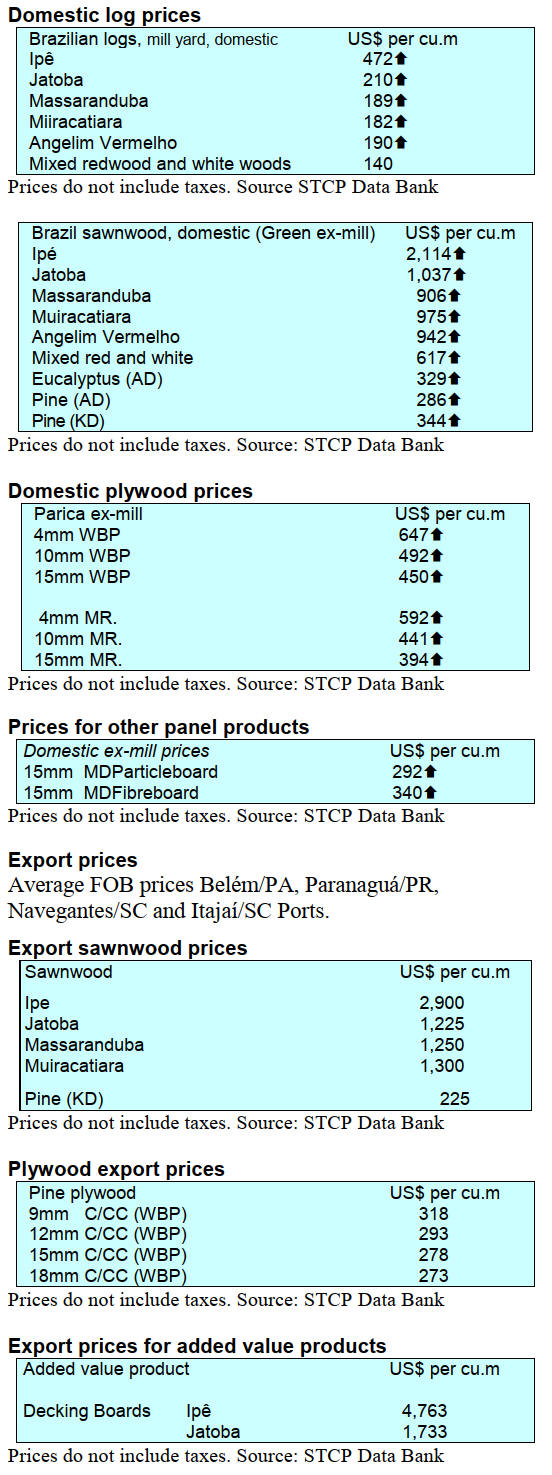
9. PERU
Increased exports in August
In August 2026, wood product exports reached a FOB
value of US$45.9 million, an increase from the US$42.6
million recorded during the same period in 2025. This
represents a positive percentage change of around 8%
according to the Center for Research on Global Economy
and Business at the Association of Exporters (CIEN-
ADEX).
The export portfolio included several product categories:
semi-manufactured goods (US$17.4 million), sawnwood
(US$15.1 million), fuelwood and charcoal (US$4.2
million), furniture and furniture components (US$2.9
million) and construction products (US$2.6 million).
France was the leading destination, with shipments
totalling US$7.7 million. France was followed by the
United States (US$6.4 million), the Dominican Republic
(US$6.1 million), China (US$5.7 million) and Vietnam
(US$5.1 million) rounding out the top five markets.
Semi-manufactured products stood out among exports
in August
According to data from the ADEX Services and Extractive
Industries Department, exports of semi-manufactured
products reached a FOB value of US$17.4 million in
August 2026, a 23% increase compared to the same month
the previous year. France led imports in this subsector,
accounting for 41% of the total exported value and
recording a 23% increase compared to August 2025.
Denmark ranked second with a 17% share and a notable
doubling of value.
The United States held the third position with a 9.5%
share, though it recorded a 22% decline compared to the
same period in the previous year. Belgium ranked fourth
with a 7% share and a contraction of 37%.
Mexico rounded out the top five destinations, accounting
for 5% of exports and showing significant doubling of
growthcompared to August 2025. These results point to a
noteworthy recovery in the foreign trade of Peruvian wood
products, driven primarily by the dynamism of the semi-
manufactured products subsector.
Expo Forestal Perú 2026 generated over US$1.4 million
in projected business
Expo Forestal Perú 2026, a platform that brought together
producers, MSMEs, investors, buyers, academia and the
public sector to promote the sustainable use of forests,
generated approximately US$1.4 million in projected
business for the next twelve months for eight timber and
bamboo-producing companies from six regions of the
country.
The event, organised by the National Forest and Wildlife
Service (SERFOR), took place in Lima on 15-16 October
this year.
Among the group were six companies specialise in
processed products and sawnwood from species such as
tornillo, cedro, copaiba, teak and pine and are based in the
Departments of Ucayali, Madre de Dios, Pasco, and
Huánuco Another two produce bamboo poles and are
located in the Departments of Piura and Amazonas. The
organizer noted that more than fifty business meetings
took place during the event’s business matchmaking
session.
See: https://www.gob.pe/institucion/serfor/noticias/1460503-
expo-forestal-peru-2026-genero-mas-de-s-4-8-millones-en-
expectativas-comerciales-para-empresas-de-madera-y-bambu
Eight Amazonian countries strengthen regional
forestry cooperation
The National Forest and Wildlife Service (SERFOR) led
the Second Regional Meeting of the Amazonian Network
of Forestry Authorities (RAFO), held from 13-16 October
in the Amazonian City of Iquitos. The event included
representatives from the eight member countries of the
Amazon Cooperation Treaty Organization (ACTO).
The meeting, which took place under Peru’s pro tempore
presidency and provided an opportunity to assess progress
on the RAFO 2025–2027 Work Plan, identify priorities
and bolster regional cooperation in areas such as forest
monitoring, traceability, community forest management,
the bio-economy, financing and the fight against
deforestation and forest degradation.
The event included field visits to the Allpahuayo Mishana
National Reserve, the Maynas Forestry Center for
Productive Innovation and Technology Transfer (CITE)
and the facilities of a secondary wood-processing
company.
During these visits, the delegations highlighted the efforts
made by member countries to link research and innovation
with the needs of the productive sector, as well as their
experiences in the efficient utilisation of timber and wood
residues.
See: https://www.gob.pe/institucion/serfor/noticias/1458725-
serfor-lidero-el-encuentro-de-los-ocho-paises-amazonicos-para-
fortalecer-la-cooperacion-forestal-regional
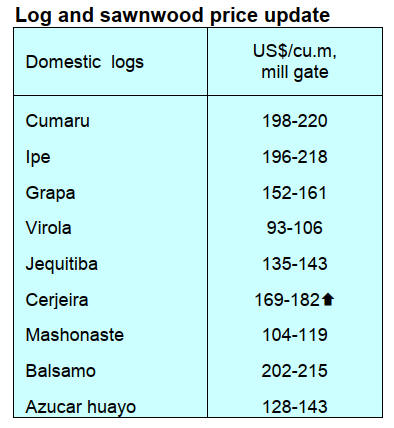
 |