|
1.
CENTRAL AND WEST AFRICA
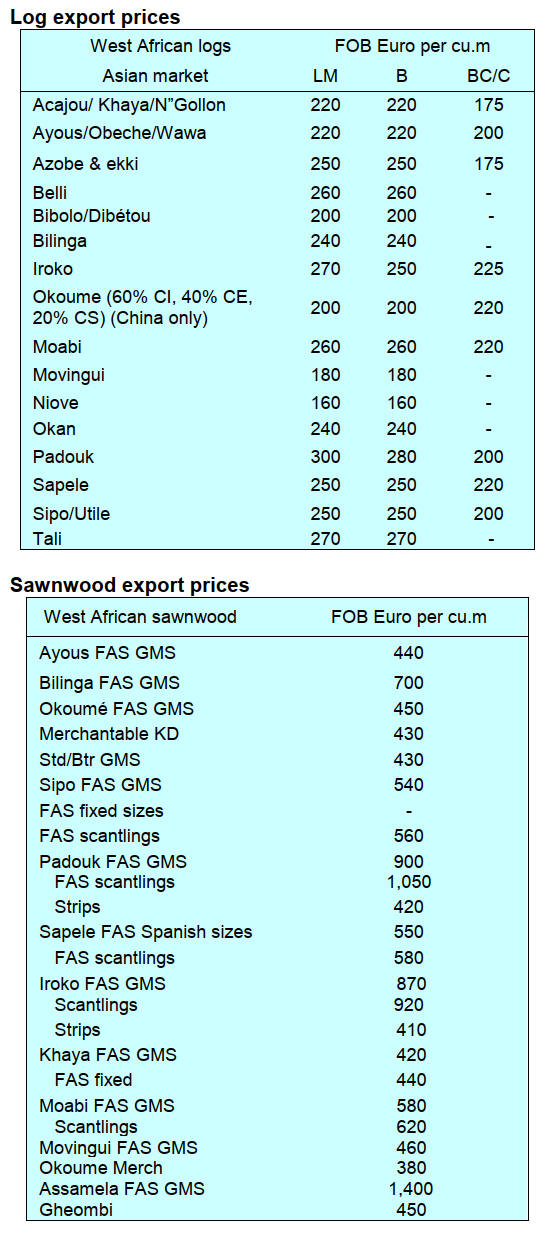
International market view
The Central African timber trade is entering mid-
September with some changes in international demand and
pricing. The most important development is once again
coming from buyers for the Chinese market.
Chinese mills in the region had, after the mid-year
slowdown, returned to relatively strong production,
particularly for sawn Okoumé alongside a range of
redwood species. However, Okoumé purchasing is now
beginning to weaken. This slowdown in purchasing by
China has arrived earlier than anticipated. Operators had
expected Chinese buying to remain stronger until the usual
slowdown in advance of the Chinese New Year.
With Chinese Okoumé demand beginning to soften, mills
and exporters are continuing to look for alternative
destinations. There are signs of increasing diversification
outside the traditional European and Asian markets.
Trade with South America countries is becoming more
noticeable with Guatemala and Bolivia purchasing species
including Padou, Limbali and some Azobé. Although
these remain relatively small markets compared with the
established destinations, they are increasingly relevant as
producers seek alternatives for species facing weaker
demand elsewhere.
Azobé supply and alternative for Europe
Azobé remains an important species to watch. New
demand has been reported from Jeddah for heavy-section
Azobé. If this business continues and develops into a
regular market, it could further tighten the volumes
available to Dutch and Belgian buyers.
European importers may therefore increasingly be
considering alternative heavy-duty species, particularly
Okan and Dabema. This comes at a time when Azobé
availability from traditional West African supply areas is
already under pressure.
While Azobé trees remain standing across West and
Central Africa, logging companies are facing a sharp drop
in the volume of commercially viable timber. The decline
is primarily characterised by depleted stocking and an
increasingly strict regulatory environment.
Many concessionaires in the region are entering their
second harvest cycle (typically 25 to 30 years after the
first). In places like eastern Cameroon, the volume of
mature Azobé trees left to harvest appears to be lower than
during the first cycle.
See: https://www.globalwoodmarketsinfo.com/reasons-
declining-european-tropical-wood-consumption/
Middle East markets
The Middle East market is also weakening. Political and
economic uncertainty is affecting purchasing confidence,
while competition from Brazilian timber products
continues to penetrate regional markets.
Demand remains concentrated mainly on red species such
as Iroko, andoung and Sapelli, while purchasing of
Okoumé is lower.
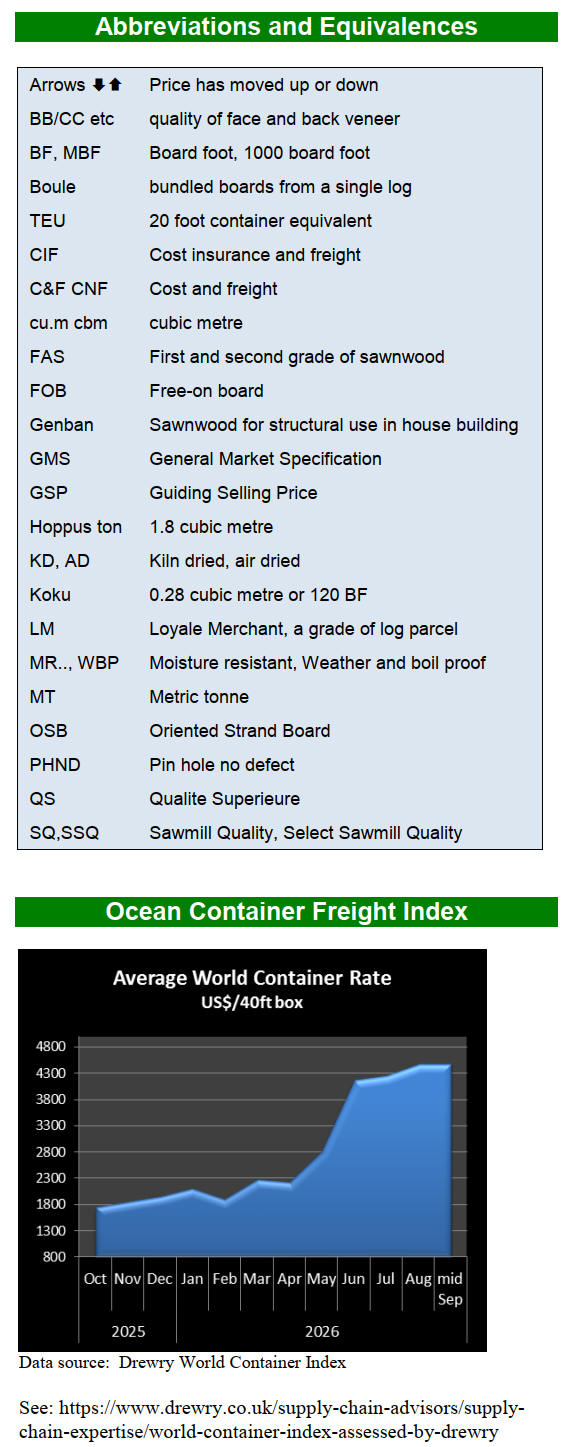
Higher freight rates to Europe
European demand remains generally subdued. Importers
are now facing an additional challenge from sharply
higher freight costs, with reported increases of around euro
100 per cubic metre for some routes.
The increases are being linked to wider oil-market
pressures and are adding substantial costs to timber
exports. This is particularly challenging at a time when
European demand is already relatively weak and importers
are facing higher regulatory and compliance costs. Higher
freight costs are therefore expected to place further
pressure on both producers and European importers during
the coming months.
These freight increases will inevitably put pressure on
landed timber costs and could result in importers
increasing prices. This will subsequently feed into
construction and manufacturing costs at a time when
European tropical hardwood demand is already relatively
weak.
Nkok Special Economic Zone – reduction in operating
mills
One of the most striking developments has been the
reduction in the number of factories operating in Gabon's
Nkok Special Economic Zone.
At its peak, approximately 86 factories were reported to be
involved in peeling Okoumé. The latest information
indicates that only around 21 remain operational. Many
Indian-operated facilities have closed as demand in India
has weakened and competition from Chinese-produced
peeled Okoumé has intensified.
The scale of the contraction is clearly visible within the
zone, with a number of large industrial buildings
reportedly standing empty and showing little or no
activity. This highlights the seriousness of the present
market difficulties affecting the Okoumé processing sector
and particularly its exposure to Indian demand.
Operations across the entire timber supply chain have
faced massive disruptions due to an active government
Task Force investigating companies' financial and social
obligations. Several major timber processors have had
their operations blocked or heavily sanctioned, preventing
the movement of logs leading to depleted log stocks at the
Gabon Special Economic Zone (GSEZ) log park.
Another contributing factor is that Gabon reduced the tax
exemption periods for companies operating within the
GSEZ from 10 years down to 5 years. This scaling back of
fiscal benefits has cooled down new private investments
and public-private cooperation compared to the zone's
peak expansion years.
Another issue that could be related to the closure of mills
in the Zone concerns tax recovery. On 6 September the
Gabonese government announced approximately FCFA
1.7 trillion in outstanding debts owed by companies,
private enterprises and other parties. Those concerned
have reportedly been given until 7 October to settle their
obligations, after which legal action may follow.
This represents a significant government effort to recover
outstanding public revenues and could place additional
financial pressure on companies already operating in
difficult market conditions.
EUTR and EUDR pressure on African timber exports
African timber exporters continue to face increasing
regulatory pressure when supplying Europe. EUTR
requirements, alongside preparations for the EUDR
framework, are influencing both producers and European
importers.
Dutch enforcement is reported to be particularly strict,
with importers facing detailed scrutiny of documentation
and traceability. Even relatively small deficiencies in
supporting documents can create significant difficulties.
Industry feedback suggests that Dutch authorities are
applying particularly strict controls.
Provisional fines of approximately €200,000 have
reportedly been presented in some cases where
documentation has been considered insufficient.
Companies are reportedly being given six months to
resolve documentary deficiencies before penalties are
implemented.
The cumulative effect of regulatory requirements, higher
freight costs and comparatively weak European demand
are encouraging African producers to continue developing
markets elsewhere. China remains important despite the
latest slowdown, while the Middle East, South America,
Bangladesh and Pakistan are increasingly relevant as
producers attempt to reduce their dependence on the
European market.
Specialised industrial zones for eastern Cameroon
To prepare for expanded domestic processing the agency
in charge of industrial land, MAGZI (Mission
d'Aménagement et de Gestion des Zones Industrielles), a
public industrial and commercial enterprise in Cameroon,
has allocated 224 hectares across two specialised industrial
zones in the Eastern Region for local processing: Doumé-
Bonis (104 hectares) and Mandjo Kano (120 hectares).
However, progress on investment has been slow as many
local operators do not have the technical and financial
resources needed to advance to secondary and tertiary
processing of products such as furniture or finished panels.
See: https://www.businessincameroon.com/public-
management/2205-16208-cameroon-tightens-log-export-rules-to-
boost-local-wood-processing
and
https://business237.org/forestry-sector/opportunities-for-wood-
processing-in-cameroon/
Market outlook
Asian demand continues to provide the strongest support,
particularly from Viet Nam and the Philippines. China
remains active across a relatively broad range of species
but there is concern that demand may be weakening again.
Vietnamese demand for Tali, Niové and Padouk continues
to help maintain sawmill activity.
With mills holding approximately two to three months of
log stocks, there is no immediate supply concern. The
main issue to monitor will be the return of heavier rains
and their effect on harvesting and road transport. Overall
production is therefore expected to remain measured, with
mills continuing to align output closely with confirmed
international orders rather than increasing stocks in a still-
cautious global market.
TDUK guides to tropical timber sourcing
A series of guides for buyers sourcing from six tropical-
producing countries is being developed by lead UK timber
sector body Timber Development UK (TDUK). The first
is for Ghana, produced in association with the Ghana
Forestry Commission (see page 5). Out soon, it describes
the new Ghana Verified Timber (GVT) legality validation
programme and the country’s EU Forest Law Enforcement
Governance and Trade (FLEGT) Licencing framework
and integral timber legality assurance system (TLAS)
which underpin it.
The other five guides are for Cameroon, Republic of
Congo, Liberia, Côte d’Ivoire and Gabon and the series is
being supported with funding from the Forest Governance,
Markets and Climate (FGMC) programme of the UK
Government’s Foreign, Commonwealth and Development
Office.
The TDUK says “Our aim with the guides is to give
timber buyers clear, practical information on the systems
behind timber from these producer countries, from legality
assurance and traceability to the products and sourcing
opportunities they offer. “By making that information
more accessible, we want to build buyer confidence,
strengthen links between responsible producers and
international markets and ultimately encourage greater
demand for verified tropical timber.”
Four of the countries covered in the guide series, Ghana,
Cameroon, Republic of Congo and Liberia, are members
of the Broader Market Recognition Coalition (BMRC)
along with Indonesia and Guyana.
This commits signatories to develop their National
Sustainable Forestry Systems and have them
independently validated against internationally accepted
forest governance principles and indicators.
See: https://timberdevelopment.uk/,
and
https://forestgovernance.org/,
and
https://fc.gov.gh/ and
and
https://woodcampus.co.uk
2.
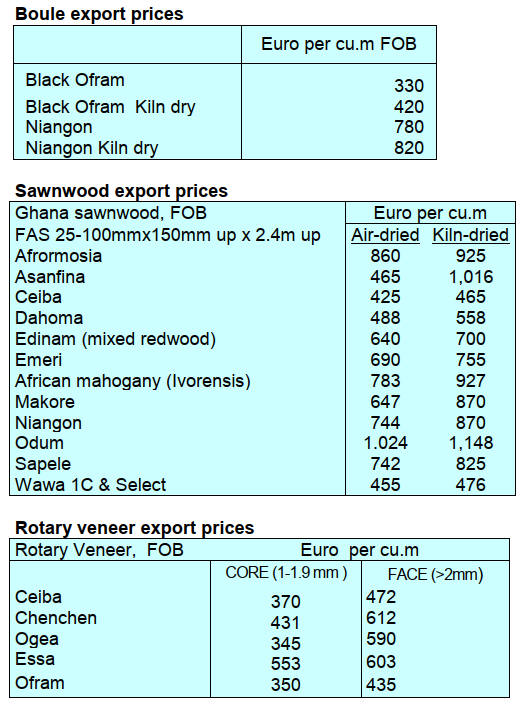
GHANA
Middle East trade slides
According to data from the Timber Industry Development
Division (TIDD) of the Forestry Commission (FC) the
country’s overall wood product export volume in the first
half of 2026 contracted compared to the first half of 2025.
The total volume shipped in the first half-year dropped by
around 12%, from 111,348 cu.m. in 2025 to 98,387 cu.m.
in 2026.This contraction was driven by a heavy downturn
in specific regional markets (Asia, Middle East and
Oceania) despite notable growth across the continents of
Europe, Africa and America).
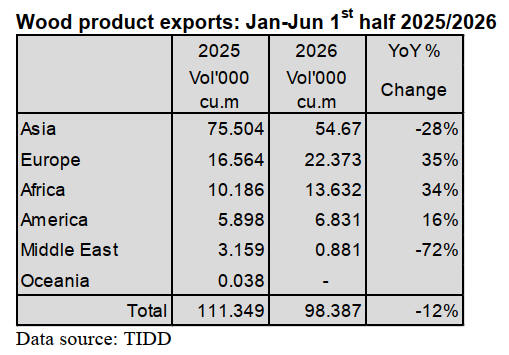
Although Asia remains the largest market by a wide
margin its dominance is weaning as volumes fell by 28%,
from 75,504 cu.m. to 54,670cu.m. which caused its market
share to slump from 68% down to 56%. However, the
volumes to Europe and the Africa region surged. Europe
experienced the largest pace of growth, increasing its
volume by 35% and elevating its market share to 23%.
Africa followed closely with a 34% volume expansion,
securing a 14% market share.
The market share of Europe, Africa and America together
rose from 29% in the first 6 months of 2025 to 44% in the
same period in 2026.
The Middle East market collapsed significantly, losing
72% of its operational volume and dropping below a 1%
market share. Oceania's contribution phased out entirely
during this timeframe. Market analysts are hopeful,
however, the Middle East economic downturn would be
short-lived to avoid negative impact on business and
industrial employment.
ECOWAS market performance – Ghana clocks 49%
growth
Nine ECOWAS member countries experienced 49%
overall growth, driven by significant changes in export
volumes and product choices between the first half year of
2025 (8,069 cu.m) and 2026 (11,930 cu.m).
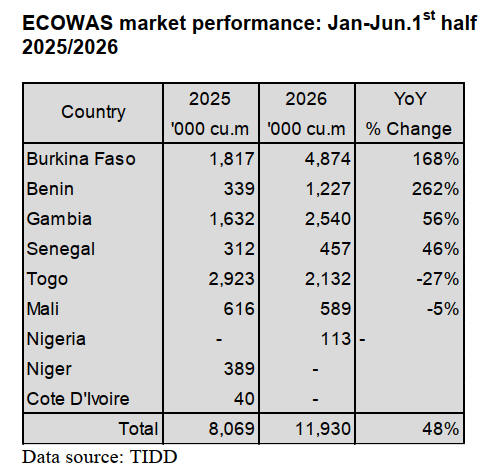
Plywood was the main trade product in the regional
market. The total volume shipped from Ghana climbed
from 7,922 cu.m to 11,633 cu.m, capturing 98% of the
entire ECOWAS wood export market share in the first half
of 2026.
TDUK – Ghana sourcing guide
A series of guides for buyers sourcing from six tropical-
producing countries is being developed by lead UK timber
sector body Timber Development UK (TDUK), the first is
for Ghana. The Ghana guide details the operation of the
Ghana Verified Timber (GVT) framework and brand and
its value to buyers of Ghanaian timber in markets
worldwide who are requiring ever higher levels of legality
and sustainability validation.
The guide explains that Ghana’s FLEGT licences are
accepted as definitive proof of legality under the EU
Timber Regulation and exempt EU operators from further
EUTR due diligence on imports of Ghanaian Timber.
Under the incoming EU Deforestation Regulation
(EUDR), EU buyers of Ghanaian timber will additionally
have to undertake due diligence that it is not implicated in
deforestation.
But FLEGT Licenses are accepted as proof of legality
under the EUDR, while geolocation coordinates for timber
origin required by the Regulation are provided under the
Ghana Timber Legality Assurance System (GhTLAS) via
the Ghana Wood Tracking and Decision Support System
(GWT-DSS).
It also notes that, post Brexit, UK buyers of Ghanaian
timber still must undertake legality due diligence to satisfy
the UK Timber Regulation as the two countries have not
yet concluded a bilateral FLEGT VPA. However, it says,
in 2025 the UK and Ghana signed a Memorandum of
Understanding to promote forest governance.
Subsequently the UK Department for Environment said it
is reviewing its approach to tackling deforestation linked
to trade. It said it will set out its approach to this, including
future VPAs with timber suppliers, ‘at the earliest
opportunity’.
In summary, the guide states that for timber buyers the
GVT framework delivers:
Clear evidence of legality for domestic and
export markets, plus compliance with EUTR due
diligence requirements and proof of legality
under the EU Deforestation Regulation
Full traceability through digital monitoring
systems
Assurance of ethical and responsible sourcing
Reduced exposure to illegal or high-risk supply
chains
GPS traceability.
See https://timberdevelopment.uk/
and
https://forestgovernance.org/
and
https://fc.gov.gh/
and
https://woodcampus.co.uk/
Restoring land degraded by illegal mining could cost
US$21billion
A former Minister for Environment, Science, Technology
and Innovation, Prof. Kwabena Frimpong-Boateng, has
hinted Ghana will require an estimated US$21 billion to
reclaim and restore lands degraded largely by illegal
mining and other destructive activities.
Professor Frimpong-Boateng said this when delivering his
keynote address at the Fourth Annual Colloquium
organised by the Department of Political Science
Education at the University of Education, Winneba, under
the theme, “Politics, the Environment and Our Future:
Ghana at Crossroads”.
He indicated, about 10% of Ghana’s land area equivalent
to approximately 23,853 square kilometres had been
illegally degraded, leaving the country with an enormous
environmental restoration bill.
He highlighted the restoration of the Ankobra River alone,
which he said had been estimated to cost about US$400
million, excluding the cost of rehabilitating other polluted
water bodies, including the Pra, Offin, Birim, Anum, Oda
and the Black, White and Red Volta rivers.
Prof. Frimpong-Boateng, once the chairman of the Ghana's
Illegal Mining Committee during the 2017-2021 era,
described the illegal mining ‘galamsey’ menace as the
largest environmental crime in the history of the country.
As a medical expert, he warned of the exposure of
chemical residues to communities, farmlands, forests and
water bodies.
Galamsey is widespread in the Ashanti, Eastern, Western
and Western North Regions with its ripple effects on
farmlands, forests and river bodies. He proposed an
independent Environmental Restoration Fund, financed by
mineral royalties, for remediation and reclamation.
See: https://www.myjoyonline.com/ghana-needs-21bn-to-
restore-lands-damaged-by-illegal-mining-frimpong-
boateng/?utm_source=vuukle&utm_medium=talk_of_town
Ghanaians encouraged to plant more trees
According to an environmental expert, researcher and
lecturer at the University of Environment and Sustainable
Development (UESD), Dr. Owusu Fordjour Aidoo, trees
play a critical role in protecting the environment.
Speaking to the media, Dr. Fordjour Aidoo, urged
individuals and communities to plant, sustain and
strengthen their tree-planting efforts to help combat the
growing effects of climate change.
He said the continuous loss of forest cover through illegal
mining, illegal logging, bushfires among other human
activities had contributed to environmental degradation
worsening of the effects of climate change on ecosystems.
Dr Aidoo emphasised that trees are a vital natural solution
for curbing climate change by absorbing carbon dioxide.
He therefore urged all Ghanaians to view afforestation as a
collective civic duty rather than just a government
initiative.
In related news, a private sector enterprise has partnered
with the Forestry Commission (FC) of Ghana and
Rainforest Alliance to restore a degraded section of the
Chipa Forest Reserve at Shai Hills, as part of its 30th
anniversary and Sustainability Month.
According to the Tema-Ada District Manager, Linda
Ansah, the reserve, which was gazetted in the 1960s,
requires ongoing restoration and welcomed MTN's
support. The planting project was intended to cover two
hectares with 1,666 trees of Mahogany, Cassia and Acacia,
specially chosen for their adaptability, quick growth and
carbon sequestration.
See: https://www.myjoyonline.com/ghanaians-urged-to-
intensify-tree-planting-and-forest-protection-to-combat-climate-
change/
and
https://gna.org.gh/2026/09/tree-planting-spirit-must-be-
rekindled-to-tackle-climate-change-researcher/#google_vignette
and
https://www.businessghana.com/site/news/Business/355023/MT
N-Ghana-to-enforce-tree-planting-initiative
3. MALAYSIA
15% to 20% of national furniture production is for
domestic consumption
Malaysia's domestic furniture retail sector saw a moderate
sales expansion of 1.8% in the first half of 2026, while
broader manufacturing conditions faced some challenges
as production costs continued to rise.
Malaysia's retail industry recorded weaker-than-expected
growth of 2.5% year on year in the second quarter of 2026
amid cautious consumer spending according to the latest
Malaysia Retail Industry Report. The growth was below
the 4.8% forecast by members of the Malaysia Retailers
Association (MRA) and Malaysia Retail Chain
Association (MRCA) in June, according to the report.
For the third quarter of 2026 the majority members of the
two retailers' associations are hopeful of better
prospects. They estimate an average growth rate of 4.7%
in retail sales for the third quarter. Approximately 80% to
85% of total furniture produced in Malaysia is destined for
international markets. Only about 15% to 20% of national
furniture production is retained for local domestic
consumption.
Strong export gains were noted in alternative markets, led
by a 32% increase in sales to India and robust growth in
Puerto Rico and New Zealand. Exporters faced tighter
margins due to growing operational expenses, compliance
mandates and shifting global buyer expectations regarding
traceability
Malaysia's logistics infrastructure supports the country’s
export success. Penang Port and Port Klang are both major
container shipping hubs. Port Klang is consistently ranked
among the top 15 busiest container ports in the world by
TEU throughput. For furniture exporters specifically, this
connectivity translates into competitive freight rates,
regular sailing schedules and multiple carrier options.
See:
https://www.nst.com.my/business/corporate/2026/01/1367089/m
alaysian-furniture-fair-targets-us131bil-site-order
and
https://theedgemalaysia.com/node/817324
and
https://www.hinlim.com/why-malaysia-is-southeast-asia-s-
leading-furniture-export-hub
Sarawak’s approach to green economic development
The 21st Malaysian Forestry Conference was held in
Kuching, bringing together forestry authorities,
policymakers, industry representatives, researchers and
other stakeholders from across Malaysia. Hosted by the
Sarawak Forest Department, the conference was held
under the theme “Forests as Catalyst for a Green
Economy”, highlighting the important role of forests in
supporting sustainable development, climate action,
biodiversity conservation and economic growth.
Abang Haji Abdul Rahman Zohari bin Tun Datuk Abang
Haji Openg, Premier of Sarawak, officiated at the opening.
In his address, the Premier emphasised Sarawak’s long-
term approach to green economic development, stressing
that economic progress must go hand in hand with
environmental conservation.
He said Sarawak’s forests should no longer be viewed
solely as a source of timber, but as valuable natural assets
with the potential to support research, innovation,
pharmaceuticals, sustainable aviation fuel and other high-
value sustainable industries.
He also highlighted the use of advanced technologies,
including artificial intelligence, to accelerate biodiversity
research and unlock new scientific and economic
opportunities.
With Sarawak’s extensive forest cover serving as a
significant carbon sink, he noted Sarawak’s strategic
potential in carbon trading while underscoring the
importance of federal-state cooperation and fair
recognition of State rights over forest resources. He also
encouraged greater participation by young people in
science, technology and research to support Sarawak’s
green economy agenda.
See:
https://sta.org.my/sta/stareview/2026/07/STAReviewJul2026.pdf
/
Sabah forest cover is maintained at 63%
The Sabah Forestry Department recorded several
noteworthy achievements last year, with forest revenue
totalling RM164.7 million amid the challenging world
economy and trade.
In a 306-page 2025 Annual Report released in Sandakan
Chief Conservator of Forests, Zulkifli Suara, said
recognition has been given to the Pin Supu Forest Reserve
(FR) in Kinabatangan as the first terrestrial International
Union for Conservation of Nature (IUCN) addition to the
Green List of Protected and Conserved Areas in Malaysia.
This recognition by the IUCN is for excellence in
conservation and protected area management.
He said the State’s forest cover is maintained at 63%, the
highest of the three regions in Malaysia, as well as 30%
Totally Protected Areas (TPAs) through planned gazetting.
The Annual Report can be obtained from the Sabah
Forestry Department.
In related news, Deputy Chief Conservator of Forests,
Indra Purwandita Herry Sunjoto, has reported Sabah
restored about 830,000 hectares of degraded forest under
its sustainable forest management efforts.
He added “reduced impact logging has been mandatory in
production forest reserves since 2010,” claiming that
Sabah’s Timber Legality Assurance System is the first in
the region to align with the European Union Deforestation
Regulation and the European Union Corporate
Sustainability Due Diligence Directive.
See: https://www.dailyexpress.com.my/news/287716/sabah-
forestry-department-s-achievements-last-year/
4.
INDONESIA
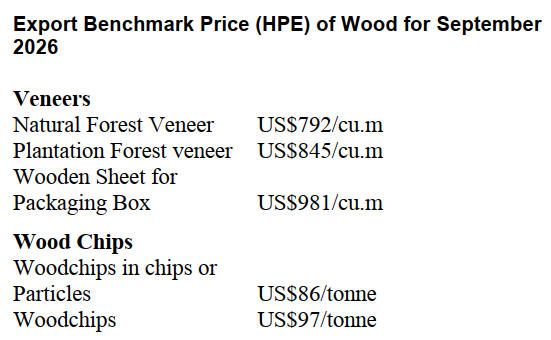
Processed Wood
Processed wood products which are leveled on all four
sides so that the surface becomes even and smooth with
the provisions of a cross-sectional area of 1,000 sq. mm to
4,000 sq.mm (ex 4407.11.00 to ex 4407.99.90)
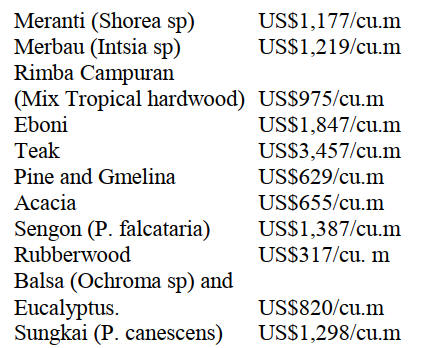
Processed wood products which are leveled on all four
sides so that the surface becomes even and smooth of
Merbau wood with the provisions of a cross-sectional area
of 4,000 sq.mm to 10,000 sq. mm (ex 4407.11.00 to ex
4407.99.90) = US$1,500/cu.m.
See: https://jdih.kemendag.go.id/peraturan/keputusan-menteri-
perdagangan-republik-indonesia-nomor-1777-tahun-2026-
tentang-harga-patokan-ekspor-dan-harga-referensi-atas-produk-
pertanian-dan-kehutanan-yang-dikenakan-bea-keluar-dan-tarif-
layanan-badan-layanan-umum
IEU-CEPA to strengthen market access for Indonesian
goods
The government says the Indonesia-European Union
Comprehensive Economic Partnership Agreement (IEU-
CEPA) will significantly improve market access for
Indonesian exports to the EU. The Agreement is expected
to benefit major commodities and products, including
palm oil, footwear, coffee, furniture, agricultural and
fishery products along with telecommunications
equipment.
The Minister of Trade, Budi Santoso, anticipates the IEU-
CEPA to be formally signed by late October 2026, with
implementation targeted for early 2027.
The Indonesian Employers’ Association (Apindo) is
supportive of the IEU-CEPA but stressed that the deal will
not automatically trigger a surge in Indonesian exports to
the EU. Apindo Chairwoman, Shinta W. Kamdani, said
the Agreement will mainly reduce tariff barriers while
companies remain responsible for meeting demanding EU
requirements, including the EUDR, CBAM, traceability,
environmental and sustainability standards, health
regulations and workers’ rights.
Despite these challenges, Shinta views IEU-CEPA as a
game changer because it will provide Indonesia with more
certain access to the EU market and a more level playing
field against regional competitors such as Viet Nam and
Malaysia.
The Indonesian Furniture Industry and Craft Association
(HIMKI) says tariff reductions under the IEU-CEPA alone
will not be enough to significantly increase Indonesian
furniture exports to the EU as some products already face
tariffs of only 0–5.6%.
The industry’s key challenges will increasingly involve
non-tariff barriers and compliance with European
standards, particularly the European Union Deforestation
Regulation (EUDR) for wooden furniture.
Exporters will need robust raw-material traceability,
including supplier mapping, geolocation data, due
diligence documentation and chain-of-custody systems,
while also meeting requirements covering chemical safety,
formaldehyde emissions, sustainability certifications,
REACH, recyclability and carbon-footprint data.
HIMKI also stresses that Indonesian furniture must
compete on more than price by strengthening design,
craftsmanship, sustainability, cultural identity and
production consistency. Ultimately, HIMKI says the
Agreement’s success should be measured by growth in
Indonesia’s European market share, added value, number
of exporters and the strength of Indonesian brands.
The HIMKI anticipates Indonesian furniture and
handicraft exports to the European Union could expand by
10–15% in the first two to three years after the IEU-CEPA
takes effect.
See:https://industri.kontan.co.id/news/apindo-ieu-cepa-bukan-
jaminan-ekspor-ri-ke-eropa-melonjak.
and
https://www.msn.com/id-id/ekonomi/ekonomi/ieu-cepa-akan-
diratifikasi-himki-soroti-hambatan-non-tarif-furnitur-ri-ke-
eropa/ar-AA2bjlUH?ocid=BingNewsVerp
and
https://katadata.co.id/berita/industri/6a95685a2cd3f/himki-bidik-
ekspor-furnitur-ri-ke-eropa-tumbuh-15-lewat-ieu-cepa
Advancing technology adoption to boost
competitiveness
The HIMKI is accelerating technology adoption to
increase productivity and strengthen the competitiveness
of Indonesia’s furniture industry amid global competition.
HIMKI chairman, Abdul Sobur, said technological
transformation is essential to combine Indonesia’s
strengths in craftsmanship, skilled artisans, diverse
materials, design and cultural creativity with modern
precision and production systems.
He added that upgrading technology would help the
industry create greater added value and compete more
effectively in international markets.
The initiative was demonstrated through a 30-company
HIMKI delegation’s visit to major furniture exhibitions in
Shanghai, China, including WMF 2026, CIFF Shanghai
and Furniture China 2026 5-8 September.
The delegation explored advances in woodworking
technology, design, materials, manufacturing systems,
automation and integrated digital production lines, while
also seeking business and technology-transfer
opportunities. HIMKI also explored cooperation with the
China National Forestry Machinery Association
(CNFMA) to expand Indonesian access to machinery,
technology, investment and industrial partnerships.
See: https://www.antaranews.com/berita/5729879/himki-perkuat-
adopsi-teknologi-pacu-daya-saing-industri-furnitur
and
https://money.kompas.com/read/2026/09/07/214300526/hadapi-
persaingan-global-industri-furnitur-ri-dituntut-adopsi-teknologi
Furniture market outreach at KOFURN 2026
Indonesia aimed to expand the market for furniture and
interior products in the Korean market by bringing 13
companies to the Korea International Furniture and
Interior Fair (KOFURN) 2026.
Organised by the Indonesian Embassy in Seoul in
cooperation with the Ministry of Trade, the participation
aimed to strengthen Indonesian product branding and
connect exporters with Korean buyers and potential
business partners.
The Indonesian Pavilion showcases the country’s strengths
in natural materials, craftsmanship, design and
sustainability, featuring furniture made from wood, teak,
recycled teak and rattan, as well as interior products using
water hyacinth, seagrass, banana leaves, mendong grass
and capiz shells.
Indonesia’s furniture prospects in Korea are further
supported by the Indonesia-Korea Comprehensive
Economic Partnership Agreement (IK-CEPA), under
which almost all Indonesian furniture products enjoy zero
import duties.
The tariff advantage is expected to enhance the
competitiveness of Indonesian exporters and encourage
greater trade in value-added products. Beyond generating
immediate sales, Indonesia hopes KOFURN will foster
long-term business partnerships, joint design development
and stronger integration between the Indonesian and
Korean furniture industries.
See: https://www.metrotvnews.com/read/k8oCQMa3-bidik-
pasar-korea-13-perusahaan-furnitur-indonesia-tampil-di-kofurn-
2026
Indonesia strengthens early detection to tackle forest
fires
The Ministry of Forestry has emphasised that better early
detection and rapid response are essential to containing
forest and land fires before they spread and cause wider
impacts on communities, public health, the environment,
economic activities and transportation.
The ministry is strengthening its control centre through
integration with the Jaga Rimba Decision Support System,
while also improving the preparedness of Forest Business
Utilization Permit (PBPH) holders, maintaining peatland
water conditions and conducting compliance monitoring
and law enforcement.
In related news, the Indonesian media has reported that
Indonesia’s defense cooperation with Japan has expanded
to include humanitarian assistance for tackling forest and
land fires, according to the Minister, of Defence,
Sjafrie Sjamsoeddin.
As part of the assistance, Japan is reportedly deploying
three CH-47 Chinook heavy-lift helicopters to conduct
aerial firefighting and water-bombing operations in
affected provinces, with a Japanese advance team already
coordinating logistics and deployment with the Indonesian
military (TNI) and the national Forest and Land Fire Task
Force.
See: https://en.antaranews.com/news/429876/indonesia-
strengthens-early-detection-to-tackle-forest-fires
and
https://en.tempo.co/read/2118513/japan-to-send-3-helicopters-to-
help-indonesia-battle-wildfires
5.
MYANMAR
6.
INDIA
Domestic consumer demand demonstrating
resilience
It has been reported that Indian consumer demand has
demonstrated notable resilience, holding up well as
inflation remains contained within the Reserve Bank of
India's tolerance band despite the ongoing Middle East
conflict. Tax relief and selective GST rate cuts enacted
prior to the crisis delivered higher disposable incomes to
households , softening the blow of subsequent imported
energy inflation.
In other news, while initial fears of a monsoon failure in
India have shifted, the season has not ended smoothly and
instead turned into a volatile pattern of extreme weather
swings. The initial severe deficit from a dry June was
heavily countered by intense July rains from Bay of
Bengal depressions.
Diwali significantly boosts India's consumption, driving
record-breaking economic trade, retail sales and festive
spending across the country. High-demand categories
include gold, jewelry, electronics, automobiles, apparel,
home décor and traditional sweets.
The Indian Festive season extends over three months
starting from August and ends with Diwali and Indian new
year. During this period consumer demand rises. As noted
by the Economic Times, this surge in domestic
consumption acts as a vital economic cushion against
global trade headwinds and external uncertainties.
Alarming heatwaves – action called for
Recent studies show India has warmed about 1.5 times the
global average over the past two decades. The country has
witnessed some of its hottest winters over the past few
years and has a disproportionately high representation in
the list of the world’s hottest cities.
The alarming heatwaves India has been experiencing
because of the climate crisis need concrete steps, including
planting trees to absorb carbon, counter the heat island
effect in cities and strengthen ecosystems against climate
chaos.
The government recently announced a drive to plant 7
million trees in the national capital. Utter Pradesh’s Mega
plantation drive aims to plant 35 crore (350 million)
saplings even as a record five crore were planted on World
Environment Day (June 5). Assam’s Amrit Briksha
Andolan targeted planting of ten million saplings in one
day and the Green Bengalure initiative saw 1.5 million
saplings planted on June 27. Ahmedabad’s Five Million
Trees drive had an eponymous target.
Such initiatives tend to overlook crucial factors, such as
species suitability, local microclimatesand, most
importantly, post- planting care. As a result, much of the
effort remains seasonal (concentrated during the monsoon)
and confined to symbolic, one day events. Without long-
term care, the ecological benefits of these initiatives will
remain largely unrealised.
Mohan Chandra Pargaien Ex-Chief Wildlife Warden and
Advisor, SCCL, Hyderabad, Telangana State in an artcle
in the Hindustan Timestimes says the scale of such drives
hides a survival deficit. The Supreme Court has repeatedly
flagged this issue in the context of compensatory
afforestation, suggesting the need for meaningful and
monitored growth.
Poor site selection is a major factor affecting plantation
survival. This is followed by poor post-planting care due
to under-funding or post-event indifference. Poor-quality
saplings and weak monitoring further aggravate the
matter. There is little heed paid to geotagging, survival
audits or public reporting. The climate crisis has also
emerged as a new threat affecting survival.
Chandra Pargaien concludes that “India’s afforestation
requires both political restraint and political courage. On
the one hand, we must exercise restraint by avoiding over-
ambitious drives without pre-allocated budgets for
maintenance and care. Funding must follow the tree
through years of care, not just stop on the day of planting.
Only then can our forests survive the headlines and protect
our communities from the worsening heatwaves.
See: https://www.hindustantimes.com/opinion/plantation-drives-
matter-only-if-the-trees-survive-101783703956711.html
Phyto-quarantine inspection services at the Darranga
border crossing
To facilitate the import of new timber species, India will
now deploy phyto-quarantine inspection services at the
Darranga Land Port on the Indo-Bhutan border in Assam’s
Tamulpur district. The Ministry of Agriculture and
Famers’ Welfare has amended its Plant Quarantine Order
to include 16 species of timber from Bhutan.
The amendment entails establishing a specific pest
treatment and phytosanitary certification process at a land
port. The change resulted from discussions that took place
in the last two years at the level of commerce secretaries
of the two countries.
Bhutan had continuously requested the inclusion of
additional timber species for export to India during these
meetings.
A gazette notification issued a few days ago stated that
Schedule VI of the Plant Quarantine Order has been
amended to create a distinct phytosanitary import pathway
for the listed timber species originating in Bhutan.
These phytosanitary measures are meant to ensure that the
timber does not carry insects or pathogens, such as stem
borer, which can potentially enter the Indian ecosystem
and prove detrimental to Indian timber species.
The timber speciesinvolved must undergo prescribed pest
treatments, which include methyl bromide fumigation,
heat treatment or another approved equivalent. The
treatment must be documented on the official
phytosanitary certificate.
The 16 timber species included are Alnus nepalensis,
Lagerstroemia parviflora, Acacia catechu (Khari),
Acrocarpus fraxinifolius, Altingia excelsa, Betula utilis,
Beilschmiedia roxburghiana, Castanopsis hystrix,
Cupressus cashmeriana, Duabanga grandiflora,
Exbucklandia populnea, Engelhardia spicata, Populus
ciliate, Schima wallichii, Syzygium cumini, Tetrameles
nudiflora and Toona ciliate.
These timber species are intended for use in the
construction industry as well as for furniture, plywood and
veneer, packaging and interior products. The Toona ciliata
species is particularly used to produce high-value wooden
items like furniture, cabinets, veneers and musical
instruments.
See: https://www.newindianexpress.com/india/2026/Aug/30/nod-
to-import-of-16-timber-species-from-bhutan
Federation requests lifting of anti-dumping duty on
Melamine
The Federation of Indian Plywood and Panel Industry
(FIPPI has written a letter to Ministry of Commerce and
Industry requesting the discontinuation of anti-dumping
duty on Melamine imported from China.
The FIPPI says the imposition of any anti-dumping duty
on critical chemicals like melamine, essential for resins
used in plywood and panel production, would severely
impact the industry. It would increase production costs,
undermine the competitiveness of domestic products in
both domestic and export markets and could force the
nation to rely more on imports to meet demand as
domestically produced products become costlier.
See: https://www.plyreporter.com/article/92043/fippi-ilma-
oppose-continuation-of-ad-on-melamine-imports
7.
VIETNAM
Wood and wood product (W&WP) trade
highlights
According to Viet Nam Customs Office, in August 2026
exports of indoor furniture reached US$930 million, up
7% compared to August 2025. In the first 8 months of
2026 exports of wooden furniture totalled US$6.7 billion,
down 0.3% over the same period in 2025.
Viet Nam’s W&WP exports to Belgium in August 2026
amounted to US$9.5 million, up 121% compared to
August 2025. In the first 8 months of 2026 exports of
wood and wood products to the Belgian market were
valued at US$82.2 million up 110% over the same period
in 2025.
Viet Nam's tali imports in August 2026 were 37,500 cu.m,
worth US$16.3 million, up 8% in volume and 6% in value
compared to July 2026 but compared to August 2025
imports were down 4% in volume but up 7% in value.
In the first 8 months of 2026 tali wood imports to Viet
Nam were estimated at 268,5500 cu.m, worth US$116.5
million, up 10% in volume and 29% in value over the
same period in 2025.
W&WP exports to the Dutch market in August 2026
earned US$16 million, up 118% compared to August
2025.
In the first 8 months of 2026 exports of wood and wood
products to the Dutch market were reported at US$124.5
million, up 110% over the same period in 2025.
In August 2026, imports of raw wood from the US stood
at 165,000 cu.m, worth US$65.3 million, down 12% in
volume and 13% in value compared to July 2026 but up
22% in volume and 12% in value compared to August
2025.
In the first 8 months of 2026, raw wood imports from the
US totalled at 1.35 million cu.m, worth US$538 million, a
sharp increase of 54% in volume and 46% in value over
the same period in 2025.
Viet Nam wood exports near US$12 billion as China
demand surges
Viet Nam’s wood exports approach US$12 billion
between January - August 2026 as demand from China
soared. In August alone, exports were estimated at
US$1.48 billion, bringing the eight-month total to
US$11.69 billion, up 5% from a year earlier. Wood and
wood products were the country’s biggest agricultural
export earner during the period.
The United States accounted for 50% of Viet Nam’s wood
and wood product exports through July, with shipments
worth US$5.09 billion, down 6% from the same period
last year.
Exports to China, meanwhile, jumped 46% to US$1.54
billion in the first seven months. China’s share of Viet
Nam’s wood exports rose to 15%, up 4% from a year
earlier making it the country’s second largest market,
overtaking Japan.
Exports to Japan, Malaysia, the Netherlands, Germany and
the United Kingdom also posted solid growth pointing to
improving demand in some Asian and European markets
and giving Vietnamese exporters more room to diversify
their customer base.
The decline in shipments to the United States came as
Washington stepped up trade-remedy measures, according
to the Import-Export Department under the Ministry of
Industry and Trade.
On 16 July the US Department of Commerce issued final
determinations in an anti-dumping and countervailing duty
investigation into hardwood plywood and decorative
plywood from Viet Nam, setting a general anti-dumping
duty rate of 84.95%.
While the final rate was well below the preliminary range
of 196.14% to 199.69%, it still poses a significant hurdle
for Viet Namese exporters, the department said.
The nearly 6% decline in exports to the US is a
development worth watching but it does not yet point to a
loss of competitiveness for Vietnamese furniture in the
market an industry expert said.
Viet Nam’s wood industry has already established a strong
foothold in the US and has become an important supplier
as American importers seek to diversify their furniture
supply chains.
But tariff policies are beginning to change buying
behavior. Importers are becoming more cautious about
signing long-term contracts, placing shorter-term orders
and asking suppliers to absorb a larger share of tariff costs.
That is likely to put further pressure on exporters’ profit
margins.
The bigger risk is that Vietnamese suppliers could
gradually lose their place in US importers’ supply chains.
Once buyers switch to alternative suppliers and set up new
inspection, logistics and product-compliance systems,
winning back market share could become much harder.
See: https://english.vov.vn/en/economy/vietnam-wood-exports-
near-us12-billion-as-china-demand-surges-
post1330983.vov?utm_source=chatgpt.com
Vietnamese exporters pivot to ease pressure from US
tariffs
The new US tariff rates are testing the adaptability of
Vietnamese exporters, requiring businesses to look beyond
pricing and market adjustments and invest in technology,
product quality, branding and compliance to sustain long-
term competitiveness.
Pressure from the new US tariff policy is prompting
Vietnamese exporters to reassess their strategies. Rather
than pursuing volume-driven growth many are shifting
towards higher-value orders, tighter cost control, greater
productivity and a more balanced allocation of markets to
reduce reliance on a single destination.
Forest product exports exceeded US$10 billion in the first
seven months, up around 5%. However, successive US
trade policies and tariffs have made businesses more
cautious and highlighted the need for stronger risk
management and proactive market strategies.
Ngô Sỹ Hoài, Vice Chairman and Secretary General of the
Viet Nam Timber and Forest Products Association
(VIFORES), said many firms were expanding exports to
China, Japan and the EU.
Exports to China rose 46%, those to Japan more than 20%,
while the EU also recorded positive growth. Expanding
these markets is viewed as a means of reducing
dependence on the US and limiting exposure to policy
changes.
A test of competitiveness
In the short term, the US’s additional 12.5 per cent tariff is
putting pressure on selling prices and profit margins. In
the longer term, however, it could test Vietnamese
businesses’ ability to adapt. Those capable of upgrading
technology, improving quality, developing brands,
securing raw materials and diversifying markets will have
greater scope to remain competitive.
The challenge extends beyond tariffs. To establish a
sustainable presence in the US, Vietnamese businesses
must address issues ranging from market research and
legal requirements to sales channels, cash-flow
management and product development.
According to Trần Lịch, Director of the Viet Nam Impact
Startup Incubator and Accelerator (VISIA), around 85% of
surveyed businesses are not yet genuinely prepared for the
US market. Their major weaknesses lie less in production
capacity than in their ability to access and operate in the
market.
Specifically, 77% identified market research and
understanding US consumers as major challenges, while
76% cited difficulties in developing marketing strategies
and sales channels. Legal and compliance requirements
were cited by 59%; 56% faced working-capital and cash-
flow issues and 53% identified branding, design and
market-appropriate R&D as weaknesses.
“Having a good product is not enough to enter the US
market," Lich stressed, saying businesses need a
comprehensive roadmap covering market research, legal
requirements, go-to-market strategy, R&D, capital,
logistics, distribution and sales.
Compliance also requires early preparation. Requirements
imposed by US regulators such as the FDA, CPSC and
USDA, along with intellectual property protection, should
be addressed during product and market preparation rather
than after orders are secured.
Early preparation can reduce order-disruption risks,
shorten negotiations by three to 12 months and limit cash-
flow risks.
VISIA and Ready2US have developed the 2026 US
Market Readiness Assessment Framework to help
businesses assess their preparedness before investing in
and expanding into the market.
Experts argue that Vietnamese businesses ultimately need
to move beyond the mindset of simply “having goods to
sell” and build sustainable competitive capabilities.
The US is therefore be viewed not merely as a market for
Vietnamese products but also as a test of quality,
transparency, management capacity and the ability to meet
increasingly demanding international standards.
See: https://vietnamnews.vn/economy/1799174/vietnamese-
exporters-pivot-to-ease-pressure-from-us-
tariffs.html?utm_source=chatgpt.com
VIFA ASEAN 2026 boosts regional furniture trade and
market links
Nearly 200 domestic and international exhibitors took part
in the fourth Viet Nam ASEAN International Furniture &
Home Accessories Fair (VIFA ASEAN 2026), which
opened on 2 September at the Saigon Exhibition and
Convention Centre in HCM City.
Held under the theme “Gathering the Best of Southeast
Asian Furniture”, the fair ran until 5 September and
featured businesses from major Vietnamese production
centres, including Hanoi, HCM City, Hưng Yên, Ninh
Bình, Khánh Hòa, Tây Ninh and Đồng Nai, as well as
exhibitors from the US, Canada, China, India, Japan,
South Korea, the Netherlands, Slovakia, Bangladesh,
Singapore, Malaysia and Cambodia.
A series of industry seminars was held during the fair to
provide market information, discuss emerging trends and
strengthen links across design, manufacturing, import-
export and e-commerce.
Speaking at the opening ceremony, Dang Quoc Hung,
General Director of Lien Minh VIFA Expo Company, one
of the fair’s organisers said despite the challenges facing
the global economy, the participation of nearly 200
businesses, strategic partners and international
organisations demonstrates VIFA ASEAN’s potential to
become a reliable and promising trade hub for businesses
in Viet Nam and Southeast Asia.
Vu Ba Phu, general director of the Viet Nam Trade
Promotion Agency, said VIFA ASEAN had established
itself as a reputable annual trade event for the wood
processing, furniture and handicraft industries.
He noted that Vietnamese wood businesses were facing
increasingly stringent requirements on quality, traceability
and sustainability in major markets, alongside intense
international competition, pressure to reduce carbon
emissions and changes in tariff policies, including new
reciprocal tariffs imposed by the US.
Phu also highlighted the potential of Viet Nam’s domestic
market of more than 100 million people, saying it could
provide an important buffer against volatility in
international markets. Businesses should gain a better
understanding of consumer preferences, follow design
trends, develop products suited to domestic demand and
strengthen their brands through both traditional and
modern sales channels.
See: https://vietnamnews.vn/economy/1798813/vifa-asean-2026-
boosts-regional-furniture-trade-and-market-
links.html?utm_source=chatgpt.com
Viet Nam targets digital mapping for 70% of domestic
raw materials by 2030
A scheme for 2026-2030 issued by the Ministry of
Agriculture and Environment aims to establish raw
material areas managed through unified data on acreage,
producers, seasons, output, quality, growing area codes
and production-consumption linkages.
More than 70% of supported agricultural, forestry and
fishery raw material areas are expected to complete digital
mapping and basic data standardisation by 2030 under a
scheme for 2026-2030 issued by the Ministry of
Agriculture and Environment.
Digital transformation is identified as a key pillar,
alongside infrastructure investment and production
organisation. The scheme aims to establish raw material
areas managed through unified data on acreage, producers,
seasons, output, quality, growing area codes and
production-consumption linkages.
The scheme stresses that digitalisation is not simply about
putting production information online but changing how
raw material areas are managed. Data must be
standardised, regularly updated and connected to shared
platforms, avoiding fragmented systems developed
independently by local authorities, businesses or
cooperatives.
The system is expected to help cooperatives, businesses
and management agencies improve production planning,
quality control and procurement. Updated data will help
balance supply and demand and organise harvesting,
collection, processing and distribution, while meeting
traceability and supply-chain transparency requirements.
The scheme requires raw material development to be
linked from the outset with data, standards and
traceability.
More than 80% of cooperatives and cooperative groups
participating in supported areas are to receive training in
governance, production planning, quality management,
contracts and data management.
Around 70% of supported areas must involve cooperatives
in organising production and have at least one enterprise
or processing, collection, distribution or consumption
organisation with a valid linkage contract or cooperation
agreement.
Cooperatives will organise producers and manage raw
material areas, data and quality, while businesses will lead
markets, set standards, invest in processing and boost sale
and exports.
The scheme also seeks to improve infrastructure and
value-chain linkages. The State will prioritise public
infrastructure connecting raw material areas with
collection, processing and storage facilities and markets.
By 2030, transport costs are targeted to fall by at least
10%, collection time by 10-15% and post-harvest losses
by 8-10%.
Material area selection will be based on market demand,
processing capacity and consumption potential rather than
acreage alone. Some 250-300 potential areas nationwide
will be reviewed based on planning, market demand,
production organisation, infrastructure, investment, digital
readiness and sustainability.
The scheme targets at least 60% of output being sold
under contracts, while cooperative revenues and producer
incomes are expected to rise by at least 10%.
The targets build on a 2022-2025 pilot implemented in
five areas across 11 provinces. By the end of 2025, these
areas covered about 169,800ha, up 20%, while enterprise-
linked acreage reached nearly 121,000ha, or 71%, up from
about 17,000ha. More than 123 cooperatives were
established or strengthened, bringing the total to 393,
while over 5,500 managers and members received
training. More than 90 linkage chains were formed./.
See: https://en.vietnamplus.vn/vietnam-targets-digital-mapping-
for-70-of-raw-material-areas-by-2030-
post351516.vnp?utm_source=chatgpt.com
Large sized log development to be accelerated
Forestry exports reached US$18.3 billion in 2025, up 5.6
per cent from a year earlier and totalled US$10.8 billion in
the first seven months of 2026, up 5% from the same
period in the previous year.
Efforts are being stepped up to expand plantations for
large timber production to secure a stable domestic supply
of legally sourced raw materials as the country's forestry
exports continue to grow, the Ministry of Agriculture and
Environment said.
To sustain growth and contribute to the country's
economic growth targets in a new phase of development,
securing a domestic supply of legally sourced, high-
quality timber from plantations managed for large-
diameter trees is an urgent priority, the ministry said.
In 2024, the former Ministry of Agriculture and Rural
Development, now the Ministry of Agriculture and
Environment, issued Decision 31/QĐ-BNN-LN approving
a plan to develop plantations for large sized timber
production. The plan aims to bring the country's total area
of production plantations of large diameter Logs to about 1
million hectares by 2030.
Deputy Minister of Agriculture and Environment Nguyen
Quoc Trị said the area of production plantations for large
timber had reached about 625,000 hectares nationwide
after more than three years of implementation, equivalent
to 62.5 per cent of the target.
Many localities have made progress but a number have yet
to give sufficient attention to implementing the plan, with
results falling short of their potential, he said.
To meet the 2030 target, the ministry has asked
provincial
and municipal people's committees to focus on a range of
key tasks. First, they should set clear annual and 2030
targets for large-timber plantations and regularly monitor
and assess implementation progress.
Local authorities should review available forestry land and
existing production plantations to identify areas suitable
for new planting and replanting of large-timber forests, as
well as small-timber plantations that can be converted to
large-timber production, the ministry said.
"Priority should be given to developing concentrated and
stable large-timber raw-material areas linked to processing
facilities, transport networks and market demand," Deputy
Minister Trị said.
The ministry also called for greater use of science and
technology in forestry production and the use of officially
recognised forestry planting materials with clear origins,
high productivity and quality, resistance to pests and
diseasesand adaptability to climate change.
Local authorities should strengthen quality controls
covering the production, distribution and use of planting
materials, while selecting tree species and varieties suited
to local ecological conditions and market demand.
They should also apply intensive-forestry techniques in a
coordinated manner, including vegetation clearance, soil
preparation, fertilisation, adjustment of planting density,
tending, stand management, thinning, pest and disease
control and forest fire prevention and suppression.
The aim is to improve the productivity and quality of large
timber and investment efficiency.
Local authorities were also encouraged to study and
propose appropriate support mechanisms to promote the
development of plantations for large-timber production.
Local authorities should also strengthen oversight of the
purchase, preliminary processing and processing of
plantation timber. They also need to inspect processing
facilities to ensure compliance with regulations on
investment, land use, environmental protection, fire
prevention and firefighting and the legal origin of forestry
products.
See: https://vietnamnews.vn/economy/1798083/large-timber-
development-accelerated-as-forestry-exports-
grow.html?utm_source=chatgpt.com
8. BRAZIL
Minas Gerais Association members have 1.3
mil. ha.
conserved
According to the Minas Gerais Association of the Forest
Industry (AMIF) the sector encompasses the largest area
of privately owned preserved native species vegetation
among Brazil’s economic activities.
In Minas Gerais State, companies affiliated with the
Association maintain approximately 1.3 million hectares
for conservation and have, on average, a 67% surplus of
Legal Reserve, exceeding the minimum level required by
law.
The forest plantation sector in Minas Gerais supplies raw
material for many sectors and there is an opportunity to
expand forest production over approximately 40 million
hectares of degraded land suitable for productive
restoration. This potential would allow the country to
increase the supply of renewable wood without converting
natural vegetation thus simultaneously helping to reduce
pressure on the natural forests.
According to AMIF, advances in technology, research,
genetic improvement and monitoring have contributed to
increased productivity and the consolidation of a forest
management model that has gained international
recognition.
AMIF has determined the combination of forest
production, natural vegetation conservation, degraded-land
restoration and technological innovation places the planted
forest sector among the leading examples of the
integration of economic development and environmental
protection.
See: https://maisfloresta.com.br/florestas-plantadas-lideram-
preservacao-de-vegetacao-nativa-em-mg/
Converting stored carbon into marketable assets is the
challenge
Brazil’s forest sector has potential to generate value from
the carbon market, particularly through the regulation of
the Brazilian Emissions Trading System (SBCE).
According to estimates from specialists, areas targeted for
restoration in Brazil could retain approximately 9.6
million tonnes of carbon per year, with the potential to
generate up to R$1.5 billion in tradable carbon credits.
However, converting stored carbon into marketable assets
depends on criteria such as additionality, measurement,
verification and permanence. The assets may include
planted forests, conserved natural forests, regenerated
areas and jurisdictional credits, each involving different
mechanisms for credit generation. In addition to forestry-
based credits, companies across the forest value chain may
generate value through industrial emissions reductions and
biochar production, with estimated potential values of
R$3.6 billion and R$1 billion, respectively.
The regulation and operationalisation of the SBCE will be
essential for establishing criteria for measurement,
verification, eligibility, registration, trading and
enforcement.
According to the Minas Gerais Association of the Forest
Industry (AMIF), more than 40 million hectares are
suitable for agricultural or forestry projects, of which
approximately 11 million hectares could be planted with
forests.
Turning this potential into a competitive advantage,
depends on a regulatory environment that provides legal
certainty, robust measurement, certification, traceability
and mechanisms for trading carbon credits, including in
international markets. Carbon storage in long-lived wood
products, particularly in the construction sector, also
expands the role of wood in the low-carbon economy.
In this context, agroforestry systems can combine
agricultural production, restoration, conservation and
carbon retention. Brazil currently has 10.52 million
hectares of planted forests and approximately 7 million
hectares conserved by the sector. The consolidation of a
regulated carbon market could therefore introduce a new
economic variable into investment decisions, increasing
the value of forests not only for timber production but also
for their capacity to remove and store carbon.
See: https://maisfloresta.com.br/setor-florestal-pode-transformar-
potencial-do-mercado-de-carbono-no-brasil/
ACTO Members seek integration in monitoring forest
degradation
Representatives of the eight Member Countries of the
Amazon Cooperation Treaty Organization (ACTO),
experts and technical partners met in Brasília in late
August 2026 to advance the development of a regional
approach to understanding and monitoring forest
degradation in the Amazon.
Organised by ACTO under the framework of the
Amazonian Network of Forest Authorities (RAFO), the
meeting aimed to bring together concepts, methodologies
and experiences developed by the countries and to identify
common elements that could strengthen monitoring and
support decision-making and public policies across the
region.
The initiative is aligned with the RAFO Work Plan 2025–
2027, which prioritises strengthening national capacities
for monitoring deforestation and forest degradation, as
well as regional coordination. Unlike deforestation, which
is characterised by the removal of forest cover,
degradation involves changes in the structure and
functioning of forests that can be more difficult to identify,
measure and compare.
Conceptual and methodological differences among
countries make the development of a regional perspective
both a technical challenge and a priority for Amazonian
cooperation.
During the meeting member countries presented their
respective experiences enabling comparisons of
methodologies, progress, gaps and challenges, with
contributions from scientific institutions, civil society
organisations, Indigenous Peoples and local communities.
Regional integration is intended to identify areas of
convergence, understand existing differences and improve
data comparability while preserving each country's
specific characteristics and capacities. The exchange also
seeks to assess how different data sources and tools can be
integrated to improve the understanding of forest
degradation at the Amazon-wide scale.
See: https://maisfloresta.com.br/paises-amazonicos-buscam-
padronizar-metodologia-para-monitorar-saude-da-floresta/
The timber export process in Brazil
Timber exports from Brazil require the integration of
traceability, product classification, documentary
compliance, logistics and conformity with the
requirements of the markets.
The operation must be structured according to the species,
origin, degree of processing and exported product, taking
into account the correct tariff classification under the
Mercosur Common Nomenclature (NCM), applicable
restrictions and evidence of the legal origin of the timber.
The exporting company must also be authorised to operate
in the Integrated Foreign Trade System (Siscomex),
maintain up-to-date tax registrations, consistent inventory
controls and properly define contracts, specifications,
payment terms and Incoterms.
The documentation must cover commercial, tax,
environmental and customs records, as well as, where
applicable, phytosanitary, origin and fumigation
certificates and specific authorisations.
It is essential to ensure consistency among declared
volumes, species, units of measurement and other
information. Solid wood products and packaging may also
be required to comply with the International Standard for
Phytosanitary Measures No. 15 (ISPM 15).
In terms of logistics, factors such as dimensions, weight,
moisture content, packaging and mode of transport
directly affect costs and cargo integrity. Pricing should
take into account packaging, storage, handling, customs
clearance, port fees, insurance, freight, commissions,
financing costs and foreign exchange exposure.
Traceability and proof of timber legality are also
becoming increasingly important for accessing markets
that require information on origin, forest management,
suppliers, certifications and due diligence procedures.
Therefore, export compliance depends on effective
coordination among the forestry, industrial, commercial,
financial, logistics and compliance functions. It is
consequently recommended to validate all procedures and
documentation in advance, prior to shipment.
See: https://maisfloresta.com.br/guia-para-exportacao-de-
madeira/
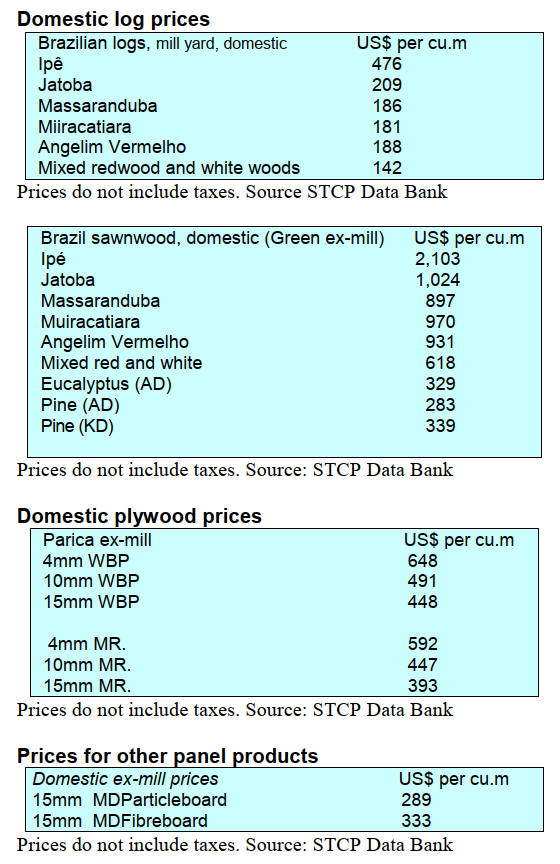
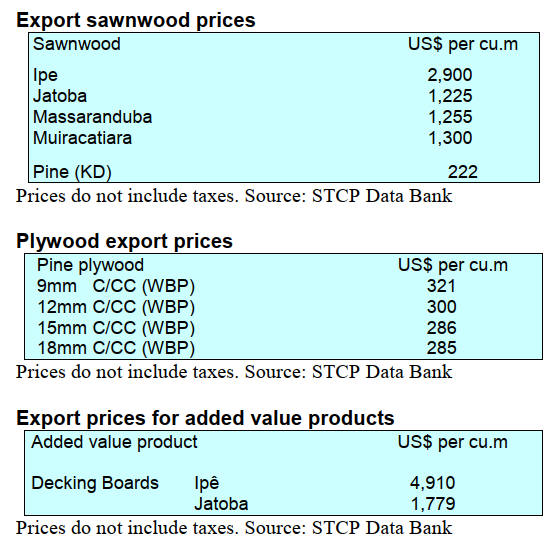
Export prices
Average FOB prices Belém/PA, Paranaguá/PR,
Navegantes/SC and Itajaí/SC Ports.
9. PERU
Partnership to promote sustainable
forest
management
The National Forest and Wildlife Service (Serfor) has
strengthened its role as a partner in the Biodiversity
Landscapes Fund (BLF) Andes-Amazon project. This UK-
funded initiative, led by the organisation ‘Practical
Action’, promotes forest conservation and sustainable
development in the region.
In Peru, the project carries out activities in the Povinces of
Jaén and San Ignacio (Cajamarca department), Bagua and
Condorcanqui (Amazonas) and Datem del Marañón
(Loreto), coordinating efforts across sustainable value
chains, biodiversity conservation, restoration and
agroforestry.
The BLF Andes-Amazon project aims to contribute to
biodiversity conservation in these territories by
strengthening indigenous organisations and improving the
income of families in Peru and Ecuador.
See: https://www.gob.pe/institucion/serfor/noticias/1439391-
serfor-y-proyecto-financiado-por-reino-unido-impulsan-gestion-
sostenible-de-bosques
CITEforestal Pucallpa secures unique INACAL
accreditation for wood testing
CITEforestal Pucallpa, part of the ITP CITE network, has
secured accreditation from the National Quality Institute
(INACAL) for two tests of particular importance to the
forestry and timber value chain: the macroscopic
identification of timber species and the determination of
wood moisture content.
This recognition strengthens the technical and laboratory
capabilities available to the sector, helping to improve the
quality, traceability and reliability of timber products.
Of the two tests, the "Macroscopic Identification of
Timber Species" stands out. Its accreditation marks a
significant milestone for the forestry sector, positioning
the CITEforestal Pucallpa laboratory as the only one in
Peru accredited to perform this type of analysis.
The implementation of this certified test represents a
strategic advancement for the Peruvian forestry industry
on multiple fronts as a tool against illegality and in terms
of commercial value and global competitiveness.
See: https://www.gob.pe/institucion/itp/noticias/1437598-
produce-citeforestal-pucallpa-logra-acreditacion-de-inacal-unica-
en-latinoamerica-para-ensayos-de-madera
Training on primary wood processing in Ucayali
More than 130 entrepreneurs, professionals, technicians
and workers from the forestry sector participated in a
training programme designed to strengthen their
knowledge and help improve sawmill production.
The initiative was driven by CITEforestal Pucallpa, part of
the Institute of Production Technology (ITP), in
coordination with the Sustainable Productive Forests
(BPS) Programme. Participants enhanced their knowledge
in areas critical to the industry, such as the maintenance
and sharpening of bandsaws, sawing techniques, wood
drying, inventory management and quality control at
primary processing centres.
These centres play a vital role in the forestry supply chain
by carrying out processes such as log registration, volume
measurement, sawing, grading, drying and conditioning
wood for domestic and international markets.
See: https://www.gob.pe/institucion/itp/noticias/1432598-
ucayali-capacitaran-a-mas-de-130-actores-de-los-centros-de-
transformacion-primaria-de-la-madera |