|
Report from
Europe
Tropical wood product imports increased driven by
plywood and flooring
EU27 import volumes of tropical wood and wood
furniture products increased during the first half of 2026,
although the underlying market remains fragile and the
recovery is heavily concentrated in a small number of
product groups. Imports of 867,000 tonnes of tropical
wood and wood furniture in January-June 2026 were 14%
more than the same period in 2025.
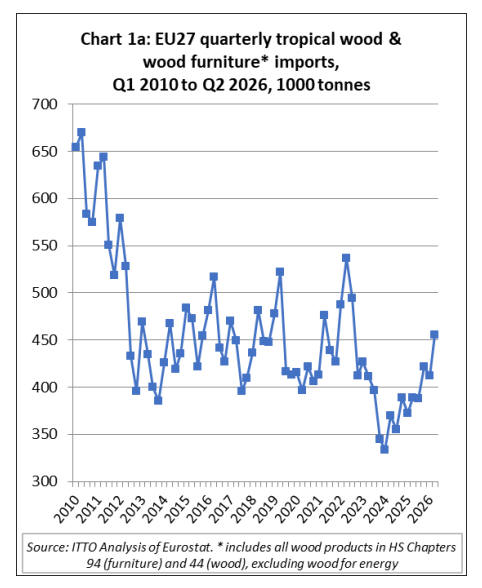
Import volume also increased during the second quarter,
reaching 455,000 tonnes, 17% more than the same quarter
last year and 11% more than in the first quarter of 2026.
(Chart 1a above).
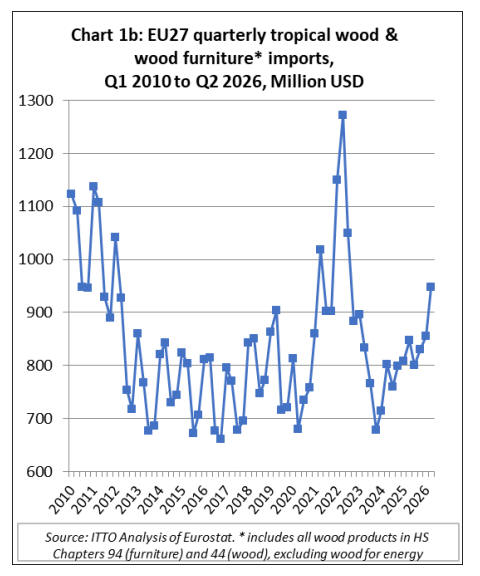
The total EU27 tropical wood and wood furniture import
value in January-June 2026 was US$1.80 billion, 9% more
than the same period last year. Import value in the second
quarter, at US$947 million was 12% more than the same
quarter in 2025 and 11% higher than the first quarter of
this year.
In nominal terms (not accounting for inflation), first-half
import value was slightly above the corresponding period
in 2019. However, import volume remained around 13%
below the pre-pandemic level of 2019, indicating that the
apparent recovery in nominal trade value continues to be
accompanied by substantially lower physical volumes than
before the pandemic. (Chart 1b).
The headline increase in imports nevertheless gives an
overly positive impression of underlying demand. The
sharp rise in tropical plywood and flooring imports
accounted for almost all of the increase in total import
volume. Excluding these two product groups, EU27
tropical wood and wood furniture import volume was
broadly unchanged from the first half of 2025. This
suggests that the wider recovery in demand for tropical
wood products remains limited.
Subdued European economy dampens demand
The wider European economic environment showed some
signs of resilience during the second quarter of 2026,
although the underlying outlook remains subdued.
Preliminary Eurostat data indicates that euro area GDP
increased by 0.4% in the second quarter compared with
the previous quarter, following flat growth in the first
quarter. GDP across the EU27 increased by 0.5% in the
second quarter.
On a year-on-year basis, euro area GDP was 1.0% higher.
However, growth remained uneven across member states,
with Spain expanding by 0.7% and Germany, France and
Italy each recording growth of only 0.2%.
Recent forecasts from major international institutions
remain cautious regarding the eurozone outlook for 2026.
The ECB's June 2026 Eurosystem staff projections
reduced expected euro area GDP growth in 2026 to 0.8%,
from 0.9% in its March projections. The OECD also
forecasts growth of 0.8% for the euro area this year.
The ECB expects higher energy prices associated with the
conflict in the Middle East to push average euro area
inflation to 3.0% in 2026, with inflation reaching 3.4% in
the third and fourth quarters.
The Q2 economic rebound therefore provides some
grounds for cautious optimism but it has yet to translate
into a broad improvement in domestic demand and
investment. The ECB expects private consumption to
remain the main driver of growth, while investment is
likely to remain constrained by uncertainty and higher
costs.
Slow eurozone construction puts the brakes on wood
consumption
The weakness of the European construction sector
continues to be a particularly significant drag on demand
for timber and wood products. Construction activity
remained firmly in contraction territory throughout the
second quarter, with the S&P Global/HCOB Eurozone
Construction PMI remaining well below the 50 threshold
separating expansion from contraction. New orders also
remained weak, indicating that construction companies
continued to face a poor pipeline of new work.
The downturn remained broad-based across the eurozone,
with particularly weak performance in France and
Germany. Commercial construction, residential
construction and civil engineering all remained under
pressure, while elevated financing costs, weak housing
investment, high energy prices and continuing economic
uncertainty continued to constrain activity.
These conditions continue to weigh heavily on European
demand for tropical wood products, particularly higher-
value interior and construction-related product groups
such as furniture, joinery products, mouldings and
decking. The strong increase in imports of plywood and
flooring during the first half of 2026 is therefore not yet
evidence of a broad-based recovery in tropical timber
consumption.
Instead, it appears to reflect a combination of product-
specific factors, changes in sourcing patterns and
exceptionally low comparison figures for some products.
5% decrease in EU27 tropical wood furniture imports
in the first half of 2026
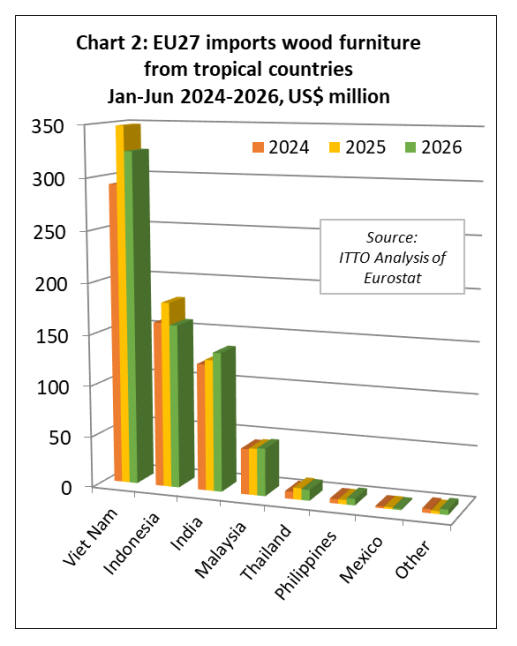
The EU27 imported 165,000 tonnes of wood furniture
from tropical countries with a total value of US$689
million in January-June 2026. Import quantity and value
were down 2% and 5% respectively compared to the same
period in 2025. This contrasts with the overall increase in
EU tropical wood imports and indicates that demand for
tropical wood furniture remains subdued.
EU27 import value of wood furniture decreased from Viet
Nam (-7% to US$324.2 million), Indonesia (-12% to
US$159.5 million) and Thailand (-7% to US$10.5
million). However, imports increased from India (+6% to
US$135.7 million), Malaysia (+2% to US$46.5 million)
and the Philippines (+46% to US$6.3 million). (Chart 2).
The continued weakness of furniture imports is significant
because furniture is less directly linked to construction
activity than many other tropical wood products and
provides an indication of wider consumer and
discretionary demand. The decline during the first half
therefore suggests that the improvement in overall EU
economic activity has not yet resulted in a broad recovery
in demand for tropical wood furniture.
EU27 imports of tropical sawnwood increase but from
exceptionally low levels
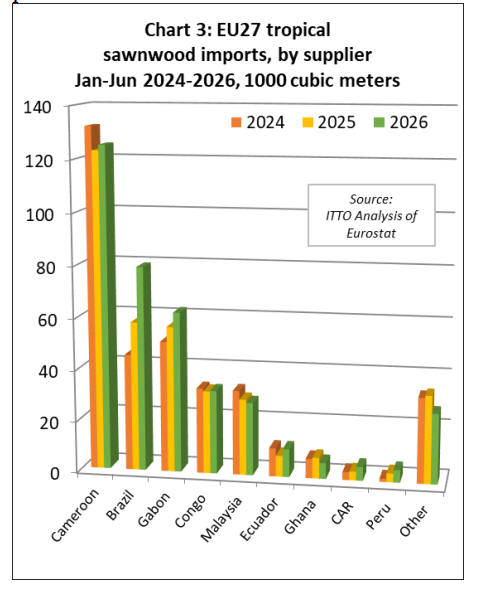
The EU27 imported 382,000 cu.m of tropical sawnwood
with a total value of US$369.3 million in January-June
2026, respectively 7% and 13% more than the same period
in 2025. Although the increase is significant, imports
remain well below long-term historical levels.
Tropical sawnwood imports increased strongly from
Brazil (+37% to 79,300 cu.m), Gabon (+10% to 62,200
cu.m), Ecuador (+33% to 10,900 cu.m), Peru (+41% to
4,800 cu.m) and the Central African Republic (+57% to
5,400 cu.m).
Imports also increased slightly from Cameroon (+2% to
125,200 cu.m), the Republic of Congo (+1% to 32,400
cu.m), Indonesia (+4% to 3,600 cu.m) and Viet Nam (+5%
to 2,900 cu.m).
However, imports declined from Ghana (-24% to 6,200
cu.m), the Democratic Republic of Congo (-24% to 3,200
cu.m), Côte d'Ivoire (-12% to 2,500 cu.m) and Malaysia (-
4% to 28,300 cu.m). (Chart 3).
The increase in sawnwood imports during the first half is
therefore relatively broad-based among several major
African and Latin American suppliers, although the
market remains far below the levels recorded before the
pandemic.
EU27 imports of tropical mouldings and decking quiet
The EU27 imported 57,700 tonnes of tropical mouldings
and decking products with a total value of US$106.6
million in January-June 2026. Import quantity was 5% less
than the same period in 2025, although import value was
3% higher.
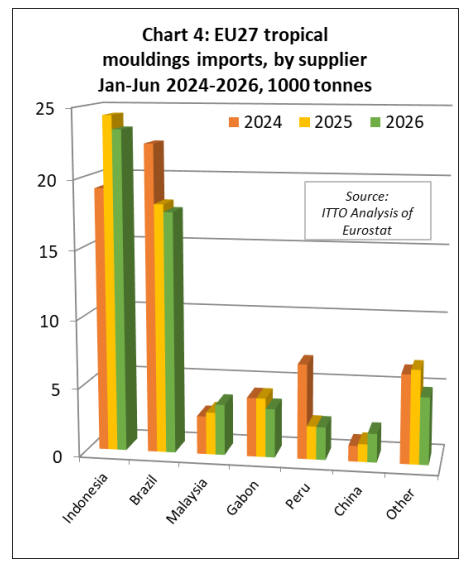
Imports declined from Indonesia (-4% to 23,400 tonnes),
Brazil (-3% to 17,600 tonnes), Gabon (-17% to 3,600
tonnes) and Peru (-1% to 2,400 tonnes). However, imports
increased from Malaysia (+20% to 3,700 tonnes) and
China (+62% to 2,100 tonnes). (Chart 4).
The continued decline in import volume is consistent with
the weakness of the European construction and renovation
sectors.
The increase in import value despite lower volume also
indicates some resilience in prices and product mix but
there is little evidence yet of a sustained recovery in
underlying demand.
EU27 tropical log imports remain in decline
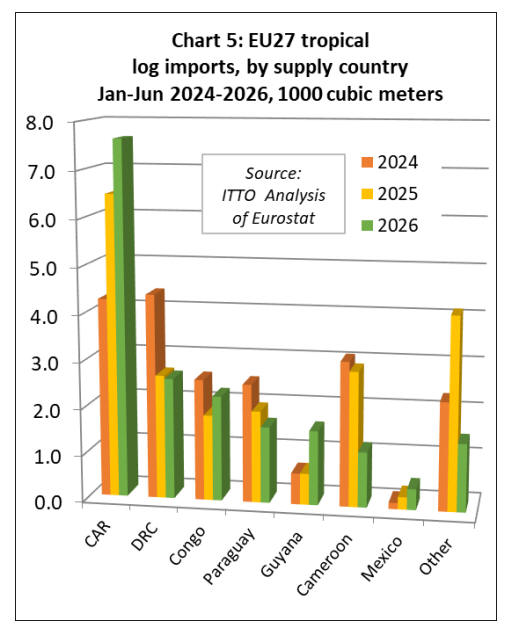
The EU27 imported 18,800 tonnes of tropical logs in
January-June 2026, 10% less than the same period in
2025. Import value was relatively stable at US$11.9
million.
Imports increased from the Central African Republic
(+18% to 7,600 tonnes), the Republic of Congo (+23% to
2,300 tonnes), Guyana (+139% to 1,600 tonnes) and
Mexico (+68% to 400 tonnes). However, imports declined
sharply from Cameroon (-59% to 1,200 tonnes), Paraguay
(-17% to 1,600 tonnes) and the Democratic Republic of
Congo (-2% to 2,600 tonnes). (Chart 5).
The continued low level of tropical log imports reflects the
combination of much tighter controls on log exports from
Central Africa and the long-term decline in EU demand
for imported tropical logs, with the market increasingly
focused on processed products rather than raw material.
EU27 tropical veneer imports remain broadly stable
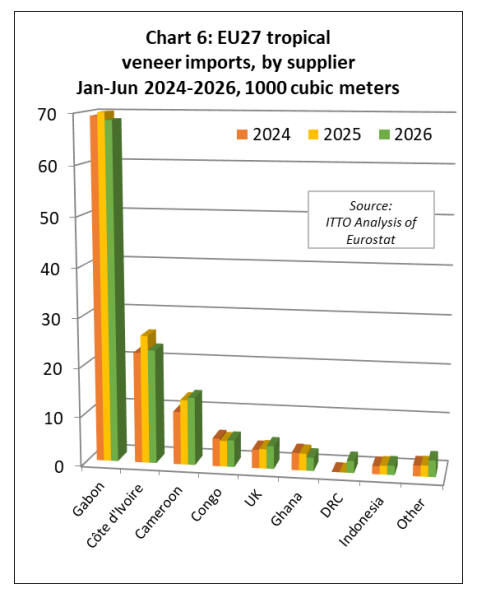
The EU27 imported 125,800 cu.m of tropical veneer in
January-June 2026, broadly unchanged from the same
period in 2025. However, import value increased 7% to
US$94.3 million.
Imports increased from Cameroon (+4% to 13,800 cu.m),
the Republic of Congo (+4% to 5,400 cu.m), the UK
(+18% to 4,700 cu.m), Indonesia (+6% to 1,900 cu.m) and
the Democratic Republic of Congo, which supplied 2,400
cu.m compared with negligible imports in the same period
last year.
However, imports declined from Gabon (-2% to 68,500
cu.m), Côte d'Ivoire (-11% to 23,100 cu.m) and Ghana (-
21% to 2,700 cu.m). (Chart 6).
The combination of broadly stable volume and higher
import value suggests a relatively resilient market for
tropical veneer despite the wider weakness in European
demand.
Higher imports of tropical hardwood plywood in
response to anti-dumping measures
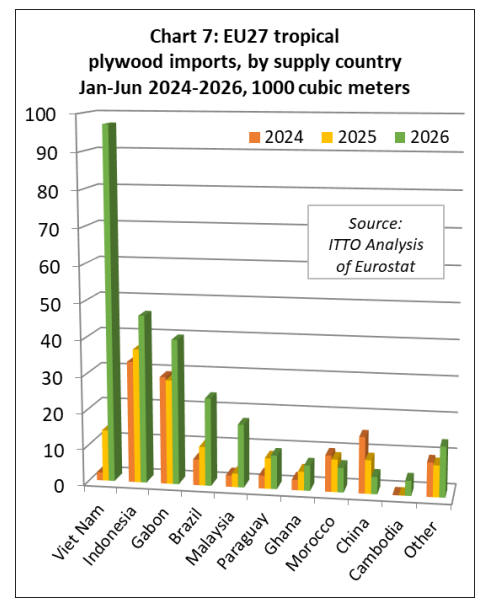
The EU27 imported 270,700 cu.m of tropical plywood
with a total value of US$168.6 million in January-June
2026, up 101% and 75% respectively compared to the
same period in 2025.
The exceptional increase was driven primarily by Viet
Nam, from which imports of plywood reached 97,100
cu.m, nearly seven times the volume imported in the same
period last year. Imports from Viet Nam alone accounted
for more than one-third of total EU27 imports of plywood
from tropical countries during the first half of 2026. (Chart
7 ).
There was also a very large increase in imports of
plywood faced with non-tropical hardwood species from
Viet Nam. EU27 imports of this product from Viet Nam
reached US$130.8 million in January-June, compared with
US$14.5 million in the same period of 2025. This
indicates the extent to which Vietnamese plywood
producers have increased their presence in the EU market
following the introduction of anti-dumping duties on
hardwood plywood from China.
There were also significant gains in EU27 first-half
imports of tropical hardwood plywood from Indonesia
(+25% to 46,200 cu.m), Gabon (+39% to 39,900 cu.m),
Brazil (+125% to 24,200 cu.m), Malaysia (+363% to
17,400 cu.m), Paraguay (+10% to 9,300 cu.m) and Ghana
(+35% to 7,000 cu.m). Imports from Cambodia also
increased substantially, to 4,100 cu.m. However, imports
declined from China (-49% to 4,700 cu.m) and Morocco (-
24% to 6,800 cu.m).
The continuing surge in plywood imports appears to be
driven substantially by changes in sourcing following the
EU anti-dumping measures on Chinese hardwood
plywood, rather than by a corresponding increase in
underlying European construction demand. The
exceptionally strong growth in imports from Viet Nam and
several other alternative suppliers has displaced a
significant proportion of Chinese supply.
Strong increase in EU27 imports of tropical wood
flooring
The EU27 imported 34,100 tonnes of tropical wood
flooring with a total value of US$94.1 million in January-
June 2026, up 130% and 151% respectively compared to
the same period in 2025.
Imports increased sharply from Viet Nam (+106% to
11,600 tonnes), Cambodia (+1,257% to 6,200 tonnes),
Indonesia (+190% to 6,000 tonnes) and Thailand (+946%
to 4,300 tonnes). Imports from Malaysia declined slightly
(-5% to 5,400 tonnes). (Chart 8).
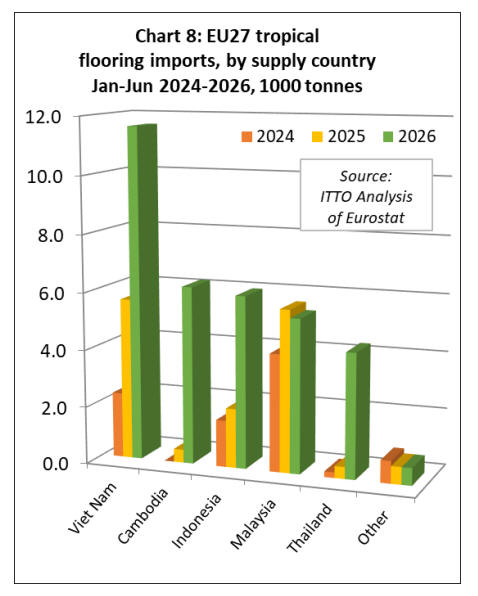
The exceptionally strong increase in flooring imports
follows the substantial growth already recorded in the first
quarter and represents the second major product category,
alongside plywood, contributing to the overall increase in
EU tropical wood imports during the first half of 2026.
However, as with plywood, the scale of the increase partly
reflects the low comparison base and changing sourcing
patterns and should not be interpreted as evidence of a
broad recovery across the tropical hardwood market.
EU27 import value of other joinery products remains
broadly stable
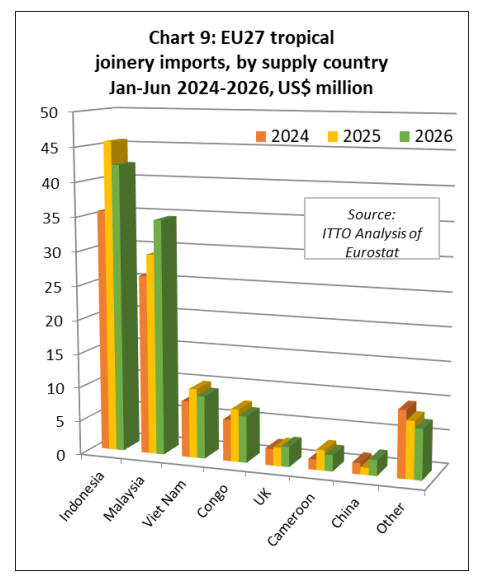
EU27 import value of other joinery products from tropical
countries – mainly laminated window scantlings, kitchen
tops and wood doors – was US$108.1 million in January-
June 2026, broadly unchanged from the same period last
year. Import quantity was also virtually unchanged at
48,700 tonnes. (Chart 9).
Import value increased from Malaysia (+17% to US$34.6
million), the UK (+10% to US$3.0 million) and China
(+113% to US$2.3 million). However, imports declined
from Indonesia (-7% to US$42.3 million), Viet Nam (-
10% to US$9.3 million), the Republic of Congo (-12% to
US$6.9 million), Cameroon (-20% to US$2.4 million) and
other supplying countries.
The broadly stable level of joinery imports suggests that
demand for these higher-value processed products has so
far remained resilient but has not entered a clear recovery
phase.
Outlook for 2026: restructuring of supply chains in
response to anti-dumping measures and EUDR
While the January-June trade figures show that the
European market for tropical wood market is stronger in
aggregate than a year ago, it is also clear that the
improvement is highly concentrated.
EU27 tropical wood and wood furniture imports increased
14% in volume and 9% in value during the first half of
2026 but almost all of the increase in physical volume
came from tropical plywood and flooring. Excluding these
two product groups, import volume was broadly
unchanged from the first half of 2025.
This distinction is important when assessing prospects for
the remainder of the year. The strong increase in plywood
imports is closely associated with the restructuring of EU
supply following the introduction of anti-dumping duties
on Chinese hardwood plywood, with Viet Nam emerging
particularly strongly as an alternative supplier.
The flooring market has also expanded rapidly, with large
increases in imports from Viet Nam, Cambodia, Indonesia
and Thailand. These product-specific factors are likely to
continue supporting import volumes in the second half,
although the exceptional rates of increase recorded during
the first half are unlikely to be sustained indefinitely as the
market adjusts to the new supply structure.
Elsewhere, the picture remains much less positive.
Tropical sawnwood imports have increased from
exceptionally low levels but remain well below historical
norms. Mouldings and decking imports have declined in
volume, while furniture imports are also lower than last
year.
Veneer and joinery imports have remained broadly stable.
These trends suggest that the improvement in overall EU
economic activity has yet to translate into a broad-based
recovery in demand for tropical hardwood products.
The wider European economic outlook provides some
support for a gradual improvement during the second half
of the year. Euro area GDP increased 0.4% in the second
quarter, while the ECB and OECD both expect growth of
0.8% for the full year. However, the continuing
contraction in European construction activity, together
with renewed energy-price and inflation pressures, means
that the recovery is likely to remain modest and uneven.
For tropical hardwood suppliers, therefore, the remainder
of 2026 is likely to be characterised by selective rather
than broad-based growth in the EU market. Products
benefiting from changes in supply chains, particularly
plywood, should continue to perform relatively strongly,
while flooring may also remain above last year's levels.
For sawnwood, mouldings, decking, furniture and other
higher-value secondary processed products, prospects
remain more dependent on a sustained recovery in
European construction, investment and consumer
spending.
The approach of the EU Deforestation Regulation
implementation date at the end of December 2026 is
another factor likely to influence the market during the
second half of the year.
Importers are increasingly likely to favour suppliers able
to provide reliable traceability and documentation,
potentially reinforcing the position of established supply
chains.
The first-half trade figures do not yet indicate a broad
recovery in EU tropical hardwood consumption. The more
likely scenario for the remainder of 2026 is continued
market restructuring, with strong growth in selected
product groups alongside generally cautious demand
elsewhere.
|


