US Dollar Exchange Rates of
25th
August
2026
China Yuan 6.72
Report from China
Investment in residential property and construction
continues to contract
China’s National Bureau of Statistics recently released
details of investment in real estate development from
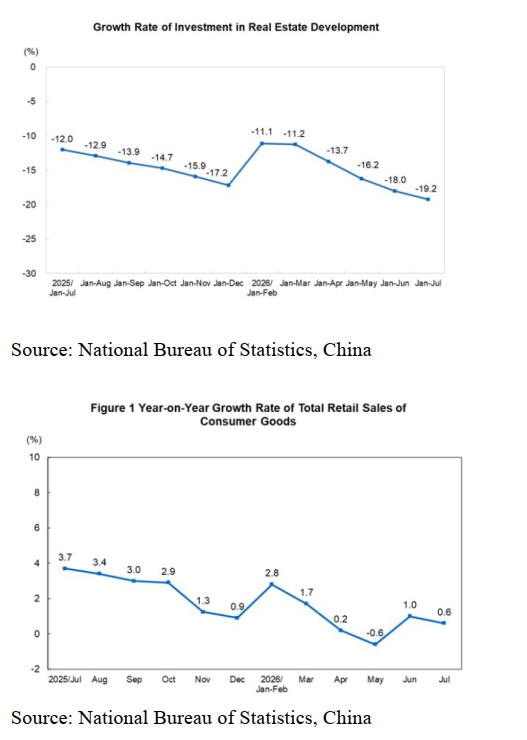
January to July 2026. The accumulated investment was
4,300.9 billion yuan, a year-on-year decrease of 19.2% of
which investment in residential buildings was 3,317.2
billion yuan, also down 19.1%.
China's residential property investment and construction
continues to contract with no immediate, nationwide
recovery in sight and analysts generally do not expect a
meaningful stabilisation before 2027.
The property downturn is entering its sixth year of
contraction, with sales down roughly 65% from peak
levels in 2020.
National home prices have experienced steep corrections
(with market estimates suggesting drops of 40% or more
from previous highs) and further moderate declines are
expected through the remainder of this year.
See: https://internationalreal.estate/insights/china-property-
market-2026-recovery-or-reset
While major tier-one cities like Shanghai and Beijing
show tentative, localised signs of stabilisation or slight
price resilience, smaller tier-three and tier-four cities
remain weighed down by massive housing inventories and
weak buyer confidence.
See: https://www.fitchratings.com/research/corporate-
finance/chinas-property-sector-remains-weak-on-uneven-
recovery-29-06-2026
The real problem, say many, is confidence not just
affordability. China has already deployed multiple support
measures over the last few years, including lower down
payment requirements, looser purchase restrictions in
some cities. Yet the market remains fragile.
The deeper problem is confidence. Buyers worry about
unfinished homes, further price declines, weak
employment prospects and whether housing is still the
safest place to store family wealth.
See: https://internationalreal.estate/insights/china-property-
market-2026-recovery-or-reset
Retail sales underperform
China's retail sales grew by just 0.6% year-on-year in July
2026 undershooting market expectations as weak domestic
demand and a prolonged property slump weighed on
consumer spending.
The impact of previous government subsidies for durable
goods has faded. Data released by the National Bureau of
Statistics highlights that policymakers face growing
pressure to launch deeper economic stimulus to revive
domestic demand.
The Bureau also released an assessment of retail sales of
consumer goods from January to July 2026 indicating the
total retail sales of consumer goods were up by 1.2% year
on year. Specifically, sales excluding automobiles were up
by 2.7% but sales of household furniture dropped 4.5%.
See: https://asianbusinessreview.com/news/china-retail-growth-
masks-weak-consumer-demand
Surge in plywood exports to Myanmar
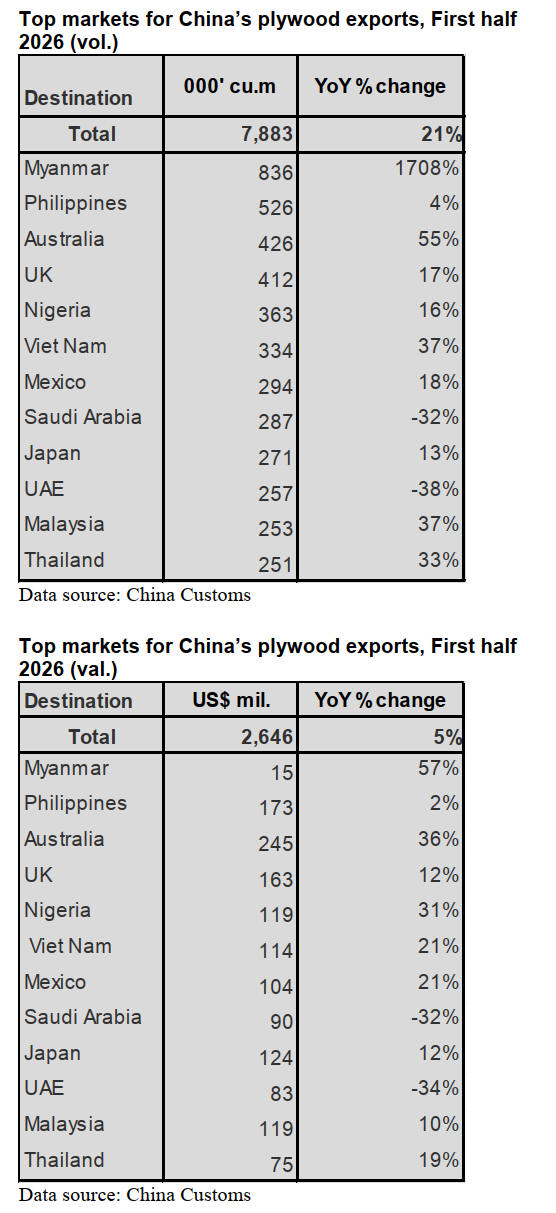
According to China Customs, Myanmar has become the
largest market for China’s plywood exports which totaled
836,000 cubic metres in the first half of 2026.
Analysts speculate that the surge in imports was mainly
due to insufficient local plywood processing capacity in
Myanmar as well as the increase in development of
infrastructure, real estate and downstream furniture
industries.
With an efficient border trade between China and
Myanmar the logistics costs are low and this, coupled with
the tariff benefits of the Regional Comprehensive
Economic Partnership (RCEP) Agreement and the
convenience of cross-border RMB settlement, the trade
conditions are improving.
In the first half of 2026 China’s plywood exports totalled
7.883 million cubic metres valued at US$2.646 billion, up
21% in volume and 5% in value over the same period of
2025.
The proportion of China’s plywood exports to the top 12
destinations accounted for 57% of the national total in the
first half of 2026.
China’s plywood exports to most destinations rose in the
first half of 2026. China’s plywood exports to the
Philippines, Australia, UK, Nigeria, Viet Nam, Mexico,
Japan, Malaysia and Thailand rose 4%, 55%, 17%, 16%,
37%, 18%, 13%, 37% and 33% respectively over the same
period of 2025.
In contrast, China’s plywood exports to Saudi Arabia and
UAE fell 32% and 38% respectively in the first half of
2026.
China’s plywood exports to USA dropped in the first half
of 2026 to 74,008 cubic metres valued at US$46 million,
down 33% in volume and 29% in value respectively over
the same period of 2025.
Decline in plywood imports
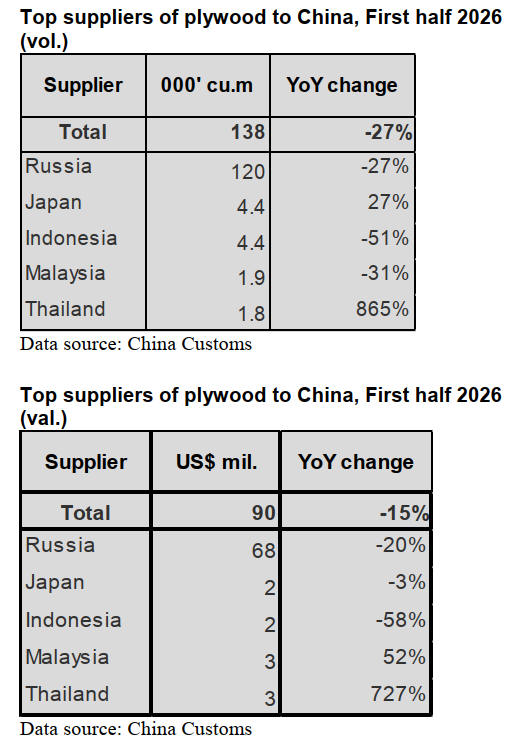
According to China Customs, in the first half of 2026
China’s plywood imports fell 27% to 138,000 cubic
metres valued at US$90 million, down 15% over the same
period of 2025.
Russia was the largest supplier of China’s plywood
imports but the volume of plywood imports from Russia
dropped 27% to 120,000 cubic metres, accounting for 87%
of the national total plywood imports in the first half of
2026.
In addition, China’s plywood from Indonesia and
Malaysia fell 51% and 31% respectively in the first half of
2026. In contrast, China’s plywood imports from Japan
and Thailand, while small, grew in the first half of 2026.
China has sufficient plywood production capacity to meet
domestic demand and thus there is no need to import
plywood.
By the end of 2025 there were over 5,010 enterprises
producing plywood across the country, with a total annual
production capacity of approximately 246 million cubic
metres. This represents an increase of 11% compared to
the end of 2024.
Rise in Particleboard exports
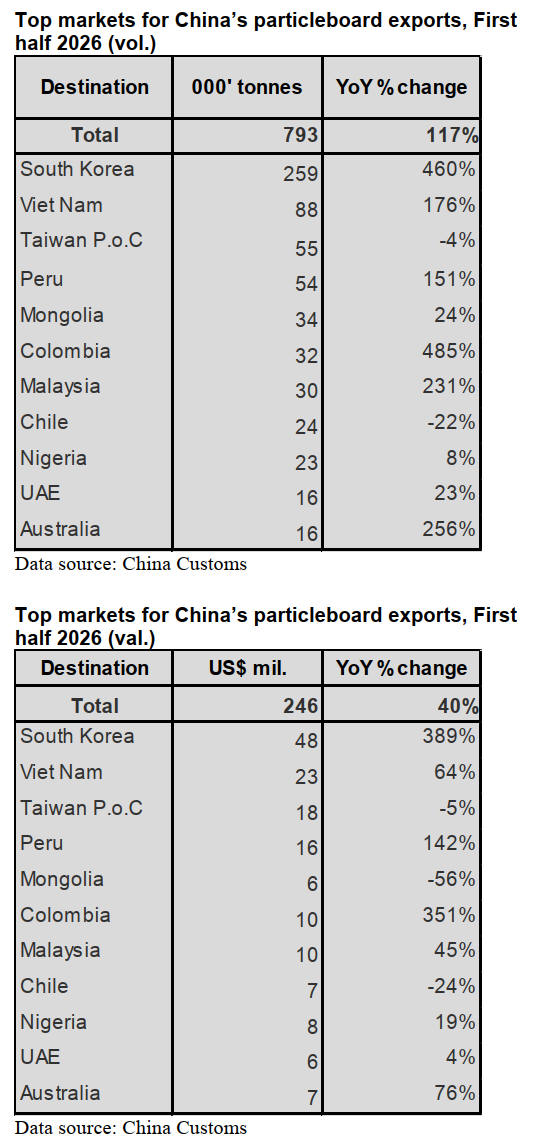
According to China Customs, in the first half of 2026
China’s particleboard exports rose 117% to 793,000
tonnes valued at US$246 million, up 40% over the same
period of 2025.
The top markets for China’s particleboard were South
Korea, Viet Nam, Taiwan P.o.C and Peru but exports to
Taiwan P.o.C and Chile dropped 4% and 22% over the
same period of 2025.
Decline in particleboard imports
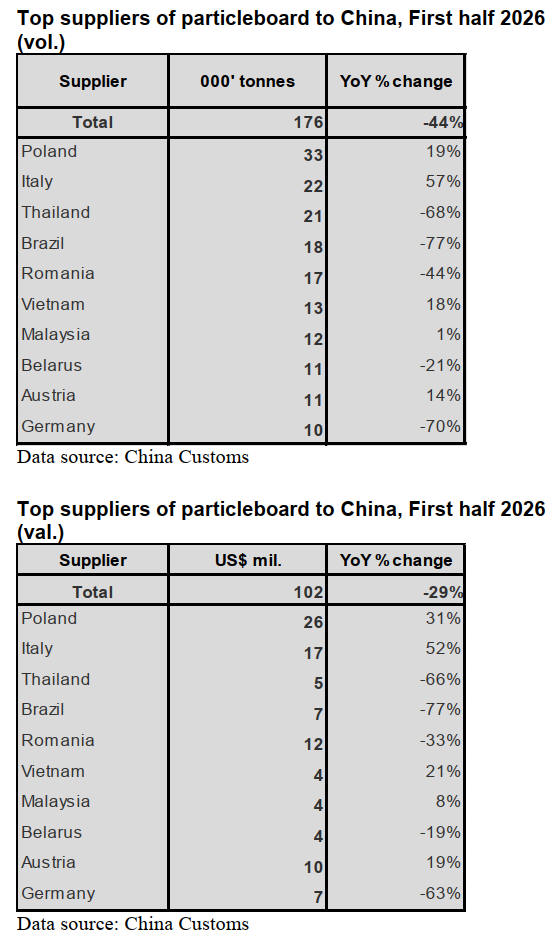
In the first half of 2026, China’s particleboard imports
totalled 176,000 tonnes valued at US$102 million, down
44% and 29% respectively over the same period of 2025.
Particleboard imports declined significantly. The main
reason was the rapid domestic expansion of high-end
production capacity for particleboard with ample supply of
ENF-level environmentally friendly boards and the high
cost-effectiveness of domestic boards.
Custom furniture enterprises shifted to domestic
procurement resulting in a prominent domestic
substitution effect. The downstream demand in the real
estate and home decoration sectors was weak and
enterprises reduced their purchases of imported raw
materials. At the same time the environmental standards
for domestic particleboard were raised and the compliance
costs for some overseas sources increased.
China’s particleboard
imports from Thailand, Brazil,
Romania, Belarus and Germany dropped 68%, 77%, 44%,
21% and 70% in the first half of 2026.
In contrast, China’s particleboard imports from Poland,
Italy, Viet Nam, Malaysia and Austria rose 19%, 57%,
18%, 1% and 14% respectively in the first half of 2026.
Through the eyes of industry
The latest GTI report lists the challenges identified by the
private sector in China
See:
https://www.itto.int/direct/topics/topics_pdf_download/topics_id=401663&no=1
|


