Japan
Wood Products Prices
Dollar Exchange Rates of 25th
August
2026
Japan Yen 159.22
Reports From Japan
Manufacturing sector expanded in August
Japan's manufacturing sector expanded in August as new
orders rose at their fastest pace since January 2018, a
business survey showed. The S&P Global Flash Japan
Manufacturing Purchasing Managers' Index (PMI) rose to
55.1 in August from 54.5 in July, a preliminary estimate
by S&P Global showed. The 50-mark separates growth
from contraction.
The Ministry of Finance has reported Japanese exports
rose 23% year-on-year in July, up for an 11th straight
month while imports grew 28% in July from a year earlier.
This brought the trade balance to a deficit of 634.5 billion
yen,.
See:https://www.reuters.com/world/asia-pacific/japan-exports-
rise-232-yearyear-july-2026-08-19/
Machinery orders in June 2026 and forecast for 3rd
quarter
Data on Japanese machinery sales and orders, specifically
core machinery orders is a widely watched leading
indicator for corporate capital spending and future
economic growth.
Japan’s core machinery orders, which exclude volatile
sectors such as ships and electric utilities, jumped 9.7%
month-on-month in June 2026, shifting from a 12.4% drop
in the prior month and exceeding market forecasts of a
7.8% gain.
This was the third increase so far this year, also marking
the fastest pace since February reflecting broad-based
recovery in business investment.
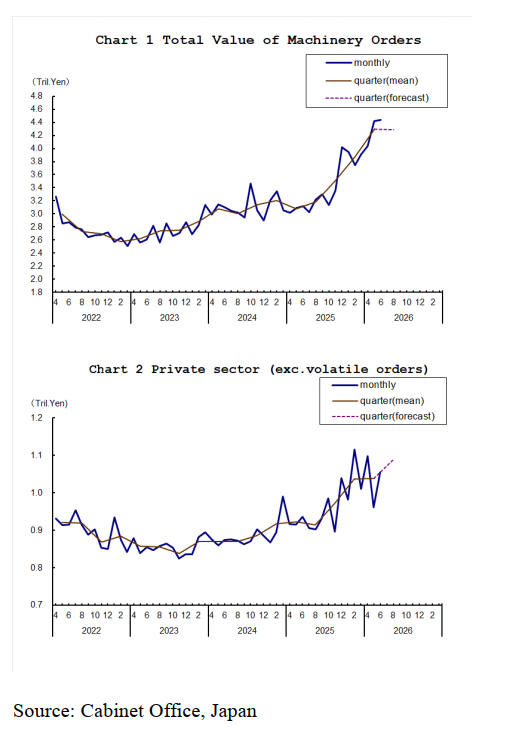
The total value of machinery orders received by 280
manufacturers operating in Japan increased by 0.4% in
June from the previous month on a seasonally adjusted
basis. In the April-June period orders increased by 11.3%
compared with the previous quarter.
In the July-September period the total amount of
machinery orders is forecast to decrease by 0.1% and
private-sector orders, excluding volatile ones, were
forecasted to increase by 4.9% from the previous quarter.
See: https://www.esri.cao.go.jp/en/stat/juchu/2026/2606juchu-
e.html
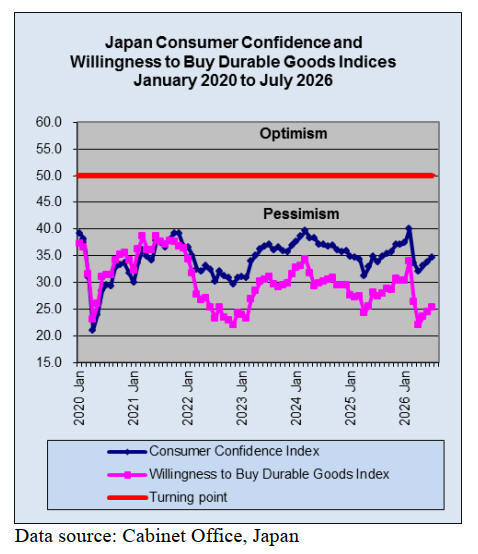
Deep-seated pessimism among Japanese households
Japan's Consumer Confidence Index has historically
remained below the 50-point neutral threshold for decades,
reflecting deep-seated structural pessimism among
Japanese households.
This persistent pessimism has altered spending habits,
creating distinct structural shifts in the household furniture
market.
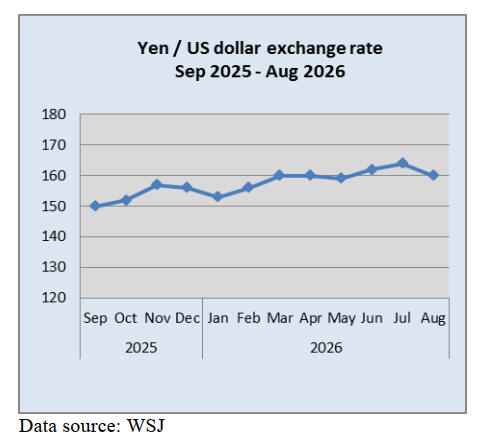
Yen intervention boost short lived
The Japanese yen has resumed its downward trend over
the past two weeks, giving up the gains made after Japan
and the US spent billions of dollars to prop up the yen
which was at four-decade low at one point.
The yen briefly strengthened to 155 per dollar after the
intervention in late July. But the rally quickly faded and
the currency was trading at around 159 in late August. The
Japanese and US governments have indicated they would
not hesitate to intervene again if “disorderly yen
movements” persisted.
The weakening after the intervention highlights the limits
of one-off currency interventions while investors remain
uneasy about Japan’s enormous debt burden, its aggressive
spending plans and a perception that the Bank of Japan is
raising interest rates too slowly.
See: https://www.nytimes.com/2026/08/14/business/japan-yen-
intervention.html
Recent multi-billion dollar efforts by Tokyo and
Washington to buy the yen and stop its slide have failed to
create lasting improvements because the underlying
interest rate and debt fundamentals remain unchanged.
Professor Ueda Kenichi of the University of Tokyo has
published an article “The Way to Revitalise Japan’s
Economy: The Government Should Not Intervene in
Prices and Business Activities.”
His conclusion is that what is truly needed is not economic
measures to counter business cycles but policies to
promote medium to long-term structural economic growth.
Research so far clearly shows that fiscal and monetary
policies for countering business cycles do not contribute to
this goal. What is effective are structural reforms that
unleash greater private sector dynamism. The only way
forward is to identify structural problems and improve
them to ensure that the market economy functions
effectively.
He says, “Japan has a variety of structural problems but
the one that comes closest to fiscal and monetary policies
is government intervention in various prices and business
activities.”
See:
https://www.japanpolicyforum.jp/economy/pt202502031152201
5093.html
Rate increase likely in September
It is widely expected that the Bank of Japan (BoJ) will
raise its benchmark interest rate next month, validating
widespread market speculation is likely to follow up with
another increase as early as January, according to a former
BoJ board member, Seiji Adachi.
With the yen still weak even after Japan/US coordinated
intervention, a decision to hold interest rates steady could
reignite a sell-off of the currency, raising the risk of faster
inflation due to costly imports.
See:
https://www.japantimes.co.jp/business/2026/08/25/economy/boj-
rate-hike-ex-official/
Soaring cost driving up home prices
New home prices in Japan are climbing rapidly due to
soaring labour shortages, rising material costs (including
petroleum-based petrochemicals like naphtha) and
increased land values, making new-build ownership
increasingly difficult for average buyers.
Bottlenecks and higher input costs for petroleum
derivatives (affecting pipes, insulation, paint and
waterproofing) have pushed builders to implement steep
price hikes. High construction expenses are shifting buyer
interest toward the existing home and renovation market
rather than brand-new builds.
While urban centres face a severe affordability crunch,
rural areas and depopulating regions struggle with millions
of vacant properties that hold little market value. High
construction costs are strengthening the case for Japan to
make better use of its existing homes.
Industry groups are pushing for more support for
renovation, energy-efficiency upgrades and a stronger
resale market that could help sound older properties
remain useful for longer.
See: https://www.patiencerealty.com/post/japan-high-
construction-costs-put-existing-homes-further-in-focus
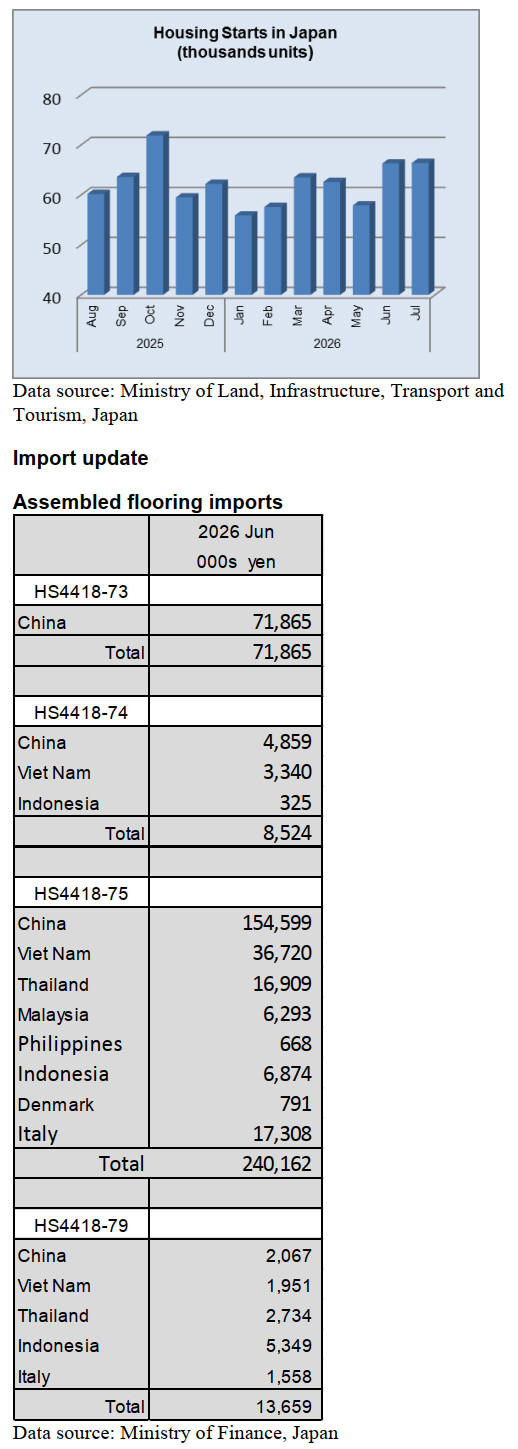
Assembled wooden flooring
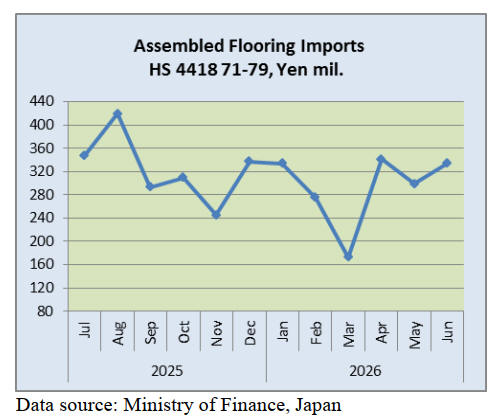
Year on year, June 2026 imports of assembled flooring
(HS441871-79) were at around the same level as in June
2025 but compared to a month earlier June2026 imports
were up12%. In the first quarter of 2026 the value of
imports dropped. This period corresponded with the time
the yen had fallen to decade lows.
In June 2026, shippers in China accounted for all of
HS4418-73 imports, the value of which was 24% higher
than in May. The value of June imports of HS4418-73
accounted for 21.5% (19% in May) of total assembled
flooring imports. The value of HS441874 imports in June
2026 was down 23% from a month earlier with China and
Viet Nam being the main shippers.
Of the various categories of assembled flooring imports
,HS441875 was the largest accounting for 72% of all
assembled flooring imports (71% in May) with China,
Viet Nam, Italy and Thailand providing most of these
imports. HS441879 accounted for 4% of total imports but
were down 26%. Indonesia and Thailand were the main
shippers of HS441879 in June 2026.
Assembled wooden flooring
Year on year, June 2026 imports of assembled flooring
(HS441871-79) were at around the same level as in June
2025 but compared to a month earlier June2026 imports
were up12%. In the first quarter of 2026 the value of
imports dropped. This period corresponded with the time
the yen had fallen to decade lows.
In June 2026, shippers in China accounted for all of
HS4418-73 imports, the value of which was 24% higher
than in May. The value of June imports of HS4418-73
accounted for 21.5% (19% in May) of total assembled
flooring imports. The value of HS441874 imports in June
2026 was down 23% from a month earlier with China and
Viet Nam being the main shippers.
Of the various categories of assembled
flooring imports
,HS441875 was the largest accounting for 72% of all
assembled flooring imports (71% in May) with China,
Viet Nam, Italy and Thailand providing most of these
imports.
HS441879 accounted for 4% of total imports but were
down 26%. Indonesia and Thailand were the main
shippers of HS441879 in June 2026.
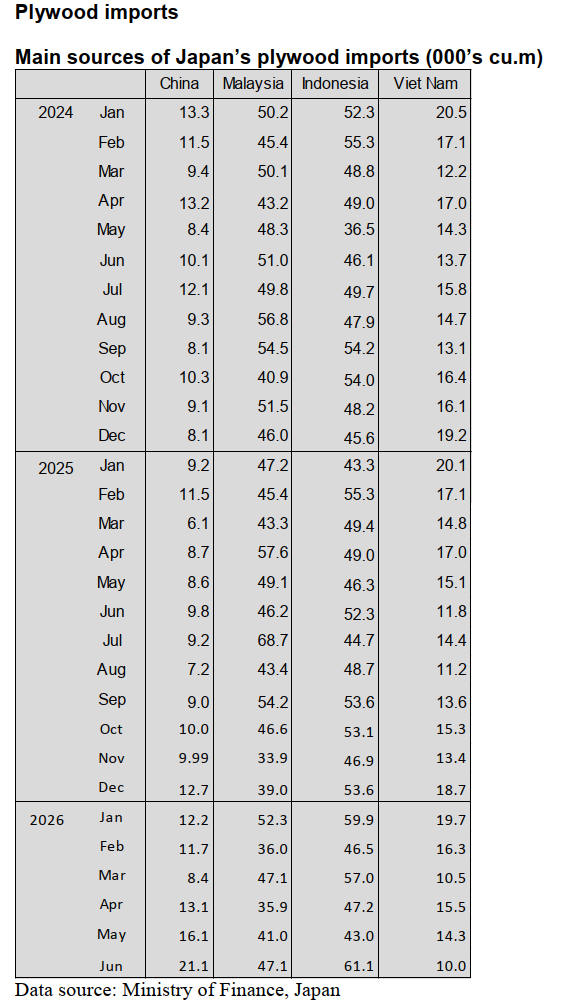
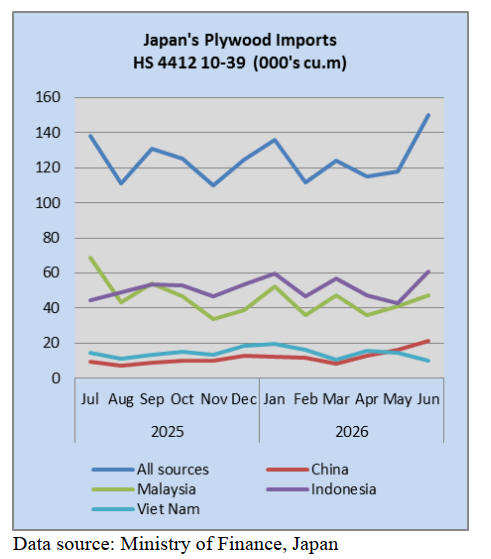
The volume of June 2026 imports of plywood (HS441210-
39) was 25% higher than in June 2025 and 17% up on the
volume of imports in May of 2026. Imports from the top
four shippers, Indonesia, Malaysia China and Viet Nam
accounted for 93% (139,300) of June imports with the
balance coming from mainly Finland, Poland and Latvia.
The top suppliers, Indonesia and Malaysia accounted for
over 90% of June imports (84% in May). The volume of
imports from top shippers Indonesia and Malaysia
increased month on month rising 42% and 15%
respectively. June imports volumes from China were 31%
higher than in May but imports from Viet Nam were down
28% compared to May.
In June 2026 arrivals of HS441210-39 were reported at
149,950 cu.m (118,000 cu.m in May).
As in previous months, of the various categories of
plywood imported in May 2026, HS4412-31 accounted for
79% (80% in May) followed by HS4412-33, 7% (7% in
May), HS4412-34 6% (6% in May) with the balance being
HS4412-39 and HS4412-10.
Trade news from the Japan Lumber Reports (JLR)
The Japan Lumber Reports (JLR), a subscription trade
journal published every two weeks in English, is
generously allowing the ITTO Tropical Timber Market
Report to reproduce news on the Japanese market
precisely as it appears in the JLR. For the JLR report
please see: https://jfpj.jp/japan_lumber_reports/
Prefectural log production in 2025
According to the 2025 Wood Supply and Demand
Statistics, national log production was led by Hokkaido,
which recorded 2.795 million cbms, a 2% decline from the
previous year. It was followed by Miyazaki at 1.829
million cbms (–4%), Akita at 1.205 million cbms (+10%),
Oita at 1.17 million cbms (+15%), Iwate at 1.13 million
cbms (–3%), and Kumamoto at 1.021 million cbms
(+11%). These six prefectures all exceeded one million
cbms in annual production.
National production by species totaled 12.184 million
cbms of cedar (+4%), 3.049 million cbms of cypress
(+1%), 1.692 million cbms of larch (–2%), and 1.134
million cbms of Yezo spruce/Sakhalin fir (–9%).
South Sea log and products
Prices for tropical hardwood products remain firm in
Japan as high origin prices and yen depreciation continue
to support domestic market levels. Tropical hardwood
lumber shows no signs of decline, with reduced log output
and elevated production costs at origin keeping prices
high. In laminated free boards, Indonesian merkusii pine
products reflect strong upward pressure from suppliers,
with new contracts offered at US$900 per m³ (C&F)—a
substantial increase from the current US$820–850 range.
However, delays in the arrival of earlier-priced cargo have
slowed progress on new contracts. Chinese manufacturers
of laminated free boards have also begun raising prices for
red pine and radiata pine products, citing firm pricing from
Indonesian suppliers and increased switching demand
away from merkusii pine.
Supply of tropical hardwood logs remains balanced. The
next shipment from Papua New Guinea is expected around
October, while Malaysia continues to ship required
volumes via container. Reduced log output at origin has
made it increasingly difficult to secure high-quality logs
for Japan, raising procurement costs. Log prices at origin
continue to show a gradual upward trend.
New wood-pellet JAS Standard takes effect
Japan’s agriculture ministry has enacted the new JAS
0030:2026 standard for wood-pellet fuel, replacing the
2023 version and reorganizing categories to align with
ISO 17225-2. The updated standard strengthens
international reliability by introducing finer classifications
for mechanical durability and requiring mandatory
labeling of ash-melting behavior.
Plywood
Domestic plywood manufacturers raised July shipment
and arrival prices for 12-mm softwood structural panels by
about 5%. Although the theoretical increase brings prices
to ¥1,470/m³, negotiations took time due to easing
procurement pressure in the building-materials distribution
channel, resulting in a ¥1,420–1,430/m³ market center in
the Tokyo region.
In July, demand through building-materials distributors
slowed as temporary buying subsided, while direct
procurement by major precut plants and housing
manufacturers remained steady. Trading firms report that
overall sales volumes were “better than expected.” With
the August holiday period approaching, domestic plywood
movement is expected to soften.
Production costs continue to rise, and manufacturers aim
to fully implement July’s intended increases, keeping
August prices flat and signaling further hikes from
September.
Imported tropical plywood remains on a firm footing in
both Malaysia and Indonesia as adhesive, log
procurement, and fuel costs climb. Malaysian coated
formwork panels face paint shortages, likely reducing
arrivals from July onward, though local production delays
have begun to ease. Export prices have risen: Malaysian
coated formwork plywood to US$630–650/m³, standard
formwork to US$540–560/m³, and Indonesian ordinary
plywood to US$990–1,020/m³ for 2.4-mm and US$900/m³
for 5.2-mm.
Domestic distribution of imported plywood shows a
stronger sense of saturation than domestic products, with
port inventories remaining full amid weak demand.
However, stocks of 2.4-mm to 5.2-mm ordinary plywood
are tightening, raising the possibility of sudden shortages
if demand picks up. Market prices remain stable: coated
formwork panels at ¥1,950 per sheet, and ordinary
plywood at ¥880, ¥1,030, and ¥1,250 depending on
thickness.
Although overseas producers intend to raise prices further,
domestic buyers show limited willingness to follow these
offers.
Domestic logs and lumber
Domestic log markets remain firm for cedar and show
steady recovery in cypress as demand shifts from imported
lumber amid yen depreciation. Extreme heat and the
Kumamoto earthquake may constrain harvesting in
Kyushu, adding upward pressure and potentially
advancing seasonal price increases earlier than usual.
Cedar 4-meter logs trade at ¥14,000– 15,000/m³, while
strong demand for 3-meter logs—used for side-cut stud—
has lifted Miyazaki to ¥17,500. Hinoki has rebounded to
¥17,000–18,000, with several regions returning to the
¥20,000 range as supply tightened after producers shifted
away during spring’s low-price period.
Concerns over adhesive shortages did not materialie,
allowing cedar laminated column production to remain
stable. High imported-lumber costs and yen depreciation
continue to support domestic cedar demand, raising KD
stud to ¥60,000–63,000/m³ after sawmills implemented
price increases. Cypress maintains strong sill demand.
Although the Kumamoto earthquake briefly raised supply
concerns, Kyushu mills resumed production quickly,
keeping hinoki KD sill prices stable in the low
¥70,000s/m³ and maintaining market continuity.
|


