|
1.
CENTRAL AND WEST AFRICA
Holiday period slows market activity
The West and Central African timber market remained
relatively quiet through August with the traditional
European summer holiday period continuing to influence
purchasing.
Many government departments and private companies
across the region have been operating at reduced capacity.
The holiday period is contributing to slower decision-
making, documentation and general commercial activity.
This subdued trade is consistent with the wider regional
market where production has recovered from earlier lows
but international buyers remain cautious. Recent industry
reporting indicates that Central African production had
recovered to around 70% of normal capacity entering the
summer period.
See: https://www.atibt.org/en/news/13909/the-tropical-timber-
market-in-central-africa-is-gradually-picking-up?utm
Weather conditions beginning to change
The first meaningful rains are beginning to appear in parts
of the region. This is slightly earlier than expected in some
areas following an extended dry period.
Gabon has benefited from a favourable dry-season
harvesting and transport conditions but the return of
rainfall will gradually begin to change operating
conditions as the region moves towards September.
Cameroon and northern Congo are already experiencing
heavier than usual seasonal rainfall, affecting harvesting
and the movement of logs from concessions. Southern
Congo remains comparatively dry.
European market remains quiet
Europe remains the weakest major destination for many
West and Central African producers. Summer holidays are
partly responsible for the current slowdown but producers
are increasingly concerned about the longer-term impact
of European environmental and timber regulations.
The transition from EUTR towards EUDR is adding
another layer of traceability and compliance requirements
for companies supplying the European market. This is not
limited to timber, with commodities such as coffee, cocoa
and other agricultural products also affected by the EU's
deforestation framework.
The regulatory environment is therefore becoming an
increasingly important factor when African producers
decide where to direct production.
Regulatory pressure on tropical timber
Compliance pressure is continuing to expand beyond
EUDR. European monitoring of tropical timber species
continues to increase with Sapele and the wider
Entandrophragma group including Sipo, Tiama and
Kosipo recently added to EU CITES Annex D.
Imports into Europe now require additional notification at
Customs.
For producers, the concern is not simply the individual
regulation but the cumulative administrative burden
associated with EUDR/EUTR, CITES, certification,
traceability and customs requirements. This is contributing
to a gradual reassessment of Europe's attractiveness as an
export destination.
Looking beyond Europe
With the trade with European businesses getting more
difficult, producers are increasingly looking towards
alternative markets. Pakistan and Bangladesh are
becoming increasingly relevant destinations for selected
African hardwoods and producers are exploring
opportunities in South America and other markets.
The most recent ITTO trade data underscores the scale of
the change. Tropical logs represented only a very small
proportion of total EU log imports at the beginning of
2026 while European and Scandinavian softwoods
continued to dominate volumes.
At the same time, regional institutions are increasingly
discussing how Central Africa can capture more value
through domestic processing rather than relying heavily on
raw timber exports. A July regional meeting in Yaoundé
highlighted that Central Africa supplies around 20% of
global tropical log exports but accounts for only around
6% of tropical sawnwood production.
See: https://www.uneca.org/eca-events/regional-high-level-
meeting-sustainable-industrialization-central-africas-timber-
industry?utm
Market outlook
For the remainder of August, significant changes in overall
market conditions are unlikely while Europe and parts of
West and Central Africa remain in the holiday mood.
The more important test will come during September and
October. European buyers will return, inventories will
become clearer and producers will have a better indication
of whether European tropical hardwood demand is
genuinely recovering or whether the industry's gradual
shift towards China, Viet Nam, Pakistan, Bangladesh and
other markets is becoming structural.
The return of rainfall will also become increasingly
important for physical supply. If Asian demand continues
improving at the same time that rains begin restricting
harvesting and transport the availability of some species
could tighten and provide additional support to prices.
Gabon update
Gabon is approaching the end of its main dry season.
Temperatures have remained relatively comfortable at
around 26–28°C, with particularly dry conditions around
Libreville and Port-Gentil. However, the first rains have
arrived in Libreville and occasional rainfall is also being
reported upcountry.
The principal species being harvested remain Okoumé,
Okan, Azobé and the major redwoods.
Log supply and Nkok industrial zone
The GSEZ log park within the Nkok Special Economic
Zone currently is reported as having adequate stocks of
Okoumé supplied by a range of operators.
Chinese-owned factories within the zone continue to
manufacture plywood and other products. These products
are produced from logs from domestic suppliers and, more
broadly within the Chinese processing industry, from logs
originating in Congo and Equatorial Guinea. Finished
Chinese plywood products are reaching a diverse range of
international destinations, including Italy, Morocco, the
United Kingdom and the United States.
Chinese demand
China has returned to the Okoumé market with new
contracts also emerging for selected redwood species.
Demand from Chinese buyers is gradually expanding
across Okoumé, Ovangkol, Okan and Belli. Current
expectations are that this purchasing activity could remain
supportive through to November.
European market
European enquiries remain low, although there are early
signs of buyers gradually returning following their
summer break. Azobé continues to move regularly into the
Netherlands with Gabonese supply estimated at
approximately 1,500–2,000 cubic metres per month.
Demand remains stronger than general European market
conditions. China is also showing interest in Azobé,
particularly for higher-value applications such as table
tops. Bangladesh and Pakistan continue to provide
alternative outlets for Azobé and Okan originating from
Gabon and Liberia.
European regulatory requirements remain one of the
principal concerns for Gabonese timber exporters. Sources
in Gabon, Dutch authorities are enforcing stringent due
diligence under the European Union Timber Regulation
(EUTR) to block illegally harvested tropical hardwoods
like azobé. Non-compliance with supply chain traceability
requirements leads to substantial punitive measures, which
have historically included hefty fines.
The industry's concern extends beyond the existing EUTR
framework to the forthcoming European deforestation
regulation which will affect not only timber but also a
wide range of agricultural products.
Transport and road infrastructure
Road transport improved considerably during the dry
season. Ongoing repairs to laterite roads meant that timber
from Makokou and Okondja can reach Owendo in
approximately two days despite the journey of roughly
750 kilometres.
Forestry administration
Forest authorities continue to strengthen enforcement
across the sector. It has been reported that a large number
(said to be over 70 enterprises) have been blocked from
obtaining export documentation because of irregularities.
While representing a potentially significant constraint for
affected operators it has been interpreted as demonstrating
the government's continuing efforts to improve regulation
compliance.
Market outlook
China currently provides the clearest signs of improving
demand, particularly for Okoumé, Ovangkol, Okan and
Belli. However, substantial existing inventories in China
continue to limit the strength of the recovery.
Europe remains subdued and increasingly difficult from a
regulatory perspective. The return from the summer
holiday period may provide some improvement in orders,
but compliance requirements remain a major concern for
exporters.The Netherlands continues to provide an
important market for Azobé. The broader trend therefore
remains towards diversification of export markets rather
than dependence on Europe.
The Gabonese market enters September in a relatively
balanced but uncertain position. Chinese purchasing is
providing some welcome support and harvesting
conditions have been favourable during the dry season.
European buyers are beginning to return while demand for
Azobé remains stronger than available supply.
The main risks for the coming period are the return of
heavier rains, limited availability of certain logs, stricter
forestry enforcement and increasingly demanding
European regulatory requirements.
The most important structural development is the gradual
diversification of Gabon's export markets. If compliance
costs to satisfy EU regulations continue to rise while Asian
and emerging markets expand their purchases, Gabonese
producers are likely to place increasing emphasis on
China, Bangladesh, Pakistan and other non-European
destinations.
Development of competitive and sustainable value
chains in Central Africa
Launch of a Call for Proposals to support the development
of competitive and sustainable value chains in Central
Africa through the promotion of Lesser-Used Timber
Species (LUTS) and products. Deadline: 19/10/2026
Proposals are invited from companies in the Republic of
Congo, Gabon and the 27 European Union Member States.
The proposal should be designed to support both short-
term interventions and larger pilot initiatives for a more
competitive and adapted supply chain and the mobilisation
of investments and finance for upscaling.
See: https://www.fao.org/in-action/legal-sustainable-wood-
assurance-programme/home/the-eu-forest-governance-and-value-
chains-programme/call-for-proposal/en
Cameroon update
Harvesting activity continues to slow as Cameroon moves
deeper into its rain season. Heavy rainfall, which began
towards the end of June, is expected to continue through to
around the beginning of December.
The deteriorating weather is restricting access to some
forest concessions and is beginning to affect the
movement of logs. Production therefore remains relatively
cautious, particularly where mills already have adequate
inventories or limited forward orders.
Sawmill production
Sawmill activity remains subdued, reflecting both seasonal
conditions and relatively weak international demand.
Earlier disruption caused by increased government
scrutiny of forestry operations and financial compliance
has largely been resolved allowing affected mills to return
to normal operations. Nevertheless, companies remain
cautious about increasing production while export markets
remain relatively soft.
International market conditions
Demand in the Middle East remains relatively stable for
red species although overall demand is not particularly
strong. Ayous demand in Italy and the Netherlands
remains low while the Philippines continues to provide
only limited purchasing activity. Viet Nam remains one of
the stronger Asian markets, particularly for Tali, Niové
and Padouk. This continues to provide an important outlet
for producers in the regions.
Europe demand remains slow for Padouk with CITES
requirements continuing to influence trade and purchasing
decisions. The European market remains one of the
weaker destinations as the summer holiday period comes
to an end.
Italy and the Netherlands continue to show limited
demand for Ayous, while CITES requirements are
affecting the attractiveness of Padouk. Producers therefore
remain cautious about building stocks specifically for
European customers until there is clearer evidence of
stronger demand.
Viet Nam is the strongest market, maintaining demand for
Tali, Niové and Padouk but demand in the Philippines
remains weak. The supplied information does not identify
any significant new movement in Chinese demand for
Cameroon during this reporting period.
Transport and railway operations
Railway operations remain stable, with no major
disruption reported. Studies involving Chinese interests
are continuing into the potential rehabilitation of parts of
the railway network. Improved rail infrastructure could
eventually strengthen the movement of timber and other
commodities towards Cameroon's export ports.
Containers and shipping
Container availability remains good, with sufficient empty
containers currently available in Cameroon. No significant
container shortage has been reported during the period,
meaning the principal logistical constraints remain inland
transport conditions and the seasonal reduction in
harvesting rather than availability of export equipment.
Forestry and government controls
Government scrutiny of forestry activities and company
financial compliance had previously contributed to a
slowdown at some mills. According to the latest
information, these issues have now largely been resolved.
Nevertheless, regulatory compliance remains an important
consideration for producers, particularly companies
handling species subject to CITES rules. requirements.
Padouk remains one of the principal species affected by
CITES requirements. The additional documentation and
controls associated with CITES continue to influence
European demand and the willingness of producers to
manufacture specifically for that market. This remains an
important issue to monitor alongside the wider regulatory
requirements affecting African tropical timber entering
Europe.
Market outlook
Cameroon's timber trade enters September under relatively
subdued conditions. Heavy rainfall will remain the
principal physical constraint on harvesting and forest
transport while international demand remains mixed.
Viet Nam continues to provide valuable support for Tali,
Niové and Padouk, while the Middle East remains stable
for red species. In contrast, the Philippines remains weak
and European demand for Ayous and Padouk is subdued.
The next important purchasing period will be September
when European companies return fully from the summer
holidays. A meaningful recovery in European enquiries
would provide additional support to Cameroonian mills
but without this improvement producers are likely to
remain cautious and keep production closely aligned with
confirmed orders.
Republic of the Congo update
Forestry operations continue under contrasting weather
conditions between northern and southern Congo. Rain
has returned across the north while southern Congo
remains in its dry period for approximately another month.
Harvesting activity is showing some improvement
supported by the return of buyers for the Chinese market.
Nevertheless, mills remain cautious about increasing
production too quickly while demand from several other
international markets remains subdued.
The principal commercial species include Sapelli, Ayous,
Iroko, Padouk, Azobé and other redwoods. Okoumé is
concentrated in southern Congo and is not commercially
present in the north.
Improving Chinese demand is providing some support to
sawmill activity, but producers continue to manage output
carefully. Mills looking towards European markets face
the risk of overproduction where demand remains weak.
Local analysts estimate that sawmills hold approximately
two to three months of log stocks, providing a reasonable
buffer against short-term interruptions to harvesting and
transport.
International demand remains mixed
China is showing renewed purchasing interest and is
currently providing one of the more positive signals for
producers. The Philippines remains relatively slow for
Okoumé, while Viet Nam continues to support demand for
Tali, Niové and Padouk. Viet Nam therefore, remains an
important outlet for mills producing species desired for the
Asian market.
Middle Eastern demand for sawn Okoumé remains low
limiting opportunities for producers traditionally supplying
this market.
European demand remains cautious as the summer holiday
period comes to an end. Producers continue to look to
production of European-oriented species but mills are
being careful not to build excessive stocks before there is
clearer evidence of returning demand. September will
therefore be an important month for determining whether
European buyers return with meaningful new orders
following the summer slowdown.
Chinese market
The improvement in Chinese orders is one of the more
encouraging developments in the current reporting period.
Chinese purchasing is helping harvesting and production
levels improve, although mills remain cautious given the
broader weakness across international timber markets.
Continued Chinese activity during the coming months
would provide an important source of demand for
Congolese producers, particularly if European and Middle
Eastern markets remain subdued.
Transport and forest roads
Road maintenance continues, particularly on laterite routes
serving forest concessions. Rainfall in northern Congo will
increasingly affect forest-road conditions and could create
additional delays as the rainy season develops. Southern
operators continue to benefit from comparatively
favourable dry-season conditions. No major new transport
disruption has been reported during the period.
Pointe-Noire port operations
Operations at Pointe-Noire remain steady with no
significant disturbances reported. Container availability
also remains good and there are currently no reported
shortages affecting timber exports. This provides an
important logistical advantage for southern Congolese
producers, particularly while inland transport conditions
remain favourable.
Log availability
Sawmills reportedly hold approximately two to three
months of log inventories. There remains a clear
geographical distinction in species availability. Okoumé is
principally found in southern Congo and is absent from
northern Congo. Northern Congo's production is instead
concentrated around Sapelli, Sipo and other redwood
species.
Government and forestry regulations
No significant new government forestry regulations or
policy changes have been reported during this period.
Similarly, no major disruption has been identified within
the forestry administration or export documentation
process.
The regulatory environment therefore remains relatively
stable compared with some neighbouring producing
countries.
Market outlook
The outlook entering September is stable but remains
dependent on the recovery of international demand. The
improvement in Chinese orders is encouraging and should
provide some support for harvesting and sawmill
production. Viet Nam also remains important for Tali,
Niové and Padouk.
However, demand for Okoumé in the Phiippines remains
slow, the Middle East is weak for sawn Okoumé, and the
European market has yet to demonstrate a significant post-
summer recovery.
With sawmills holding two to three months of log stocks
there is no immediate pressure to increase harvesting.
Producers are therefore likely to continue matching
production closely to confirmed orders while waiting to
see whether Europe returns more strongly during
September.
Through the eyes of industry
The latest GTI report lists the challenges identified by the
private sector in the Republic of Congo and Gabon.
See:
https://www.itto.int/direct/topics/topics_pdf_download/topics_id
=401663&no=1
2.
GHANA
Secondary wood products accounted for 31% of first
half year exports
The Timber Inspection Development Division (TIDD)
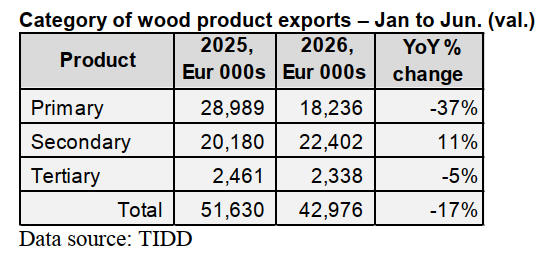
data shows that, for the first half year (January-June) 2026,
Ghana earned Eur42.98 million from the export of 98,387
cu.m of wood products. These covered shipment of
various wood products through the ports of Takoradi and
Tema as well as overland exports to neighbouring
ECOWAS countries.
The first half exports represented a decrease of 17% in
value and a decrease of 12% in volume compared to the
same period in 2025 when exports generated revenue of
Eur51.63 million from 111,348 cu.m.
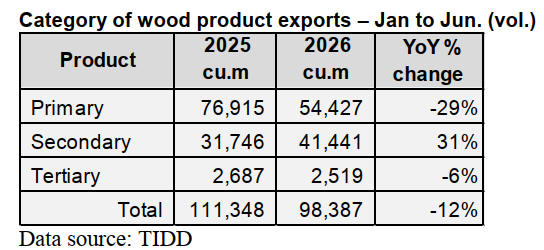
Primary products, secondary wood products and tertiary
wood products accounted for 55%, 42% and 3%
respectively of the total export volume for the first half of
2026.
Receipts generated from these shows that SWP earned the
highest revenue, contributing Eur22.42 million (52%) of
the total value (Eur42.98 million) for the period. This was
followed by primary products at Eur18.24 million
representing 42%, followed by tertiary wood products
Eur2.34 million representing 5%.
Kiln-dried sawnwood, sliced veneer, plywood and rotary
veneer were some of the exports that contributed to the
high receipts. The increased export earnings during the
half-year period was also a reflection of the fact that
overland exports of plywood to neighbouring ECOWAS
countries increased by more than 50% in volume and
value terms.
Air- and kiln-dried sawnwood shipments continue to
account for the highest number of wood products export.
The demand for sawnwood was higher than for secondary
processed wood products like furniture parts, mouldings,
floorings and dowels.
Although markets in Asia are the most lucrative
destinations for Ghana’s wood product exports Asian
markets accounted for 56% in 2026, down from 68% in
the same period in 2025, equating to an 18% decline year
on year. This is attributed to a substantial fall in exports of
sawnwood and billets.
Teak accounted for about 42% of the species processed for
the period followed by ceiba and these were mainly for
Indian markets.
AGI warns electricity tariff hike threatens businesses
The Association of Ghana Industries (AGI) has raised
alarm over soaring electricity costs, with some companies
facing tariff adjustments of over 40%.
Speaking at the AGI 2nd Quarter Business Barometer
presentation and Corporate Forum, AGI president Kofi
Nsiah-Poku, said the Electricity Company of Ghana
(ECG) withdrew a negotiated discounted rate for some
bulk customers exposing them to immediate hikes.
This was a major setback compounding the cost pressures
incurred by manufacturers despite improved
macroeconomic conditions. The increases add to earlier
tariff adjustments this year.
The AGI president noted that a stable cedi and declining
inflation have improved business forecasting and planning.
He commended the government for moving from fiscal
distress to consolidation, citing strong business confidence
in the AGI Q2 Barometer decision not to seek a
supplementary budget and reserves covering about five
months of imports.
The AGI President, however, cautioned that gains made
remain fragile amid the Middle East conflict, dependence
on gold, cocoa and oil and rising utility costs. He urged a
shift from macro-economic stability to structural
transformation to support a competitive industry and
create jobs.
See: https://www.myjoyonline.com/agi-raises-alarm-over-40-
electricity-tariff-hikes-facing-businesses/
Association urges government to evaluate
environmental cost from mining practices
The president of the Ghana Journalists Association (GJA),
Albert Kwabena Dwumfour, has urged Ghana to adopt a
broader approach to assessing the benefits and costs of
mining, saying the economic value of gold must not
overshadow the value of water, fertile land, healthy
ecosystems and the wellbeing of communities.
Speaking at the National Mining Dialogue Mr. Dwumfour
said decisions on mining must take into account the people
whose lives and livelihoods are directly affected, arguing
that the consequences and eventual costs of environmental
degradation could extend far beyond the immediate
financial returns generated by the industry.
The GJA president said Ghana's mineral wealth had
undeniable economic value but cautioned against treating
gold as the only resource that matters in areas where
mining takes place.
In his contribution, Mr. Dwumfour suggested that Ghana's
mineral resources should be exploited in a productive
manner that allows the community and the country as a
whole to benefit economically without destroying the
ecosystems which could be complex and expensive to
restore.
In a related move, Professor of Finance and Economy at
the University of Ghana Business School (UGBS),
Godfred Bokpin, has warned that Ghana cannot achieve
sustainable economic development through a growth
model that relies heavily on illegal mining, environmental
destruction and primary commodities.
See:https://www.myjoyonline.com/gja-president-urges-ghana-to-
weigh-environmental-and-social-costs-alongside-mining-
revenues/
and
https://www.myjoyonline.com/any-growth-model-built-on-
environmental-destruction-will-fail-prof-bokpin-on-galamsey/
and
https://www.myjoyonline.com/the-gains-are-not-durable-prof-
bokpin-warns-over-ghanas-gold-driven-stability/
FDI projects contribute US$368 million to the
manufacturing sector
According to the 2025 Ghana Investment Promotion
Authourity (GIPA) report titled “Resetting Ghana’s
investment landscape for unlocking opportunities in a
transforming economy”, Ghana secured US$2.62 billion in
Foreign Direct Investment (FDI) in 2025, up from
US$651.7 million in 2024.
The report attributed 2025 as a turning point for the GIPA
after the country’s macroeconomic adjustment, driven by
stabilisation, renewed investor engagement and targeted
missions across Asia, Europe and Africa.
The report revealed that inflows covered 245 new and
existing projects led by China with 70 projects followed
by India 22, Nigeria 10, UAE 9 and UK 8. Project
numbers on regional basis were: the Greater Accra (143
projects), Western (9 projects), Eastern (3 projects) and
Ashanti (18 projects).

Ghana also secured US$11.48 billion in announced and
pipeline investments. The FDI outlook remains positive,
with broad-based growth across agriculture, industry and
services positioning Ghana for diversified, investment-
driven expansion in agro-processing, manufacturing,
digital services and value-added exports.
See: https://www.myjoyonline.com/ghana-secured-us2-6bn-fdis-
in-2025-gipc-report/
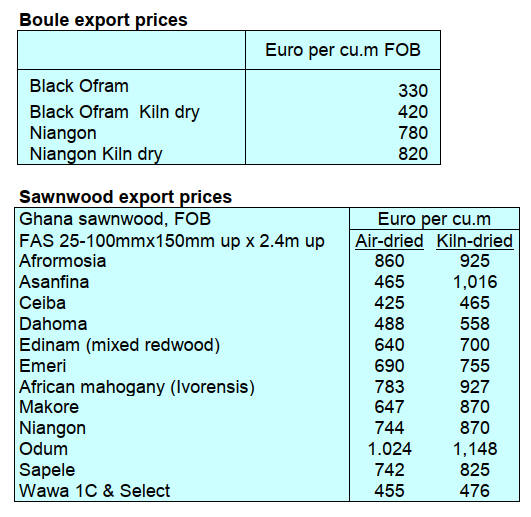 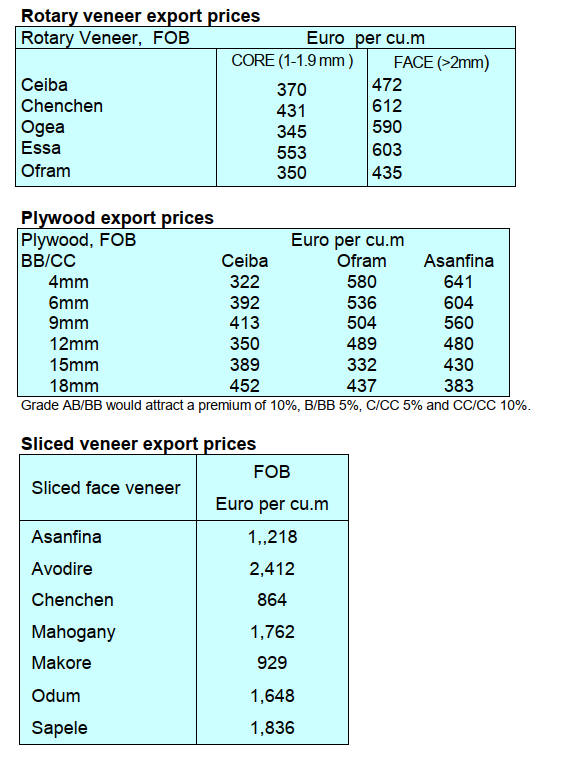
Through the eyes of industry
The latest GTI report lists the challenges identified by the
private sector in Ghana.
See:
https://www.itto.int/direct/topics/topics_pdf_download/topics_id
=401663&no=1
3. MALAYSIA
Economy exceeds expectations
Malaysia’s economy expanded 6% in the second quarter
of the year, up from 5.4% in the first quarter. This figure
exceeded market expectations and represents Malaysia’s
strongest second-quarter growth since 2014. The growth
was supported largely by strong domestic demand and
electrical and electronics exports.
The Economy Minister, Akmal Nasrullah Mohd Nasir,
said. the latest performance brought GDP growth for the
first half of the year to 5.7%, up from 4.5% in the
corresponding period last year.
He added the strong second-quarter performance came
despite a challenging global environment, including the
impact of geopolitical tensions in West Asia on energy
prices, logistics costs and supply chains. Akmal also said
that employment opportunities, higher incomes and greater
purchasing power for the people were more important.
See:
https://www.thestar.com.my/news/nation/2026/08/15/economy-
exceeds-expectations
Forests protect natural resources
The importance of forests has seen the Federal and State
governments, together with various parties including
agencies and communities, continue efforts to preserve the
nation’s forest resources through greening efforts at the
local level and global cooperation.
The Natural Resources and Environmental Sustainability
Minister, Arthur Joseph Kurup, said the commitment was
significant to ensure the country’s forest resources
remained protected and sustainable.
Development efforts must continue alongside
environmental conservation through sustainable forest
management, biodiversity protection, ecosystem
restoration and proactive measures to address climate
change.
During the launch of the International Tropical Forestry
Conference 2026 in Kota Kinabalu, the Minister said
tropical forests were among the most valuable natural
assets due to their role in regulating the climate, protecting
water catchment areas, conserving soil, supporting
livelihoods and providing habitats for biodiversity.
The two-day conference brings together researchers,
policymakers, government agencies, industry players and
stakeholders from Malaysia and abroad under the theme
‘Tropical Forestry and Sustainability for Community
Wellbeing’.
The Ministry of Natural Resources and Environmental
Sustainability has also strengthened forest and biodiversity
protection through the Malaysian Forestry Policy and the
National Policy on Biological Diversity 2022/2030, which
is aligned with the Kunming-Montreal Global Biodiversity
Framework. Kurup noted that Malaysia aims to conserve
at least 20% of its terrestrial and inland water areas by
2030.
Indigenous peoples and local communities are important
custodians of forest landscapes. Sustainable forestry must
be inclusive, respect local knowledge and provide tangible
benefits to communities,” Kurup said.
See:
http://theborneopost.pressreader.com/article/281861535340388
Sarawak to boost furniture for domestic and
international markets
Sarawak’s timber resources and growing industrial
infrastructure could open up new opportunities for the
State’s furniture industry, particularly in producing higher-
value products for domestic and international markets.
This was among the key areas explored during a courtesy
visit by the Kuala Lumpur and Selangor Furniture
Association (KSFA) to the Sarawak Timber Industry
Development Corporation (STIDC) in Kuching. The nine-
member delegation led by KSFA president, Cindy Kong,
who said KSFA was keen to better understand Sarawak’s
timber industry and explore ways to strengthen
cooperation with STIDC.
“KSFA is also interested in exploring how Sarawak’s
timber and plywood resources could be further utilised to
produce higher-value furniture products for the Malaysian
and international markets,” she said.
STIDC General Manager, Zainal Abidin Abdullah said
“the STIDC is fully committed to supporting KSFA
members interested in establishing or expanding their
operations in Sarawak”. He also noted that Sarawak was
moving towards greater utilisation of timber from
sustainable and renewable forest plantations, in line with
the State’s development aspirations under the Post Covid-
19 Development Strategy 2030 (PCDS 2030).
See:
http://theborneopost.pressreader.com/article/281762751099595
Timber drying course
Proper seasoning is the cornerstone of high-quality wood
manufacturing, determining the durability, stability, and
ultimate value of timber products. Recognising this critical
industry need, the Wood Industry Skills Development
Centre (WISDEC) Selangor successfully organised an
intensive Basic Wood Drying Course.
The four-day programme attracted a group of dedicated
timber industry players, all committed to sharpening their
technical expertise, optimising production efficiency, and
elevating the quality of their wood products to meet
stringent market standards.
See: https://www.mtib.gov.my/maskayu/category/49-emaskayu-
2026.html
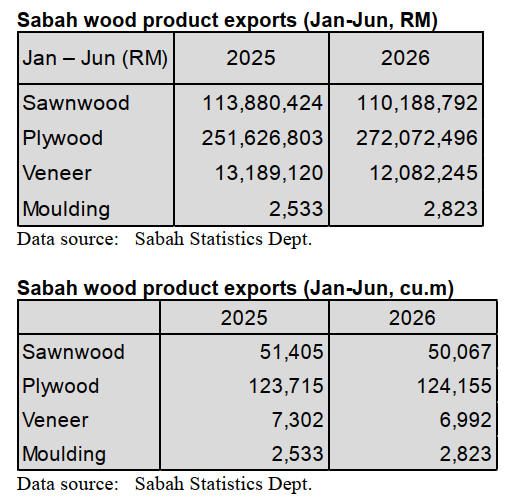
Through the eyes of industry
The latest GTI report lists the challenges identified by the
private sector in Malaysia.
See:
https://www.itto.int/direct/topics/topics_pdf_download/topics_id
=401663&no=1
4.
INDONESIA
Indonesia and EU strengthen cooperation on
sustainable forest trade
Indonesia and the European Union are strengthening
cooperation on sustainable forest management and trade in
legally and responsibly sourced forest products. During
the 11th meeting of the Joint Implementation Committee
of the Forest Law Enforcement, Governance and Trade
Voluntary Partnership Agreement (FLEGT-VPA)
Indonesia and the EU reviewed their cooperation and
exchanged views on global developments in forestry
regulations and trade.
Indonesia highlighted its Legality and Sustainability
Verification System (SVLK) and FLEGT-VPA as key
mechanisms to ensure the legality and traceability of forest
products and provide greater certainty for international
markets.
The two sides also emphasised the need for closer
dialogue to align their understanding of market
developments, particularly the European Union
Deforestation Regulation (EUDR). EU Ambassador to
Indonesia, Denis Chaibi, said the FLEGT-VPA remains
relevant under the EUDR, with FLEGT-licensed forest
products recognised as meeting its legality requirements.
He also reaffirmed support for Indonesian exporters
seeking access to the European market through the
FLEGT mechanism.
See: https://www.kehutanan.go.id/pers/indonesia-dan-uni-eropa-
perkuat-kerja-sama-kehutanan-berkelanjutan-melalui-joint-
implementation-committee-ke-11
US antidumping duties on plywood exports
The US is moving toward imposing antidumping and
countervailing duties on decorative plywood imports from
Indonesia, China and Viet Nam after the US International
Trade Commission (USITC) unanimously determined on
19 August 2026 that these imports had materially injured
the US decorative plywood industry.
For Indonesian products the combined antidumping and
countervailing duty margins set by the US Department of
Commerce range from 28% to 213%, significantly
increasing the cost of Indonesian plywood in the US
market.
The antidumping case stems from a petition filed by a
coalition of US plywood producers in May 2025, alleging
that imports from the three countries were unfairly priced
and benefited from subsidies.
See:
https://www.woodworkingnetwork.com/news/woodworking-
industry-news/international-trade-commission-rules-imports-
harmed-us-plywood
Indonesian furniture at just 3% of US market - room for
growth
US furniture imports reached approximately US$52 billion
in 2025 while Indonesian furniture exports to the US
totalled only US$1.57 billion, or about 3%. The
opportunity for growth was highlighted at an online forum
organised by the Indonesian Embassy in Washington,
D.C., attended by 112 Indonesian furniture manufacturers.
Indonesian Ambassador, Indroyono Soesilo, emphasised
that expanding Indonesia’s share of the US market could
significantly boost national exports, the wood-processing
industry, artisans and SMEs.
To capture more of the market, Indonesian manufacturers
are encouraged to target higher-value segments rather than
compete primarily on volume, focusing on distinctive
designs, consistent quality, legally sourced and certified
wood and stronger digital marketing.
Rattan, bamboo, teak and woven-wood products are well
positioned to benefit from growing US demand for natural
and sustainable furniture. However, exporters must
prepare for evolving trade regulations, quality standards,
design trends, logistics costs and policies such as Sections
232 and 301.
Strengthening SME export clusters with improved drying,
testing, design, order-management and export facilities
will be crucial to achieving HIMKI’s target of US$3–4
billion in furniture exports by 2030 with the US expected
to remain a key market.
See: https://forestinsights.id/furnitur-indonesia-baru-raih-4-pasar-
as-peluangnya-masih-sangat-besar/#
Task force on Rp106 trillion in furniture exports by
2031
The Ministry of Trade and the Indonesian Furniture
Industry and Craft Association (HIMKI) have established
a joint task force to accelerate exports of furniture,
handicrafts and home décor, with a target of reaching
US$6 billion (approximately Rp106.63 trillion) by 2031.
Launched on 20 August 2026, the task force will focus on
concrete export outcomes rather than serving as another
coordination forum. Its priorities include market and buyer
intelligence, transaction-oriented business matching,
export market diversification, identifying trade barriers
and maximising the networks of Trade Attachés and
Indonesian Trade Promotion Centers (ITPCs). Progress
will be measured through indicators such as new buyers,
new export destinations, new exporters, transactions and
repeat orders.
HIMKI Chairman, Abdul Sobur, emphasised that
Indonesia already has various export-promotion tools,
including business matching through Trade Expo
Indonesia (IFEX), trade missions and overseas trade
representatives but these need to be better integrated to
convert market opportunities into actual buyers and
transactions.
HIMKI also argues that achieving the 2031 target requires
structural changes in the industry, including shifting from
manufacturing toward design and innovation, moving
from commodity-based products toward higher value-
added goods and strengthening Indonesian brands and
control over international markets.
See:
https://money.kompas.com/read/2026/08/20/163432626/kemend
ag-dan-himki-bentuk-task-force-kejar-ekspor-mebel-rp-106-
triliun-pada?page=all#page2.
In related news, the Minister of Trade, Budi Santosa, has
urged Indonesia’s furniture and handicraft industries to
expand their global presence by taking advantage of
market access opportunities, including the 41st Trade
Expo Indonesia (TEI) scheduled for October 2026.
He said TEI serves as a strategic platform to connect
Indonesian businesses with international buyers and
strengthen exports, particularly amid new trade
agreements such as the Indonesia-EU Comprehensive
Economic Partnership Agreement (EU-CEPA) and the
trade agreement with the United States.
The government expects the event to help open new
markets, boost furniture and handicraft exports and
improve the international competitiveness of Indonesian
furniture and home décor products.
See: https://www.metrotvnews.com/read/NLMC8vjv-mendag-
dorong-industri-mebel-dan-kerajinan-tembus-pasar-global
Technology a key to boosting value
Indonesia’s wood industry is being urged to increase
value-added production and adopt modern technology to
strengthen its competitiveness in global markets.
Indonesian Sawmill and Woodworking Association
(ISWA) Chairman, Jimmy Chandra, said Indonesia’s
abundant timber resources need to be supported by
technological modernisation and stronger export
promotion, with the government playing a key role in
facilitating technology adoption and expanding overseas
market access.
He also highlighted the importance of government support
and export incentives. Meanwhile, Indonesian Wood Panel
Association (APKINDO) official, Tina Azizi, emphasised
that technological capabilities and the ability to capitalise
on market opportunities are increasingly essential.
See:https://surabaya.tribunnews.com/surabaya-
metro/1947072/industri-kayu-indonesia-dituntut-naik-kelas-
teknologi-jadi-kunci-daya-saing-global?page=2.
and
https://jatim.antaranews.com/berita/1090297/iswa-dorong-
industri-kayu-nasional-tak-sekadar-ekspor-bahan-mentah
IEU-CEPA to deliver zero tariffs
The Indonesian government is accelerating
implementation of the Indonesia-European Union
Comprehensive Economic Partnership Agreement (IEU-
CEPA) to expand export market access, increase EU
investment and strengthen supply-chain diversification and
economic resilience.
Coordinating Minister for Economic Affairs, Airlangga
Hartarto, said the Agreement would significantly benefit
Indonesia by eliminating or reducing tariffs on Indonesian
products entering the EU market. If implemented at the
beginning of 2027 90% of Indonesia’s export tariff lines to
the EU would immediately receive zero tariffs while
others will be reduced gradually.
The tariff concessions are expected to improve the
competitiveness of Indonesian products and create greater
opportunities for exporters to expand in the EU market.
Key potential beneficiaries include palm oil, footwear,
coffee, furniture, agricultural and fisheries products and
telecommunications services.
The government also expects the agreement to increase
bilateral trade and investment while providing Indonesian
businesses with greater opportunities to enter new markets
and expand their international operations.
See:
https://ekonomi.bisnis.com/read/20260823/12/1998307/manfaat-
ieu-cepa-tarif-904-ekspor-ri-ke-uni-eropa-jadi-0.
and
https://jakartaglobe.id/special-updates/ieucepa-ratification-to-
unlock-greater-business-and-investment-opportunities
In related news, the Indonesian Employers Association
(Apindo) has proposed establishing a joint task force to
oversee the ratification and implementation of the IEU-
CEPA. Apindo Chairman, Shinta Kamdani, said the task
force would operate at both the EU-wide technical level
and the level of individual EU Member States, helping
ensure that agreed provisions are implemented effectively
and identifying market opportunities in each country.
The initiative is intended to strengthen coordination
between the Indonesian government and EU authorities
while maximising the Agreement’s benefits for Indonesian
businesses.
Shinta also called for broader outreach on IEU-CEPA,
particularly to micro, small and medium-sized enterprises
(MSMEs), which may be able to participate in European
supply chains but remain unaware of the Agreement’s
potential benefits.
EU Ambassador to Indonesia, Denis Chaibi, welcomed the
proposal, saying the joint task force could provide a
platform for EU member states and Indonesian authorities
to coordinate implementation and ensure that businesses
are involved not only in technical preparations but also in
bilateral discussions with government officials.
See: https://m.antaranews.com/amp/berita/5705884/apindo-
mengusulkan-pembentukan-tim-khusus-kawal-implementasi-ieu-
cepa
Forest fires ravage Indonesian provinces
Forest and land fires affected more than a dozen Regencies
and cities across 10 Indonesian Provinces in early August
2026, with incidents reported in Sumatra, Java, Sulawesi,
Maluku and Papua. The fires were mainly triggered by
human activities such as burning trash and clearing land
with fire.
The most severe fire on Java occurred in Bromo Tengger
Semeru National Park in East Java, burning about 520
hectares, while significant fires were also reported in
Banggai Islands, East Halmahera and Tana Toraja.
The National Disaster Management Agency (BNPB) has
deployed joint response while urging the public to avoid
activities that could spark fires.
See: https://en.tempo.co/read/2117153/forest-fires-ravage-10-
indonesian-provinces
President Prabowo Subianto has vowed firm legal action
against corporations proven to be involved in land clearing
by burning as wildfires spread across parts of Kalimantan,
Sumatra and Java. After chairing a coordination meeting
on wildfires in Central Kalimantan, Prabowo warned
companies of severe consequences for environmental
violations and emphasised that any proven involvement
would be dealt with under the law.
He also expressed optimism that the fires could be
contained, stressing the importance of sustained
coordination between central and regional authorities in
strengthening firefighting efforts.
State Secretary Prasetyo Hadi said four corporations in
West Kalimantan are currently under investigation over
suspected involvement in forest and land fires. Companies
found responsible could face government sanctions,
including the possible revocation of their operating
permits. The government will determine the appropriate
legal measures based on the results of the ongoing
investigations.
See: https://en.antaranews.com/news/428259/prabowo-vows-
action-against-firms-linked-to-land-forest-fires
Government accelerates customary forest recognition
The Indonesian government is accelerating the recognition
of customary forests to provide greater certainty over
territories managed by indigenous communities. However,
the process continues to face challenges, particularly in
determining the legal status and size of proposed
customary forest areas, including cases involving
overlapping land claims or designations.
To address these issues, the Ministry of Forestry is using
the Forestry Geospatial Information System (SIGAP) and
the Jaga Rimba Forestry Decision Support System (DSS)
to support mapping and clarify the boundaries and status
of proposed areas.
Director General of Social Forestry, Catur Endah
Prasetiani, stressed that customary forest recognition
requires more than accurate mapping. Effective
coordination among ministries, local governments and
relevant institutions is also essential to resolve overlapping
claims and ensure that recognition processes are carried
out comprehensively.
The government hopes that stronger inter-agency
coordination, supported by improved geospatial tools, will
accelerate the recognition and protection of indigenous
communities’ rights over their customary forests.
See: https://nasional.kontan.co.id/news/pemerintah-dorong-
percepatan-penetapan-hutan-adat-pemetaan-masih-jadi-kendala
Indonesia targets 15,000 hectares for ecosystem
restoration
Indonesia’s Forestry Ministry aims to restore 15,000
hectares of degraded ecosystems in 2026, with a focus on
oil-palm-encroached areas in Riau’s Tesso Nilo National
Park, as well as degraded peatlands and coastal
mangroves. The initiative is part of a broader plan to
rehabilitate around 1.27 million hectares of protected areas
and restore 12.7 million hectares of degraded land
nationwide by 2030.
Implemented through 47 technical units, the programme
will combine ecosystem restoration with legal
enforcement and the recovery of State assets from illegal
land occupation.
See: https://en.antaranews.com/news/426408/indonesia-targets-
15000-hectares-of-ecosystem-restoration-in-2026
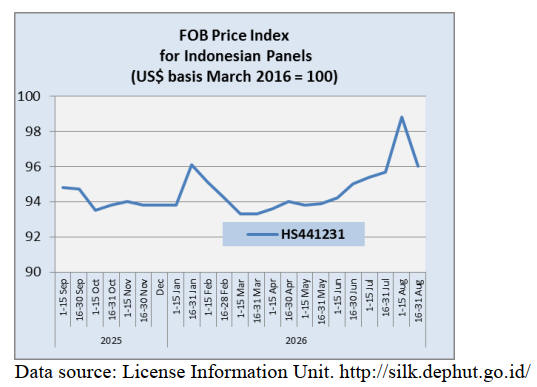
Through the eyes of industry
The latest GTI report lists the challenges identified by the
private sector in Indonesia.
See:
https://www.itto.int/direct/topics/topics_pdf_download/topics_id
=401663&no=1
5.
MYANMAR
Timber sector export performance
According to data presented by the Myanmar Forest
Products and Timber Merchants Association (MFPTMA)
Myanmar’s FY2025-26, timber exports totalled 13,541.65
cubic tons (CBT) worth approximately US$19.11 million.
The figures show a pronounced difference between the
composition of trade by volume and by value.
Teak: 4,364 CBT, US$15.08 million, 32% of
volume and 79% of value. Average price
indicator, US$3,455 per CBT.
Hardwoods: 252 CBT, US$0.38 million, 1.9% of
volume and 2% of value. Average price indicator,
US$1,510 per CBT.
Other species: 8,925 CBT, US$3.65 million, 66%
of volume and 19% of value. Average price
indicator, US$409 per CBT.
Total: 13,541 CBT and US$19.11 million. Average price
indicator, US$1,411 per CBT.
Data Source: MFPTMA presentation. Average unit prices
are calculated from aggregate reported species values and
volumes and should not be read as product-specific prices.
Although the total export value remained relatively low
the data show that teak accounted for less than one-third of
total export volume while generating nearly four-fifths of
reported export earnings. The indicative price for teak of
about US$3,455 per CBT was more than eight times that
of the broad ‘Other’ species group.
Hardwoods other than teak remained marginal, accounting
for about 2% of both volume and value. The data therefore
confirm that total export revenue remains highly sensitive
to changes affecting teak availability, transaction
acceptance and buyer demand.
Veneer leads shipments
The product structure remains concentrated on
intermediate processing. Veneer accounted for about 65%
of total volumes and more than 91% of veneer was
reported under ‘Other’ species. Sawnwood represented
21%, furniture and components 9% and plywood 5%.
Teak had a more diversified product mix: approximately
54% was sawnwood, 29% furniture and components and
17% veneer. Teak was the main timber for furniture and
parts manufacturing, by contrast, ‘Other’ species
dominated veneer and accounted for all reported plywood.
Data caution. The MFPTMA data is described as FY2025-
26 but appears to include a June 2026 cut-off. CBT and
the ‘Hardwood’ and ‘Other’ groupings are not defined
and it is unclear whether the figures represent approvals,
licences, Customs-cleared shipments or realised export
receipts.
Myanmar’s economy is experiencing declining export
earnings and rising import costs. Timber and forest-
product exports, once a major source of foreign exchange
and public revenue, have been reduced by lower
extraction, raw-material constraints, sanctions, restricted
premium-market access and increasingly stringent buyer
requirements. Regional trade continues but has not
restored the sector’s former contribution.
See: https://elevenmyanmar.com/news/myanmar-parliament-
speaker-pledges-to-pursue-national-property-tax-law
Legality, traceability and market access
Two recent papers on Forests assess Myanmar’s forest
certification, timber legality and traceability arrangements:
‘Challenges and Weaknesses of Myanmar Forest
Certification Sector’ (Forests 17:115) emphasises
institutional capacity, accreditation,
documentation, stakeholder participation,
financing and market incentives.
‘Timber Legality and Traceability in Myanmar’s
Forest Supply Chains’ (Forests 17:945)
These review the development of MFCS, MTLAS, the
Myanmar Timber Chain of Custody Process and DTTS,
while noting that published evidence of consistent,
independently verified operational performance remains
limited.
The studies provide useful food for thought. Their central
distinction is well founded: standards, procedures and
digital tools are essential foundations but their existence
alone does not automatically demonstrate legality,
sustainability or market admissibility.
Credibility ultimately depends on effective
implementation, consistency of documentation, volume
reconciliation, risk assessment, independent verification
and transparent evidence of actual performance..
Some findings require clarification when applied to
MFCC. As national scheme owner, MFCC develops
standards, provides technical guidance and facilitates
system improvement; it is not the forest regulator, forest
owner, harvesting enterprise, law-enforcement authority or
accreditation Body.
Certification of natural forests managed under the
Myanmar Selection System is more complex than
certification of compact, high-output plantations. MSS
applies selective, relatively low-intensity harvesting across
extensive and often dispersed forest areas. Management
planning, biodiversity and social safeguards, monitoring
and field auditing may cover a very large area, although
harvest volume per unit area remains low.
Certification, surveillance and travel costs must therefore
be distributed across comparatively small timber volumes,
raising the effective cost per cubic metre.
MFCC’s implementation experience has brought this cost-
effectiveness constraint into sharper focus than was
anticipated when MFCS development began.
See: https://www.mdpi.com/1999-4907/17/1/115
https://www.mdpi.com/1999-4907/17/1/115
and
https://www.mdpi.com/1999-4907/17/8/945
6.
INDIA
Teak no longer a regulated species – good
news for
farmers
Maharashtra’s 2026 decision to remove teak from the list
of regulated species marks a historic shift from colonial-
style control to farmer-centric agroforestry. The decision
sends a clear message that farmers should not be treated as
offenders for harvesting trees they have nurtured on their
own land. The State decision removes the risk of penalties
from harvestingf farm-grown teak.
The State‘s aim is to unlock teak’s role as a “biological
savings account” for rural households, boost tree cover,
restore degraded land and cut dependence on imported
timber.
In June 2026, Maharashtra State took a decision that may
reshape the future of agroforestry in India. Through a
notification under the Maharashtra Felling of Trees
(Regulation) Act, 1964, the state removed teak from the
list of regulated tree species, substantially reducing
barriers associated with harvesting farm-grown teak.
At first glance, the notification appears to be a
routine
administrative amendment. In reality, it marks the
culmination of a policy shift that has been underway for
more than a decade, a shift from controlling trees to
encouraging farmers to grow them.
Teak remains one of the world‘s most valuable tropical
hardwoods. Native to India, Myanmar, Thailand and Laos,
it is now cultivated across Asia, Africa and Latin America.
According to the United Nations Food and Agriculture
Organization’s Global Teak Resources and Market
Assessment, India manages nearly 1.69 million hectares of
planted teak forests, representing about 35 % of the worlds
teak plantation resource. Yet, India continues to be one of
the largest importers of teak timber.
Madhya Pradesh and Maharashtra States together contain
some of India‘s largest teak resources. For both States,
teak is not merely a forest species it is increasingly
becoming an agroforestry long-term financial asset for
rural households.
While Maharashtra‘s deregulation is a welcome step,
removing regulatory barriers alone will not transform the
teak sector, the bigger challenge is technical rather than
administrative.
For decades, farmers have been encouraged to invest in
teak plantations, particularly tissue-cultured teak, based on
claims of rapid growth and high returns. Yet evidence
supporting many of these claims remains limited. Despite
the widespread adoption of tissue-cultured planting
material and the presence of over 200 tissue-culture
laboratories in India, there are no long-term comparative
studies exceeding 25 years that conclusively demonstrate
superior growth, timber quality or economic returns.
Plantation performance depends far more on spacing,
thinning, pruning, site quality and overall management
than on planting material alone. A Karnataka study found
that well-managed teak plantations produced nearly four
times more usable wood per tree than poorly managed,
densely planted stands, highlighting the importance of
scientific management.
Another challenge that deserves greater attention is timber
traceability. As States move towards liberalised harvesting
and transit regulations, concerns regarding illegal timber
movement are likely to increase.
The solution, however, is not a return to cumbersome
permit systems. Instead, it has been suggested that India
invest in modern traceability mechanisms. Digital
plantation registration, geo-referenced tree inventories,
QR-code-based timber tracking and certification systems
can help distinguish legally grown farm timber from
illegally harvested forest timber.
Such systems would simultaneously support agroforestry
expansion and strengthen forest conservation, the
incentive to plant new trees declines.
Along with teak, other commercially valuable tree species
preferred by farmers in agroforestry systems should be
exempted from restrictive harvesting and transit
regulations, thereby reducing regulatory burdens and
encouraging greater investment in tree-based farming.
The future of teak-based agroforestry will depend on the
availability of quality planting material, scientifically
validated management practices, assured markets and
reliable traceability systems.
Equally important is the need for transparent timber
pricing. Even after growing quality teak, farmers are often
forced to sell at low prices because intermediaries
undervalue the wood as suitable only for poles or
fuelwood. This undermines the profitability of teak
cultivation and discourages long-term investment by
farmers.
See:https://www.downtoearth.org.in/forests/liberating-the-king-
of-timbers-why-maharashtras-teak-reform-matters
Source: Liberating the king of timbers: Why State of
Maharashtra‘s Teak reform matters, by Sangram B Chavan a
senior scientist (agroforestry) at the ICAR-National Institute of
Abiotic Stress Management, Baramati (Pune) Maharashtra and
AR Uthappa is a senior scientist (agroforestry) at the ICAR-
Central Coastal Agricultural Research Institute, Goa.
Russian birch plywood returning to the Indian market
Russian birch plywood is returning to the Indian market as
more overseas manufacturers secure mandatory Bureau of
Indian Standards (BIS) licenses. Imports had slowed and
faced major disruptions after BIS Quality Control Orders
enforced mandatory ISI certification for wood-based
panels starting in early.
The supply chain is picking up momentum as additional
international and Russian mills successfully obtain their
BIS standard certifications, clearing the legal path for
entry. Buyers and importers can check active manufacturer
credentials and license details directly through the Bureau
of Indian Standards portal.
See: https://www.plyreporter.com/article/154372/russian-birch-
ply-again-arriving-in-india-with-new-bis-licence
GenAI for higher sales velocity and faster launches
Generative AI (GenAI) has the potential to drive
significant performance gains in India’s real estate sector,
with EY-Parthenon-CREDAI latest report titled, GenAI in
Indian Real Estate indicating that developers could see a
30–50% improvement in sales velocity and around 30%
faster product launches.
These possibilities stem from AI-driven customer
intelligence, automated design workflows and predictive
project monitoring, signaling a shift from scale-driven
operations to a more intelligence-led approach to real
estate.
Early adopters could experience strong operational
benefits, including 20-50% improvement in workforce
productivity, 20–50% lower customer acquisition costs
and decision cycles that may compress from “months to
weeks or days.”
The EY Parthenon- CREDAI report notes that such
advancements have the potential to reshape how
developers assess feasibility, plan projects, manage
construction and engage with customers.
See: https://www.ey.com/en_in/insights/real-estate-hospitality-
construction/how-gen-ai-is-driving-real-estate-transformation-
with-actionable-insights
and
https://credai.org/media/view-details/?file_no=106
7.
VIETNAM
Wood and wood product (W&WP) trade
highlights
According to statistics from the Viet Nam
Customs, W&WP exports reached US$1.60
billion in July 2026, up 4% from June 2026 and
up 9% from July 2025. Of this total, WP exports
amounted to US$1.05 billion, increasing by 6%
month-on-month and 3% year-on-year.
In the first seven months of 2026, Viet Nam’s
W&WP exports totalled US$10.2 billion, up 6%
from the same period in 2025. Of this, WP
exports reached US$6.57 billion, down 1% year-
on-year.
Viet Nam’s W&WP exports to the EU reached
US$65 million in July 2026, down 16% from
June 2026 but up 26% from July 2025. In the first
seven months of 2026, W&WP exports to the EU
totalled US$540 million, an increase of 55.2%
compared with the same period in 2025.
Viet Nam’s exports of bedroom furniture have
been valued at US$175 million in July 2026, up
5% from June 2026 but down 2% from July 2025.
During the first seven months of 2026, bedroom
furniture exports totalled US$1.10 billion, down
5% year-on-year.
Viet Nam’s imports of wood raw materials from
the EU have been estimated at 125,000 cu.m in
July 2026, valued at US$38.17 million. This
represented increases of 11% in volume and 11%
in value compared with June 2026 and increases
of 23% in volume and 26% in value compared
with July 2025.
In the first seven months of 2026, imports of
wood raw materials from the EU have been
estimated at 638,800 cu.m, valued at US$195.09
million, up 21% in volume and 23% in value
year-on-year.
Viet Nam’s exports of W&WP to Canada have
been estimated at US$28 million in July 2026, up
4% from June 2026 and 19% from July 2025.
In the first seven months of 2026, W&WP
exports to Canada have been estimated at
US$173 million, an increase of 9% compared
with the same period in 2025.
Viet Nam’s exports of kitchen furniture have
been estimated at US$119 million in July 2026,
down 16% from July 2025. In the first seven
months of 2026, kitchen furniture exports have
been estimated at US$705 million, a decrease of
15% year-on-year.
Viet Nam’s imports of pine wood have been
estimated at 135,000 cu.m in July 2026, valued at
US$26.6 million. This represented increases of
19% in volume and 13% in value compared with
June 2026 and increases of 22% in volume and
24% in value compared with July 2025.
In the first seven months of 2026, Viet Nam’s
pine wood imports have been estimated at
756,300 cu.m, valued at US$148.9 million, up
29% in volume and 26% in value compared with
the same period in 2025.
Businesses ‘thirsty’ for raw materials for added value
production
Although Vietnam's wood industry has exported to more
than 140 countries and territories many businesses believe
that the industry's growth potential is being limited by the
raw material supply issue.
Mr. Pham Thanh Long, Director of Raw Material
Procurement at Trieu Thai Son, Ltd., stated that the
company currently operates a deep processing plant with a
capacity of approximately 15,000 cu.m of plywood and
particleboard per month using entirely domestic raw
materials and providing employment for over 1,000
workers.
However, according to Mr. Long, the biggest challenge
currently is the lack of a stable, high-quality source of raw
materials. The exploitation of young forests (3-4 years old)
along with the development of small-scale purchasing and
chipping facilities is leading to increasingly fierce
competition for raw materials, while businesses investing
in processing face many disadvantages.
Sharing the same view, Mr. Nguyen Tat Son - Chairman
of the Board of Directors of Thang Nam Forestry
Company said that the company owns two wood
processing factories in Nghe An with a total capacity of
over 500,000 m³ of finished products per year requiring
about 1 million tonnes of raw wood to maintain
production.
Despite having partnered with about 60,000 forest-
planting households and committing to purchasing at a
price about 3% higher than the price of wood chips, the
company still faces difficulties in securing supply due to
the increasing demand for wood chips and pellets for
export.
According to Mr. Son, exporting raw materials with low
added value is reducing the supply of materials for deep
processing, directly affecting the competitiveness of
Vietnam's wood industry.
Extend forest planting cycle to increase value
Businesses agree that to enhance the value of the timber
industry, the first step is to change the way raw materials
are developed. According to TH Group's calculations,
extending the forest harvesting cycle from 3-4 years to 7-8
years could increase biomass efficiency by approximately
2.5 times, while forest growers' profits would increase by
1.5-2 times. Not only does it bring higher economic value
but larger timber also better meets the requirements of
export markets.
See: https://www.vietnam.vn/en/doanh-nghiep-nganh-go-khat-
nguyen-lieu-chat-luong
Addressing bottlenecks in wood raw material
development
The country ranked fifth globally, second in Asia and first
in Southeast Asia in wood and wood product exports
providing an important foundation for the industry to
pursue modern, sustainable development and generate
higher added value.
The Vietnam Chamber of Commerce and Industry (VCCI)
hosted a forum in Hanoi on 23 July to discuss solutions to
bottlenecks in developing sustainable material sources for
deep wood processing as the sector seeks to shift from
growth based on volume to higher quality, added value
and sustainability.
VCCI Vice Chairman, Bui Trung Nghia, said that after
nearly three decades of development, Vietnam’s wood
processing industry has become a key export sector,
recording export revenue of over US$17 billion in 2025.
However, he noted that future growth will no longer come
from expanding production scale but must instead be
driven by higher-quality growth, improved productivity
and the ability to adapt to new market requirements.
Increasingly stringent regulations on deforestation, carbon
emissions and traceability, together with the growing trend
towards green consumption, are compelling the wood
industry to transform its development model.
To achieve the target of US$25 billion export revenue by
2030, the industry needs to move towards sustainable
forestry, greater material self-sufficiency, upgraded value
chains and more efficient use of forest resources, Nghia
said.
He noted that a sustainable and transparent material supply
chain is not only essential for meeting export market
standards but also helps businesses secure supplies, reduce
dependence on imported materials, improve
competitiveness and raise the value of deeply processed
products.
Ngo Sy Hoai, Vice Chairman and Secretary General of the
Vietnam Timber and Forest Products Association
(VIFOREST), said that while the forestry sector has
successfully expanded planted forest areas over the past 30
years the next three decades should focus on improving
timber quality and the value of raw materials.
The focus should shift from “planting more to harvest
more” to creating greater value from the same forest area
by developing large-timber plantations, applying science
and technology and improving added value processing
capacity, he said.
Bui Thi Nha Trang, Sustainability Team Manager at
Control Union of Vietnam, said global forest-product trade
was shifting from a “trust-based” to an “evidence-based”
model. Businesses must now demonstrate not only the
legality of their materials but also traceability, sustainable
forest management and carbon-emission control
throughout the supply chain.
Participants said sustainable development of the wood
industry required a stronger focus on material quality,
technological innovation and transparent and traceable
supply chains, rather than simply expanding planted forest
areas. The development of large-timber forests, high-yield
varieties and smart forestry was identified as key to raising
the value and efficiency of forest resources.
They noted that the US$25 billion export target by 2030
will require a comprehensive restructuring of the industry
towards greener, more sustainable and lower-carbon
growth rather than simply increasing output.
To remove bottlenecks, Doan Van Tinh, Chairman of the
Board of Directors of MDF Mekong, called for policy
adjustments to encourage deep processing instead of raw-
material exports.
He also urged measures to address high material
costs,
improve forestry-related administrative procedures and
increase investment in research and development of high-
yield and high-quality forest varieties suited to local
conditions and processing.
See: https://en.vietnamplus.vn/measures-sought-to-address-
bottlenecks-in-sustainable-wood-material-development-
post348861.vnp?utm_source=chatgpt.com
8. BRAZIL
Challenges facing Brazil’s forestry sector
The Brazilian forest sector has important competitive
advantages including high productivity, short growth
cycles, accumulated technical expertise and a diversified
industry.
However, its competitiveness depends on its ability to
address challenges related to climate change, costs, labour,
logistics, environmental licensing, traceability and
territorial relations.
The increasing frequency and intensity of extreme weather
events require climate risks to be incorporated into forest
planning through genetic improvement, diversification of
planting materials, monitoring and adaptation strategies.
Integrated forest fire prevention and response are also
becoming increasingly important to reduce production and
operational losses.
Cost pressures and the pursuit of higher productivity
remain structural challenges, compounded by the
availability and qualification of labour. Mechanisation and
digitalisation improve efficiency but require new skills. In
logistics, road conditions, transportation availability and
bottlenecks in rail and port infrastructure affect the timber
competitiveness and the reliability of industrial supply.
At the institutional level, greater predictability in
licensing, legal certainty and traceability systems are
essential in response to growing environmental and
regulatory requirements. Engagement with local
communities, rural producers and other stakeholders is
also essential to strengthen the social license to operate,
reduce conflicts and expand value creation.
Digitalisation can reduce uncertainty and improve
decision-making through remote sensing, artificial
intelligence, drones, telemetry and management systems.
Its effectiveness depends on connectivity, capacity
building and sound governance. Thus, the future
competitiveness of Brazil’s forestry sector will depend on
combining economic efficiency, environmental adaptation,
technological innovation and responsible territorial
engagement.
See: https://maisfloresta.com.br/principais-desafios-do-setor-
florestal-no-brasil/
Trends in the Brazilian timber market
The Brazilian timber sector in 2026 is being shaped by a
combination of prices, demand, exports, logistics costs,
forest resource availability and traceability requirements.
The trend is toward greater market segmentation, with
increasing value placed on timber quality and
characteristics, supply reliability, certification and
proximity to consuming facilities. Market dynamics also
vary by species and end use, particularly between pine and
eucalyptus.
Forest supply remains influenced by long production
cycles making strategic planning of the forest base, stand
age structure and harvesting windows strategic to ensure a
supply. Productivity, weather conditions, wildfire risks,
pests, diseases and infrastructure also determine the
effective availability of timber.
In price formation, freight and loading costs, road
conditions, seasonality and industrial yield are becoming
increasingly important, making average market references
less suitable for specific decision-making.
Traceability and proof of timber origin are also gaining
importance, affecting commercial relationships, audits and
market access. The organisation of records of forest areas,
inventories, harvesting, volumes and transportation,
together with sound environmental and forest management
practices are becoming increasingly relevant to ensuring
business continuity and competitiveness.
Technology is gaining importance in operational
management through remote sensing, telemetry,
management systems and forest operations monitoring. Its
main potential lies in integrating data to improve decisions
on harvesting, transportation, maintenance and supply,
rather than simply adopting sophisticated tools.
Planning will therefore combine market indicators with
information on demand, contracts, inventories,
productivity, costs and risks, increasing predictability and
opportunities for value addition throughout the value
chain.
See: https://maisfloresta.com.br/tendencias-mercado-madeira-
2026/
Export update
In July 2026 Brazilian exports of wood-based products
(except pulp and paper) decreased 7% in value compared
to July 2025, from US$305.6 million to US$285.2 million.
Pine sawnwood exports decreased 0.5% in value between
July 2025 (US$62.1 million) and July 2026 (US$61.8
million). In volume terms, exports decreased 4% over the
same period, from 265,100 cu.m to 254,400 cu.m.
Tropical sawnwood exports remained unchanged in July
2026, totaling 28,800 cu.m in volume. In value, exports
increased 23% from US$11.7 million to US$14.4 million
over the same period.
Pine plywood exports increased 2% in value between July
2025 (US$61.4) and July 2026 (US$62.8). In volume,
exports decreased 39% over the same period, from
194,700 cu.m to 189,100 cu.m.
Tropical plywood exports increased 7% in volume, from
2,800 cu.m in July 2025 to 3,000 cu.m in July 2026. In
value, exports decreased 6% from US$1.8 million in July
2025 to US$1.7 million in July 2026.
As for wooden furniture, exports decreased 14% in value,
from US$54.1 million in July 2025 to US$46.6 million in
July 2026.
Brazilian wood product exports declining
Brazilian exports of major wood products (excluding
MDF, pulp and pape), totalled US$1.5 billion between
January and July 2026, a decrease of approximately
US$275 million compared with the same period in 2025.
The decline reflects growing international protectionism,
Brazil’s high dependence on the US market and domestic
factors that undermine the industry’s competitiveness.
Performance varied across products. While pine
sawnwood exports increased by 3% in volume, pine
plywood exports declined by 17% in volume and 18% in
value, while wood mouldings recorded a decrease of more
than 50%. This divergence highlights the need for product
and market specific strategies.
Tariffs and other trade barriers have become part of
companies’ strategic planning. The concentration of
exports in the US increases exposure to economic and
tariff related changes, making gradual market
diversification necessary.
Europe and Asia offer opportunities, supported by the
Mercosur-European Union and Mercosur-Singapore
agreements but accessing these markets requires
adaptation of products and processes, compliance with
certifications and traceability requirements.
In the European market, market access opportunities
coexist with barriers such as the EUDR and the 5.4% anti-
dumping tariff on Brazilian softwood plywood. In this
context, effective traceability systems and environmental
compliance can become competitive advantages. At the
same time, high logistics costs, inadequate infrastructure,
bureaucracy and high interest rates continue to undermine
export competitiveness and contribute to Brazil’s so-called
“Brazil Cost.”
The "Brazil Cost" (Portuguese: Custo Brasil) is the set of
structural, bureaucratic, and operational hurdles that make
doing business or living in Brazil significantly more expensive
and less efficient than in many other countries.
A recovery of timber exports will therefore depend on an
integrated strategy combining market diversification,
industrial adaptation and innovation, traceability and close
monitoring of geopolitical developments.
Maintaining the US market will remain important but
expanding Brazil’s presence in Europe and Asia will be
essential to reduce risks and strengthen the sector’s
international competitiveness.
See: https://maisfloresta.com.br/exportacoes-brasileiras-de-
madeira-perdem-us-275-milhoes-e-setor-busca-novos-mercados/
The “Plano Brasil Soberano” expands financing for
plantation product exports
Brazil’s Law No. 15,473/2026 expanded the country’s
official export credit support system under the “Sovereign
Brazil Plan” (Plano Brazil Soberano), including exporters
of products from planted forests, their derivatives, by-
products and economically valuable residues and their
suppliers, among the potential beneficiaries of financing
lines.
The measure is particularly relevant to the timber sector
amid international trade instability and the 25% US tariff
on timber products.
In the programme’s third phase, exporters of planted forest
products became part of the eligible group. Financing
modalities for investment and the acquisition of capital
goods remain available, while the Working Capital and
Export Working Capital lines were temporarily suspended
as of 31 July to allow for adjustments related to the new
Provisional Measure.
The initiative expands access to financing mechanisms for
the forestry sector to address the impacts of international
instability, geopolitical issues and trade barriers, helping
Brazilian exporters preserve their competitiveness.
See:
https://www.bndes.gov.br/wps/portal/site/home/emergenciais/bra
sil-soberano/programa-brasil-soberano-
competitividade?utm_source=chatgpt.com
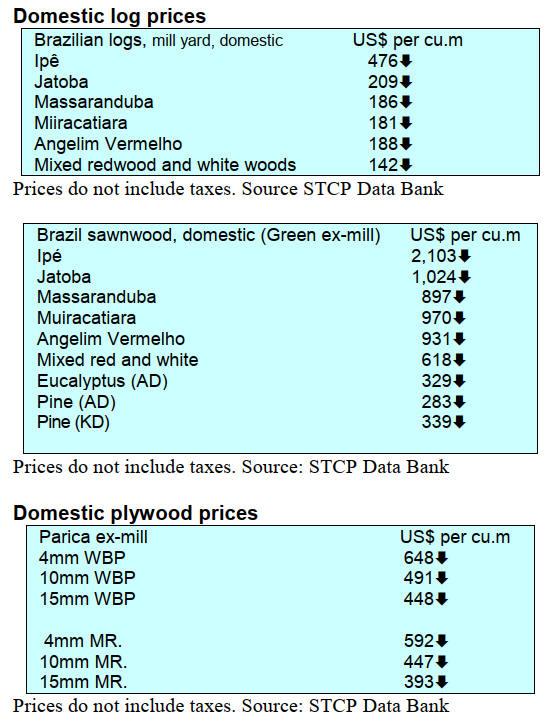
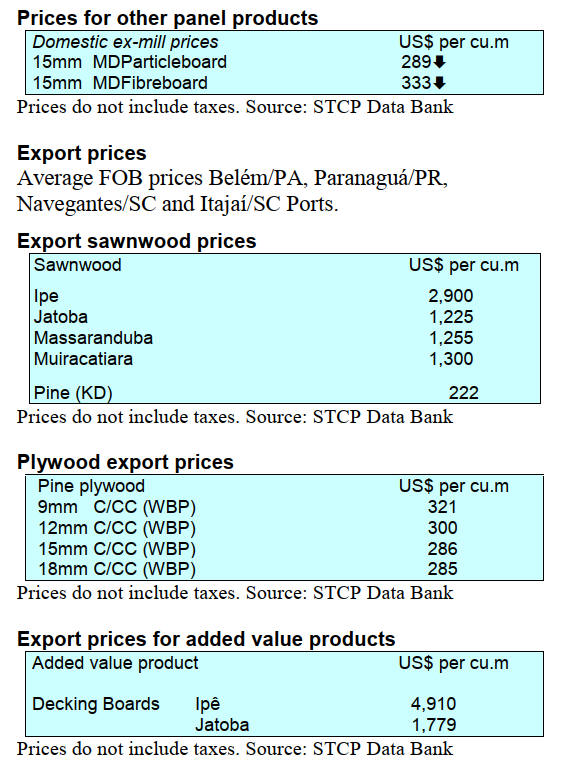
Through the eyes of industry
The latest GTI report lists the challenges identified by the
private sector in Brazil.
See:
https://www.itto.int/direct/topics/topics_pdf_download/topics_id
=401663&no=1
9. PERU
Exports rose in June
During the period ending June 2026, wood product exports
registered an FOB value of US$34.9 million, an increase
of 8% compared to the US$32.4 million in the same period
of 2025. according to the Center for Research on Global
Economics and Business at the Association of Exporters
(CIEN-ADEX).
Exports included products such as semi-finished goods
(US$13.9 million); sawnwood (US$11.8 million),
firewood and charcoal (US$2.9 million), furniture and
furniture parts (US$2.0 million) and construction products
(US$1.7 million).
The leading destination was France with shipments
totaling US$6.5 million. The Dominican Republic
followed with US$5.1 million, the United States with
US$4.5 million then China with US$4.1 million and
finally Viet Nam with US$3.6 million.
Semi-finished products boosted exports in June 2026
According to information from ADEX's Services and
Extractive Industries Management, exports of semi-
finished products reached US$13.9 million FOB in June
2026, representing a 46% increase compared to the same
month of the previous year.
France led imports in this sector, accounting for 43% of
total exports and registering a 67% increase compared to
June 2025. Denmarkw as in second place with a 17%
share and a remarkable 185% growth. The United States
ranked third, with an 8.5% share, although it registered an
18% decrease compared to the same period of the previous
year. Belgium ranked fourth, with a 8% share but a 16%
contraction.
Mexico completed the group of the top five destinations,
accounting for 4% of exports and showing remarkable
growth of 147% compared to June 2025. The results
demonstrate a favorable recovery in the foreign trade of
Peruvian wood products driven mainly by the dynamism
of the semi-finished products subsector and by the
strengthening of demand in European markets.
Promoting the training of forestry professionals
The National Forest and Wildlife Service (SERFOR)
signed a framework agreement for institutional
cooperation with the College of Engineers of Peru- Lima
Departmental Council (CIP-CDLIMA) to promote
technical assistance, training, knowledge exchange,
research and academic activities that contribute to the
competitiveness of forestry engineering and the
sustainability of the sector.
The alliance, which will be in effect for two years, aims to
contribute to having increasingly specialised professionals
with better tools to meet the needs of the sector, promoting
the sustainable management of forests and wildlife, as well
as strengthening the role of forestry engineering in the
country's development.
See: https://www.gob.pe/institucion/serfor/noticias/1435155-
serfor-y-colegio-de-ingenieros-impulsaran-la-investigacion-y-la-
formacion-de-profesionales-del-sector-forestal
Strengthening regional cooperation on Amazon forest
degradation
The National Forest and Wildlife Service (SERFOR),
which holds the Pro Tempore Presidency of the Amazon
Network of Forest Authorities (RAFO), participated in the
“Regional Meeting on Forest Degradation in the Amazon:
Methodologies and Tools for Cooperation within the
Framework of RAFO,” held on August 27 and 28 at the
headquarters of the Permanent Secretariat of the Amazon
Cooperation Treaty Organization (ACTO) in Brasilia,
Brazil.
At the opening of the meeting, ACTO Executive Director,
Vanessa Grazziotin, highlighted that addressing this
challenge requires combining the knowledge already
produced by the countries with a regional perspective.
“We need to advance not only in the concept of
degradation but also in the methodologies that allow us to
carry out this monitoring. The expectation is that we can
move forward together and build a common path for the
region,” Grazziotin said.
The opening session was also attended by the Pro
Tempore Presidency of RAFO and representatives of the
Delegation of the European Union to Brazil.
See: https://otca.org/en/amazonian-countries-seek-to-standardize-
a-methodology-for-monitoring-forest-
health/#:~:text=The%20event%2C%20which%20brings%20toge
ther,Amazon%20Network%20of%20Forest%20Authorities
and
See: https://www.gob.pe/institucion/serfor/noticias/1435526-
serfor-fortalece-la-cooperacion-regional-frente-a-la-degradacion-
forestal-en-la-amazonia |