|
1.
CENTRAL AND WEST AFRICA
Gabon
Harvesting and production
Gabon remains in the dry season providing favourable
conditions for harvesting and transport. Production
continues to improve as operators benefit from better
access to concessions and improved road conditions.
Transport conditions continue to improve during the dry
season with timber from southern and eastern production
areas now generally reaching Libreville within two days.
It has been reported that the GSEZ log yard in the Nkok
Special Economic Zone currently holds sufficient Okoumé
log stocks to support approximately one month of
industrial production with supplies coming from multiple
operators.
Industry estimates also suggest that the Port of
Zhangjiagang in China continues to hold approximately
one year's stock of mixed tropical hardwood logs,
including Okoumé, Ovangkol, Okan and Belli.
Local seasonal holidays have temporarily reduced
production levels with many companies operating below
capacity due to worker holidays. It has been noted that a
significant proportion of expatriate technical staff are from
Indonesia.
Transport and infrastructure
The government continues to invest in transport
infrastructure utilising funding from the African
Development Bank. The programme includes road
rehabilitation, bridge construction and restoration of the
national railway network.
SETRAG, Gabon's railway operator, has received
additional financial support to improve rail infrastructure
and increase the availability of wagons for timber
transport. Upgraded concrete sleeper rail sections are
expected to accommodate heavier freight trains and
improve logistics over the longer term.
Electricity and water supply
Electricity supply continues to present operational
challenges, with power outages typically occurring two or
three times per day and lasting three to four hours. The
government has reduced the regulated price of privately
supplied water, lowering the cost of a standard plastic
container from FCFA8,000 to FCFA4,000 in an effort to
reduce costs for households.
Port operations and shipping
Port operations at Owendo continue to function normally
with container availability remaining good. Transport to
and from the port is operating efficiently, although vessels
continue to see delays before berthing.
Shipping companies serving Gabon and Cameroon have
begun reducing available cargo space due to high timber
inventories currently held at the Port of Antwerp.
In some cases, shipping lines have reduced available cargo
capacity by as much as 50%. The industry expects this
situation to improve as European timber importers and
millers return from the summer holiday period and
inventories begin to fall.
Market conditions
European demand remains relatively subdued, although
enquiries are beginning to recover gradually as some
business return to normal after the holiday season.
Demand for Azobé in the Dutch market is said to exceed
available supply. Chinese demand remains selective but
continues for Azobé table tops while Bangladesh and
Pakistan also remain active buyers of Azobé and Okan
from Gabon and Liberia.
National developments
Domestically, preparations are underway for Gabon's
Independence Day celebrations on 17 August. Military
rehearsals are taking place every Saturday resulting in
temporary road closures. Several government
infrastructure projects are being accelerated to ensure
completion before the national celebrations. The
Independence Day period will include four public
holidays.
Outlook
The outlook for Gabon's timber sector remains cautiously
positive. Dry-season conditions continue to support
harvesting and transport while infrastructure investment is
gradually improving logistics.
Although European demand remains subdued, Asian
markets continue to provide support, particularly for
Okoumé and selected hardwood species. Demand for
Azobé remains stronger than available supply, while
shipping capacity constraints into Europe will be an
important issue to monitor over the coming months.
Government investment in transport, mining and public
infrastructure also point towards a broader diversification
of Gabon's economy over the medium term.
Cameroon
Harvesting conditions
Harvesting activity is slowing as the rainy season
intensifies. Heavy rains have returned across the main
forestry regions disrupting harvesting operations and
reducing access to some concessions. The rain season is
expected to continue until the beginning of December.
Operators had previously used the drier period to repair
forest roads and increase production, which has helped
provide some resilience as conditions deteriorate.
Sawmill production
Sawmill activity remains relatively subdued. In general,
mills are operating on a single-shift basis and currently
have order books covering approximately one to two
months.
The Middle East market remains stable for red species
while demand for Ayous in Italy and the Netherlands is
weak. Philippine demand remains low, whereas Viet Nam
continues to provide stronger demand for Tali, Niové and
Padouk.
European demand for Padouk remains slow influenced
partly by CITES requirements and the additional
documentation associated with the trade.
Market and order levels
Overall order levels remain stable to low and vary
considerably by species. Azobé continues to attract good
demand from the Dutch market, although availability of
certain dimensions is restricted by forestry requirements.
Okan is increasingly being considered alongside Azobé
where supply is an issue. Demand for Ayous and some
redwood species has weakened, say millers.
Local sawn timber prices for species including Ayous,
Bilinga and Sapelli are currently reported at approximately
FCFA200,000–350,000 per cubic metre, depending
specification.
Containers and port activity
Container availability remains good, with sufficient
containers available for exporters. The reduction in log
arrivals from northern Congo and the Central African
Republic will be important to monitor. Continued heavy
rainfall could further restrict volumes moving towards
Cameroon and subsequently affect both sawmill
production and export availability.
Forest administration
The government is strengthening controls on timber
species covered by CITES regulations. Particular attention
is currently being given to Doussié, with the Ministry of
Forestry reportedly issuing firm instructions for increased
checking and enforcement. This could have implications
for harvesting, documentation and export procedures for
companies handling this timber.
International demand
Asian markets continue to provide an important outlet for
Cameroon’s timber industry. Viet Nam remains one of the
stronger markets for Tali, Niové and Padouk, while
Philippine demand remains subdued.
European demand remains generally slow during the
summer holiday period, particularly for Ayous and
CITES-regulated species. The Middle East continues to
provide relatively stable demand for redwoods, although
overall volumes remain restrained.
Outlook
The principal challenge for the coming weeks will be the
weather. Heavy rainfall is already restricting harvesting
and reducing timber movements from Cameroon, northern
Congo and the Central African Republic.
With mills generally operating one shift and holding one
to two months of orders, the immediate market remains
manageable.
However, continued rainfall could tighten log availability
further, particularly for Azobé, where Dutch demand is
already relatively strong.
At the same time, tighter government scrutiny of CITES
species, particularly Doussié, will require close attention
as enforcement could further influence production and
export availability during the remainder of the rainy
season.
Republic of the Congo
Harvesting and weather conditions
Forestry operations continue under mixed weather
conditions. Rain has returned to northern Congo while the
south remains in its dry season for approximately another
month. Harvesting remains at broadly normal levels,
although overall production continues to be restrained by
relatively subdued markets in both Asia and Europe. There
are, however, signs of improvement as Chinese orders
provide additional support to harvesting and sawmill
activity.
Sawmill production and species demand
Sawmills are responding to improving Chinese demand,
although operators remain cautious about increasing
production too quickly. With some markets still weak,
there is a risk of overproduction of timbers preferred in
European markets as previously experienced with Padouk.
Philippine demand for Okoumé remains slow. Viet Nam
continues to provide an important market for Tali, Niové
and Padouk. Middle Eastern demand for sawn Okoumé is
reported as currently low.
Sawmills generally have sufficient log inventories for
approximately two to three months of production,
providing some protection against short-term interruptions
in harvesting or transport.
Transport to Cameroon
Northern Congo continues to make extensive use of
Cameroonian ports because of the country's geography and
the long distance to Pointe-Noire. Operators in the
Likouala region are transporting containerised sawn
timber towards Kribi while logs and conventional sawn
timber continue to move towards Douala.
Road conditions are improving, although sections of the
route remain unpaved and can add approximately two days
to transport times. Timber from the Central African
Republic also continues to travel through Cameroon. The
route from Bangui to Douala is approximately 1,200
kilometres and remains challenging because the entire
route is unpaved.
Labour and milling operations
Worker availability remains relatively good. Congo
benefits from a comparatively strong level of technical
education within its forestry workforce, helping companies
maintain skilled personnel for harvesting and sawmill
operations.
There are no major reported problems obtaining spare
parts, including components required for logging
machinery. As a result, equipment availability is not
currently a significant constraint on production.
Port operations
Pointe-Noire continues to operate normally with no
significant shortage of containers reported. Port dispatch
remains steady with no major operational disturbances
currently affecting timber exports. Northern operators
nevertheless continue to use Douala and Kribi where these
routes offer logistical advantages compared with
transporting timber approximately 1,400 kilometres south
towards Pointe-Noire.
Market conditions
Overall market conditions remain mixed. China is
providing some increased demand and is helping support
harvesting activity. Viet Nam remains active for Tali,
Niové and Padouk, while the Philippines remains
comparatively slow for Okoumé. European demand
remains subdued during the summer holiday period, while
the Middle Eastern market is also currently weak for sawn
Okoumé.
The combination of adequate log stocks and restrained
demand means mills remain in a relatively balanced
position, although producers will need to avoid building
excessive inventories if European and Asian demand does
not strengthen. No significant new forestry regulations
have been reported during the period.
Outlook
The immediate outlook remains stable but cautious.
Improving Chinese orders are positive for producers while
Viet Nam continues to support demand for several
important species.
Weather will remain an important factor. Rainfall in
northern Congo could increasingly affect forest access and
transport, while southern Congo should continue to benefit
from dry-season conditions in the short term.
With mills holding approximately two to three months of
log stocks there is no immediate supply concern. The more
important question will be whether international demand
strengthens sufficiently after the European summer
holiday period to absorb additional production.
Health alert
The Ebola outbreak in the DRC has spread to a sixth
province, The head of the World Health Organization said
the outbreak was on track to surpass the deadliest in
history. The current outbreak has killed more than 2,100
people out of more than 4,500 cases, according to the
latest government figures.
See: https://www.who.int/emergencies/disease-outbreak-
news/item/2026-DON614
No direct disruption to Congo's forestry operations or
timber trade from the Ebola outbreak has been reported as
of mid-August.
2.
GHANA
AGI Industry and Quality Awards launched
The Association of Ghana Industries (AGI) has launched
the 15th AGI Industry and Quality Award under the theme
“From Stability to Growth: Strategic Industrialisation as a
Catalyst for Economic Transformation” .
At the launch, AGI President, Dr. Pharm Kofi Nsiah-Poku,
said improving macroeconomic indicators in Ghana,
easing inflation, moderating exchange rate volatility and
rising business confidence provide an opportunity for
industry to lead the next phase of growth.
Ghana Standards Authority (GSA) Director-General, Prof.
George Agyei, stressed that Standards are critical to
product quality and competitiveness, driving productivity,
value addition, export growth and job creation.
A representative of the Ministry of Trade, Agribusiness
and Industry (MoTAI) reaffirmed government’s
commitment to supporting AGI and rewarding innovation
and production of quality goods and services.
Chairperson of the AGI Awards Planning Committee, Dr.
Nora Bannerman-Abbott, assured of a transparent, fair and
credible awards process and acknowledged support from
GSA, government, sponsors, media and participating
companies.
Source: https://agighana.org/agi-launches-15th-industry-and-
quality-awards/
Wood product exports dip in volume and value
Data from the Timber Industry Development Division
(TIDD) indicates that Ghana processed and exported a
total volume of 83,250 cu.m during the period January to
May 2026, down from 96,416 cu.m in the same period in
2025. Wood product exports fell 14% in volume and 20%
in value. Eighteen wood products were exported during
the period in 2026 earning Eur36.0 million compared to
Euro44.8 million in 2025.
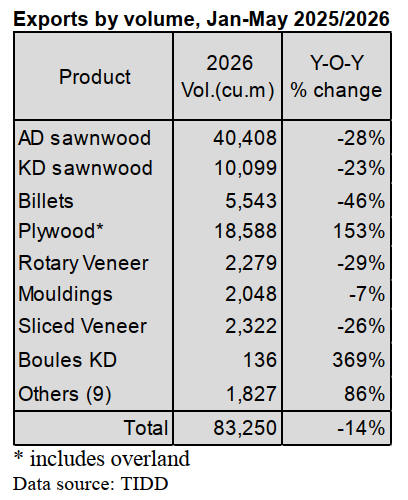 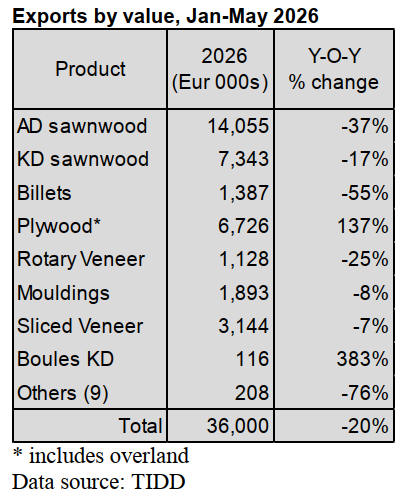
Exports of major wood products including sawnwood and
veneer dropped in volume and value. The exceptions were
plywood and kiln-dried boules which recorded increases
(153% and 369%) in volume and increases (137% and
383%) in value respectively.
The drop in export volumes could largely be attributed to
the shortage of logs and high production costs which
increasingly make it difficult for most sawmillers to break-
even.
Air-dried and kiln-dried sawnwood, plywood and billets
continued to be the leading wood products exported from
Ghana contributing 49%, 12%, 22% and 7% respectively
of the total volume of exports during the period.
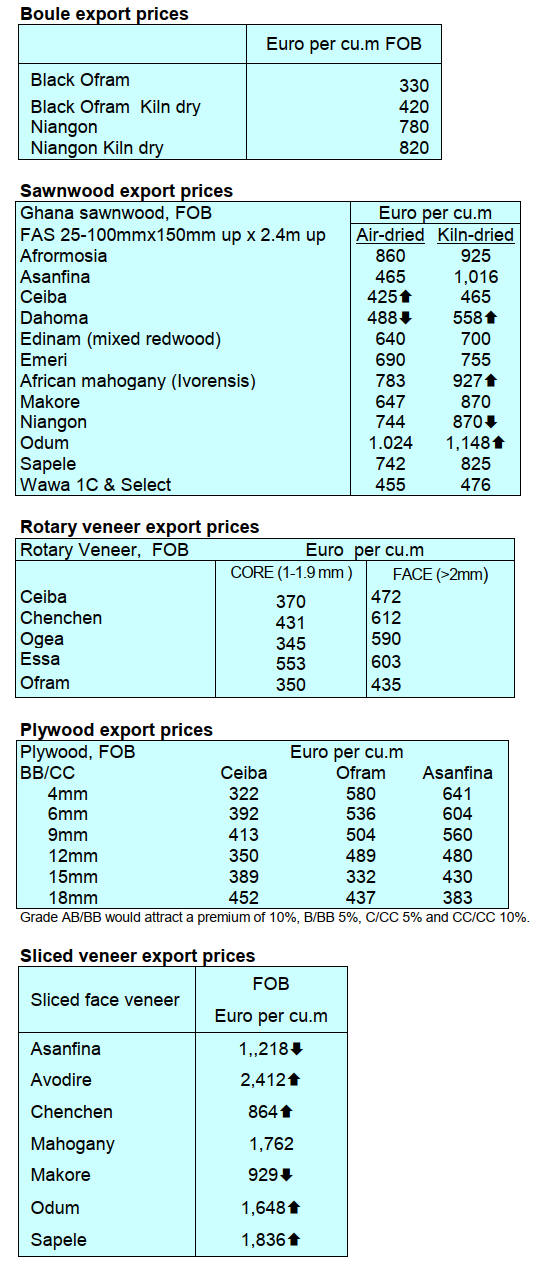
Export prices declined for major species
During the first 5-months period of 2026, export prices for
species including teak, mahogany, white ofram, tali
decking, tetekon and dubini declined in the range of Eur17
to Eur54 per cu.m. Most plywood and kiln-dried boule
shipments were destined for Greece, Germany, France and
Italy while plywood for the regional market was exported
to Gambia, Burkina Faso, Benin and Togo.
Markets in Asia (56% of the total), Europe (22%) and
Africa (14%) continued to be the major destination for
wood products.
Calls for review of Ghana’s environmental laws
Professor Edward Wiafe Debrah, Pro-Vice Chancellor of
the University of Environment and Sustainable
Development (UESD), has called on government and
policymakers to review and strengthen Ghana's
environmental policies to address emerging threats to
biodiversity. Speaking at a virtual training for West
African journalists organised by WAJESHA on the theme
“Understanding Biodiversity: Why nature matters to our
future,” he said many existing policies are outdated, some
dating to the colonial era and cannot respond to modern
methods of natural resource exploitation.
Professor Debrah cited the Forest Ordinance, Cap 157,
which permits utilisation of trees outside forest reserves
without replacement, a policy introduced to expand cocoa
production but still in force despite changed ecological
realities.
Professor Debrah noted that Ghana is developing rapidly
through mining, road construction, agriculture and
settlements but warned development must not be at the
expense of biodiversity. He said Ghana is at a crossroads,
facing deforestation, illegal mining, uncontrolled timber
harvesting, bush fires, bushmeat hunting, plastic and
chemical pollution and wetland destruction.
He cautioned against indiscriminate insecticide use, noting
that 75% of crops depend on animal pollination. He
emphasised that water pollution is not only from galamsey
but also refuse dumping and wetland conversion..
He called for stronger, enforceable laws with
accountability, restoration of degraded forests and
wetlands, investment in environmental research and
greater involvement of local communities in sustainable
management.
See:
https://www.businessghana.com/site/news/general/353905/Revie
w-outdated-env%E2%80%99tal-policies
Ghana’s merchandise trade - exports surpass imports
The Ghana Statistical Service (GSS) has published its
“Ghana’s Merchandise Trade Statistics 2004/25: Two
Decades in Review” report, which shows that for the first
time in nearly two decades, merchandise exports have
surpassed imports. According to the Government
Statistician, Dr. Alhassan Iddrisu, in 2025 exports
accounted for 61% of total trade compared to 32% in
2004, thus Ghana sold more than it purchased in only
seven of the 21 years reviewed.
A turning point came in 2023 when Ghana returned to a
trade surplus and has remained positive since. The surplus
was GHS5.3 billion in 2023, rising to GHS44.7 billion in
2024 and a record GHS148.3 billion in 2025. Total
merchandise exports grew from US$1.93 billion in 2004 to
US$32 billion in 2025 while imports rose from US$4.09
billion to US$20.5 billion.
Dr. Iddrisu said the improved balance has strengthened
Ghana’s foreign exchange earnings but emphasised that
sustaining the gains will require export diversification and
greater value addition to local products including timber
wood products.
Meanwhile, the Ghana Investment Promotion Authority
(GIPA) has announced major changes under the GIPA
Act, 2026 (Act 1173) with the removal of minimum
capital requirements for wholly foreign-owned businesses
and joint ventures.
See: https://www.myjoyonline.com/ghanas-exports-surpass-
imports-after-two-decades-of-trade-imbalances/
and
https://www.myjoyonline.com/gipa-scraps-minimum-capital-
requirement-for-foreign-owned-businesses/
3. MALAYSIA
MTC ‘Factory Transformation Programme’
The Malaysian Timber Council (MTC) conducts targeted
outreach and sharing sessions for its Factory
Transformation Programme (FTP), designed to upgrade
wood-based and furniture manufacturing capabilities
through Green 5S, Lean Management, Innovation
Management and Industry 4.0 adoption.
Training and implementation modules cover Lean
manufacturing principles, waste reduction, continuous
improvement, Green 5S practices and business
digitalisation. Regular stakeholder engagement and
briefing sessions, often held in collaboration with expert
bodies allow timber operators to witness live
demonstrations of smart factory cells, automation and
collaborative robots.
The Factory Transformation Programme is considered a
successful flagship initiative endorsed by Malaysia's
Ministry of Plantation and Commodities. It effectively
helps wood-based and timber manufacturing enterprises
upgrade operations, reduce costs, increase production
capacity and improve global competitiveness through lean
management.
For details and the aims of the programme see:
https://www.mfc.my/post/mtc-factory-transformation-
programme
Bamboo developments
The Sabah State Development Office (ICU JPM), Yayasan
Sabah and Sabah Handicraft Centre have strengthened
efforts to develop bamboo industry through a two day
working visit to the Sarawak Timber Industry
Development Corporation (STIDC).
Sabah JPM Director, Samsul Dollah, said Sarawak had
made strong progress in the bamboo industry making
STIDC’s experience and expertise a valuable reference for
Sabah. “We want to see the bamboo industry emerge as a
new catalyst for economic growth, not only in Sabah but
also in Sarawak.
He said the bamboo industry holds significant potential if
developed systematically, citing the success of countries
such as China, Thailand and Taiwan P.o.C in transforming
bamboo into a high value commodity.
See:
https://theborneopost.pressreader.com/article/281668261773125
State on track to achieve protected forest target
Sarawak has made significant progress towards its target
of gazetting at least one million hectares of forest as
Totally Protected Areas (TPAs), said Awang Tengah Ali
Hasan, the Deputy Premier.
He said the State has intensified various efforts to realise
the plan, including expanding TPAs and the Permanent
Forest Estate (PFE), implementing the Malaysia Greening
Programme and the Greening Sarawak Campaign,
promoting sustainable forest management and developing
Forest Carbon initiatives.
Awang Tengah, said Sarawak’s land use policy serves as a
key guideline in balancing economic development with
environmental sustainability. “In our development
framework, we have a land use policy that guides the
State’s development towards environmental
sustainability”.
He noted that through the Malaysia Greening initiative and
the Greening Sarawak Campaign more than 57 million
trees have been planted.
See:
https://theborneopost.pressreader.com/article/281638196999650
Bio-char products for export
According to Chairman of the China Green Finance
Committee, Dr. Ma Jun, Sabah could generate billions of
ringgit by converting its vast biomass waste into value-
added bio-char products for export, particularly to China.
He said Sabah should capitalise on its abundant
agricultural and forestry waste instead of relying mainly
on carbon credits and ecotourism revenue.
The Green Finance Committee (GFC) of the China
Society for Finance and Banking is a leading professional
body established in 2015 under the guidance of the
People's Bank of China. It drives national green finance
policies, standards, product innovation and international
cooperation, helping mobilise private capital for
environmental and low-carbon projects.
Instead of depending on the carbon credit market Jun said
Sabah could embrace the circular economy by converting
agricultural and timber waste into bio-char, a product in
growing global demand for industrial decarbonisation.
“Sabah has abundant forestry biomass waste, including
leaves and tree trunks that can be converted into biochar,
fertiliser and other value-added products. These can be
used to decarbonise coal-fired power plants and the steel
industry,” he said.
Bio-char, produced by carbonising biomass or carbon-
containing waste, is said to have high calorific value and
improved combustion characteristics while containing
lower levels of ash, sulphur and nitrogen. These properties
make it suitable as a substitute for fossil fuels in
steelmaking and power generation.
See: https://www.dailyexpress.com.my/news/285609/sabah-can-
profit-from-biochar-expert/
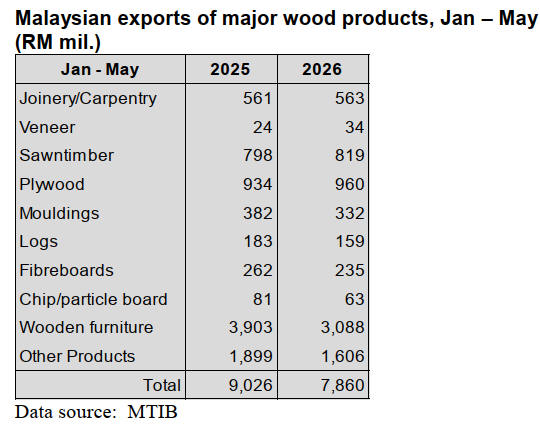
Wooden furniture – positive trade balance
In June 2026 Malaysia exported MYR219 mil and
imported MYR123 mil. of wooden furniture resulting in a
positive trade balance of US$96 mil..
Between May 2026 and June 2026, exports
of furniture from Malaysia decreased by 5%, during the
same period imports increased by 9%.
See: https://oec.world/en/profile/bilateral-product/furniture-
wooden-nes/reporter/mys
4.
INDONESIA
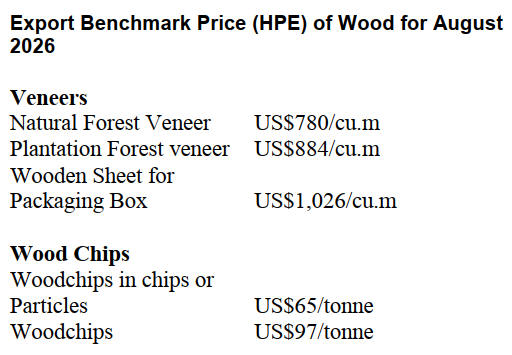
Processed Wood
Processed wood products which are leveled on all four
sides so that the surface becomes even and smooth with
the provisions of a cross-sectional area of 1,000 sq. mm to
4,000 sq.mm (ex 4407.11.00 to ex 4407.99.90)
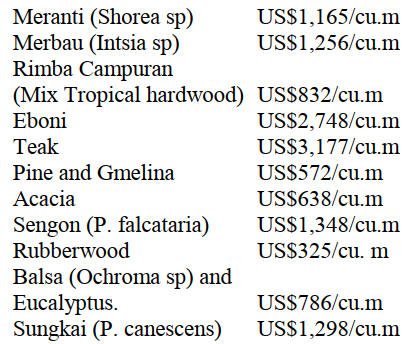
Processed wood products which are leveled on all four
sides so that the surface becomes even and smooth of
Merbau wood with the provisions of a cross-sectional area
of 4,000 sq.mm to 10,000 sq. mm (ex 4407.11.00 to ex
4407.99.90) = US$1,500/cu.m
See: https://jdih.kemendag.go.id/peraturan/keputusan-menteri-
perdagangan-republik-indonesia-nomor-1667-tahun-2026-
tentang-harga-patokan-ekspor-dan-referensi-atas-produk-
pertanian-dan-kehutanan-yang-dikenakan-bea-keluar-dan-tarif-
badan-layanan-umum
Forest certification reform with SVLK-PEFC combined
audit
Indonesia’s Ministry of Forestry has partnered with the
Indonesian Forestry Certification Cooperation
(IFCC)/Programme for the Endorsement of Forest
Certification (PEFC) to develop and pilot a combined
audit mechanism that integrates Indonesia’s mandatory
Timber Legality and Sustainability Verification System
(SVLK) with the internationally recognised IFCC/PEFC
forest certification scheme.
The combined audit system will allow a single audit team
to assess both certification schemes simultaneously,
reducing duplication, improving efficiency and
maintaining the integrity of each standard.
The collaboration includes establishing a joint working
team, developing audit procedures, aligning SVLK and
IFCC/PEFC requirements, defining auditor competencies,
conducting pilot audits and refining the mechanism based
on evaluation results. Both parties also committed to
ongoing coordination, monitoring and evaluation to
support effective implementation before wider adoption.
In related news, the strengthened SVLK+ will require all
forest products traded domestically and internationally to
be supported by legality assurance documentation,
creating an integrated certification and traceability system
across the supply chain.
The framework is supported by five key instruments,
including SVLK certification, Sustainable Forest
Management and Legality Certificates, V-Legal
Documents, FLEGT Licenses for exports to the European
Union and the United Kingdom and Independent
Assessment and Verification Bodies (LPVI).
The government is also expanding support for small
businesses, cooperatives and social forestry groups
through certification assistance, export documentation,
improved access to government procurement and
marketing capacity-building reinforcing Indonesia's
commitment to sustainable forest governance and
competitive global trade.
See: https://ecobiz.asia/indonesia-advances-forest-certification-
reform-with-svlk-pefc-combined-audit/
and
https://www.tvonenews.com/daerah/jateng/455859-kementerian-
kehutanan-dan-ifcc-tandatangani-perjanjian-kerja-sama-
pengembangan-audit-kombinasi-sertifikasi-svlk-dan-ifccpefc
Update product processing rules to boost downstream
industries
Indonesia's Ministry of Forestry is updating regulations on
forest product processing to accelerate downstream
industry development, increase the value of forest
resources and enhance the competitiveness of the national
forest products sector.
The revisions, which include amendments to Minister of
Environment and Forestry Regulation No. 8 of 2021, are
aimed at implementing Government Regulation No. 28 of
2025 while addressing industry growth, global trade
dynamics and the need for stronger business certainty.
The Ministry is encouraging a forest-based value chain
approach that integrates forest management, harvesting,
transportation, processing, distribution, marketing and
exports into a unified ecosystem. This strategy is expected
to improve industry efficiency and competitiveness while
meeting global demands for legal sourcing, sustainability
and lower carbon footprints. The revised regulations will
also strengthen governance through improved reporting,
monitoring, evaluation and supervision systems to ensure
sustainable forest management and a consistent supply of
legal raw materials.
See: https://rri.co.id/en/environment/2594283/ministry-revises-
forest-rules-to-accelerate-downstreaming
Strong business climate will spur growth
Abdul Sobur, Chairman of the Indonesian Furniture
Industry and Craft Association (HIMKI), said that a
stronger business climate built on public trust is essential
to accelerating Indonesia's transition to developed nation
status. He emphasised that trust encourages investment,
strengthens businesses and enhances industrial
competitiveness, while highlighting Indonesia's abundant
natural resources, demographic dividend, strategic location
and creative workforce as key advantages.
Sobur also stressed that the government must consistently
uphold the rule of law to reinforce public and business
confidence, adding that Indonesia's progress depends on
the collective commitment of government, law
enforcement, businesses, academics, the media and the
public to uphold integrity.
See: https://www.antaranews.com/berita/5662765/himki-yakin-
penguatan-iklim-usaha-akselerasi-ri-jadi-negara-maju
Furniture exports to US could fall
The HIMKI estimates that Indonesia's furniture and
handicraft exports to the United States could decline by
5%–10% in the second half of 2026 following the
introduction of an additional 10% US import tariff.
HIMKI Chairman, Abdul Sobur, said the export
performance is expected to remain flat or record a
moderate decline under the baseline scenario, while
weaker US consumer demand, delayed purchases by
American buyers or additional tariffs stemming from
excess-capacity investigations could deepen the decline to
10%–15%.
HIMKI warned that additional tariffs will increase
pressure on Indonesian exporters through price
renegotiations, delayed order confirmations, reduced order
volumes and buyers shifting orders across multiple
sourcing countries to manage risk.
Sobur noted that the furniture industry is highly price-
sensitive, with the greatest impact likely to fall on
manufacturers of mass-market products that operate on
thin margins and rely heavily on one or two US buyers.
However, the industry could limit the impact by
maintaining competitive pricing, leveraging Indonesia's
tariff advantage over rival exporters and securing orders
relocated from competing countries.
See:
https://ekonomi.bisnis.com/read/20260727/257/1991358/industri
-mebel-ketar-ketir-efek-berantai-tarif-as.
Businesses thrive with policy certainty
The Indonesian Employers’ Association (Apindo) has
urged the government to provide greater policy certainty
as businesses face uncertainty over US tariff policies.
Apindo Chairwoman, Shinta W. Kamdani, emphasised
that companies need clarity, not only on tariff levels but
also on the direction and implementation of US trade
policies.
She called for continued economic diplomacy between
Indonesia and the United States to finalise negotiations on
product tariff exemptions which would help protect the
competitiveness of Indonesian exports.
Apindo also encouraged the government to accelerate
structural reforms to strengthen Indonesia’s investment
climate and attract global investment. Key priorities
include improving legal certainty, simplifying regulations,
increasing logistics efficiency, maintaining competitive
energy costs, strengthening infrastructure, speeding up
licensing and improving human-resource quality.
In addition, Apindo called for greater export-market
diversification through international trade agreements to
reduce Indonesia’s dependence on specific markets amid
increasing fragmentation in global trade.
See:
https://ekonomi.bisnis.com/read/20260724/12/1990647/apindo-
dunia-usaha-butuh-kepastian-kebijakan-hadapi-tarif-as.
Accelerating digital transformation of forestry services
Indonesia’s Minister of Forestry, Raja Juli Antoni, is
accelerating the digital transformation of forestry services
and licensing to make public services faster, easier and
more transparent.
He has instructed all First Echelon units within the
Ministry of Forestry to map their services and identify
priorities for digitalisation. Existing initiatives include
National Park e-tickets, a law enforcement complaints
system, an electronic portal for transporting wild plants
and animals and a forest and land fire monitoring system.
The ministry views digital transformation as an important
step toward strengthening bureaucratic reform, improving
service quality and increasing public trust.
See: https://www.metrotvnews.com/read/kM6C4dLZ-menhut-
percepat-transformasi-layanan-kehutanan-melalui-digitalisasi
Innovation key to advancing value-added forest
products
The National Research and Innovation Agency (BRIN)
highlighted technological innovation as key to improving
production efficiency, yields and the development of
value-added forest products. BRIN also emphasised that
wood remains a highly relevant material for the future.
Meanwhile, industry stakeholders identify raw material
availability, production efficiency, market certainty,
competitiveness, inefficient licensing, geopolitical
developments and changing global market demands as
major challenges facing Indonesia’s downstream wood
industry.
In related news, the Association of Indonesia Forest
Concession Holders (APHI) is calling for research-driven
development of non-timber forest products (NTFPs)
through stronger collaboration with universities to
promote more productive and sustainable forest
management while increasing economic value for local
communities.
APHI Chairman, Soewarso, said the Multi-Business
Forestry approach, which integrates timber, NTFPs and
environmental services, is expected to become a key
model for future forest management. He emphasised the
importance of university research in developing NTFPs
from cultivation and processing to value addition and
market development while also urging universities to
update forestry curricula to reflect advances in policy,
technology, industry needs and changing forest-
management practices.
See: https://www.antaranews.com/berita/5663985/brin-inovasi-
teknologi-penting-bagi-pengembangan-produk-hasil-hutan
and
https://esgnow.republika.co.id/berita/tikdhp522/aphi-dorong-
pengembangan-komoditas-hasil-hutan-bukan-kayu-berbasis-riset
Indonesia urged stronger sustainable forest-product
trade at APEC forum
Indonesia urged APEC members to strengthen legal and
sustainable forest-product trade at the 2026 APEC
Ministerial Meeting on Forestry in Shenzhen, China.
Indonesia highlighted its Timber Legality and
Sustainability Verification System (SVLK) as an
internationally recognised mechanism for ensuring the
legality of forest products and strengthening market
confidence. It also encouraged greater regional
cooperation on market access, traceability systems,
reducing technical trade barriers and green investment,
while promoting non-timber forest products (NTFPs) as
alternative sources of income for communities living
around forests and as an incentive for forest conservation.
Indonesia also emphasised the importance of protecting
mangrove ecosystems and called for stronger cross-border
cooperation to address threats such as the illegal trade of
mangrove wood for charcoal production.
As Indonesia is home to around 23% of the world’s
mangroves, it is promoting the World Mangrove Center
(WMC) as a platform for international collaboration
among governments, research institutions, organisations,
civil society and other stakeholders.
The initiative supports Indonesia’s broader efforts to
strengthen global forest governance, promote sustainable
trade, protect biodiversity, mitigate climate change and
advance green economic development.
See: https://ecobiz.asia/indonesia-serukan-penguatan-
perdagangan-hasil-hutan-lestari-di-forum-kehutanan-apec/
and
https://forestinsights.id/di-forum-apec-indonesia-dorong-
penguatan-svlk-dan-perdagangan-hasil-hutan-berkelanjutan/
International forestry cooperation
Indonesia and Australia have agreed to strengthen
cooperation in sustainable forestry, focusing on legal and
sustainable forest-product trade, forest protection and
improved forest governance.
The partnership aims to enhance the legality and
traceability of timber, expand market access for
sustainably sourced products, support local communities
and build trust in forest-product trade across the Asia-
Pacific region. Both countries also discussed ongoing
initiatives and deeper collaboration in sustainable forest
management, law enforcement, human-resource
development, multilateral forums and sustainable
management of coastal ecosystems.
Indonesia and South Korea have agreed to strengthen their
forestry partnership through greater technical cooperation
in sustainable forest management, community
empowerment and climate change adaptation.
During a bilateral meeting on the sidelines of the 2026
APEC Forestry Ministers’ Meeting in Shenzhen, both
sides discussed expanding existing collaboration and
exploring new initiatives to address increasingly complex
forest management challenges. Indonesia also expressed
appreciation for South Korea’s support for the
development of its forestry sector.
Both countries emphasised the importance of balancing
forest ecosystem protection with community welfare,
safety and economic development. South Korea considers
Indonesia a strategic forestry partner and has established
an overseas Forest Service Center in Indonesia. The
strengthened partnership is expected to advance
cooperation in sustainable forest management, forest fire
prevention, climate change adaptation, knowledge
exchange and community empowerment, contributing to a
more resilient, inclusive and sustainable forestry sector.
Indonesia and Japan reaffirmed their commitment to
deepening bilateral forestry cooperation during a meeting
on the sidelines of the 2026 APEC Ministerial Meeting on
Forestry in Shenzhen, China. Indonesia highlighted
Japan’s support through the Japan International
Cooperation Agency (JICA) for sustainable forest
management, community-based forest and land fire
prevention and mangrove management.
The two countries also discussed strengthening
cooperation on the World Mangrove Center (WMC), with
Indonesia seeking Japanese support for research, capacity
building, knowledge exchange and innovation to advance
mangrove conservation and climate change mitigation and
adaptation.
The countries also explored cooperation on national park
management through the Sister Park initiative, biodiversity
conservation and wildlife conservation, including a
proposed Komodo dragon loan to Japan subject to national
regulations and international animal welfare standards.
They further discussed combating illegal logging and
promoting legal and sustainable forest-product trade,
including efforts to improve interoperability between
Indonesia’s Timber Legality and Sustainability
Verification System (SVLK) and Japan’s timber legality
requirements under the Clean Wood Act. Both sides
expressed their commitment to ensuring that the
partnership delivers concrete and mutually beneficial
outcomes.
See: https://en.antaranews.com/news/424813/indonesia-australia-
deepen-sustainable-forestry-cooperation
and
https://www.kehutanan.go.id/news/indonesia-dan-korea-selatan-
perkuat-kerja-sama-kehutanan-berkelanjutan-di-sela-apec-
forestry-ministers-meeting
and
https://www.tvonenews.com/amp/berita/internasional/456289-
indonesia-dan-jepang-perkuat-kerja-sama-kehutanan-
berkelanjutan-di-sela-pertemuan-the-2026-apec-ftmm
Progress on wildfire management centre
Indonesia and South Korea are finalising the development
of a Forest and Land Fire Management Center in South
Sumatra, aimed at strengthening Indonesia’s capacity to
address increasingly complex wildfire risks linked to
climate change. The centre is the result of five years of
bilateral cooperation involving the exchange of
technology, expertise and best practices in wildfire
prevention and mitigation.
The Ministr of Forestry, Raja Juli Antoni, highlighted the
importance of continued cooperation in addressing the
transboundary impacts of forest and land fires, while the
center is expected to serve as a foundation for further
Indonesia-South Korea collaboration after its planned
completion later this year.
See: https://www.metrotvnews.com/read/KYVCeAnl-indonesia-
south-korea-build-fire-management-center-in-south-sumatra
Indonesia-EAEU FTA opens US$3 trillion market
The ratification of the Indonesia-Eurasian Economic
Union Free Trade Agreement (IEAEU-FTA) is expected
to give Indonesian products access to a market worth
around US$3 trillion.
Trade Minister, Budi Santoso, said EAEU members
(Russia, Belarus, Kazakhstan, Armenia and Kyrgyzstan)
have committed to eliminating or reducing tariffs on
11,882 tariff lines or 90.5% of their total tariff lines. Key
Indonesian exports expected to benefit include palm oil
and its derivatives, natural rubber, coffee, fishery products,
textiles, footwear, furniture, electrical equipment and
wood and wood products.
The Agreement is also expected to create new
opportunities for Indonesian micro, small and medium
enterprises (MSMEs) to expand into Central Asia, West
Asia and Eastern Europe.
In return, Indonesia will reduce tariffs on 10,257 tariff
lines, equivalent to 89.9% of its national tariff lines mainly
covering industrial inputs and raw materials such as wheat,
fertiliser, pharmaceuticals, basic chemicals, dairy products
along with paper and pulp.
The Trade Ministry projects that full implementation of
the Agreement could raise Indonesia’s exports to the
Eurasian region to between US$2.87 billion and US$2.89
billion.
See: https://en.antaranews.com/news/423541/indonesia-eaeu-fta-
opens-us3-trillion-market-for-local-products
5.
MYANMAR
6.
INDIA
Inflation update
India's annual headline inflation was recorded at 4.38% for
June 2026, rising from 3.93% in May 2026, according to
provisional data released by the Ministry of Statistics and
Programme Implementation. Urban retail inflation
was 3.92%, while rural inflation hit 4.74% in June.
The year-on-year housing inflation rate for June 2026 was
2.10% (Provisional) and the corresponding inflation rate
for rural and urban areas were 2.66% and 1.90%,
respectively.
See: https://www.mospi.gov.in/themes/product/9-consumer-
price-index-cpi
Wood product price indices
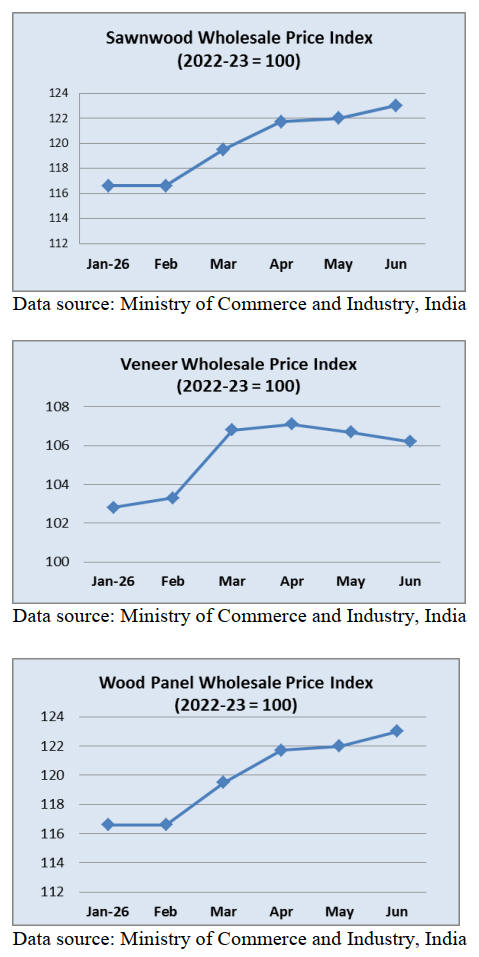
The Office of Economic Adviser (OEA), Department for
Promotion of Industry and Internal Trade (DPIIT) has
released the revised series of indices with a base year
2022-23. The new series will replace the existing series.
Please note the change in base year when examining the
trends in the graphic below.
Encouraging private sector plantations on degraded
land
India’s paper and pulp industry has been lobbying since
1970s to secure regulatory changes allowing plantations
on forest land, a move that could provide relief to the
struggling industry by reducing import dependence.
Early this year the Union Ministry of Environment,
Forests and Climate Change (MoEF&CC) notified an
amendment to the Van (Sanrakshan Evam Samvardhan)
Adhiniyam, 1980 (Forest Conservation Act, 1980)
granting direct access to forest land. Under the revised
rules, private entities can now undertake commercial
plantations in forest areas without paying long-standing
environmental levies such as Net Present Value (NPV)
and Compensatory Afforestation (CA).
The NPV is one-time charge levied on users diverting
forestland, based on a scientific calculation of the value of
ecosystem goods and services such as clean air, water and
biodiversity.
India's plywood and wood-panel sector is also expected to
benefit from eased forest plantation and land-lease rules.
Amendments allowing commercial short-rotation tree
crops (like poplar and eucalyptus) on degraded forest
lands without heavy environmental levies aim to lower
domestic raw material costs and reduce heavy reliance on
expensive timber imports.
There have been long-standing concerns over the
availability of domestic wood due to rising demand and
growing dependence on imports. According to Indian
Paper Manufacturers Association’s (IPMA) annual report
for 2024-25, domestic wood availability is estimated at
around nine million tonnes per annum against a current
demand of about 11 million tonnes.
The amendment could help bridge this gap while also
contributing to national greening targets, the report said.
Manufacturers also link their case to India’s climate
commitments, arguing that commercial plantations can
align with broader restoration goals.
Under its Nationally Determined Contributions (NDC),
India has committed to bringing an additional 25-30
million hectares of degraded land under forest and tree
cover by 2030, creating an additional carbon sink of 2.5-3
billion tonnes of carbon dioxide equivalent.
It is estimated that around 500,000 farmers are engaged in
growing eucalyptus, subabul (Leucaena leucocephala),
coastal she-oak (Casuarina equisetifolia), acacia, poplar
(Populus), chinaberry tree (Melia azedarach), mango
(Mangifera indica) and silver oak (Grevillea robusta)
species largely used in the industry.
According to the India State of Forest Report 2023, around
92,989 square kilometres of land has been identified as
suitable for potential upgrades with an estimated carbon
sequestration potential of 636.5 million tonnes.
See: https://www.downtoearth.org.in/forests/access-open-why-
indias-paper-industry-wants-forest-rules-eased
and
https://plyinsight.com/eased-plantation-and-forestry-rule-cheers-
industry/
Investments in Tanzania
The Haryana State government has MoUs with Tanzania
which are likely to make hundreds of hectares of land
available for various sectors in India such as paper,
plywood and agriculture. The local media reports that
doing business in Tanzania has increasingly become
attractive with the Haryana State government and the
central government is expanding ties with the East
African nation.
Some entrepreneurs from Haryana‘s Yamunanagar have
established veneer mills in Tanzania for the production of
core veneers. After Gabon, Tanzania is another African
country where the Indian wood panel sector is investing in
veneer production.
See: https://www.deccanherald.com/india/haryana/haryana-govt-
signs-mou-for-one-lakh-acres-of-farm-land-in-tanzania-3989240
7.
VIETNAM
Wood and wood product (W&WP) trade
highlights
According to the Viet Nam Customs Office, W&WP
exports in July 2026 reached US$1.55 billion, up 0.1%
compared to June 2026 and up 5.3% compared to July
2025. The WP export share was US$950 million, down
3.6% compared to June 2026 and down 5.5% compared to
July 2025.
In the first 7 months of 2026, the W&WP exports are
estimated at US$10.1 billion, up 5% over the same period
in 2025. WP exports contributed US$6.4 billion, down
2.3% over the same period in 2025.
Viet Nam's imports of raw wood (logs and sawnwood) in
June 2026 amounted to 821,700 cu.m, worth US$257.8
million, up 19% in volume and 7% in value compared to
May 2026 and up 31% in volume and 21% in value
compared to June 2025.
In the first 6 months of 2026, Viet Nam's imports of raw
wood totalled 3.76 million cu.m, worth US$1.25 billion,
up 15% in volume and 21% in value over the same period
in 2025.
Viet Nam’s W&WP exports to the US in July 2026
fetched US$815 million, up 4% compared to June 2026
but down 3% compared to July 2025. In the first 7 months
of 2026, W&WP exports to the US earned US$5.08
billion, down 6% over the same period in 2025.
Imports of raw wood from China in July 2026 were
135,000 cu.m with a value of US$44.9 million, up 3% in
volume and 4% in value compared to June 2026 and an
increase of 51% in volume and 52% in value over the
same period in 2025.
In the first 7 months of 2026, imports of raw wood from
China amounted to 760,400 cu.m with a value of
US$252.9 million, down 10% in volume and down 2% in
value over the same period in 2025.
Viet Nam's NTFP exports in June 2026 earned US$89.75
million, up 11% compared to May 2026 and up 22% over
the same period in 2025. In the first 6 months of 2026 Viet
Nam's NTFP exports reached US$489.94 million, up
119% over the same period in 2025.
Euro 20 million boost for sustainable forest
management
The European Union and Germany have launched a €20
million initiative to help Viet Nam conserve and
sustainably manage its natural forests as part of a broader
push to strengthen the country's climate resilience and
rural livelihoods. This Forestry Support Programme will
run to the end of 2030 and focus on five provinces: Son
La, Dien Bien, Quang Ngai, Gia Lai and Dak Lac.
The programme will be jointly implemented by the Viet
Nam Administration of Forestry (VNFOREST) and the
German Development Agency GIZ and is co-financed by
the EU and Germany's Federal Ministry for Economic
Cooperation and Development (BMZ). The programme
will run alongside a separate €7.5 million German-funded
project launched earlier this year supporting conservation
and ecosystem financing in Viet Nam's special-use and
protection forests.
VNFOREST Director, Tran Quang Bảo, said the forestry
sector sustains the livelihoods of millions of Vietnamese
people who are engaged in forest protection and planting
and timber processing, while playing a central role in the
country's climate and economic goals. He said the
programme would prioritise natural forest restoration,
sustainable management and climate adaptation in the
northwest and Central Highlands, regions with significant
forest-dependent populations.
The programme centres on three priorities: restoring and
sustainably managing natural forests in the face of climate
change; developing greener, more inclusive forest-based
supply chains that ensure fair participation and gender
equality; and strengthening legal frameworks and
technical capacity to scale up nature-based solutions
nationwide.
On the ground, it will promote integrated forest
management, community-based forest protection, digital
tools for biodiversity monitoring and sustainable
livelihood models, efforts officials say, will boost forests'
capacity to absorb carbon, cut greenhouse gas emissions,
preserve biodiversity and strengthen resilience to climate
change.
Kristina Buende, head of cooperation at the EU Delegation
to Viet Nam, said the country's forests are critical to
climate action, water and soil protectionand the
livelihoods of roughly 25 million people, even as climate
impacts, forest degradation and biodiversity loss put those
ecosystems at risk.
Michael Lehmann, Deputy Head of Cooperation at the
German Embassy in Hanoi said Germany's combined
technical and financial support for Viet Nam's forestry
sector now totals nearly €100 million with the focus not
simply on expanding forest cover but on ensuring forests
remain healthy, protected and inclusively managed.
The new initiative builds on decades of German-
Vietnamese cooperation on forest governance and
biodiversity, Lehmann said, including two projects
completed last year on sustainable management of forest
plantations and on ensuring legal, transparent timber
sourcing under the EU-Viet Nam Voluntary Partnership
Agreement on Forest Law Enforcement, Governance and
Trade.
Lehmann said that over the next five years, Germany and
its partners will work with local, provincial and national
authorities to promote sustainable forest management,
with lessons from pilot activities expected to feed into
national policy and capacity-building efforts.
See: https://Viet Namnews.vn/environment/1797095/viet-nam-
receives-23-million-boost-for-sustainable-forest-
management.html
Timber supply bottlenecks slowing expansion of
value-added processing
Removing bottlenecks in timber raw materials supply for
value-added processing is crucial for Viet Nam's wood
industry to increase export value and strengthen its
position in the global supply chain, say industry insiders.
Viet Nam's wood industry has grown rapidly in recent
years with exports reaching US$17.2 billion in 2025.
Wood and wood products are now shipped to more than
160 countries and territories making Viet Nam an
important processing hub in the global supply chain.
However, despite having around 4.9 million ha of planted
forests, many manufacturers are struggling to secure
sufficient raw materials for processing and value-added
production. Large volumes of timber are still harvested
young and exported as woodchips and pellets and there is
limited supplies of larger-diameter logs. An industry
spokesperson said acacia trees are commonly harvested
after just three to four years as numerous woodchip
processors compete aggressively for timber which can
create instability in the raw material market.
He said the current practice significantly reduces the value
of forest resources. Three tonnes of fresh acacia generate
only around 4 million VND (US$152.4) when exported as
woodchips or 5 million Dong as pellets, compared with up
to 20 million Dong if used for plywood and other value-
added products. As a result, many manufacturers have had
to cut production or suspend operations because of raw
material shortages.
According to the Viet Nam Timber and Forest Product
Association (Viforest) the country's four major export
product groups required about 59.5 million cu.m of timber
in 2025.
Woodchips and pellets accounted for 46.5 million cu.m, or
78% while industrial wood panels and furniture consumed
just 13 million cu.m, or 22% indicating that most timber is
still used for low-value exports.
According to the Chairman of MDF Mekong, woodchips
continue to account for a large share of Viet Nam's
forestry exports despite their low added value and limited
contribution to the wood industry's value chain. He
attributed this to the low export tax on woodchips, at
around 2%, which is fully refundable, effectively reducing
the rate to nearly zero. In contrast, value-added wood
products are subject to export taxes of 8–10%. At the same
time, woodchip facilities require far less investment than
deep-processing plants.
The structure of Viet Nam's forestry sector also poses
challenges. Most plantation forests are managed by small
household growers with limited financial resources,
prompting many to harvest trees after only three to five
years to recover capital quickly and minimise risks.
With the industry targeting US$19 billion in exports in
2026, businesses have called on authorities to gradually
curb raw material exports by raising export taxes on
woodchips, introducing export quotas, stepping up
inspections and tightening oversight of wood chipping
facilities, collection points and unlicensed weighing
stations and taking firm action against operations that fail
to meet regulatory requirements.
Viforest Secretary General, Ngo Sy Hoai, said Viet Nam
does not lack plantation forests but lacks stable supplies of
large, high-quality and legally sourced timber suitable for
deep processing. Addressing fragmented forest ownership,
improving tree varieties and cultivation techniques and
strengthening cooperation between growers, cooperatives
and processors would be key to building a sustainable
timber supply chain.
He stressed the need to shift towards sustainable plantation
forest management, saying that rather than treating forests
as short-rotation crops for quick returns, plantations
should be managed as long-term assets, with appropriate
tree species selection, optimal planting density, effective
pest and disease control, soil and water conservation,
carbon management and harvesting based on quality
objectives.
Under this approach, forest growers would no longer sell
timber solely by weight, but could also market it based on
log diameter, quality, certification and processing
capacity, Hoai noted.
According to Nguyen Van Dien, Deputy Director of the
Forestry and Forest Protection Department under the
Ministry of Agriculture and Environment, the industry
must shift from pursuing export volume to creating greater
value by ensuring timber is legal, fully traceable, sourced
without deforestation, certified under sustainable forest
management standards and produced with low carbon
emissions.
He said the ministry will continue promoting large-timber
plantations, expanding certified forests, developing digital
traceability systems and improving policies on finance,
investment and carbon markets to secure a sustainable raw
material base for the industry's long-term growth./.
See: https://en.Viet Namplus.vn/tackling-timber-supply-
bottlenecks-needed-for-value-added-processing-experts-
post349582.vnp
Domestic market seen as key growth pillar for wood
industry
The wood industry should treat the domestic market as a
strategic growth pillar rather than a fall back when exports
weaken, industry executives and policymakers said during
a conference on developing the local wood product
markets.
Valued at about US$5 billion a year and projected to
exceed US$7 billion by 2030, the domestic wood and
furniture market is increasingly seen as a new source of
growth for one of Viet Nam's largest export industries,
they said. Experts argued that stronger local demand could
reduce the sector's dependence on overseas markets and
improve its resilience to global economic shocks.
The wood industry has built its reputation on exports, with
overseas shipments and Vietnamese wood products are
sold in more than 160 countries and territories. Industry
representatives said that success has exposed a gap at
home, where the domestic market has yet to receive the
same strategic attention despite its size and growth
potential.
Ngo Sy Hoai, Secretary-General of the Viet Nam Timber
and Forest Product Association (VIFOREST), said
domestic spending on wood and furniture averages about
US$50 per person a year, putting the market's current
value at around US$5 billion. Some studies estimate the
market is already approaching US$7 billion and could
exceed US$7.3 billion by 2030 if annual growth of 7 to
9% is maintained, he said.
The potential could be even larger as those estimates do
not fully account for demand from green public
procurement, social housing projects and the biomass
energy sector, all of which are expected to expand in the
coming years.
Phung Quoc Man, Vice Chairman of VIFOREST and
Chairman of the Handicraft and Wood Industry
Association of Ho Chi Minh City (HAWA) said
manufacturers have already demonstrated their capabilities
in production, design, management and sustainability by
competing successfully in international markets. The
challenge now is translating those strengths into stronger
domestic demand.
"Exports and the domestic market should not be viewed as
alternatives but as two complementary pillars," Man said.
"Exports integrate businesses into global value chains,
while the domestic market provides the foundation for
building brands, diversifying revenue and improving
resilience against external shocks."
HAWA proposed giving the domestic market a more
prominent role in industry policy including by considering
preferences for Vietnamese wood products in public
procurement, strengthening promotion of locally made
products and leveraging exporters' reputation to boost
consumer confidence. They also are development of
supporting market infrastructure such as business
databases, digital trading platforms and product exhibition
centres. VIFOREST said the domestic market's biggest
constraint is not demand but weak market infrastructure.
Technical standards remain incomplete, while information
on businesses, products and market size is fragmented.
Systems for product traceability, quality certification and
emissions disclosure are also inconsistent, making it
harder for consumers to identify legally sourced, high-
quality products and reducing incentives for companies to
invest for the long term.
Industry representatives said establishing common
standards, reliable databases and robust certification and
traceability systems would be essential to building a more
transparent and higher-value domestic market.
Experts also said green public procurement could help
stimulate demand by prioritising legally sourced, low-
emission wood products in public construction projects, in
line with Viet Nam's legal framework and international
commitments.
From a business perspective, Le Duc Nghia, Chairman of
An Cuong Wood JSC, said companies would need to
invest consistently in branding, distribution networks,
customer service and corporate governance to unlock the
domestic market's potential. He called for national quality
standards and product labeling requirements for wood
products sold domestically to help consumers identify
certified products while providing a clearer basis for
government procurement.
Nghia also urged policies to encourage the use of
plantation timber, develop supporting industries, improve
market data and strengthen links between wood processors
and raw material suppliers. He said digital transformation
had become a key competitive advantage, adding that
digitising the company's management system had
improved operational efficiency and lifted profit margins
by 2 to 3 percentage points without a corresponding
increase in staffing.
The Chief Executive of Woodsland JSC, said the domestic
market offers opportunities well beyond manufacturing,
particularly in higher value-added activities such as
distribution, design, installation and after-sales services.
"If we fail to develop the domestic market effectively,
foreign companies will enter and capture the high value-
added segments," Bằng said.
Industry executives said closer links between plantation
forests, wood processors and distribution networks,
combined with stronger technical standards and
traceability systems would be critical to expanding the
domestic market, increasing value-added production and
supporting the long-term sustainable growth of Viet Nam's
wood industry.
See: https://Viet Namnews.vn/economy/1797091/domestic-
market-seen-as-key-growth-pillar-for-wood-industry.html
8. BRAZIL
Strengthening the forestry sector in Mato
Grosso
The Center for Timber Producing and Exporting Industries
of the State of Mato Grosso (CIPEM) held its 7th Ordinary
Board Meeting, bringing together representatives of the
State’s forest-based trade unions to discuss strategic issues
for the forest sector.
The meeting was attended by representatives of the
Ministry of Labour who provided clarification on
inspection procedures and highlighted the importance of
dialogue with companies. Topics discussed included
judicial and institutional proceedings, an assessment of the
“One day in the Forest” (Dia na Floresta) event, projects
developed in partnership with research and educational
institutions, updates from the National Forum of Forestry
Based Activities (FNBF) and Federal Bill No. 6,190/2025
on timber certification.
The meeting reaffirmed CIPEM’s commitment to
defending the interests of Mato Grosso’s forest sector,
strengthening its representation and competitiveness of
companies and developing solutions aimed at sustainable
development of forestry activities in the state.
See: https://noticiaexata.com.br/geral/cipem-debate-pautas-
estrategicas-para-o-fortalecimento-do-setor-florestal-em-mato-
grosso/
Forest traceability in Brazil
Forest traceability in Brazil is evolving from isolated
documents toward an integrated data structure connecting
the timber supply chain from origin, forest stands,
management, harvesting, transportation, yards, processing
and shipment.
Integrating forest transport documents, invoices, weighing
records, inventories and third-party controls enables the
linking of volumes, species, suppliers and areas of origin
facilitating the identification of discrepancies and
strengthening proof of provenance.
Geo-referencing through coordinates, property and forest
stand polygons, satellite imagery and operational maps is
increasingly important for assessing socio-environmental
risks and demonstrating compliance, particularly in
international markets.
Growing regulatory pressure, including European rules on
products associated with deforestation, as well as forest
certifications, chain-of-custody audits and customer
requirements increases the need for reliable information on
origin, geolocation and due diligence.
The trend is toward processes and data standards capable
of meeting different requirements without rebuilding
systems for each new demand. Digitalisation through
mobile devices, QR codes, RFID and digital identifiers
increase the visibility of shipments and lots, while inter-
operability among forest management systems, ERPs,
transportation platforms and geographic databases remains
a key challenge.
Enhanced traceability can generate efficiency gains by
integrating production, harvesting, transportation and
inventory data, supporting operational scheduling, yard
management, freight contracting and industrial supply.
Organised records can also improve supplier management
and responses to documentation, quality or provenance
discrepancies, reducing the time required to identify lots
and implement corrective measures. Implementation
should begin by mapping timber flows and critical
information points, clearly defining responsibilities across
transporters, harvesting operators, nurseries, partner
producers and buyers.
Traceability can thus become an effective tool for control,
compliance and efficiency, strengthening companies'
ability to demonstrate timber origin and traceability and
respond to increasingly demanding markets.
See: https://maisfloresta.com.br/tendencias-rastreabilidade-
florestal-brasil/
US tariffs accelerate market diversification
The additional 25% US tariff on Brazilian products has
intensified challenges for Brazil’s timber industry which
was already facing declining exports and competitiveness.
Following a Section 301 investigation, tariffs on some
products temporarily reached 35% due to overlap with an
additional 10% tariff.
Brazilian timber exports totalled US$855.2 million in the
first half of 2026, down 8% in value and 6% in volume
year-on-year, while exports to the US fell 33%. The
industry has also been losing market share to Argentina,
Paraguay, Uruguay, Chile and Mexico with reports of
suspended contracts, negative margins and reduced
industrial activity.
Higher-value products were particularly affected. US
imports of Brazilian pine sawnwood fell 37% in volume
and 41% in value, while mouldings and other processed
products declined by around 40%, resulting in
approximately US$351 million in losses during the first
half of the year.
Market diversification toward Asia, Europe, Latin
America and the Middle East is emerging as an
alternative, although these markets cannot immediately
absorb current US-bound volumes and specifications. The
Brazilian government has announced a R$18.5 billion
financing line for working capital, equipment, productive
investments and market expansion, with part of the
programme still pending regulation.
The sector is also seeking to strengthen domestic demand,
particularly in construction. Diversifying markets,
developing higher-value products, investing in technology
and timber industrialisation and strengthening domestic
consumption are seen as key strategies to reduce the
industry’s vulnerability to changes in international trade
policies.
See: https://maisfloresta.com.br/tarifa-dos-eua-agrava-crise-na-
industria-da-madeira-e-acelera-busca-por-novos-mercados-e-
investimentos-no-brasil/
Climate adaptation in Amazon communities
Climate adaptation in the Amazon is increasingly being
shaped with the direct participation of Indigenous peoples,
Quilombola and other local communities. Despite their
key role in forest conservation, these groups are highly
vulnerable to the impacts of climate change.
Droughts, floods, wildfires and changes in rainfall patterns
affect food security, river transportation and livelihoods
while access to climate finance remains limited.
In this context, the “COP30 Journey (Jornada)” initiative,
launched in 2025, mobilised 1,285 participants across all
states of Brazil´s Legal Amazon and resulted in 99
Territorial Climate Action Plans, 60 of which received
technical assistance. A key convergence event was the
“Banzeiro da Esperança”, held during COP30, bringing
together around 200 representatives from communities,
governments, the private sector, institutions and civil
society organisations.
The experience highlighted the value of combining local
knowledge with modern technologies, with recurring
priorities including drinking water, solar energy, food
security and connectivity.
These priorities were incorporated into the Climate
Adaptation Mandala which also covers education,
healthcare, environmental conservation, stronger local
institutions and income generation. An estimated BRL21.6
billion will be needed over ten years to implement actions
across approximately 5,000 communities.
Key measures include water supply, sanitation, solar
energy, digital connectivity, bio-economy, agroforestry
systems, territorial protection and forest fire prevention.
The initiative underscores that strengthening forest-
dependent communities is integral to Amazon
conservation and offers a potentially replicable approach
for other tropical forests and territories vulnerable to
climate change.
See: https://umsoplaneta.globo.com/opiniao/colunas-e-
blogs/virgilio-viana/post/2026/08/da-amazonia-para-o-mundo-
um-modelo-de-adaptacao-climatica-guiado-pelas-
comunidades.ghtml
9. PERU
Ideas for digital systems for certifying
the legal origin
of timber
Ten teams of people from various backgrounds were asked
to design digital proposals to certify the legal origin of
timber harvested from forests managed with permits and
supervised by the Supervisory Agency for Forest
Resources and Wildlife (OSINFOR). This was done
within the framework of the ‘Transformagob 2026
Program’.
The challenge was posed as an initiative of OSINFOR's
Innovation and Digital Transformation Laboratory
(OsinforLAB) which seeks to strengthen timber
traceability to guarantee the legal origin and contribute to
the fight against illegal logging through innovative
solutions that also contribute to the digital transformation
of the State.
“As part of our work in the field, we identified the need
for a tool that certifies the legal origin of timber products
and strengthens the confidence of national and
international markets. Thanks to the technical support of
the ‘Transformagob Program’ we have been able to define
this challenge and develop solutions together with citizens
,” said the head of OSINFOR.
See: https://www.gob.pe/institucion/osinfor/noticias/1424961-
ciudadanos-disenan-propuestas-para-certificar-el-origen-legal-
de-la-madera
Veneer and plywood exports increased in May
According to information provided by the Services and
Extractive Industries Management of the Association of
Exporters (ADEX), during the period of May 2026 veneer
and plywood exports reached a value of US$1.27 million
FOB, representing a rise of 7% compared to the same
period in the previous year.
Ecuador was the main export destination for these
products, accounting for 40% of total exports and up 65%
compared to the same period in 2025. Mexico ranked
second with a 29% share but this was down 39%
compared to the same period of the previous year. The US
ranked third with a 12% share. The top five were
completed by the Dominican Republic and Colombia,
respectively, with shares of 8% and 5%.
Progress in identifying potential of forest resources
The National Forest and Wildlife Service (SERFOR),
together with the Regional Governments of Áncash,
Cajamarca, Junín, Loreto, Madre de Dios, and Pasco are
advancing the development of physiography and life zone
studies as part of their Forest Zoning process.
Through the Sustainable Productive Forests Program
(BPS), SERFOR provided technical assistance to ensure
that the studies were tailored to the specific characteristics
of each region. As part of this work, specialists analyzed
satellite imagery to identify different landforms and
develop preliminary maps.
The Sustainable Productive Forests Program is co-
financed by German cooperation through KfW, as part of
SERFOR's commitment to regional governments to
promote sustainable forestry development.
See: https://www.gob.pe/institucion/serfor/noticias/1427036-
serfor-seis-regiones-avanzan-en-la-elaboracion-de-mapas-para-
identificar-el-potencial-de-su-territorio-forestal |