Japan
Wood Products Prices
Dollar Exchange Rates of 25th
July
2026
Japan Yen 163.89
Reports From Japan
Bank of Japan - emerging confidence the economy
can avoid a serious downturn
Many analysts anticipate the Bank of Japan (BoJ) is likely
to raise its economic growth forecast at its next meeting
while leaving the policy interest rate unchanged after last
month’s rise to the highest level since 1995.
The consensus is that, in its quarterly outlook report, the
BoJ will probably raise its growth forecast from the
current projection of 0.5% for the year ending next March,
noting that global demand tied to artificial intelligence has
helped keep Japan’s economy resilient. Officials will also
consider revising their assessment that risks to the
economy are “skewed to the downside,” reflecting
emerging confidence that the economy can avoid a serious
downturn.
See:https://www.japantimes.co.jp/business/2026/07/18/economy/
boj-july-meeting-assessment/
Cabinet approves economic blueprint stressing BoJ
independence
In late July the cabinet approved the revised government’s
annual economic and fiscal policy replacing an earlier
version to emphasise the independence of the Bank of
Japan. An early draft suggested that the “appropriate
management of monetary policy is critically important to
achieve a strong economy” interpreted as an effort to
pressure the BoJ to maintain low interest rates.
The policy document says that Japan aims for economic
growth of over 1% in real terms and over 3% in nominal
terms and is also aiming for stable inflation.
Consumption tax on food to be lowered to 1%
The government has confirmed plans to cut the
consumption tax on food to 1%. The change will take
effect at the start of the next fiscal year and apply for two
years. The government also plans to provide benefits to
low- and middle-income earners.
See:
https://www.japantimes.co.jp/news/2026/07/30/japan/politics/tak
aichi-decision-tax-cut/
Inflation picks up, keeping BoJ on path for rate
increases
According to the Ministry of Internal Affairs the consumer
price index (excluding fresh food) rose 1.6% in June from
a year earlier rising for the first time in three months. This
would appear to keep the Bank of Japan (BoJ) on course
for another interest-rate hike this year.
See: https://www.japantimes.co.jp/business/2026/07/24/economy/japan-
inflation-picks-up-june/
Deepening financial burden on low income families
Low-income families in Japan are reducing their
children’s food intake and restricting air conditioning use
as rising prices deepen financial pressure during the school
summer holidays.
Kidsdoor, the Tokyo-based nonprofit organisation
surveyed households registered with its family support
programme from June 1 to June 8. Among households
with children of elementary or junior high school age,
64% said the loss of school lunches during summer
vacation would force them to reduce the amount of food
served at each meal.
About 61% expected more days when they could not
afford meat or fish, while 44% said their children would
be less likely to eat three meals a day.
The situation was most severe among households with
annual income below ¥1 million (US$6,154). In that
group, 31% said children were unable to eat enough
almost every day. More than 30% of those households also
said their children were thinner or shorter than others of
the same age.
In related news, the government has confirmed ite
intention to cut the consumption tax on food to 1%. The
change will take effect at the start of the next fiscal year
and apply for two years. The government also plans to
provide benefits to low- and middle-income earners.
See: https://www.facebook.com/thejapantimes/posts/low-
income-families-in-japan-are-reducing-their-childrens-food-
intake-and-limiti/1448799593952291/
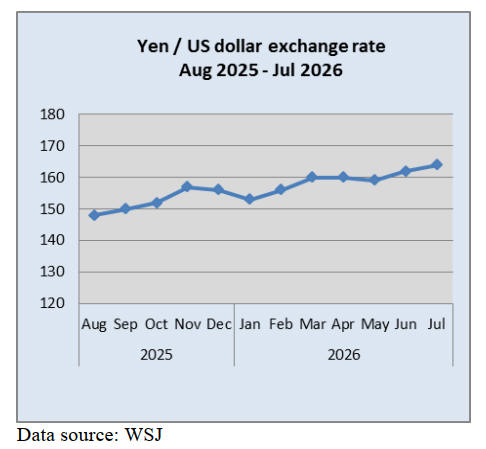
Currency market intervention anticipated
As the yen continues to weaken against the dollar,
touching the 164 to the dollar level at the end of July
intervention by Japanese authorities would appear
imminent. However, with an intervention by Japan alone
the impact could be short-lived. One key factor is the
policy stance of the US Federal Reserve.
In mid-July the Minister of Finance, Satsuki Katayama,
used the strongest language in weeks to warn of possible
intervention in the currency market but this did little move
the sentiment of yen speculators as the currency continues
to linger at around 162-163 to the US dollar, close to its
lowest level in four decades.
See:https://www.japantimes.co.jp/business/2026/07/18/yen-
verbal-intervention-threat-weakness/
Breaking news: In response to intervention on 1 August by
Japan and the US the yen/dollar exchange rate was 157/US$.
Massive quake in Kumamoto Prefecture
Following the 28 July earthquake that brought violent
shaking with a maximum of 7 on the Japanese seismic
intensity scale in Kumamoto Prefecture the prefectural
disaster response headquarters announced that as of 7:30
on 31 July, 34 people had been confirmed dead. The
extent of the damage and estimates of recovery costs are
still being assessed.
The Japan Meteorological Agency said the quake
originated in the Kumamoto region on the island of
Kyushu at a depth of about 16 kilometres. It was the first
quake in the country to reach the maximum intensity level
of 7 on Japan's seismic scale since the 2024 Noto
Peninsula earthquake. The agency warned that strong
temblors may continue for some time.
See:
https://www.pref.kumamoto.jp/uploaded/attachment/315565.pdf
Is forestry sector is at a crossroads?
Annelise Giseburt, writing for the Japan Times, has
suggested Japan’s forestry sector is at a crossroads as
competitively priced imported timber are driving down
prices in a sector where forest ownership is fragmented
and small-scale and the workforce is aging and shrinking.
The result is that many forests are now under-managed or
abandoned.
It is estimated that around 40% of Japan’s total forest area
consists of plantations of cedar or however, low
profitability leaves many foresters and forest owners to
either manage the woods for timber or restore them as
self-sustaining ecosystems.
Some suggest that could be about to change if carbon
credits can provide the financial backing needed to turn
the planted forests into a boon, not a burden, for both local
landowners and the environment.
Together with corporate partners, the foresters are
applying for credits certified by an international body, a
rarity among forest carbon projects in Japan. With plans to
nurture their forests in new ways the project members
hope to lead by example in a sector where business as
usual has become untenable.
See:
https://www.japantimes.co.jp/environment/2026/05/31/sustainabi
lity/forestry-carbon-credits-future/
Import update
Assembled wooden flooring
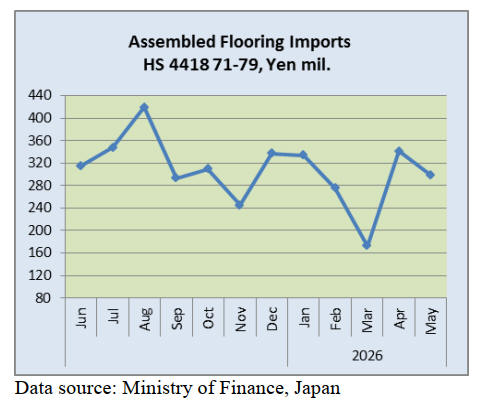
There was a significant upward recovery in the value of
assembled wooden flooring (HS441871-79) in April after
the steep declines in February and March. The value of
April imports was down 12% on March but still at around
the average for the final quarter of 2025.
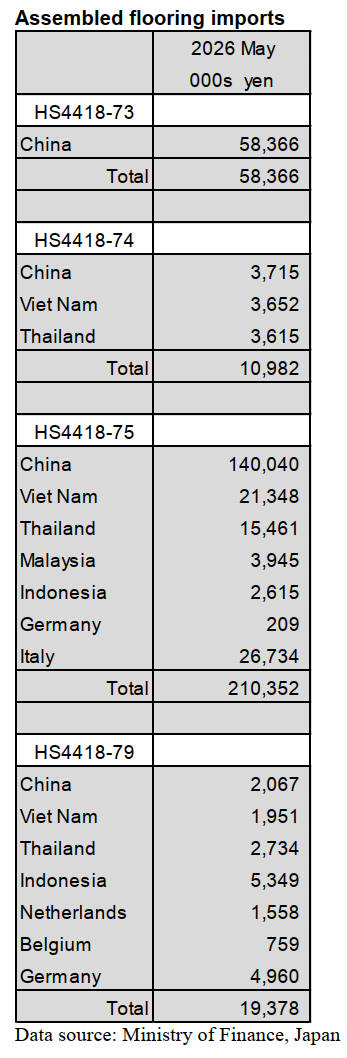
In May 2026, shippers in China accounted for all of
HS4418-73 imports, the value of which was much higher
than in April. The value of May imports of HS4418-73
accounted for 19% of total assembled flooring imports. In
addition, shippers in China accounted for 67% of the value
of imports of HS441875.
Of the various categories of assembled flooring
imports in
May, 71% was HS4418-75, 19% was HS4418-73, 6%
HS4418-79 and 4% HS4418-74.
 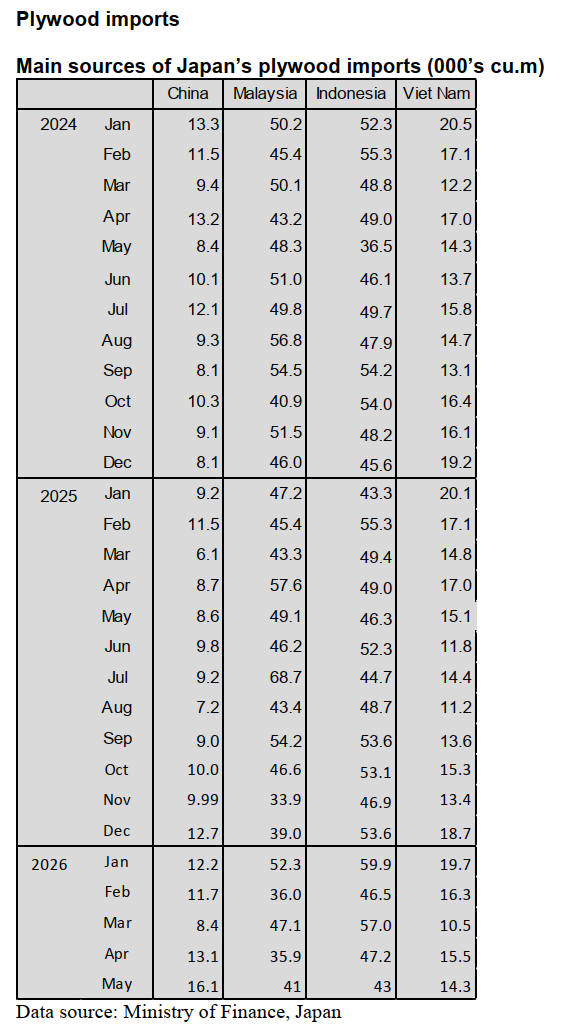
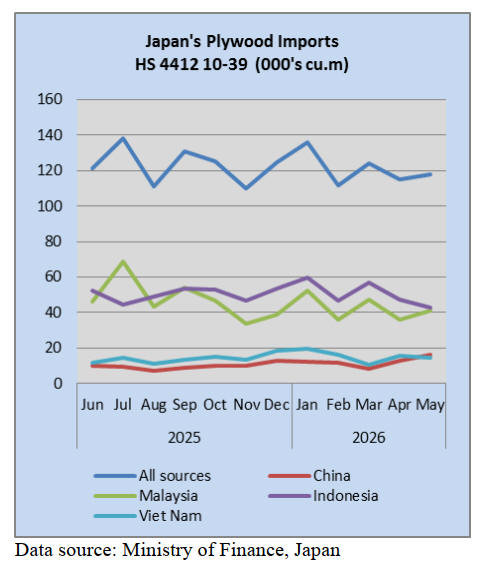
The volume of May imports of plywood (HS441210-39)
were surprisingly consistent, there being no change either
year on year or month on month. The top suppliers,
Indonesia and Malaysia accounted for 84% of all plywood
imports (96% in April).
The other main shippers were Viet Nam (13% of May
total) and China (11% of May total). The volume of
shipments from Malaysia and China increased month on
month in May while shipments from Indonesia and Viet
Nam declined compared to a month earlier.
In May 2026 arrivals of HS441210-39 were reported at
118,000 cu.m (115.000 cu.m in April). As in previous
months, of the various categories of plywood imported in
May 2026, HS4412-31 accounted for 80% (80% in April)
followed by HS4412-33, 7% (8.5% in April), HS4412-34
6% (6% in April) with the balance being HS4412-39 and
HS4412-10.
Trade news from the Japan Lumber Reports (JLR)
The Japan Lumber Reports (JLR), a subscription trade
journal published every two weeks in English, is
generously allowing the ITTO Tropical Timber Market
Report to reproduce news on the Japanese market
precisely as it appears in the JLR. For the JLR report
please see: https://jfpj.jp/japan_lumber_reports/
Japan’s 2025 Wood Supply and Demand
The Statistics Department of the Ministry of Agriculture,
Forestry and Fisheries released the 2025 Wood Supply and
Demand Statistics. Log demand totaled 22.653 million
cbms, virtually unchanged year-on-year (up 0.8%). The
share of domestically sourced timber rose to 88.6%, up 0.7
points.
By sector, lumber production demand reached 14.431
million cbms (63.7%), unchanged year-on-year. Demand
for plywood and related uses rose 7.4% to 4.498 million
cbms (19.9%), while wood chip demand fell 3.4% to 3.724
million cbms (16.4%).
The increase reflects higher output of softwood structural
plywood (12–24 mm) and structural LVL. Log supply
continued its recent trend, with domestic timber totaling
20.071 million cbms (up 1.6%) and imports 2.582 million
cbms (down 4.7%). Domestic softwood reached 18.798
million cbms (up 2.2%), while hardwood fell to 1.273
million cbms (down 6.7%).
By species, cedar totaled 12.184 million cbms (up 4%);
cypress 3.049 million cbms (up 1%); Japanese larch 1.692
million cbms (down 2.4%); and Yezo spruce/Sakhalin fir
1.134 million cbms (down 8.5%).
By origin, U.S. timber totaled 2.137 million cbms (down
3%); New Zealand 243,000 cbms (down 17.1%); and
Russian Far East 117,000 cbms (down 6.4%). Imports of
semi-processed wood fell 24.3% to 153,000 cbms, with all
categories declining.
Shipments of sawn timber rose 2.0% to 7.754 million
cbms. Construction-use timber reached 6.322 million
cbms (up 1.9%); boxes and packaging 900,000 cbms (up
2.4%); civil engineering timber 301,000 cbms (up
2.4%); and furniture/fittings timber 45,000 cbms (up
12.5%).
Kiln-dried lumber shipments totaled 4.045 million cbms,
up 5.2%, with its share rising to 52.2%. The number of
sawmills declined to 3,423, down 124, while output per
mill increased to 177.0 kW, up 6.0 kW. Wood chip
production increased for logs (2.087 million tonnes, up
7.6%), mill residues (1.896 million tonnes, up 5.7%), and
forest residues (55,000 tonnes, up 22.2%). Only
demolition and waste wood declined, falling 20.8% to
536,000 tonnes. Softwood chips totaled 3.29 million
tonnes (up 9.7%), while hardwood chips fell to 748,000
tonnes (down 3.9%).
Signs of a floor in export prices
Export prices for cedar logs to China, which had been
softening, are now showing clearer signs of bottoming out.
Prices for 8-centimeter logs stand at US$112–113 per cbm
(C&F), about US$4–5 below the pre-Lunar New Year
peak. Inventory at Taicang Port—China’s main hub for
Japanese cedar fell from nearly 180,000 cbms to 120,000
cbms in early June, further supporting the price floor.
Profitability remains tight, and maintaining last year’s
volumes will require higher selling prices. Japan’s log
exports to China reached 612,273 cbms for January–April,
essentially flat year-on-year. Shipments rose from 102,986
cbms in January to 185,644 cbms in April, but demand
weakened from late April as inventories grew and the
market entered its summer lull. As a result, export
prices—previously US$116– 118 per cbm (C&F)—have
continued to decline.
Prices for 18-centimeter and larger direct-shipment logs
have slipped to ¥11,000–11,500 per cbm, about ¥500
below early-year levels. Freight rates have eased to around
US$60,000 for 3,000-cbm vessels, down US$7,000 from
the peak. The weaker yen, moving from ¥155 to ¥160 per
dollar, has also reduced export costs.
Exports to China have diversified, ranging from small-
diameter 8-centimeter logs to mid-sized 18– 28-centimeter
logs and large-diameter logs of 30 centimeters and 50
centimeters or more. Lengths now span 3 to 5 meters,
instead of being centered on 4 meters.
Exports of fence-grade lumber to the United States have
fallen to about 200 containers per month from 300, due to
the 45% Trump-era tariff. The decline has stabilized, and
suppliers have expanded into civil engineering, formwork,
packaging, and coffin production. Trading companies say
that “if supply increases, the market could exceed 20
million cbms annually.” With Chinese port inventories
declining and autumn demand approaching, conditions for
log exports have improved. Still, higher selling prices are
essential.
Plywood
Domestic plywood manufacturers continue to push for
price increases amid rising production costs, particularly
adhesives and fuel. Supply was delayed in April and May
due to temporary demand and although delays continued
into June, tightness has eased.
Major producers raised June prices for softwood structural
plywood (12mm, 3×6) to ¥1,400 per sheet, up ¥100, with
thicker panels at ¥2,800 (24 mm) and ¥3,400 (28 mm),
both up ¥200. These levels are now widely accepted.
Procurement by major precutting plants and homebuilders
remains steady, though some distributors secured
inventory earlier, reducing current buying pressure.
Producers are seeking a further 5% increase for July,
though its adoption will depend on negotiations as
procurement stabilises. Imported tropical hardwood
plywood from Malaysia and Indonesia remains firm at the
source, with higher adhesive, log procurement and fuel
costs. Production of April-contracted volumes has been
delayed and shipping delays, especially from Indonesia,
persist.
Shift from wood use and supply toward strategic
planning
The government has approved the “Forest and Forestry
Basic Plan: Toward a Century-Long Nation of Forests and
Cities of Wood” at a Cabinet meeting. The plan
traditionally revised every five years, for the first time
introduces a subtitle to articulate its overarching concept,
while also setting concrete performance indicators that
will be used to review policies through the PDCA cycle.
It also marks a shift from the conventional approach
focused on the flow from mountain forests to timber use
toward a model that begins with the utilization of mature
forest resources, followed by the development of supply
chains and supportive measures aimed at achieving
sustainable forestry and forest management.
Amid global momentum on climate-change mitigation and
biodiversity conservation, the White Paper notes that
conditions are increasingly favorable for expanding the
use of domestic timber. It sets a target of producing 23
million cubic meters of Japan-grown construction timber
by 2030, equivalent to a 70% domestic-wood share and a
30% increase from 2024, through broader utilisation and
the creation of new demand across sectors.
|


