|
1.
CENTRAL AND WEST AFRICA
Export markets
Export markets remain generally quiet as the traditional
European summer holiday period continues. Orders from
Europe are generally slow during July and August
resulting in lower purchasing activity from many
importers.
In contrast, Asian markets continue to strengthen with
stable demand from China providing welcome support for
regional sawmills and encouraging production where
harvesting conditions permit.
The Middle East remains a relatively subdued market.
Ongoing regional uncertainties, high inventory levels and
increasing competition from Brazilian timber continue to
limit buying activity.
Infrastructure developments
Gabon’s, President, Brice Clotaire Oligui Nguema, has
reportedly visited France seeking international support and
investment for several strategic infrastructure projects.
These include the Kobe-Kobe deep-water port, new rail
links for future iron ore exports, manganese and potash
developments and improvements to the country's water
supply infrastructure.
Varied weather patterns across the region
Gabon, Equatorial Guinea and southern parts of the
Republic of the Congo continue to benefit from dry-season
conditions with daytime temperatures generally ranging
between 24°C and 26°C. These favourable conditions are
supporting harvesting operations and improving
transportation from forest concessions.
On the other hand, Cameroon, the Central African
Republic and northern Congo have entered their rainy
season. Heavy rainfall is slowing harvesting operations
and creating delays in transporting logs to sawmills and
export routes, particularly shipments moving towards the
Port of Douala.
Holiday slowdown
The holiday season is also affecting government
administrations and commercial activity throughout the
CEMAC region. Administrative procedures and document
processing has slowed as many public institutions and
private companies operate with reduced staffing during the
holiday period.
Despite the quieter business environment, forestry
operations continue where weather conditions allow with
Asian demand helping mills maintain production.
Regional outlook
Market conditions are expected to remain relatively calm
until European buyers return from the summer holiday
period. The gradual recovery in Asian demand,
particularly from China, is providing positive support for
the West African timber industry and helping offset
weaker European activity.
Weather conditions will continue to influence production,
with dry conditions favouring operations in Gabon and
southern Congo while heavy rains will continue to restrict
harvesting and transport in Cameroon, northern Congo and
the Central African Republic.
Gabon
Dry season supports harvesting
Libreville and Port-Gentil remain particularly dry while
some isolated showers have been reported in inland forest
areas. Overall, the favourable weather continues to
improve harvesting conditions and transport from forest
concessions. Production of the main commercial species,
Okoumé, Okan, Azobé and redwood species continues to
increase as forest access improves.
Market sentiment
Market activity strengthened modestly in the second half
of July. China has returned to the Okoumé market with
new purchasing contracts while demand has also improved
for selected redwood species. European enquiries remain
relatively weak, reflecting the traditional summer holiday
period and overall enquiry levels remain below normal.
Infrastructure development
Development of the Mayumba potash project continues to
receive attention. As part of the long-term mining
investment, plans remain in place to rehabilitate and
expand the deep-water port at Mayumba which is expected
to play an important role in supporting future mineral
exports.
Construction activity also continues in Libreville ahead of
the national celebrations on 14 August with new
administrative buildings now completed. In addition, work
has commenced on a proposed 50-storey building,
reflecting the government's broader infrastructure
ambitions.
Among the priorities are solutions to Gabon's ongoing
water supply challenges. A major five-year, €200 million
agreement with the French water management company,
Suez and the Gabonese Energy and Water Company
(SEEG), was signed in 2025 to optimise drinking water
production and distribution followed by further bilateral
energy and water cooperation frameworks signed during
the Gabonese Presidential visit to France in July 2026.
Ongoing infrastructural challenges have prompted broader
state utility overhauls, including plans to split Gabon's
water and electricity operations to boost efficiency. Port
operations continue under normal conditions.
Container availability remains good, with no shortages
reported and exports through the Port of Owendo continue
without significant disruption.
Forestry administration and tax enforcement
The Presidential Office established a task force to inspect
timber companies regarding the payment of taxes and
statutory duties. Reports suggest the enforcement
campaign, involving transport checks, temporarily
disrupted some sectors and created concern among timber
operators, transport companies and shipping agents.
Following industry appeals and concerns over potential
layoffs the inspection barriers were withdrawn and normal
operations have resumed. Nevertheless, the government
continues to emphasise improved fiscal compliance across
the forestry sector.
Outlook
The outlook remains cautiously positive. Dry-season
conditions continue to support harvesting and transport,
while renewed Chinese demand is helping improve
confidence within the timber sector.
European markets are expected to remain relatively quiet
until the end of the summer holiday period. Meanwhile,
government efforts to strengthen fiscal compliance,
together with ongoing infrastructure and mining
developments, will continue to shape the operating
environment for Gabon's forestry industry during the
second half of 2026.
Cameroon
Harvesting and weather conditions
Heavy rainfall continues to affect Cameroon following the
start of the rainy season at the end of June. Wet conditions
are expected to persist until early December, slowing
harvesting operations and restricting access to many forest
concessions.
Prior to the rains, operators successfully repaired forest
roads and increased production, allowing many companies
to build sufficient log inventories. However, market
conditions remain generally stable to subdued, limiting the
need for higher production levels.
Transport and logistics
Transport conditions continue to be heavily influenced by
the weather. Laterite roads remain subject to seasonal rain
barriers, with traffic suspended on certain routes during
periods of heavy rainfall to prevent road damage.
Rail transport continues to operate without major
disruption. Chinese engineering teams are reportedly
studying the rehabilitation and modernisation of sections
of the national railway network which could improve
freight transport in the future.
Milling operations
Most sawmills continue to operate normally. Earlier
production slowdowns caused by government inspections
involving forestry and finance authorities have now been
resolved, allowing normal operations to resume.
Many mills currently hold sufficient log stocks for
approximately two months of production, providing some
stability despite the difficult harvesting conditions.
Port operations
Port operations remain stable at both Douala and Kribi.
Douala continues to handle conventional timber exports,
general cargo and log shipments, while Kribi continues to
expand its role as the principal container export port,
including increasing volumes of sawn timber from
northern Congo.
Container availability remains good, with no shortages
reported. Vessel waiting times at Douala continue to
average around seven days.
Infrastructure development
Electricity shortages continue to affect major urban centres
across Cameroon. Frequent power interruptions and
unreliable water supplies have encouraged private
investment in boreholes, rooftop water tanks and
independent storage systems for both residential and
commercial buildings.
Market sentiment
International demand remains mixed. The Middle East
continues to provide stable demand for redwood species,
although purchasing activity has softened for Iroko,
Sapelli and other traditional hardwoods.
Viet Nam remains the strongest Asian market, maintaining
steady demand for Tali, Niové and Padouk. Demand from
the Philippines remains relatively weak, while Italy and
the Netherlands continue to purchase small volumes of
Ayous. Dutch buyers maintain good demand for Azobé,
although available dimensions remain limited due to
harvesting restrictions. Interest in Okan has also improved.
Chinese enquiries have increased during the reporting
period providing additional support as European demand
remains subdued during the summer holiday season.
Cameroon's timber industry continues to demonstrate its
ability to respond rapidly to European orders, with many
mills able to process and ship new contracts within
relatively short lead times.
Regulatory developments
Exporters continue to monitor CITES requirements for
regulated species, particularly Padouk. European due
diligence requirements under the EU Timber Regulation
(EUTR) and preparations for the implementation of the
European Union Deforestation Regulation (EUDR)
continue to influence marketing strategies.
Many producers are increasingly seeking alternative
export destinations in Asia, the Middle East and South
America where regulatory requirements are generally less
demanding.
Outlook
The rain season is expected to continue restricting
harvesting and transport through the coming months.
Nevertheless, sufficient log inventories, stable port
operations and improving demand from China are helping
to support production.
European demand is likely to remain subdued until the end
of the summer holiday period, while Asian markets,
particularly Viet Nam and China, are expected to remain
the principal drivers of export activity. Overall, the
outlook remains cautiously stable despite weather-related
operational challenges and increasing international
regulatory requirements.
Republic of the Congo
Harvesting and weather conditions
Harvesting operations continue at normal levels across
most of the Republic of the Congo. Dry-season conditions
in the south continue to support forestry activities while
operators in the north remain active where weather
conditions permit.
Production remains aligned with current market demand
with companies maintaining balanced harvesting
programmes in response to relatively stable export
markets.
Transport and logistics
Road transport continues without major disruption.
Maintenance of laterite forest roads remains ongoing,
helping to improve access to concessions during the dry
season.
Northern operators continue to utilise the transport
corridor to the Port of Douala in Cameroon where
commercially advantageous, while Pointe-Noire remains
the principal export gateway for timber produced in
southern Congo.
Milling operations
Sawmills continue to operate normally with no significant
production disruptions reported. The supply of spare parts,
particularly for logging and harvesting equipment, remains
adequate allowing companies to maintain production
schedules.
Most mills continue to hold approximately two to three
months of log inventories ensuring stable production
despite fluctuating market demand.
Port operations
Port operations at Pointe-Noire remain stable. Container
availability is good, with no shortages reported and cargo
handling continues without significant disruption.
Pointe-Noire continues to strengthen its position as one of
Central Africa's leading deep-water ports, supporting
regional timber exports efficiently.
Market sentiment
Export demand remains generally stable. Importers in the
Philippine market continues to purchase Okoumé sawn
timber at steady levels while Viet Nam remains an
important destination for Tali, Niové and Padouk
providing consistent support for sawmill production.
China continues to purchase a broad range of Congolese
species, including Okoumé, Okan, Ovangkol, Belli and
Azobé with continued interest in value-added Azobé
products such as table tops and other processed timber
products. Azobé exports from the Congo remain primarily
oriented towards Asian markets.
Overall enquiry levels remain steady, allowing producers
to maintain relatively stable production schedules despite
subdued European activity.
Forestry administration
No significant new forestry regulations have been
introduced during the reporting period. Following the
Congo Basin forest discussions held earlier this year, no
major new national projects or policy initiatives have been
announced in the Republic of the Congo comparable to
those recently introduced in neighbouring Gabon.
The forestry administration continues to maintain strict
oversight of forest operations and export procedures.
Documentation processing and regulatory controls remain
efficient with no significant operational changes reported
The International Monetary Fund (IMF) continues to
encourage the government to increase export revenues,
including through greater utilisation of timber resources
and log exports within the existing regulatory framework.
Outlook
The outlook for the timber sector in the Republic of the
Congo remains stable. Comfortable log inventories,
efficient port operations and continued demand from
Asian markets are supporting the sector during the quieter
European summer period.
Market activity is expected to improve gradually as
European buyers return after the holiday season. In the
meantime, China, Viet Nam and the Philippines are
expected to remain the principal export destinations,
providing a solid foundation for timber production through
the coming months
Through the eyes of industry
The latest GTI report lists the challenges identified by the
private sector in the Republic of Congo and Gabon.
https://www.itto-
ggsc.org/static/upload/file/20260722/1784691765519460.pdf
2.
GHANA
Mid-year budget targets government’s new digital
system
In his 2026 mid-year budget review to Parliament the
Minister of Finance, Dr. Cassiel Ato Forson, said the
Pelican AI cross-border technology solution for collecting
Value Added Tax (VAT) from non-resident platforms
piloted in April 2026 has been largely successful.
He confirmed that the system is functional, stable, secure
and compliant with regulatory requirements.
According to him, the technology-driven reform is part of
broader efforts to modernise revenue administration,
improve tax compliance and expand Ghana’s revenue base
and is expected to generate about GH¢2.3 billion in its
first full year of operation.
The Minister noted that leveraging technology into the tax
administration of the country to block loopholes is a key
component of government’s strategy to improve
compliance and mobilise more domestic revenue without
relying solely on increases in tax rates.
The piloted system has increased Customs-assessed values
by more than US$300 million, representing a 17.5%
increase of declared values by importers.
In a related development, the Deputy Minister of Finance,
Thomas Nyarko Ampem, has indicated that Government
has done a lot to support businesses in the country through
measures to promote company growth mostly in the Value
Added Tax (VAT) system, which makes it easier for
businesses to thrive.
Earlier at its rollout stages, the Ghana Institute of Freight
Forwarders raised concerns that the automated AI
valuations sometimes conflicted with standard World
Trade Organization invoice rules and cause port clearance
delays.
See: https://www.citinewsroom.com/2026/07/digital-vat-system-
to-generate-gh%C2%A22-3bn-in-first-year-ato-forson/
and
https://3news.com/news/we-have-done-a-lot-to-promote-
businesses-in-ghana-deputy-finance-minister
Cabinet restores Achimota forest status
The Cabinet has revoked Executive Instrument (E.I.) 144
and amended it with E.I. 234, restoring the Achimota
Forest to its original status as a Forest Reserve and
ecological safe zone for Accra and environs.
The announcement was made by the Minster for Lands
and Natural Resources, Emmanuel Armah-Kofi Buah, at
the Government Accountability Series at the Presidency.
He described the 24 June Cabinet decision as historic and
a major victory for environmental protection.
E.I. 144 had excised approximately 360 acres from the
protected reserve for other uses, including physical
development. Its revocation reverses that prospect and
blocks alternative exploitation of the forest.
The Minister further added that the country has issued 411
Forest Law Enforcement Governance and Trade (FLEGT)
licenses so far this year to deepen the country’s certified
timber and wood trade while strengthening its position
with trade partners in global markets.
Ghana has issued a cumulative total of 600 FLEGT
licenses to date, to 22 European Union destinations.
He assured the country of the sector’s continuous efforts in
restoring Ghana’s lands, forests and water bodies against
illegal mining and appealed for national unity in defending
the country's natural resources.
The Ghana Institute of Foresters has welcomed the
revocation of EI 144g, urging the government and
Parliament to amend laws to require parliamentary
approval for forest reservation or de-reservation to
strengthen protection and prevent controversies.
See: https://www.graphic.com.gh/news/general-news/ghana-
news-achimota-forest-regains-original-status.html
and
https://www.myjoyonline.com/foresters-calls-for-protection-of-
other-urban-forests-following-reversal-of-achimota-forest-
declassification/
Export earnings slump almost 20%
Ghana’s wood product exports declined as international
demand remains quiet, according to the Timber Industry
Development Division (TIDD). For the first four months
of the year ending April the value of exports slumped by
19.6% as the result of a 14% fall in the export volume of
timber and wood products, when compared to the same
period last year.
The total value of timber exports for the period January to
April 2026 was Eur 29.34 million as compared to Eur
36.49 million in the same period last year.
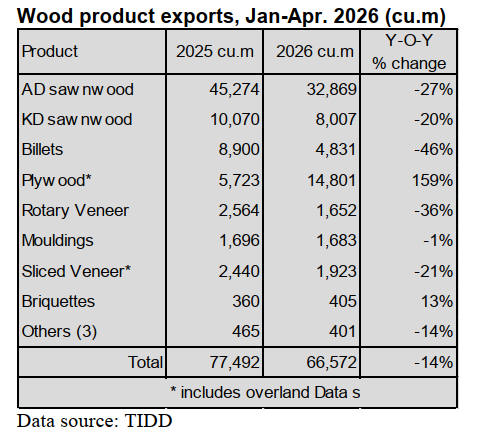
During the period under review most products recorded
losses both in export volume and value. These included
kiln-dried sawnwood, sliced veneer, air-dried sawnwood,
rotary veneer and billets decreasing by 14%, 19%, 36%,
37% and 55% respectively as compared to the previous
year’s figures to reflect values of Eur5.96 million, Eur2.62
million, Eur0.80 million, Euro11.50 million and Eur1.20
million.
The significant declines can be attributed to slow demand
in the major markets of India, Viet Nam, Burkina Faso, the
US and Togo.
Ghana’s trade with African markets for the period under
review increased in both volume and value. The total
revenue increased to Eur4.00 million (14% share of all
trade) in 2026, from Eur3.63 million (10% share) in 2025.
Ghana’s trade with major markets of the US and EU also
increased during the period, attributed largely to higher
exports of kiln-dried sawnwood and sliced veneer.
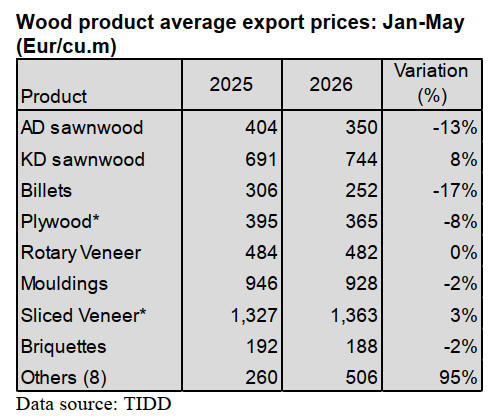
Prices of kiln-dried sawnwood and sliced veneer exports
registered significant improvement to achieve an average
price of Eur744/cu.m and Eur1,363/cu.m from the
previous average of Eur691/cu.m and Eur1,327/cu.m
respectively while all the others showed decreases in
average prices.
Kiln-dried sawnwood and sliced veneer export accounted
for 15% of total export volume in 2026, compared to 16%
recorded in 2025 during the same period. The leading
export species were teak, gmelina, cedrela, wawa and
eucalyptus.
Promoting agroforestry with stakeholders
The Forestry Commission (FC) has engaged with the
Agroforestry Technical Work Group (ATWG) to develop
a collaborative roadmap for a national agroforestry policy
in Ghana. The initiative is to strengthen government
leadership in agroforestry and position the ATWG as a
multi-stakeholder technical support platform.
The Chief Executive of the FC, Dr. Hugh Brown, in
welcoming the ATWG delegation led by H.E Jeroen
Verheul, Ambassador of the Netherlands to Ghana said the
Commission recognises the need to integrate trees into
agricultural landscapes, especially cocoa farms, to boost
productivity, biodiversity and for climate resilience.
Dr. Brown highlighted FC’s working engagement with
COCOBOD, the World Bank and AfDB under the Ghana
Forest Investment Program, which has supported planting
millions of trees on cocoa farms. He stressed that
expanding agroforestry beyond forest reserves is critical to
restoring degraded lands, improving farmers’ livelihoods
and driving sustainable economic and environmental
growth.
Ambassador Verheul commended the FC and noted the
Netherlands’ support for technical studies, consultations
and workshops that led to the ATWG. He stressed that a
comprehensive national policy is needed to harmonise
initiatives and guide investment with the FC as lead
partner.
See: https://3news.com/news/forestry-commission-fc-has-
engaged-the-agroforestry-technical-work-group
and
https://3news.com/news/forestry-commission-assures-
stakeholders-of-commitment-to-forest-restoration
Ghana’s half-year economic performance best in years
Ghana’s economic performance in the first half of 2026
has been described as the best in years, highlighting
improving economic conditions and growing signs of
macroeconomic stability.
The development points to the impact of ongoing fiscal
consolidation and economic management efforts with the
government maintaining a focus on strengthening public
finances and improving revenue mobilisation.
The positive performance could help boost business
confidence and support private sector activity while
providing a stronger foundation for sustained economic
growth. However, maintaining the gains will require
continued fiscal discipline, sound economic policies and
measures to address structural challenges facing the
economy.
Meanwhile, Ghana’s year-on-year inflation as of June
2026 was 5.3%, while for the third consecutive meeting,
the MPC has maintained the Bank of Ghana policy rate at
14%.
See: https://graphicnewsplus.com/newspapers/2488/details
Through the eyes of industry
The latest GTI report lists the challenges identified by the
private sector in Ghana.
https://www.itto-
ggsc.org/static/upload/file/20260722/1784691765519460.pdf
3. MALAYSIA
US tariffs
The US has imposed tariffs on 60 countries following a
Section 301 investigation launched by the US Trade
Representative (USTR) in March regarding allegations of
forced labour. The new tariffs follow the expiry of the
temporary tariff imposed under Section 122 of the US
Trade Act of 1974.
Malaysia remains among 17 economies subject to a 10%
US Section 301 tariff. Many other countries are subject to
a 12.5% tariff. The Investment, Trade and Industry
Ministry said the USTR’s Section 301 investigation into
excess capacity involving 16 economies, including
Malaysia is ongoing.
See:
https://www.thestar.com.my/news/nation/2026/07/25/putrajaya-
seeks-fairer-terms
Sabah to diversify forest economy
Sabah aims to unlock greater economic value from its
forests by diversifying beyond traditional timber
production into nature-based solutions, such as carbon
trading, forest recreation, agroforestry and renewable
energy while maintaining one of the highest forest cover in
the region.
Deputy Chief Conservator of Forests, Indra Purwandita
Herry Sunjoto, said the move is aimed at balancing
biodiversity conservation with socio-economic
development as forests currently generate relatively low
financial returns despite covering more than half of the
State. He said Sabah is actively exploring new sustainable
revenue streams that recognise the value of ecosystem
services rather than relying solely on timber production.
Indra said Sabah continues to maintain approximately 64%
forest and tree cover, equivalent to 4.6 million hectares of
its total landmass. He explained that forest cover does not
refer solely to forest reserves but also includes the
Permanent Forest Estate and forests located on State land.
Despite Sabah’s extensive forest resources, only around
25% is categorised as productive forest.
Indra noted that while Sabah has nearly 1.9 million
hectares designated as productive forests, they contribute
only around RM160 million annually to State revenue.
The State also has approximately two million hectares
gazetted as production forests, presenting both
opportunities and challenges in improving economic
returns without compromising environmental
sustainability.
Indra explained that production forests are not entirely
designated for timber harvesting, with significant portions
retained for conservation to safeguard biodiversity. The
conservation network also extends to important ecological
areas located on State land, alienated land and mangrove
ecosystems.
However, he acknowledged that one of the greatest
challenges facing forest conservation is the substantial
difference in economic returns compared with other land
uses. Using a conservative comparison, he said production
forests currently generate only around RM110 per hectare
annually, whereas oil palm plantations can generate
between RM7,000 and RM10,000 per hectare each year.
This illustrates the enormous economic challenge of
maintaining forests while foregoing more profitable land
uses,” he said.
To narrow this gap, Sabah is pursuing several nature-based
programmes that can generate sustainable income while
preserving forests.
See: https://www.dailyexpress.com.my/news/285073/sabah-
diversifies-forest-economy-beyond-timber/
Timber roof trusses
Malaysian Timber Industry Board (MTIB) organised an
Awareness Workshop on the Use of Timber Roof Trusses
in Segamat, Johor.
The workshop reflected a strategic initiative aimed at
strengthening the use of timber-based materials in the
domestic construction sector in line with the government’s
aspiration towards sustainable and competitive
development.
The workshop was conducted with the objective of
providing exposure and enhancing the level of technical
knowledge among participants, particularly in relation to
structural design, structural analysis, material
specifications, installation techniques as well as
compliance with safety and quality standards in timber
roof truss construction.
In addition, the workshop emphasised the importance of
understanding relevant guidelines and best practices to
ensure that construction projects utilising timber roof truss
systems are implemented efficiently, safely and to a high
quality standard. The objective of the workshop also
aligned with the government’s plan to implement policies
promoting the use of timber roof trusses, particularly for
construction in coastal areas.
See: https://www.mtib.gov.my/maskayu/category/49-emaskayu-
2026.html
Waste to energy
A workshop on a feasibility study on Waste-to-Energy
(WtE) Potential in Sarawak was held bringing together
government agencies, industry representatives and
relevant stakeholders to review the study’s interim
findings and provide feedback on the proposed direction
of the assessment.
The study, which commenced in December 2025 and is
scheduled to be completed this year, is being carried out
by Sarawak Energy Berhad (SEB) with funding from
Swedfund International AB, in support of Sarawak’s
longer-term waste management and clean energy
objectives. The study focuses on the potential use of
agricultural and industrial waste generated in Sarawak for
electricity generation.
The interim findings identified oil palm and sago residues
as among the most promising feedstock sources for WtE
development in Sarawak and excluded forestry-related
residues due to the remoteness of upstream forestry
operations and the associated logistical challenges.
However, further discussions revealed additional potential
from the forestry sector, from tree bark and residues
generated from industrial tree plantations.
Drawing on international experiences, the consultants
noted that some WtE facilities have faced feedstock
shortages due to increased recycling rates and changing
waste generation patterns. As such, the study seeks to
identify realistic feedstock availability, estimate an
appropriate plant scale and determine the most suitable
location for a pilot WtE facility based on the concentration
and accessibility of available resources.
See: https://sta.org.my/sta/sta-review
4.
INDONESIA
HIMKI urges focus on
competitiveness by furniture
makers
The Indonesian Furniture Industry and Craft Association
(HIMKI) called on domestic manufacturers to strengthen
their competitiveness as global competition in the furniture
and handicrafts markets intensifies. HIMKI Chairman,
Abdul Sobur, said Indonesia now faces growing
competition, not only from China and Viet Nam but also
from Malaysia, Mexico, Eastern European countries and
several African nations that are expanding their production
capacity.
He stressed that success in international markets depends
on more than competitive pricing, urging the industry to
focus on value-added products, market-driven design,
innovation, higher productivity and greater efficiency.
Sobur also emphasised the need for a conducive business
environment to support the sustainable growth of
Indonesia's furniture industry.
The HIMKI has outlined five key strategies to enhance the
competitiveness of Indonesia’s furniture industry in the
global market: strengthening design, innovation,
productivity, efficiency and the industrial ecosystem.
Sobur said design is the most crucial factor as products
must align with market demand while innovation should
cover aspects ranging from raw material selection to
product functionality.
Sobur added that improving productivity requires not only
increasing production capacity but also maximising output
quality through skilled workers, effective production
engineering and appropriate technology.
He also emphasised the government’s role in creating a
supportive business environment through industry-friendly
policies and access to affordable financing as high interest
rates can hinder business growth and competitiveness.
See: https://rri.co.id/yogyakarta/regional/2573594/hadapi-
persaingan-global-himki-dorong-peningkatan-daya-saing-
industri-mebel
and
https://rri.co.id/yogyakarta/regional/2573523/himki-series-2026-
lima-strategi-jitu-dorong-daya-saing-industri-mebel-nasional
In related news, HIMKI plans to establish marketing hubs
in key export destinations as part of a new strategy to
expand market access and strengthen the global
competitiveness of Indonesian furniture and handicraft
products. Abdul Sobur said the initiative is intended to
complement the industry's reliance on short-term trade
exhibitions which, he believes, are insufficient to fully
capture opportunities in international markets.
The planned hubs will serve as HIMKI's official
representatives overseas, acting as promotion and
information centres where prospective buyers can explore
members' products throughout the year.
Sobur added that stronger collaboration among industry
players is crucial to expanding export markets and urged
businesses to avoid product imitation and destructive price
competition in favour of cooperation to enhance the
industry's overall competitiveness.
See: https://rri.co.id/yogyakarta/regional/2573537/himki-
siapkan-hub-pemasaran-global-untuk-perluas-ekspor-mebel
Rattan design and innovation
The Indonesian Furniture Industry and Craft Association
(HIMKI) brought together dozens of manufacturers to
enhance rattan production capabilities and design
innovation.
The event focused on developing rattan and bamboo based
furniture, encouraging businesses to maximise Indonesia's
abundant natural resources while creating higher-value
products for global markets.
HIMKI Deputy Chairman for SMEs and Entrepreneurship,
Bambang Wijaya, said Indonesia has a natural advantage
over competitors such as China and Viet Nam due to its
rich supply of timber, rattan and bamboo. However, he
emphasised that success in international markets depends
on stronger design innovation. By partnering with
internationally recognised Indonesian designers, HIMKI
aims to improve product quality, expand production
capacity and boost the country's furniture exports.
See: https://www.detik.com/jabar/bisnis/d-8572630/andalkan-
rotan-dan-desain-industri-furnitur-ri-bidik-pasar-global.
Carbon trading reforms restoring investor trust
Indonesia's Ministry of Forestry has restored confidence in
the country's carbon market through a series of regulatory
reforms, according to The Reform Initiatives (TRI). The
revision of Presidential Regulation No. 98/2021 into
Presidential Regulation No. 110/2025 marks a turning
point by allowing carbon project developers to register
projects through either international registries or
Indonesia's National Registry System for Climate Change
Control (SRN-PPI).
The updated policy replaces earlier restrictions that limited
registration to the national system which had reduced the
international appeal of Indonesian carbon credits and
discouraged investment.
TRI also praised the issuance of Ministerial Regulation
No. 6/2026, which establishes new procedures for carbon
trading in the forestry sector, as well as the Ministry's
decision to reinstate previously suspended forestry carbon
credit units.
Together with the removal of restrictions that had
prevented carbon projects from trading before Indonesia
met its 2030 Nationally Determined Contribution (NDC)
target, these reforms provide greater legal certainty,
improve market access, send a strong positive signal to
international investors and buyers, helping restore global
confidence in Indonesia's carbon trading framework.
See: https://en.antaranews.com/news/422369/indonesia-carbon-
trading-reforms-restore-investor-trust
and
https://www.metrotvnews.com/read/N0BC10e5-transformasi-
regulasi-perdagangan-karbon-kemenhut-kembalikan-
kepercayaan-investor
In other news, Indonesia is promoting carbon trading as a
financing mechanism to attract private investment for
forest planting and restoration, aiming to shift the forestry
sector from a logging-based model toward forest
restoration and expanded forest cover.
The Minister of forestry, Raja Juli Antoni, said the
initiative requires transparent governance and reliable data
on potential project locations and activities to support the
development of high-quality, nature-based financing.
To facilitate investment, the Ministry is preparing spatial
data that can be integrated with maps of Forest Utilization
Business Permit (PBPH) areas and social forestry zones to
identify suitable locations for carbon and restoration
projects. Antoni said the Ministry will provide investors
with clear guidance on project sites, planting methods ,
implementation procedures, while ensuring that carbon
projects meet high standards of quality, credibility and
governance.
See: https://en.antaranews.com/amp/news/423059/indonesia-
promotes-carbon-trading-to-restore-forests
and
https://rri.co.id/jakarta/info-kementerian/2574921/menhut-
perdagangan-karbon-buka-peluang-swasta-investasi-untuk-
restorasi-hutan
Carbon trading crucial breakthrough for green
economy: envoy
The Special Presidential Envoy for Energy and Climate,
Hashim Djojohadikusumo, said Indonesia's fully
operational carbon trading system marks a major
breakthrough in advancing the country's climate goals and
green economy.
The system is supported by the Carbon Unit Registration
System (SRUK) and the Ministry of Forestry's approval to
issue carbon units under the Non-SPE-GRK scheme,
providing the regulatory foundation that has been awaited
since the 2015 Paris Agreement.
Hashim said the system will not only help reduce
emissions but also generate financing to accelerate
Indonesia's clean energy transition, including supporting
the government's target of developing 100 gigawatts of
solar power capacity over the next decade.
See: https://en.antaranews.com/news/422995/carbon-trading-
crucial-breakthrough-for-green-economy-envoy
Social forestry clusters support down-streaming
The Ministry of Forestry is promoting the development of
social forestry commodity clusters to accelerate product
down-streaming, increase the economic value of forest
products and strengthen rural livelihoods.
The Director General of Social Forestry, Catur Endah
Prasetiani, said collaboration between district governments
and Social Forestry Business Groups (KUPS) through
integrated area development will help establish
commodity clusters that improve production scale and
market competitiveness.
She noted that 10 priority commodities—including coffee,
cocoa, candlenut, pepper, coconut, cashew, nutmeg,
vanilla and cloves have been identified for downstream
development through agroforestry systems.
Catur said commodity clusters will enable social forestry
groups to better meet market demand by ensuring
consistent quality, quantity, continuity of supply, local
value and sustainability. The ministry expects downstream
products to first serve domestic markets before expanding
to exports. She added that the Ministry and the
Environmental Fund Management Agency (BPDLH) will
help connect producers with buyers and support
innovations that increase farmers' incomes and improve
market access.
See: https://lampung.antaranews.com/berita/826067/kemenhut-
sebut-klaster-komoditas-perhutanan-sosial-dukung-hilirisasi-
produk
5.
MYANMAR
ITTO is pleased to resume contributions from
its
correspondent in Myanmar. The following is his personal
take on the current situation in the forestry sector.
Timber-sector outlook remains constrained
Following the election in late 2025 Myanmar entered a
new administrative phase that has been presented
domestically as a move towards a more regularised
constitutional framework. In the forestry sector, the
immediate effect appears more likely to be institutional
continuity.
The Forest Department, Myanma Timber Enterprise and
other existing agencies are expected to retain their central
roles in forest management, timber administration and
legality oversight.
Notably, there is no apparent indication of
strengthened
efforts to demonstrate legality compliance through
credible legal evidence and supporting documentation.
Recently, a newly appointed government officer met with
representatives of the timber and non-timber forest product
(NTFP) industries to discuss export development.
According to industry sources, similar meetings have been
held periodically in the past but have produced limited
demonstrable progress. They observed that discussions
tended to focus on procedural matters rather than on the
broader policy approach needed to establish a coherent
framework for the sustainable development and export of
timber and NTFPs.
The operating environment remains difficult. Continuing
conflict, logistical disruption, financing constraints and
weak international confidence limit the practical reach of
forest governance and private-sector activity. The near-
term outlook is therefore more likely to be characterised
by cautious management and maintenance of essential
institutional functions than by rapid growth in timber
harvesting or exports.
There is, at present, no clear indication that the
administrative transition will result in a major reopening
or liberalisation of the timber sector. Any significant
recovery would probably depend on improvements in
security, operational access, market confidence and the
ability of suppliers to satisfy increasingly detailed legality
and traceability requirements.
See-
https://www.moi.gov.mm/moi%3Aeng/article/20594?utm_source
Timber trade data indicate a substantial contraction
Publicly accessible and internally consistent information
on Myanmar’s timber trade has been limited since 2021.
This has made it difficult for market participants,
researchers and forest-sector institutions to assess changes
in harvesting, processing and exports on a fully
comparable basis.
The available limited statistical data should therefore be
treated cautiously; it does not necessarily indicate the
absence of trade but neither does it provide sufficient
evidence to confirm legality, sustainability or market
destination.
A 2025 academic study presents timber export data for the
past decade in two periods: 2015–2020 and 2021–2025.
The figures should be interpreted as the quantities
approved for export by the Forest Department, rather than
as final Customs-cleared shipment data. The dataset
covers teak and other hardwood species and includes
rough-sawn timber, semi-finished products and finished
wood products.
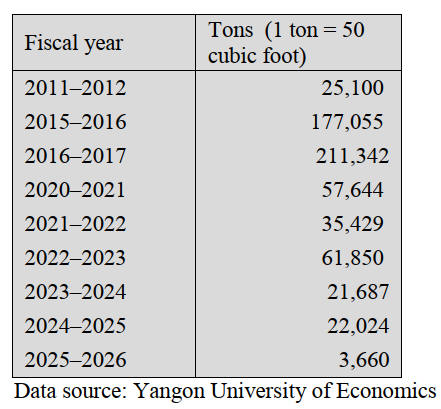
The series indicates strong growth between 2011–2012
and 2016–2017, followed by a sustained contraction. A
temporary recovery was recorded in 2022–2023 but
reported volume subsequently fell to around 22,000 cubic
tons (50cu.ft) CBT in each of the following two fiscal
years.
The figures should be treated as provisional.
Nevertheless,
the available series provides a useful indication of the
broad direction of formal trade. It suggests that
Myanmar’s documented timber-export channel has
contracted substantially from its mid-2010s level, with
implications for processors, employment, government
revenue and the commercial viability of value-added
manufacturing. A rapid recovery in timber trade appears
unlikely without improvements in operating conditions
and market confidence.
Data reconciliation remains a sector priority
The principal statistical requirement is not simply the
publication of additional figures but the establishment of
consistency among the records maintained at different
stages of the timber supply chain. Harvesting records
should be capable of reconciliation with log
measurements, removal passes, transport documents, mill
intake records, processing recovery, sales documentation,
forest certificates, export licences and Customs
declarations.
In the past the Myanmar Extractive Industries
Transparency Initiative forestry reports included dedicated
assessments of timber production, sales, exports, data
reliability and reconciliation. This provides a useful
methodological precedent for future cross-agency
reporting, even though the institutional and operating
conditions have since changed.
Improved reconciliation would support forest-resource
assessment, legality verification and market analysis. It
would also reduce the risk that incomplete data are
selectively interpreted either to defend the sector or to
advance political or advocacy positions without adequate
technical examination.
See-
https://meiti.org/sites/default/files/attachments/myanmar_forestry
_eiti_final_report_2017-18_final_-_signed.pdf
Market access increasingly depends on verifiable
supply-chain information
Restricted access to several major markets and financial
channels has had an important effect on Myanmar’s timber
industry. However, from a market-information
perspective, the issue is best examined through a technical
and legality-based framework rather than solely through
political interpretation.
International buyers increasingly require evidence
demonstrating the legal origin of timber, the precise
harvesting location, authorised harvesting rights, payment
of applicable charges, transport legality, processing history
and an uninterrupted chain of custody.
Due-diligence requirements may also include geolocation
data, supplier and beneficial-ownership information, risk
assessment, independent verification and evidence that
identified risks have been effectively mitigated.
The existence of laws, procedures or documentation
systems does not, by itself, provide full assurance that
requirements have been implemented. Credibility depends
on records being complete, internally consistent,
accessible for verification and supported by evidence from
the forest through to the point of export. At the same time,
the absence of internationally visible information should
not automatically be treated as proof that all timber is
illegal, the appropriate description may instead be that its
origin or compliance remains insufficiently verified.
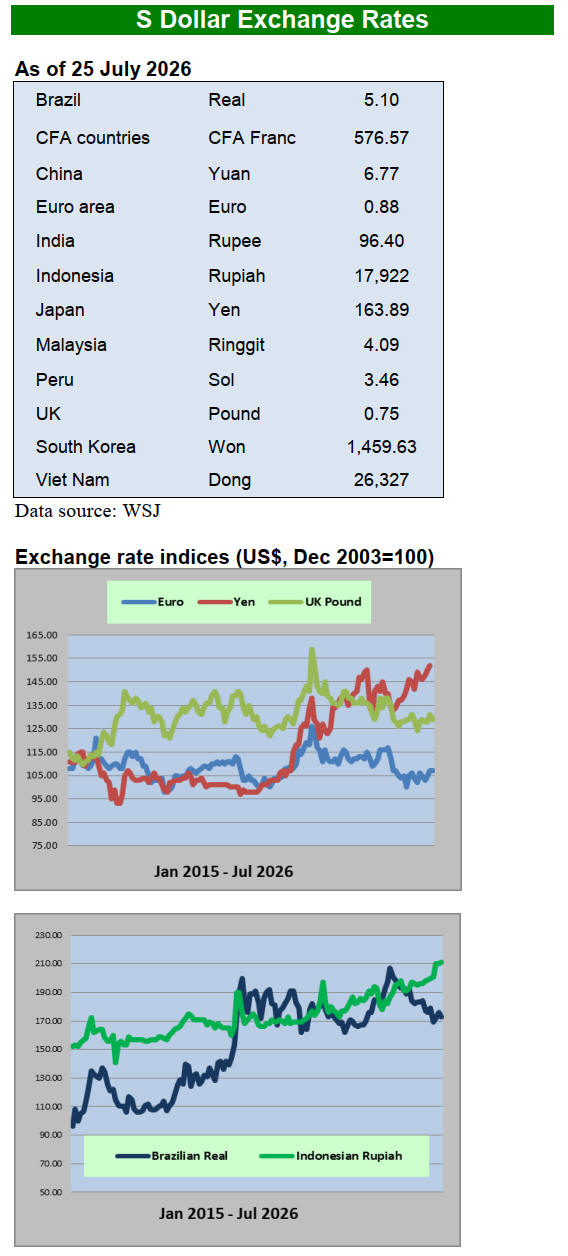
Exchange-rate stability
The authorities have continued to place emphasis on
monetary and exchange-rate stability. While reduced
volatility against the US dollar may provide some
predictability for trade and business planning, exchange-
rate movements alone do not fully reflect conditions in the
real economy.
Basic commodity prices, transportation costs and the cost
of industrial inputs remain elevated, while manufacturers
continue to report difficulties obtaining raw materials,
imported components and foreign currency through timely
and predictable channels.
The World Bank reported that inflation reached 24.6%
year-on-year in April 2026 and observed that businesses
continued to face rising costs, administrative burdens and
uneven policy implementation.
For domestic and export-oriented manufacturers, the
effective cost structure is also influenced by licensing
requirements, intermediary expenses, transport delays and
reported informal payments or route-specific levies at
checkpoints. Such costs are difficult to quantify nationally
and vary by location, but they may operate as additional
transaction costs that are ultimately reflected in raw-
material and consumer prices.
Recent research indicates that checkpoint-related
restrictions and payments have increased the cost and time
required to move commercial goods through some
conflict-affected areas.
In the timber sector, these conditions can affect the
movement of logs and wood products between harvesting
areas, depots, mills and export points. Exchange-rate
stability should therefore be considered alongside
inflation, raw-material availability, electricity and fuel
supply, transport costs, industrial capacity utilisation and
actual Customs-cleared export performance.
On this broader basis, current conditions appear to indicate
constrained and uneven economic activity rather than
comprehensive economic stabilisation.
See -
https://documents1.worldbank.org/curated/en/09906282623004083
0/pdf/P507203-dff79228-e6a1-4a31-a626-ae65ddb72917.pdf
6.
INDIA
Furniture makers facing steep rise in
production costs
Furniture manufacturers across the country are
experiencing a sharp rise in production costs owing to
increased prices for raw materials such as MDF,
particleboard and edge-banding which are the key
components in a furniture manufacturer unit.
MDF and particleboard are widely appreciated by
furniture makers for the smooth finish, consistency and
affordability making it ideal for wardrobes, cabinets and
office furniture.
In the face of rising costs most panel product makers in the
country have announced price increases. Furniture makers
are trying to pass on the price increases to their customers
but they are under pressure to supply the current orders
many of which were negotiated before the raw material
cost increases.
A Bangalore based furniture maker says that he is facing
pressure from customers in many ongoing contracts
because they are not willing to increase prices.
Increasing domestic manufacturing resilience
The Times of India reports the government is initiating a
series of measures spearheaded by the Prime Minister's
Office to shield the economy from global disruptions,
particularly following conflicts in West Asia. The
roadmap, which is being monitored by top officials,
targets several key areas to reduce external vulnerabilities
and boost self-reliance. Officials are identifying 100 to
150 critical items for domestic production to reduce
reliance on overseas supply chains.
There are also discussions and suggested measures for
both the public and private sectors to optimise resource
use, reduce unnecessary travel and promote virtual
collaboration.
Energy is a priority with measures to increase ‘green’
hydrogen production, bolster solar and other renewable
energy and expand storage capacity.
The initiative was put together in a short time and
identified immediate steps to ensure that the economy is
not hit by shortages, be it energy or other inputs and raw
material that come from West Asia.
In parallel steps that address structural vulnerability in the
medium to long term have been initiated. For example
there will be lower reliance on imported LPG and greater
use of piped natural gas.
The Ministry of Petroleum and Natural Gas is also
expected to announce measures as part of a plan to step up
focus on exploration of oil and gas within the country. A
similar push is also expected in the case of rare earths and
critical minerals where a MOU involving Assam and
Nagaland is among the initial steps. Ethanol blending is
expected to be stepped up .
On exports, the government is keen to reduce dependence
on countries with high tariffs. The Principal Secretary,
Shakti kanta Das, Commerce Secretary Rajesh Agrawal
and Foreign Secretary, Vikram Misri, have reportedly held
detailed consultations with missions across the world on
the issue as India also seeks to be part of multiple global
value chains.
It is reported the Commerce and Industry ministry is
working on a strategy to reduce dependence on import of
over 100 items and exploring the feasibility of domestic
production.
It is reported there is a review of the Production Linked
Incentive Scheme. An analysis is being conducted by the
National Institution for Transforming India.
See: https://timesofindia.indiatimes.com/business/india-
business/govt-starts-work-on-steps-to-increase-domestic-
resilience/articleshow/131898769.cms
Core veneers from Tanzania and Cambodia
To overcome rising domestic timber costs and raw
material shortages, Indian plywood manufacturers are
increasingly securing core veneers, particularly
eucalyptus core veneers, from Tanzania and Cambodia.
This global sourcing strategy provides several strategic
advantages for the Indian wood panel industry: Sourcing
from nations with established timber economies, such as
Tanzania, Cambodia and Viet Nam stabilises raw material
flows. This protects manufacturers from volatile domestic
wood prices and local log shortages
Panel industries and factories in North India, such as those
in Punjab and Haryana, have resumed operations as
imported veneers offer cost-effective alternatives to
domestic raw materials.
In related news, the government is encouraging private
entities to undertake afforestation and timber plantations
on degraded forest land. The policy exempts these
commercial projects from mandatory compensatory
afforestation charges and other fees.
To stimulate domestic wood production, the government
has eased regulations by classifying commercial "tree
crops" as forestry activities.
State-level programmes (such as those in Kerala) offer
financial incentives, direct technical assistance, and
revenue-sharing models to encourage both farmers and
private investors to grow timber like teak, eucalyptus and
poplar
See: https://frontline.thehindu.com/environment/india-forest-
policy-private-plantations/article70528235.ece
BIS plywood certification frustrating international
suppliers
Mandatory BIS (Bureau of Indian Standards) certification
for all plywood imports has heavily frustrated international
suppliers.
While local Indian manufacturers face a standard 30-day
clearance, the Foreign Manufacturers Certification
Scheme (FMCS) forces foreign suppliers to comply with
complex audits which may take as long as 180 days.
This regulatory system requires plywood products sold in
India to comply with BIS certification as defined by IS
303. To most foreign producers BIS applications, testing,
factory inspection and documentation may prove
cumbersome and time-consuming. International exporters
who previously operated without regulation are now
actively partnering with compliance agencies to expedite
their laboratory testing and ensure pre-certified stock
For a complete breakdown of compliance regulations,
required application documents and official Indian
Standards see: https://www.bis.gov.in/?lang=hi
7.
VIETNAM
Wood and wood product (W&WP) trade
highlights
According to the Viet Nam Customs Office W&WP
exports in June 2026 reached US$1.53 billion, up 6%
compared to May 2026 and up 12% compared to June
2025. WP exports contributed US$942 million, up 2%
compared to May 2026 and up 0.7% compared to June
2025.
In the first 6 months of 2026 W&WP exports were valued
at US$8.55 billion, up 4% over the same period in 2025.
WP exports alone earned US$5.45 billion, down 3% over
the same period in 2025.
Viet Nam’s W&WP exports to China in June 2026 fetched
US$224 million, up 330% compared to June 2025. In the
first 6 months of 2026 W&WP exports to the Chinese
market contributed US$1.28 billion to earnings, up 46%
over the same period in 2025.
Exports of living and dining room furniture in June 2026
earned US$219 million, up 9% compared to June 2025. In
the first 6 months of 2026 exports of living and dining
room furniture totalled US$1.2 billion, down 6% over the
same period in 2025.
Viet Nam's oak wood imports in June 2026 were 73,000
cu.m, worth US$42.9 million, up 17% in volume and 12%
in value compared to May 2026 and up 12% in volume
and 23% in value compared to June 2025.
In the first 6 months of 2026 oak imports amounted to
345,700 cu.m, worth US$203.5 million, up 40% in volume
and 45% in value over the same period in 2025.
Viet Nam's office furniture exports in June 2026 brought
in about US$25.2 million, down 18% compared to June
2025. In the first 6 months of 2026 exports of office
furniture brought in about US$137 million, down 26%
over the same period in 2025.
In June 2026 W&WP exports to Australia reached US$13
million, up 2% compared to June 2025. In the first 6
months of 2026 W&WP to the Australia market
contributed US$72 million to earnings, up 4% over the
same period in 2025.
Viet Nam’s imports of logs and sawnwood from Africa in
June 2026 totalled 60,000 cu.m at a value of US$23.8
million, up 10% in volume and 1% in value compared to
May 2026 but down 19% in volume and 8% in value over
the same period in 2025.
In the first 6 months of 2026, log and sawnwood imports
from Africa amounted to 398,260 cu.m, with a value of
US$158.2 million, up 2% in volume and 15% in value
over the same period in 2025.
From a manufacturing hub to a trusted partner in
sustainable supply chains
An opinion from Nguyen Quoc Khanh, VIFOREST
president.
Success in the US market has placed Viet Nam
prominently on the global wood and furniture industry
map. However, excessive dependence on a single market
is also becoming the industry’s greatest strategic risk.
Thirty years ago, the central question facing Viet Nam’s
wood industry was how to increase exports. Today, the
question must be different: What position should Viet
Nam occupy in the global wood value chain over the next
three decades?
In 2025, Viet Nam’s exports of wood and wood products
reached US$17.2 billion. Together with approximately
US$1 billion in non-timber forest products the forestry
sector contributed US$18.3 billion to national export
earnings while imports amounted to only US$3.25 billion.
This is a remarkable achievement by thousands of
enterprises, hundreds of craft villages, millions of workers
and more than one million households engaged in
plantation forestry.
However, the impressive figures do not automatically
translate into a sustainable position. During the first six
months of 2026, sector exports reached US$8.54 billion,
an increase of only 4.4%.
More importantly, exports of higher-value products
including indoor and outdoor furniture, declined by almost
3%. Growth came mainly from woodchips, wood pellets
and wood-based panels. This raised concern in the sector.
From reactive growth to the capacity to shape the
game
Over the past three decades, Viet Nam’s forestry and
wood-processing industries have achieved a major
breakthrough. Much of this development, however, has
remained reactive. Processing capacity and exports have
expanded rapidly but the share of value retained
domestically has not increased proportionately while the
sector’s resilience to external shocks remains limited.
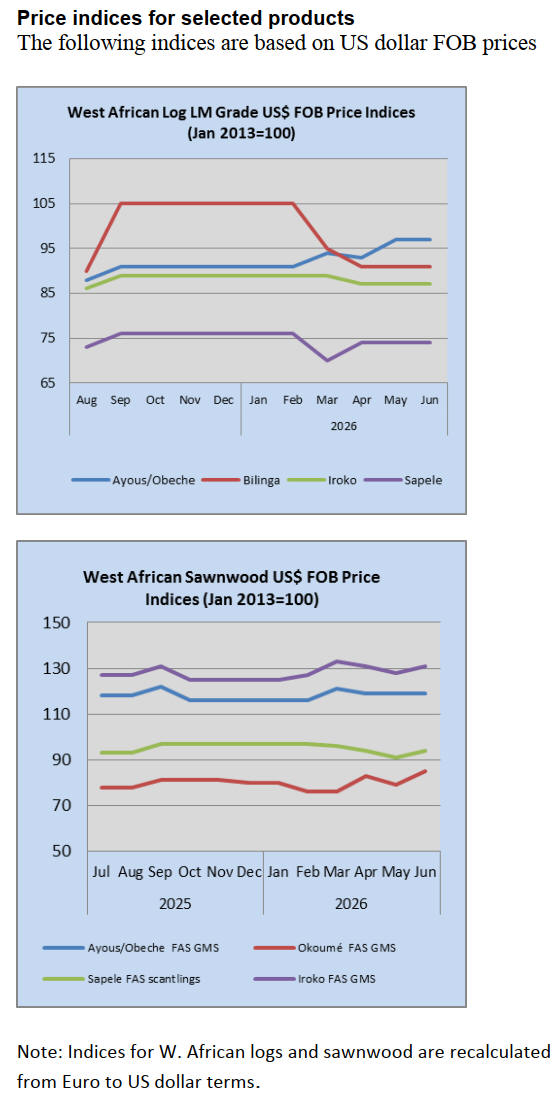
US tariffs, geopolitical conflicts, supply-chain disruptions
and sharp fluctuations in ocean freight rates can quickly
overturn the production and business plans of hundreds of
enterprises.
Until now, businesses have often begun responding
only
after tariffs have been announced, trade-remedy
investigations initiated, transport routes disrupted or
logistics costs increased unexpectedly. Such a response
places enterprises in a defensive position, consumes
substantial resources and makes it difficult to protect
already narrow profit margins.
An industry with significant export earnings and an
increasingly visible role in the global marketplace remains
highly vulnerable if it lacks early-warning capabilities and
contingency plans.
Moving towards a more initiative-taking position does not
mean that Viet Nam can determine every rule of the game.
It means that the industry must strengthen its ability to
forecast developments, identify risks early, prepare
response scenarios and participate actively in shaping the
rules that directly affect it.
Trade-remedy capacity, origin management, supply-chain
data systems, market diversification and contingency
funds should be treated as integral components of
competitiveness, rather than temporary measures activated
only after a crisis has occurred.
When venturing into the open sea, one cannot wait for the
storm before deciding how to respond. The wood industry
must be able to forecast the “market weather” and prepare
the necessary databases, legal expertise, financial
resources and contingency measures so that it is not
destabilised by uncertainties that are occurring with
increasing frequency.
A global value chain being rewritten
The global wood value chain is entering a period of
profound restructuring. Trade geopolitics, the green
transition, the bio-economy, artificial intelligence,
environmental, social and governance requirements and
new forms of protectionism are simultaneously reshaping
markets.
On the demand side, slow economic growth, high interest
rates and prolonged weakness in housing markets in
several major economies are constraining furniture
consumption. ITTO reported a substantial decline in
global furniture trade in 2025 while China’s imports of
tropical timber continued to decrease. On the supply side
enterprises face rising costs for energy, logistics, labour,
finance and regulatory compliance.
At the policy level, due diligence systems, traceability,
proof of deforestation-free production, emissions reporting
and data governance are increasingly becoming mandatory
conditions for market access.
The EU Deforestation Regulation is expected to apply
from 30 December 2026 to most large and medium-sized
enterprises. The US continues to use instruments such as
the Lacey Act, Sections 232 and 301 and other trade-
remedy measures to scrutinise imports of wood products.
Japan, Australia, the United Kingdom and many other
markets are also strengthening legality and due-diligence
requirements.
The green transition does not create costs alone. FAO has
estimated that global demand for materials could increase
by approximately 60% by 2060 and that demand for forest
products is likely to rise substantially towards 2050.
Sustainably sourced wood, as a renewable material
capable of storing carbon, has the opportunity to become a
strategic material for the bio-economy and low-emission
construction. If the twentieth century was defined by
competition over cost and scale, the twenty-first century
will be defined by competition over sustainability, data,
innovation and market trust.
Success in US market under the microscope
The US has been the most important market driver behind
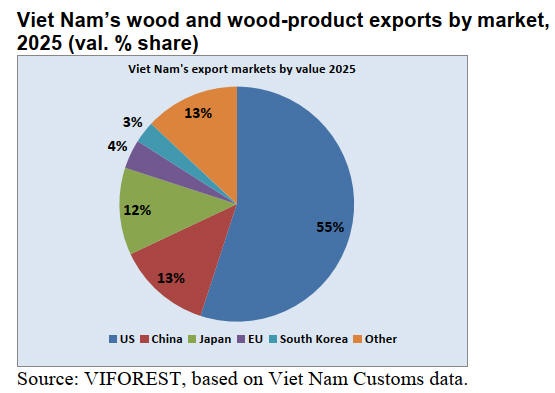
the development of Viet Nam’s wood industry. In 2025,
exports of wood and wood products to the US reached
US$9.46 billion, representing 55% of the sector’s total
export value. The top five markets of the US, Japan,
China, the EU and the Republic of Korea together
accounted for nearly 90% of exports. It can be said the
industry has placed too many eggs in one basket and that
basket is becoming increasingly unstable.
Market concentration has generated economies of scale,
enabled enterprises to specialise their production lines and
helped them build long-term relationships with customers.
At the same time it has weakened their bargaining power,
reduced their ability to redirect orders and made the entire
sector vulnerable to individual policy decisions made in
Washington.
The more successful Viet Nam’s wood industry becomes
in the US, the more visible it becomes and the more
closely it is scrutinised. Viet Namese plywood is currently
subject to preliminary determinations by the US
Department of Commerce, with preliminary anti-dumping
margins for certain respondents reaching 196.14% and a
preliminary countervailing-duty rate of 15.56%, taken
together they demonstrate the exceptionally high level of
risk facing the industry.
Upholstered furniture, kitchen cabinets and vanities are
subject to a 25% tariff under Section 232. At the same
time, the US has expanded investigations under Section
301 concerning excess manufacturing capacity and
measures to prevent the importation of goods produced
using forced labour.
Viet Nam also faces the risk of allegations concerning
intellectual-property-rights violations. These
investigations do not automatically imply that final tariffs
will be imposed but they create considerable uncertainty
for production, investment and pricing decisions.
A more fundamental concern is the asymmetry in the
power to establish the rules of the game. Viet Nam and
Viet Namese enterprises may participate in consultations
and hearings, submit evidence and undertake policy
advocacy but they do not determine how US trade
instruments are designed and applied.
A change in criteria, margin-calculation methodology or
product coverage can overturn a business model built over
many years.
The paradox of the “Growth-without-Growing” trap:
producing more but retaining less value
A growth model based on contract manufacturing,
capacity expansion and concentration on one principal
export market has helped Viet Nam’s wood industry grow
rapidly. However, the model that created this success may
become an obstacle as conditions change.
When enterprises compete mainly on price, buyers retain
control over design, branding, distribution systems and
consumer data. The largest share of value is created and
retained outside the factory, while manufacturers carry the
risks associated with raw materials, labour, finance,
delivery, compliance and trade-remedy proceedings. A
tariff increase of 20–25% can be many times greater than a
manufacturer’s profit margin.
This is the “growth-without-growing” trap: revenue and
output may continue to rise but the value retained
domestically does not increase proportionately.
Profit margins narrow, investment requirements rise
and
legal and market risks grow faster than enterprises’
capacity to absorb them. Under such conditions, producing
more does not necessarily make an enterprise stronger. A
larger scale of production may instead mean greater
exposure to risk.
This challenge is not confined to the US. In the EU
enterprises must prepare for EUDR compliance, plantation
geolocation data and due-diligence systems. Globally,
buyers increasingly require information concerning carbon
emissions, labour conditions, chemicals, material
circularity and social responsibility.
If Viet Namese enterprises continue to export mainly
higher volumes at low prices, they will be required to bear
additional compliance costs without necessarily being able
to pass those costs on to buyers.
The “growth-without-growing” trap is a conceptual
illustration in which dependence and production volumes
increase while profit margins decline and risks rise.

Change or fall behind
Repositioning is no longer a communications choice it is
essential to the survival of the industry’s development
model.
Seven strategic transitions
• From export growth to value creation The objective
should not be limited to increasing export earnings. It
should include increasing the value retained from every
cubic metre of timber, every hectare of forest and every
worker employed. Priority should be given to deeply
processed products, design services, logistics, e-
commerce, after-sales services and intellectual property.
• From contract manufacturing to innovation Enterprises
need to participate in market research, design, material
selection and product development. Artificial intelligence
can support product design, demand forecasting,
optimisation of sawing and component preparation,
equipment maintenance and quality control.
• From compliance to competitive advantage Timber
legality, EUDR compliance, forest certification, carbon
governance and social responsibility should not be treated
merely as documentation needed to clear customs.
They should become evidence that builds trust, facilitates
access to higher-quality customers, strengthens bargaining
power and helps enterprises defend appropriate prices.
• From supply chains to trusted supply networks Viet Nam
needs stronger links among forest growers, processors,
input suppliers, banks, technology providers, logistics
companies and buyers. Data should be shared in a
controlled, verifiable and secure manner.
• From selling products to providing sustainable solutions
The industry should sell not only tables, chairs and
cabinets but also integrated interior solutions, low-
emission materials, design for disassembly, repair
services, reuse options and end-of-life recovery.
• From order-taking to strategic partnership Relationships
with customers should move beyond short-term
transactions towards joint product development, risk
sharing and co-investment in market development.
• From reactive responses to initiative-taking forecasting
and participation in rule-making. Viet Nam must move
beyond responding to problems only after they have
occurred. It needs early-warning systems, systematic
monitoring of policy changes, identification of trade-
remedy risks and market-specific contingency planning.
At the same time, Viet Nam should participate more
actively in ITTO, FAO, ASEAN, APEC and the WTO, as
well as in dialogues with the US, the EU and Japan. It
should contribute data, initiatives and practical standards
rather than responding only after regulations have been
finalised or supply chains disrupted.
An action programme towards 2035
Repositioning should be translated into an action
programme at both national and industry levels. The
immediate objective should be to reduce dependence on
the US gradually not by withdrawing from this important
market but by creating a more balanced market structure.
Japan, the EU, the Republic of Korea, Canada, Australia,
the Middle East countries and emerging economies should
be approached through market-specific product strategies,
rather than by attempting to sell the same products to
different buyers.
Viet Nam needs to upgrade its domestic timber supply.
The country has succeeded in developing plantation
forests but small-diameter timber and short rotation cycles
remain dominant. Moving from small-diameter to larger-
diameter timber, from selling raw materials to deep
processing and from maximising output to optimising
value per hectare are essential conditions for increasing
domestic value retention.
The industry needs an integrated data infrastructure. Data
concerning plantation areas, origin, transactions,
emissions, certification and risk should be interoperable.
This is not only an EUDR requirement, it is also the
foundation for modern governance, green finance and
supply-chain insurance.
Viet Nam needs a national programme on design,
branding and technological innovation for the wood
industry. Helping small and medium-sized enterprises gain
access to artificial intelligence, automation, digital design
and modern quality-management systems would generate
broader benefits than support aimed solely at expanding
factory capacity.
Trade-remedy capacity and risk forecasting should be
recognised as components of national and enterprise
competitiveness. Government agencies, associations,
enterprises and legal experts should establish early-
warning mechanisms, systems for monitoring policies in
major markets, reliable cost databases, origin-control
procedures and rapid-response resources.
Every enterprise should also prepare scenarios for tariff
increases, order relocation, logistics disruptions,
exchange-rate volatility and changes in customer
standards. The objective should not be merely to manage
an individual trade case effectively but to prevent the
entire industry from being destabilised whenever market
conditions change.
Viet Nam needs a coherent national message. “Viet
Namese wood products are made from legal and
responsibly sourced materials, using modern processing
capabilities, while supporting rural livelihoods, carbon
storage and the circular economy.
Viet Nam has invested substantially in ‘doing the right
thing’ but it has not invested equally in ensuring that the
world understands correctly and pays appropriately for
what the country has achieved”.
8. BRAZIL
Development Bank expands forest
restoration
financing
The Brazilian Development Bank (BNDES) and the
Ministry of the Environment and Climate Change (MMA)
announced five new credit operations under the Climate
Fund Forests Program totalling BRL834 million in
financing for forest restoration and establishment of
agroforestry systems. Combined with private sector
investments, the projects are expected to mobilise
approximately BRL2.7 billion for the restoration of
degraded lands. Including all previous Climate Fund
operations, total resources mobilised by BNDES for
reforestation initiatives have reached BRL8.2 billion.
See: https://maisfloresta.com.br/bndes-r-834-mi-de-operacoes-
do-fundo-clima-vao-alavancar-r-27-bi-para-reflorestamento/
National policy on payment for environmental services
The Brazilian Federal Government enacted Decree No.
13,018 of 11 June 2026 regulating the National Policy for
Payment for Environmental Services (PNPSA) and
consolidating the mechanism established under Law No.
14,119/2021 as a permanent component of Brazil’s
environmental policy.
The regulation establishes governance rules, contract
requirements, monitoring procedures, funding sources and
socio-environmental safeguards to expand financial
incentives for family farmers, indigenous peoples,
traditional communities and other stakeholders who
contribute to ecosystem conservation.
According to the Brazilian Ministry of the Environment
and Climate Change (MMA), the new regulation
strengthens the legal framework for both public and
private Payment for Environmental Services (PES)
programmes while recognising the contributions of
indigenous peoples and traditional communities in
environmental conservation.
The regulation is aligned with Brazil’s strategy for
sustainable development and the bio-economy, promoting
forest conservation, biodiversity protection, restoration of
degraded areas and climate change mitigation through
market-based economic instruments. The policy aims to
establish long-term mechanisms for valuing ecosystem
services and to increase investments in conservation
initiatives throughout the country.
The Floresta+ Amazônia Project was highlighted as
Brazil’s largest Payment for Environmental Services
(PES) initiative currently in operation with investments of
approximately US$40 million across the Legal Amazon
States.
The programme supports family farmers, traditional
communities and natural resource managers by promoting
forest conservation, bio-economy development, income
generation and sustainable forest management.
See: https://www.florestamaisamazonia.org.br/noticia/governo-
do-brasil-regulamenta-a-politica-nacional-de-pagamento-por-
servicos-ambientais-pnpsa/
Export update
In June 2026 Brazilian exports of wood-based products
(except pulp and paper) decreased 9% in value compared
to June 2025, from US$305.3 million to US$278.8
million.
Pine sawnwood exports increased 6% in value between
June 2025 (US$56.5 million) and June 2026 (US$60.0
million). In volume, exports increased 4% over the same
period, from 240,500 cu.m to 250,000 cu.m.
Tropical sawnwood exports decreased 7% in volume, from
31,000 cu.m in June 2025 to 28,800 cu.m in June 2026. In
value, exports increased 20% from US$12.4 million to
US$14.9 million over the same period.
Pine plywood exports in June 2026 totalled US$64.3
million. In volume, exports decreased 5% over the same
period, from 202,500 cu.m to 192,700 cu.m.
Tropical plywood exports increased 40% in volume, from
3,000 cu.m in June 2025 to 4,200 cu.m in June 2026. In
value, exports increased 47% from US$1.7 million in June
2025 to US$2.5 million in June 2026.
As for wooden furniture, exports decreased 4% in value,
from US$51.7 million in June 2025 to US$49.4 million in
June 2026.
New US tariffs raise concerns
The Brazilian Mechanically Processed Timber Industry
Association (ABIMCI) has signalled concern over the
confirmation of a new 25% tariff imposed by the US on
Brazilian wood products, noting that the measure
announced following the investigations conducted under
Section 301 of the US Trade Act.
According to ABIMCI, the new tariff lowers the
competitiveness of Brazil’s wood processing industry,
hinders the sector’s recovery from previously imposed
tariffs and threatens long-established business
relationships while also negatively affecting investments,
production and employment.
ABIMCI argues that trade relations between Brazil and the
US should be guided by technical, economic and
commercial criteria. The Association emphasised the need
for a proactive role by the Brazilian government to
mitigate the impacts of the new tariffs on the Brazilian
wood products industry.
During the Section 301 investigation process, ABIMCI
coordinated technical, legal and institutional actions
including the submission of a formal comment to the
Office of the United States Trade Representative (USTR).
This highlighted that Brazilian wood products industry
relies primarily on plantation forests, adopts sustainable
forest management practices, operates traceability systems
and complies with Brazilian environmental legislation.
ABIMCI also stressed the strategic importance of
Brazilian wood products to the US market, arguing that
they complement domestic production, do not directly
compete with US manufacturers and are not easily
replaced by suppliers from other countries.
See: https://abimci.com.br/novas-tarifas-dos-estados-unidos-
afetam-a-competitividade-da-industria-madeireira-brasileira-
alerta-abimci/
Wood product exports declined in the first half of 2026
Brazilian exports of wood products declined in the first
half of 2026, with export volumes falling by 6% from 3.6
million cubic metres to 3.4 million cubic metres, export
earnings fell by 8%, from US$929.5 million to US$855.2
million compared to the same period in 2025.
The downturn was mainly driven by US tariffs,
fluctuations in the US dollar exchange rate and higher
logistics costs resulting from international conflicts which
have reduced the competitiveness of Brazilian wood
products in global markets.
Despite the cumulative decline, exports recovered in June
2026, reaching 624,100 cubic metres, a 6% increase
compared to May (589,000cu.m).
The United States remained the leading destination for
Brazilian wood product exports, accounting for 25% of the
sector's exports in 2026. This dependence increases the
sector’s exposure to US trade policies.
Brazilian companies have continued to diversify both
export markets and product portfolios, while emphasising
the need for measures to reduce tariffs and restore the
competitiveness of Brazilian wood products in the US.
The European Union remains a strategic market,
particularly for pine plywood products.
Given the challenging market outlook the Brazilian timber
industry is expected to continue diversifying markets and
products while expanding its presence in the domestic
market to reduce dependence on exports and strengthen
resilience against international market fluctuations.
See: https://www.remade.com.br/noticias/21509/exportacoes-de-
madeira-caem-8-por-cento-no-primeiro-semestre
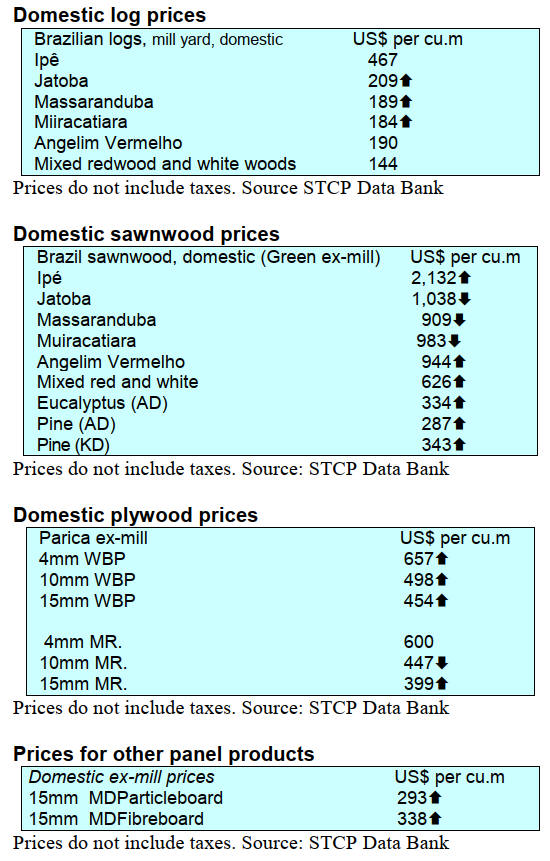 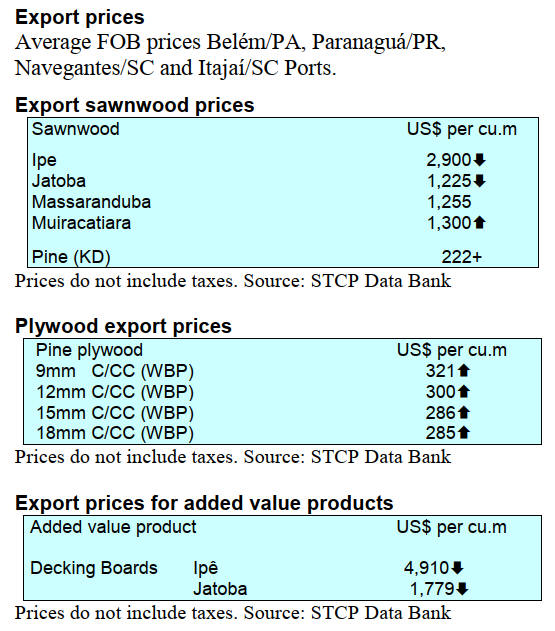
Through the eyes of industry
The latest GTI report lists the challenges identified by the
private sector in Brazil.
https://www.itto-
ggsc.org/static/upload/file/20260722/1784691765519460.pdf
9. PERU
May exports 9% higher than in 2025
In May this year, wood exports recorded a FOB value of
US$29.2 million marking an increase over the US$26.8
million reached during May 2025. This rise represented a
rise of 9%, according to the Center for Research on Global
Economics and Business of the Association of Exporters
(CIEN-ADEX).
According CIEN-ADEX, the export mix included products
such as semi-manufactured goods (US$1.8 million),
sawnwood (US$10.2 million), firewood and charcoal
(US$2.3 million), furniture and parts (US$1.6 million) and
construction products (US$1.3 million).
France was the leading export destination with shipments
totalling US$5.5 million. France was followed by the
Dominican Republic (US$4.2 million), the US (US$3.7
million), China (US$3.6 million) and Viet Nam (US$2.9
million).
Exports of semi-manufactured products increased
According to data provided by the Services and Extractive
Industries Department of the Association of Exporters
(ADEX), France emerged as the leading destination for
exports of semi-manufactured products, accounting for a
42% share and recording a 124% increase compared to the
same period in 2025.
Denmark ranked second with an 18% share, showing a
332% increase compared to the same period of the
previous year. Meanwhile, the US took third place with a
9% share, recording a 24% increase relative to the same
period in 2025. Belgium held the fourth position with an
8% share while Mexico rounded out the top five with a 4%
share of semi-manufactured product exports and a 157%
increase compared to last year.
SERFOR offers virtual and hybrid courses
The National Forest and Wildlife Service (SERFOR) is
helping strengthen the capabilities of various forestry
stakeholders through specialised courses offered by
‘SERFOR Educa’. "SERFOR Educa allows us to bring
specialised knowledge to all regions of the country and
empower the people working directly on the conservation,
management and sustainable use of our forests," noted
SERFOR’s Director of Capacity Building.
The platform offers virtual and hybrid courses featuring
practical content, tutor support and tools such as
videoconferences, forums, digital materials, manuals and
educational videos. This format enables participants to
manage their schedules and access training from any
location with an internet connection.
Upcoming training sessions include Urban Forestry, Forest
and Wildlife Legislation, Ethics in Forest Management
and Commercial Capture as well as Forest Stewardship
and Wildlife Stewardship programs for the Madre de Dios
and Ucayali regions.
See: https://www.gob.pe/institucion/serfor/noticias/1422012-
serfor-fortalece-capacidades-de-mas-de-2-300-actores-del-sector-
forestal-y-de-fauna-silvestre-en-el-primer-semestre-de-2026
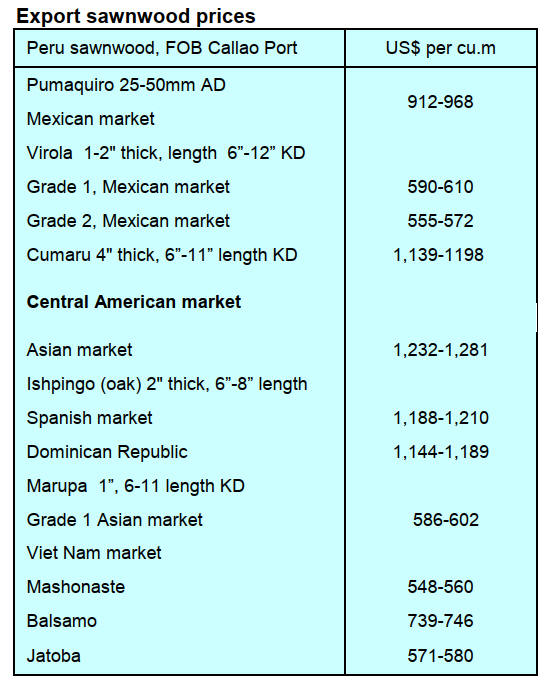
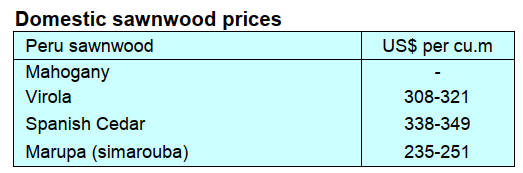 |