|
Report from
Europe
Slow start to the year for UK tropical imports
UK imports of tropical wood products have started this
year very slowly, continuing at the low level maintained
since the end of the COVID pandemic in 2022 and remain
around 15% below the pre-pandemic level. Prospects for
any significant uptick in 2026 remain very muted as the
economy is struggling to shift into a higher gear and
supply is also a constraint.
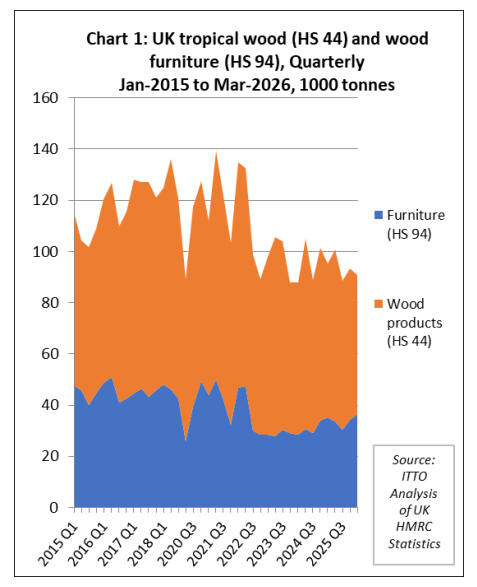
In the first four months of this year, the UK imported
123,000 tonnes of tropical wood and wooden furniture
products, 6% less than the same period in 2025.
Import value in the first four months was US$351 million,
1% less in nominal terms and over 3% less in real terms
(i.e. taking account of inflation) than the same period in
2025. On a quarterly basis, import tonnage in Q1 2026
was 7% down on previous quarter and 4% down compared
to Q1 last year (Chart 1).
The quantity of tropical wooden furniture imported into
the UK increased by 2% to 48,700 tonnes in the first four
months this year compared to the same last year.
There were also good percentage gains in imports of some
smaller volume products including mouldings/decking
(+23% to 3,800 tonnes), flooring (+8% to 1,100 tonnes),
and kitchenware (+30% to 1,000 tonnes). However
tropical plywood was down 25% to 22,500 tonnes, joinery
was down 12% to 23,000 tonnes, and sawnwood was
down 4% to 18,100 tonnes.
UK accounts for around one quarter of all tropical
imports into Europe
Chart 2 sets UK imports from the tropics (red line) in the
wider context of UK wood and wooden furniture trade. It
highlights the relatively small, but still significant, role
played by tropical products in this market.
The UK alone now accounts for about a quarter of the total
value of all tropical wood and wooden furniture product
imports into European countries.
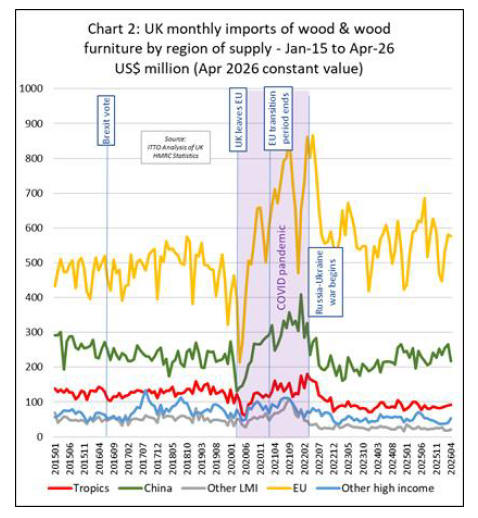
Unlike UK imports from the EU and China, which saw
massive, unsustainable peaks during the 2020–2022
pandemic peak, UK imports from the tropics have
remained relatively flat over the long term if measured in
real dollar terms (adjusted for inflation). Since the start of
2021, they have bumped along at around US$90 million a
month (in April 2026 constant value). This, however, is a
significant downward step change from a figure of around
US$130 million per month in the five years leading up to
the COVID pandemic.
The EU (yellow line) is consistently the UK's largest
supplier of wood and wooden furniture, a dominant
position not only maintained, but enhanced despite Brexit
in the recent years of highly volatile trading conditions.
Between 2025 and early 2026, UK imports from the EU
have stabilized at a higher baseline (averaging around
US$550 million per month) than pre-pandemic levels
(when they averaged around US$450 million).
In contrast, imports from China (green line), after
experiencing rapid gains during the immediate post
COVID boom, have since levelled out at close to their
historical average of around US$200–US$250 million per
month.
In the first four months of this year, UK import value of
wood and wooden furniture from all supply regions
totalled US$3.72 billion, 1% less in real terms compared
to the same period in 2025.
The share of tropical wood and wooden furniture products
in total UK import value was 9.5% during the first four
months of this year, down from 9.8% in the same period in
2025. The long term slide in share is continuing for now,
down from share of 11.4% in 2022 and close to 14%
typical before the COVID pandemic.
UK growth constrained by rising interest rates
Prospects for a significant short-term surge in the UK
market for wood products remain muted as the economy
struggles to shift into a higher gear.
According to recent consensus reports, City analysts are
forecasting a highly gradual trajectory for GDP, tempered
by sticky inflation risks.
While early-year fears of a dramatic economic contraction
have faded into a pattern of stagnation, there remains little
room for substantial fiscal or government intervention due
to persistent global supply uncertainties stemming from
ongoing tensions in the Middle East.
Independent forecasts show the limits of the current
recovery. The IMF recently lowered its UK GDP growth
forecast for 2026 to 0.8%, while the OECD projects a
similarly modest expansion of 0.9% for the year, noting
that geopolitical risks continue to stoke inflationary
pressures. Oxford Economics points to a consumer
squeeze, forecasting that real income growth will slow to
0.6% as tighter fiscal policies take hold.
Though Consumer Price Index (CPI) inflation fell to 2.8%
in May—a notable drop from earlier spikes—it continues
to hover stubbornly above the Bank of England's 2.0%
target. In response, the Bank of England’s Monetary
Policy Committee (MPC) voted 7–2 at its June 2026
meeting to maintain the base interest rate at 3.75%.
Although some analysts had earlier hoped for a steady
sequence of rate cuts by mid-year, two hawkish MPC
members actually voted for a hike to 4.0%, citing
structural inflation risks.
Financial markets have capitulated on hopes for swift
monetary relief, with the consensus now indicating that
borrowing costs—which remain anchored at near-two-
decade highs—will stay at 3.75% for the foreseeable
future, severely capping real estate and commercial
financing flexibility.
The latest data from the UK construction sector directly
mirrors this tight credit environment, offering a mixed but
generally challenging outlook for industrial wood demand.
According to the June 2026 data from the Office for
National Statistics (ONS), total construction output rose
by 1.6% in the three months to April 2026. This rolling
three-month growth was overwhelmingly driven by a
3.4% surge in repair and maintenance activity, whereas
new work grew by a marginal 0.3%.
On an annual basis, the picture is considerably more
troubling for primary timber consumption. Total year-on-
year construction output for April 2026 dropped by 1.0%,
led by a sharp 4.8% contraction in overall new work. At
the sector level, new housing remains the primary drag on
the industry; private housing output plunged by 8.2% year-
on-year, and public housing collapsed by 12.6%.
Monthly construction output edged up by just 0.1% in
April 2026, marking a sharp deceleration from the 1.5%
growth seen in March. Crucially for the hardwood sector,
this minimal monthly expansion came solely from a 0.6%
increase in repair and maintenance, which continues to
provide some relief for joinery and refurbishment
products.
In contrast, monthly volume for new build projects fell by
0.3%, highlighting that high borrowing costs continue to
suppress the breaking of new ground across the UK
housing market.
Sharp rise in UK imports of wooden furniture from Viet
Nam
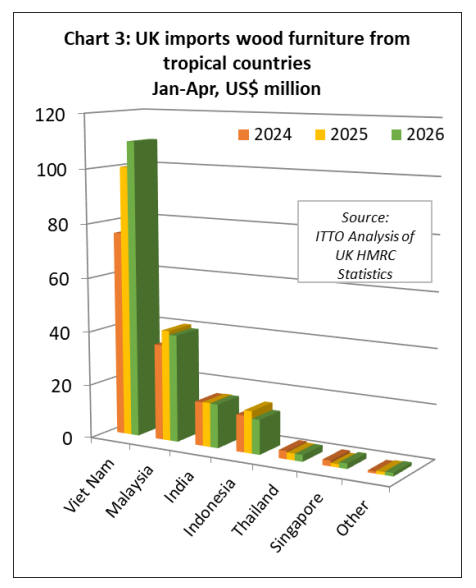
In the first four months of this year, UK import value of
wooden furniture from tropical countries increased 3% to
US$184 million while import quantity increased 2% to
48,700 tonnes. The growth so far this year has been
strongly concentrated in furniture products imported from
Viet Nam (+9% to US$191 million).
Imports of wooden furniture declined from other major
supply countries, including Malaysia (-3% to US$40
million), India (-1% to US$16 million), Indonesia (-18%
to US$13 million), and Thailand (-2% to US$2.5 million).
However, imports from Singapore increased by 60% from
a small base, to US$2.0 million. UK wooden furniture
imports were negligible from all other tropical countries
during the first four months of this year (Chart 3).
Decline in UK imports of joinery
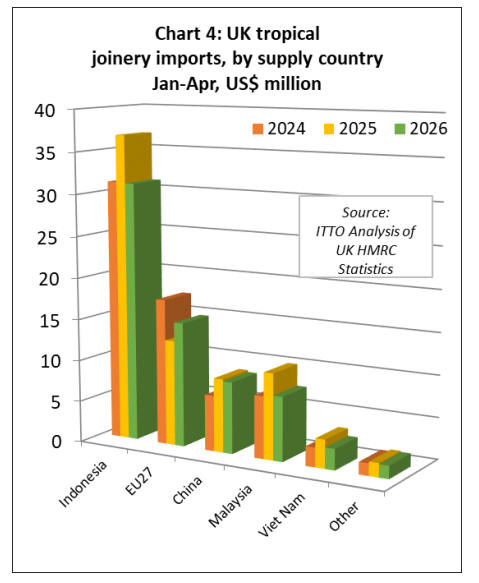
In the first four months of this year, UK import value of
wood joinery from tropical countries decreased 10% to
US$67 million. The decline during the period was
widespread among major Asian suppliers, particularly
affecting Indonesia (-15% to US$31.2 million), Malaysia
(-25% to US$7.7 million) and Viet Nam (-26% to US$2.5
million). Imports from China fell slightly by 3% to US$8.6
million.
In contrast, tropical wood joinery imports from the EU27
bucked the trend, rising 18% to US$15 million. Wood
joinery imports were negligible from all other tropical
countries during the first four months of this year (Chart
4).
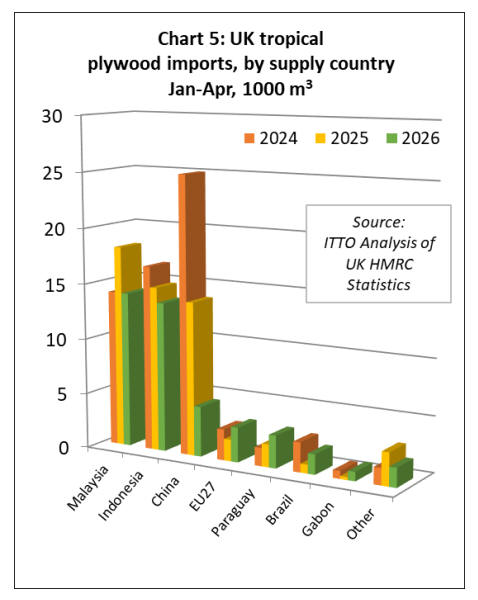
Collapse in UK imports of plywood from China
In the first four months of this year, UK import volume of
plywood from tropical countries decreased 23% to 42,400
cu.m. The reduction so far this year has been heavily
driven by a collapse in shipments from China (-67% to
4,500 cu.m).
Imports also contracted from major traditional suppliers,
including Malaysia (-23% to 14,000 cu.m) and Indonesia
(-9% to 13,500 cu.m). However, imports of tropical
hardwood plywood from the EU27 increased by 60% to
3,100 cu.m, and imports from Paraguay continued to
grow, up 43% to 2,900 cu.m. Notable gains from small
bases were also recorded for Brazil (+128% to 1,800 cu.m)
and Gabon (+212% to 800 cu.m), while imports from
other tropical regions remained low (Chart 5).
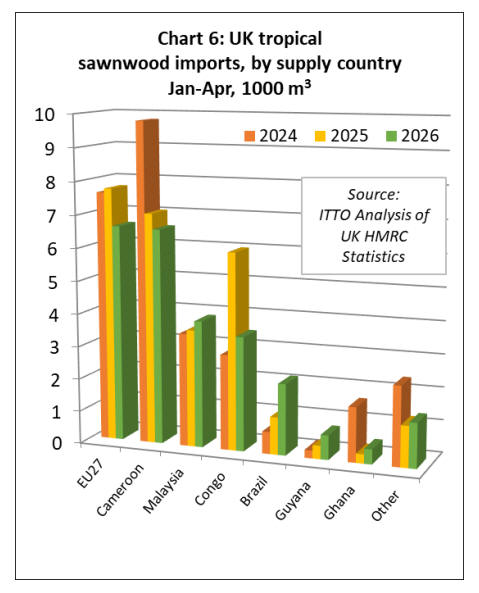
UK tropical sawnwood imports as Congo slip
In the first four months of this year, UK import volume of
tropical sawnwood decreased 8% to 25,300 cu.m. The
contraction so far this year was significantly influenced by
a sharp correction in imports from the Republic of Congo
(-42% to 3,500 cu.m). Shipments from Cameroon also
eased slightly, down 7% to 6,600 cu.m. There was also a
15% drop in imports from the EU27 to 6,600 cu.m.
The EU nevertheless remained the largest single supply
region for tropical hardwood sawnwood to the UK, much
of the wood coming from the Netherlands and Belgium.
On the positive side, imports from Malaysia grew 8% to
3,900 cu.m, while shipments from South American
suppliers rose steeply, with Brazil expanding 90% to 2,200
cu.m and Guyana jumping 84% to 700 cu.m. Ghana also
rebounded from a very low base, increasing 60% to 500
cu.m (Chart 6)
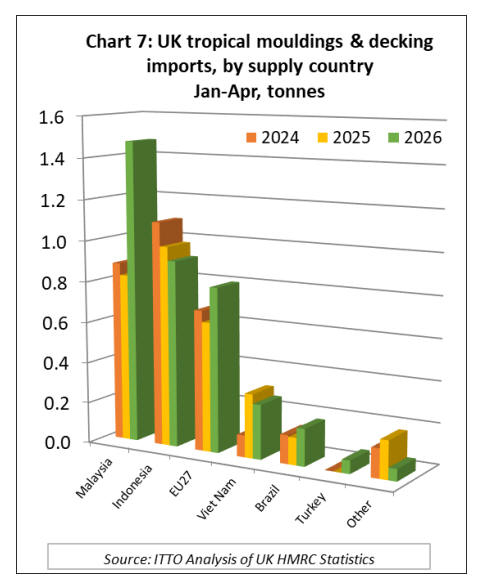
Robust growth in UK tropical decking and mouldings
imports led by Malaysia
In the first four months of this year, UK import volume of
tropical decking and mouldings increased 23% to 3,760
tonnes. The expansion so far this year has been
predominantly driven by a major surge in shipments from
Malaysia (+80% to 1,480 tonnes).
Imports from the EU27 also advanced strongly, rising
27% to 800 tonnes, while Brazil increased 37% to 180
tonnes. In contrast, imports slowed from Indonesia (-7% to
910 tonnes) and Viet Nam (-15% to 270 tonnes).
Meanwhile, imports from Turkey have just appeared on
the radar, rising from zero last year to reach 60 tonnes
(Chart 7).
UK announces intent to align closely with EUDR
On 23 June 2026, the UK government announced a
strengthened legislative approach to combatting global
deforestation in import supply chains with significant
implications for the wood and timber industries. Under the
new strategy the government plans to introduce
regulations for Great Britain (GB) in 2027 that will build
upon and strengthen the existing UK Timber Regulation
(UKTR). The new measures are specific to GB, i.e. that
portion of the UK not including Northern Ireland, which is
already part of the EU single market and therefore subject
to EUDR when implementation begins on 31 December
2026.
The upcoming framework will require GB businesses with
an annual turnover exceeding £1 million to conduct
mandatory due diligence on forest risk commodities,
explicitly including wood and derived products like
furniture. To prove compliance with local laws, affected
operators must establish verification systems, submit
activity reports and collect precise origin geolocation data.
Crucially for the market, the GB framework is designed to
align closely with the EUDR. This deliberate alignment
aims to minimise regulatory divergence, protect the UK
internal market and ease trading burdens for businesses
operating across both jurisdictions.
Because the UK is classified as a low-risk country,
businesses exporting GB-produced wood products to the
EU or moving them to Northern Ireland will benefit from
simplified due diligence requirements. That, however,
does not exempt UK suppliers from providing geolocation
data with their shipments into the EU internal market.
The evolving regulatory landscape raises complex
operational questions regarding how EU-derived timber
and products will be treated upon entering GB.
The EUDR underwent significant structural amendments
in December 2025 which not only postponed the
application dates but also significantly reduced due
diligence obligations for downstream operators in the EU.
As GB structures its independent 2027 framework to
broadly match EU data and traceability standards market
analysts are closely watching how the UK will evaluate
compliance for imports from the EU that benefit from
these newly amended, simplified European rules and
whether any reciprocal regulatory shortcuts will be
codified between the UK and EU.
Additionally, the 2027 framework raises questions around
treatment of the UK’s Voluntary Partnership Agreements
(VPAs) under the Forest Law Enforcement, Governance
and Trade (FLEGT) framework. Currently, the UK
FLEGT regime provides a streamlined "green lane" for
timber originating from VPA partner countries, most
notably Indonesia and Ghana, whereby a valid FLEGT
license serves as automatic proof of legality, bypassing
standard UKTR due diligence.
However, because the upcoming UK regulations shift
focus from merely stopping illegal logging to ensuring
broader deforestation-free supply chains, questions arise
around how these bilateral agreements will be integrated.
If the new 2027 rules mirror the EUDR's stance - where a
FLEGT license satisfies legality criteria but does not
exempt an importer from mandatory geolocation and
deforestation-free verification - the commercial advantage
enjoyed by FLEGT licensed products in the UK tropical
wood market could be altered.
There are also wider geopolitical issues raised by the UK’s
announcement. Last year the UK imported, from China,
US$3.7 billion of forest products that would be subject to
the new regulations. UK importers seeking to comply with
the new UK regulations will therefore need to navigate
both those requirements and China’s Decrees 834 and 835
which regulates foreign entities from conducting certain
due diligence and supply chain information-gathering
activities within China.
Last year, the UK also imported US$2.3 billion of forest
products from the US. This includes US$1.75 billion of
wood pellets which are important to the UK's current net-
zero strategy as they constitute the vast majority of
industrial biomass used for baseload electricity and is a
necessary component for negative emissions technologies
like Bioenergy with Carbon Capture and Storage
(BECCS).
The UK is also now by far the US largest export market
for solid hardwood products, with a total value of US$250
million last year. Nearly all these products derive
ultimately from innumerable small harvest sites distributed
amongst family forest owners in the Eastern US.
This has created obstacles to conformance with the
property level geolocation requirements of EUDR. The US
administration is calling for an exemption to the EUDR
requirements for this reason and can be expected to call
for a similar exemption in the UK.
|


