US Dollar Exchange Rates of
25th
June
2026
China Yuan 6.80
Report from China
Housing market continues to struggle
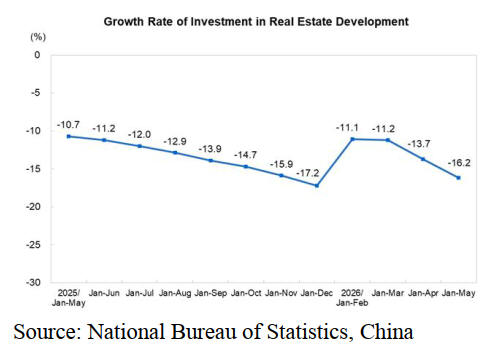
The National Bureau of Statistics (NBS) has reported
investment in real estate development from January to
May 2026 saying there was a year-on-year decrease of
16.2%, of which the investment in residential buildings
was down 15.6%.
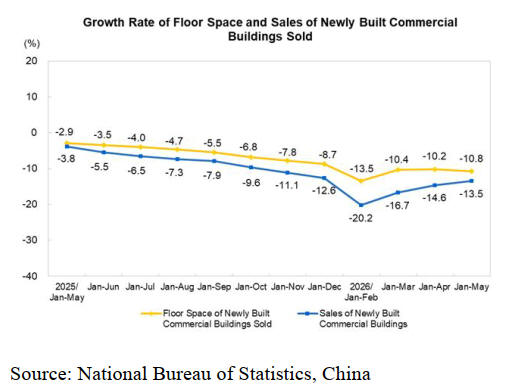
From January to May, the floor space of newly built
commercial buildings sold was 313.20 million square
metres, a year-on-year decrease of 10.8%, of which the
floor space of residential buildings sold decreased by
12.1%. Sales of newly built commercial buildings were
2,936.6 billion yuan, down 13.5%.
See:
https://www.stats.gov.cn/english/PressRelease/202606/t2026061
7_1963968.html
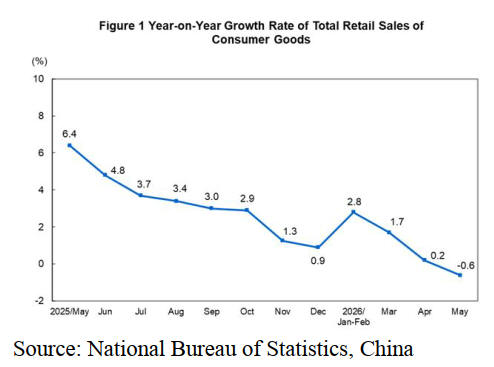
The NBS has also
reported total retail sales of consumer
goods. From January to May total retail sales of consumer
goods reached 20,603.1 billion yuan, up 1.4% year on
year. Specifically, retail sales of consumer goods
excluding automobiles reached 19,002.2 billion yuan, up
by 2.7%.
In May, retail sales of consumer goods reached 4,109.0
billion yuan, down by 0.6% year on year. Specifically, the
retail sales of consumer goods excluding automobiles
reached 3,778.1 billion yuan, up by 1.1%. Retail sales of
furniture between January and May declined 3%.
Rise in annual
timber production
It has been reported that China's forest harvest volume will
have approached 21 billion cubic metres in 2025, an
annual increase of over 1 billion cubic metres and the total
output value of forestry and grassland industries will reach
nearly RMB11 trillion (approximately US$1.6 trillion). As
of 2025 annual timber production has increased by nearly
36% compared to 2020.
Decline in wooden furniture exports to USA
According to China Customs, the value of China’s wooden
furniture exports to US dropped 13% in the first quarter of
2026. The US was the largest destination for China’s
wooden furniture exports. 25% of China’s wooden
furniture was exported to US in the first quarter of 2026
but the share of the US market continues to decline.
Exports of wooden furniture from China to the US have
decreased mainly due to the impact of US tariffs as well as
anti-dumping and anti-subsidies on China’s wooden
furniture.
Chinese wooden furniture has lost competitiveness and
companies are reluctant to take large orders from US
buyers, preferring to reduced their business in the US. As
a result, buyers in the US are increasingly turning to
Vietnam and Mexico. The tariffs applied to these two
countries are only around 10% giving them a significant
cost advantage over China.
The US market for wooden furniture has experienced a
sharp decline while the European Union has seen a steady
increase which has mainly benefitted SE Asian shippers.
China's wooden furniture exports have rapidly diversified.
Despite the drop in the value of China’s wooden furniture
exports to the US, total wooden furniture exports in the
first quarter 2026 rose 2% to US$5.4 billion over the same
period in 2025 due to the rise in exports to UK, Germany
and the Netherland.
The value of China’s wooden furniture exports to UK,
Germany and Netherland grew 18%, 36% and 28%
respectively. In addition, exports to both Australia and
France rose 9% in the first quarter of 2026.
In contrast, China’s wooden furniture exports to Japan,
South Korea and Saudi Arabia fell 6%, 5% and 1%
respectively in the first quarter of 2026.

China’s wooden furniture is exported to more than 200
countries. The value of China’s furniture exports to the top
10 countries accounted for only 65% of the national total
wooden furniture exports in the first quarter of 2026.
Decline in wooden furniture imports
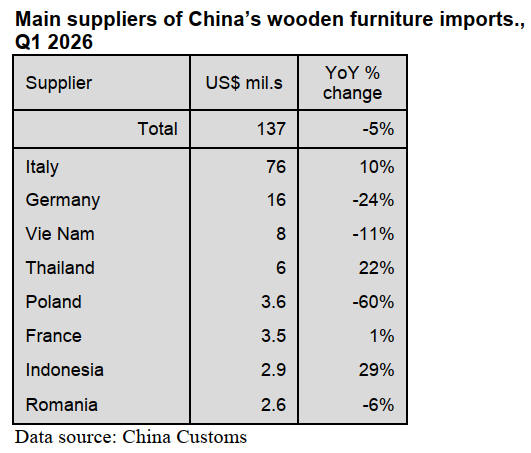
China Customs data shows the value of China’s wooden
furniture imports in the first quarter of 2026 fell 5% to
US$137 million over the same period of 2025.
The main reasons for the decrease in the import of Chinese
wooden furniture are as follows:
New housing projects have started in China but
the demand for renovating old houses is sluggish.
The domestic demand for full-house
customisation and solid wooden furniture is
weak.
Factories are reducing inventory and not stocking
up on wooden furniture materials.
The wooden furniture factory significantly
reduced production and imports of logs and wood
panels both contracted simultaneously.
Domestic solid wood and panel furniture has seen
an improvement in quality and a reduction in
price, while the consumption of high-end
imported furniture has cooled down.
Italy and Germany are the top 2 suppliers of China’s
wooden furniture imports. 66% of China’s wooden
furniture were imported from these two countries and rose
10% from Italy but from Germany dropped 24% in the
first quarter of 2026.
The value of China’s wooden furniture imports from
Vietnam, Poland and Romania dropped 11%, 60% and 6%
respectively in the first quarter of 2026.
In contrast, the value of China’s wooden furniture imports
from Thailand and Indonesia rose 22% and 29%
respectively in the first quarter of 2025.
Rise in fibreboard exports
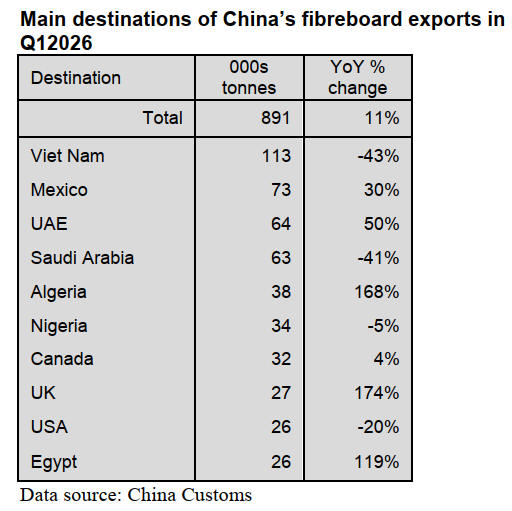
According to China Customs, fibreboard exports rose 11%
to 891,000 tonnes in the first quarter of 2026. Although
China’s fibreboard exports to Vietnam, as the largest
market in the first quarter of 2026, dropped 40% to
113,000 tonnes over the same period of 2026.
China’s fibreboard exports to Mexico and the UAE, as
second and third largest destination countries in the first
quarter of 2026 rose 30% and 50%.
In addition, China’s fibreboard exports to Algeria, UK and
Egypt surged over 160%, 170% and almost 120%
respectively in the first quarter of 2026.
The increases offset the decrease in the export of
fiberboard to Vietnam resulting in an overall 11% increase
in China's total fibreboard exports in the first quarter of
2026.
In contrast, in the first quarter of 2026, China’s fibreboard
exports to Saudi Arabia, Nigeria and US dropped 41%, 5%
and 20% respectively over the same period of 2025.
Decline in fibreboard imports
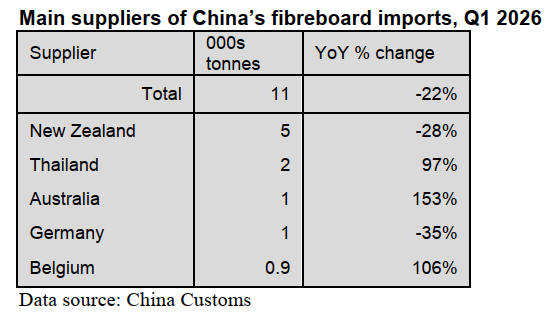
China Customs data indicates fibreboard imports totalled
11,000 tonnes in the first quarter of 2026, down 22% over
the same period of 2025. Imports from New Zealand in the
first quarter of 2026 dropped 28% from the same period of
2025.
It is worth noting that China’s fibreboard imports from
Thailand, Australia and Belgium in the first quarter of
2026 surged 97%, 153% and 106% over the same period
of 2025. In contrast, China’s fibreboard imports from
Germany in the first quarter of 2026 fell 35% year on year.
The main reason for the significant decline in China's
fiberboard imports in the first quarter of 2026 was the
abundant domestic supply which led to a substitution of
imports by domestic products.
The domestic capacity for fiberboard production is huge
and the self-sufficiency rate is continuously increasing.
China is the world's largest producer of fiberboard with a
total production capacity exceeding 40 million cubic
metres. Ordinary fibreboard and decorative fiberboards are
fully self-sufficient, while only a small amount of high-
quality speciality fibreboards are imported.
In the first quarter of 2026 there was a concentrated
logging of reserve forests and plantation and the supply of
wood chips for fibreboard increased significantly. The
production of fibreboard factories remained stable and the
inventory was sufficient.
Leading home furnishing enterprises are building their
own production lines upstream and reducing the purchase
of imported boards. Customised home furnishing leaders
such as OPPEIN and SOGAL have built fibreboard
workshops on their own, prioritising the use of domestic
non-toxic, F4-star environmentally friendly fibreboard.
The domestic supply chain has been advanced
significantly reducing the amount of overseas decorative
fiberboard purchases.
After adding shipping costs, tariffs and exchange rate costs
prices of imported fiberboard are generally higher than
those of similar domestic products.
May 2026 GTI report
Customs data shows that China’s timber imports reached
around 4.86 million cubic metres in April this year, up 4%
month-on-month. Of this volume, log imports stood at
approximately 2.98 million cubic metres, a 7.9% increase
from the previous month, while sawnwood imports edged
down 1.7% to about 1.88 million cubic metres.
During the same month, China imported 185,000 cubic
metres of timber from the United States, representing a
year-on-year increase of 23.6% and a sharp 44.5% rise
month-on-month, signaling tentative signs of recovery in
bilateral timber trade.
At present, China is actively promoting the development
of plantation forests such as eucalyptus and teak, in an
effort to achieve synergies between ecological
preservation and economic returns.
The latest data indicate that China’s annual eucalyptus
timber output exceeds 30 million cubic metres,
significantly reducing the country’s external dependence
on timber and securing raw material supplies for industries
such as construction, papermaking, furniture and
packaging.
In other news, data from the National Bureau of Statistics
of China shows that furniture manufacturers above the
designated size nationwide recorded a total profit of 2.67
billion yuan in the January–April period.
Currently, the furniture industry is showing a development
structure characterised by "export recovery but
manufacturing under pressure. Furniture enterprises are
maintaining their order volumes through price adjustments
and are in the "trading price for volume" stage.
In May 2026, the GTI-China index registered 47.8%, a
decrease of 5.7 percentage points from the previous month
and below the critical value (50%) again after two months.
Regarding the twelve
sub-indexes, five indexes (inventory
of finished products, purchase quantity, import, inventory
of main raw materials and delivery time) were above the
50% critical value, while the remaining seven indexes
(production, new orders, export orders, existing orders,
purchase price, employees and market expectation) were
below the critical value.
Compared to the previous month, the indexes for import
and inventory of main raw materials increased by 1.8 to
4.9 percentage points; the index for delivery time was
unchanged from the previous month and the remaining
nine indexes declined by 0.9 to 23.0 percentage point(s).
See: https://www.itto-
ggsc.org/static/upload/file/20260615/1781506386105682.pdf
|


