Japan
Wood Products Prices
Dollar Exchange Rates of 25th
June
2026
Japan Yen 161.79
Reports From Japan
Inflation steady as subsidies restrain energy costs
Japan’s key inflation measure in May was little changed
from a month earlier due largely to government subsidies
that capped energy costs.
The Ministry of Internal Affairs and Communications
reported core consumer prices (excluding fresh food) rose
1.4% from a year earlier. .A measure that excludes both
fresh food and energy rose 1.8% from a year earlier.
The figures show how effective the government support
programmes have been in containing the cost of living,
largely through fuel subsidies. Recently the government
prepared an extra budget that will help continue to cushion
the impact of rising costs.
Even though the United States-Iran interim peace deal has
taken effect, oil prices are still elevated and importers say
it will take months, if not longer, for volumes of oil and
liquefied natural gas passing through the critical Strait of
Hormuz to return to normal.
The core consumer price index, excluding fresh food in
Japan was up 1.4% year on year in May. Hideo Kumano,
Chief Economist at Daiichi Life Research Institute warned
that the pass-through was not over: “Companies have yet
to fully pass on higher crude oil costs, meaning that price
increases will continue for a while, particularly further
down the supply chain.”
Kumano said restoring energy flows is also expected to be
difficult. Ensuring safety in the Strait of Hormuz and
removing mines would take time, while a tanker round trip
to bring crude oil to Japan would probably require around
six weeks.
See:
https://www.japantimes.co.jp/business/2026/06/19/economy/japa
n-inflation-holds-steady/
Investment plan for next 14 years unveiled
The government has unveiled a long-term vision for
economic development featuring massive investment in
artificial intelligence and semiconductors as well as other
key sectors including defense, space and shipbuilding.
This, says the government, will call for a combination of
public and private investment.
This new plan has shifted the fiscal focus toward reducing
the debt-to-GDP ratio, moving away from using a primary
balance target that had guided government policy for more
than two decades.
The debt-to-GDP metric is generally considered
easier to
improve during periods of inflation.
See:
https://www.japantimes.co.jp/business/2026/06/24/economy/inve
stment-plan-unveiled-14-years/
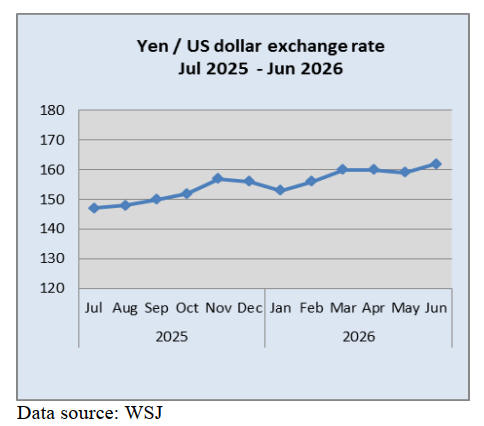
Yen at 162 to the US dollar, - intervention would not be
very effective now say experts
The yen crossed the ¥161 to the US dollar in late June
coming close to levels not seen since the 1980s. Finance
Minister, Satsuki Katayama, said “When we act, we will
act decisively.” Although the yen was back near levels that
triggered intervention in April and May recent verbal
warnings from the Minister were considered less
threatening than those ahead of the intervention earlier this
year.
Soichiro Tateishi, an economist at the Japan Research
Institute, suggested financial officials in Japan may have
assessed that intervention would not be very effective now
compared to the last time. The Finance Ministry spent a
total of almost ¥12 trillion to support the yen between
April 28 and May 27.
Recently the Bank of Japan (BoJ) lifted interest rates to
1%, the highest level since 1995, the first rate increase
since the end of 2025.
However, the BoJ’s decision did little to boost the yen as
the market had already fully priced in the decision,
according to analysts. Although exchange rates are not
within the BoJ’s policy target scope, currency fluctuations
are now more likely to affect prices compared to the past,
so exchange rates will be consider at future meetings, said
the BoJ Governor.
See:
https://www.japantimes.co.jp/business/2026/06/19/markets/yen-
market-june-19-2026/
Home mortgage holders face increased rates
Interest rates for Japan’s popular ‘Flat 35’ long-term
fixed-rate mortgages rose to 3.21% in June, raising the
hurdles to homeownership. Flat 35 is a commonly used
long-term fixed-rate mortgage loan in Japan with a
maximum term of 35 years, offered through a partnership
between private financial institutions and the Japan
Housing Finance Agency. In June, the minimum interest
rate for Flat 35 rose to 3.21%, surpassing the 3% level for
the first time in 17 years.
These rates are influenced by the Bank of Japan’s
monetary policy which is to raise the benchmark interest
rate gradually. At present, variable-rate mortgages are
roughly two percentage points lower than fixed-rate
mortgages. About 80% of mortgage borrowers choose
variable-rate mortgages.
Kobayashi Masahiro, a visiting researcher at the NLI
Research Institute, notes that “it is difficult to know what
lies ahead” with regard to short-term variable rates “now
that long-term interest rates are on the rise ahead of other
rates and inflation is expected to intensify, along with the
uncertainty about the situation in Iran.”
See: https://www.nippon.com/en/japan-data/h02807/
Import update
Assembled wooden flooring
In April 2026, shippers in China account for most of
Japan’s imports of assembled flooring and shipments. All
imports of HS4418-73 and 76% of HS4418-74 originated
in China, just 2% was from Austria. China was the main
shipper of HS4418-75 followed by Viet Nam and
Thailand. For HS4418-79 the main suppliers in April were
China and Thailand.
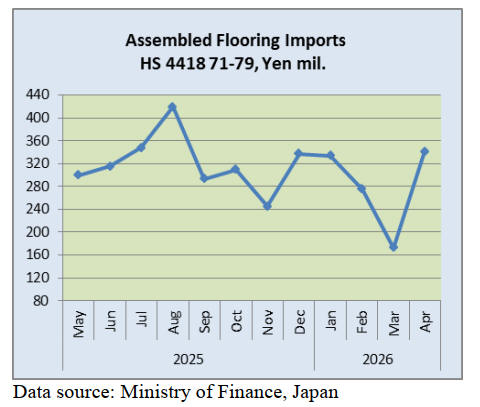
Imports of assembled wooden flooring (HS441871-79)
dropped sharply in February and March but there was a
significant upward adjustment in April and this was by
more than can be explained by the continual weakness in
the yen US dollar exchange rate.
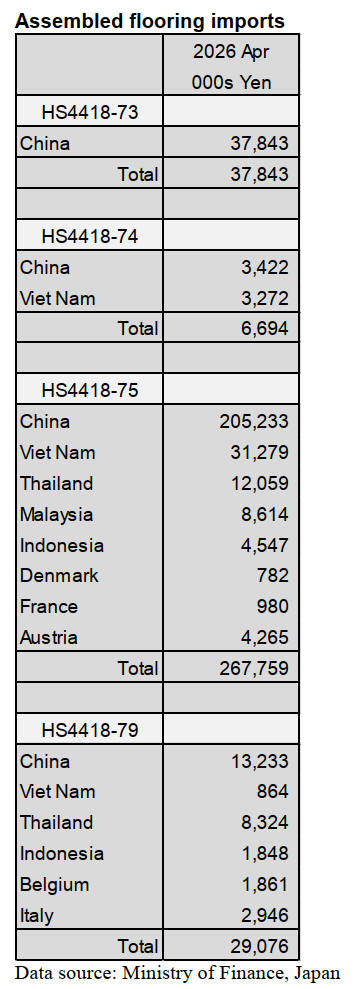
Of the various categories of assembled flooring imports in
April, 76% was of HS4418-75 (63% in March),11% was
of HS4418-73 (23% in March), an almost halving of the
value of this category, 8% was of HS4418- 79, with the
balance being HS4418-73.
Plywood imports
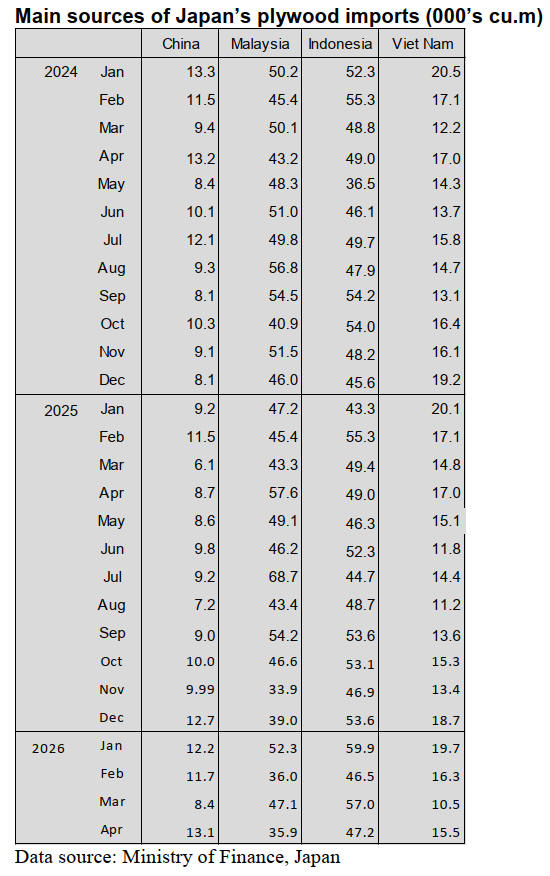
The combined volume of shipments from the two main
shippers in April 2026 (Indonesia and Malaysia)
accounted for 72% of total imports (84% in March). April
shipments from Malaysia dropped compared to a month
earlier as did shipments from Indonesia.
The other main shippers of plywood to Japan in April
were Viet Nam and China. April arrivals from Viet Nam
were around 50% higher than in March and arrivals from
China were at 13,000 cu.m, the highest in the past 18
months.

In April 2026 arrivals of HS441210-39 were reported at
114,838 cu.m (123,896 cu.m in March). As in previous
months, of the various categories of plywood imported in
January 2026, HS4412-31 accounted for most (80%)
followed by HS4412-33(8.5%), HS4412-34 (6%) with the
balance being HS4412-39 and HS4412-10.
Trade news from the Japan Lumber Reports (JLR)
The Japan Lumber Reports (JLR), a subscription trade
journal published every two weeks in English, is
generously allowing the ITTO Tropical Timber Market
Report to reproduce news on the Japanese market
precisely as it appears in the JLR. For the JLR report
please see: https://jfpj.jp/japan_lumber_reports/
Japan prepares shift to new training and employment
programme
The number of foreign technical trainees in the forestry
sector reached 127 roughly one year after the occupation
was added to Japan’s Technical Intern Training Program
in September 2024. Labor shortages remain severe in
western Japan, including Kyushu and Shikoku, and more
operators in regions such as Chugoku and Kanto are now
planning to accept new trainees. Japan’s Immigration
Services Agency reported that as of the end of 2025, the
forestry category counted 127 trainees and the wood-
processing category 541, up from 299 a year earlier,
showing steady nationwide growth.
Attention is now turning to the new “Training and
Employment Program,” which will replace the Technical
Intern Training Program and take effect on April 1, 2027.
Operational guidelines released in February outline a shift
toward securing a stable workforce.
The new program sets a standard stay of three years
(extendable to four), and workers who pass the required
skills and N4-level language tests may transition to
Specified Skilled Worker (i). It also allows worker-
initiated job changes and caps fees paid to sending
organizations. Regional areas will be permitted larger
intakes, and transitional measures will allow current
trainees to complete their existing terms.
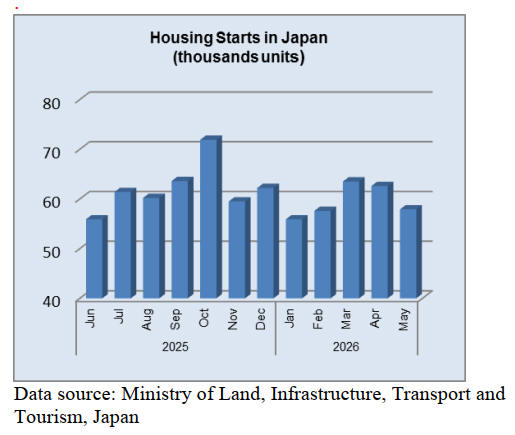
Orders for house builders
Orders received in April by major housing manufacturers
and builders were generally strong, exceeding the levels
recorded in the same month last year. Although a few
companies posted slight year-on-year declines, some
reported increases of around 30 percent compared with the
same month last year.
In addition to higher per-unit prices pushing up overall
order values, some prospective homebuyers moved to
purchase earlier than planned due to uncertainty stemming
from instability in the Middle East. Orders at major
housing manufacturers and builders remained strong in
April, following solid results in March.
Adhesive shortages push up wood product prices
Amid a surge in demand for petroleum-based chemical
products triggered by the effective closure of the Strait of
Hormuz, adhesive suppliers have begun imposing price
hikes and supply restrictions on structural laminated
timber manufacturers. In response, manufacturers have
started moving to raise prices on shipments from May.
In western Japan, adhesive suppliers notified
manufacturers at the end of March that they would impose
volume restrictions on adhesives used heavily in softwood
plywood production. As a result, manufacturers were
already forced to cut output by April. As a result,
speculative buying by distributors worried about potential
shortages has tightened supply, prompting manufacturers
to begin raising prices.
Meanwhile, inquiries from distributors concerned about
potential supply disruptions prompted several structural
laminated timber manufacturers to state in mid-April that
adhesive supplies had not yet been restricted, mirroring the
situation seen in the plywood market. However, by late
April, adhesive manufacturers began issuing notices that
supply restrictions would be implemented.
Japan calls for stable housing-material supply
Japan’s METI, MLIT and the Forestry Agency have asked
distributors and homebuilders to help maintain a stable
supply of housing materials amid concerns over naphtha-
related product shortages. While key chemical supplies
remain generally stable the ministries warn that excessive
ordering could tighten the market.
They outlined three cooperation measures—ordering only
immediate-need volumes, improving communication
across the supply chain, and using a newly established
Housing Sector Information Desk. The government has
also launched a task force to secure critical materials
affected by Middle East developments.
Plywood
Prices for domestic plywood continue to rise as
manufacturers push through increases, with structural
panels leading since April. Middle East tensions have
raised costs for adhesives and other materials, and mills—
already struggling with weak markets— implemented
further hikes. Buyers, concerned about supply, continued
securing inventory, and by May structural plywood (12
mm, 3×6) settled around ¥1,300 per sheet, ¥200 higher
than in April. In June, major producers are seeking another
10%, pushing prices toward ¥1,400.
Imported tropical hardwood plywood from Indonesia and
Malaysia is also firm. While mills report no major
production issues, costs for adhesives, logs, coatings, and
freight continue rising.
Malaysian producers in Sarawak raised May offers by
about US$20 per m³ (C&F). Export prices have
strengthened, with coated formwork plywood at US$610–
630, formwork plywood at US$520–540, and structural
plywood at US$530–550. Indonesian ordinary plywood
trades around US$970–1,000 for 2.4 mm, with 3.7 mm at
US$880 and 5.2 mm at US$850.
Domestic prices remain on an upward trend. Coated
formwork plywood is around ¥1,920 per sheet, with some
deals at ¥2,000. Formwork plywood is
¥1,650–1,700, and structural plywood—still tight—is
centered around ¥1,700. Indonesian ordinary plywood
remains firm at ¥780 for 2.5 mm, ¥930 for 4 mm, and
¥1,150 for 5.5 mm.
Domestic logs and lumber
Prices of domestically produced lumber rose in May,
mainly for cedar items supplied to precutting plants. With
supplies tightening, sawmills have begun passing on
increases for cedar posts, studs, and 90 mm cedar and
cypress squares. Imported lumber and laminated cedar
posts—key competitors—had risen by about ¥5,000
between March and April, creating room for domestic
prices to move higher. From late 2024, precutting plants
and builders accelerated their shift from imports to
domestic materials, but for more than a year domestic
prices rose only to the lower end of competing imports.
This spring, as imported lumber increased again, domestic
lumber followed.
Cedar 105 mm KD premium posts for precutting plants
rose ¥2,000–4,000 to ¥55,000–58,000 per cubic meter,
while market prices at ¥57,000–60,000 now exceed
precutting plant levels once delivery costs are included.
Cedar KD premium studs increased ¥2,000–3,000 to
¥60,000–63,000.
Log prices show contrasting trends: cedar remains firm,
while cypress continues to weaken. In the Chugoku
region, cypress logs for posts and sills have found a
tentative bottom at ¥17,000 per cubic meter, though mid-
sized logs may fall below ¥16,000 depending on lamina
demand.
In Kyushu, cypress logs for posts remain at ¥17,000 and
sills at ¥17,500, narrowing the gap with cedar post logs at
¥16,000 and raising concerns about harvesting motivation.
Some areas in Shikoku have seen cypress sill logs fall to
¥16,000.
Cedar logs remain relatively resilient. In northern Kanto,
post logs fell ¥500 to ¥15,000 but remain ¥1,000 above
last year’s sharp decline. In Kyushu, cedar post logs stay
at ¥16,000, while mid-sized logs rose ¥500 to ¥15,500. In
Akita, mid-sized cedar logs remain unchanged at ¥15,000
|


