|
Report from
Europe
EU tropical wood imports at a low ebb in the first
quarter of 2026
At a time when global supply conditions for tropical
hardwood products are very tight and the economic
outlook extremely uncertain, EU27 import volume during
the opening months of 2026 remained very low by long-
term historical standards.
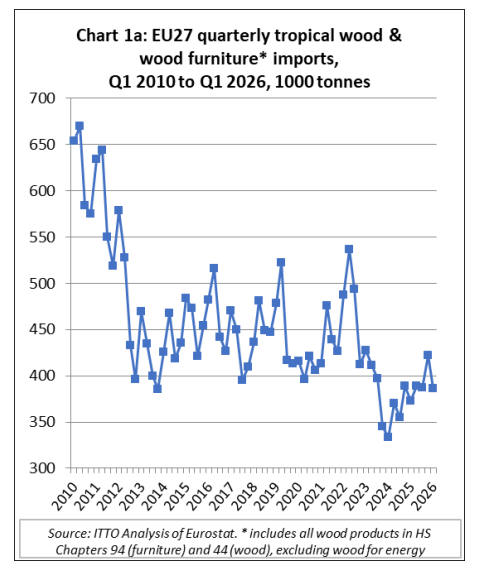
Imports of 386,000 tonnes of tropical wood and wood
furniture in the first quarter of 2026, while 4% more than
the same quarter in 2025, were down nearly 9% compared
to the previous quarter. (Chart 1a).
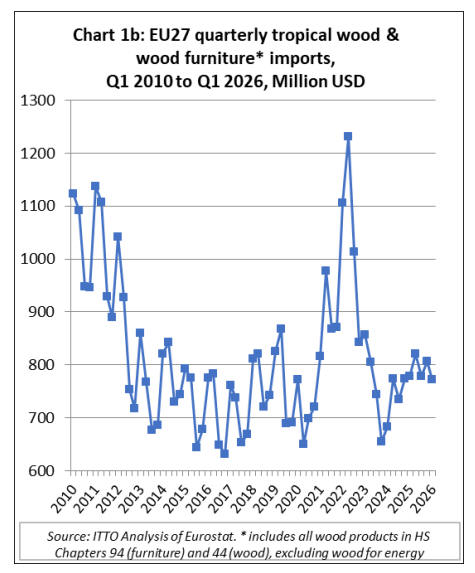
Total EU27 tropical wood and wood furniture import
value in the first quarter of 2026 was US$772 million, 1%
less than the same period last year and 4% down on the
previous quarter. In nominal terms (not accounting for
inflation), import value in the first quarter of 2026 was
more closely aligned with the pre-pandemic 2013-2019
period (Chart 1b). However, when inflation and exchange
rate changes are accounted for, the real value of EU
imports now is down around 30% compared to 2019.
Subdued European economy dampens demand
The wider European economic environment remained
subdued during the opening months of 2026. While
inflation continued to ease and household purchasing
power improved modestly, economic growth across the
eurozone slowed significantly amid weaker global trade,
persistent geopolitical tensions, and higher energy costs.
Preliminary Eurostat data shows that euro area GDP
increased by only 0.1% in the first quarter of 2026
compared to the previous quarter, down from 0.2% growth
in the final quarter of 2025.
Recent forecasts from major international institutions have
become increasingly cautious regarding the eurozone
outlook for 2026. The ECB’s latest macroeconomic
projections published in March 2026 reduced expected
euro area GDP growth in 2026 to 0.9%, while the OECD
lowered its 2026 euro area growth forecast to 0.8%.
Slow eurozone construction puts the brakes on wood
consumption
The weakness of the European construction sector
continues to be a particularly significant drag on demand
for timber and wood products. Forward-looking indicators
suggest that eurozone construction activity deteriorated
further during the first quarter and early second quarter of
2026. The S&P Global Eurozone Construction PMI fell
from 44.6 in March to 41.7 in April 2026, signalling the
sharpest contraction in construction activity since August
2024 and extending the current downturn in the sector to
four years. Any reading below 50 indicates contraction in
activity.
According to the latest survey data, the downturn was
broad-based across the eurozone construction sector, with
particularly weak performance in France and Germany.
Commercial construction activity recorded the steepest
decline, while residential construction and civil
engineering activity also remained firmly in contraction
territory. New orders weakened further amid elevated
financing costs, weak housing investment, rising energy
prices, and continuing economic uncertainty.
These conditions continue to weigh heavily on European
demand for tropical wood products, particularly higher-
value interior and construction-related product groups
such as furniture, joinery products, mouldings, and
decking. While imports of plywood and flooring products
increased strongly during the first quarter of 2026, overall
market conditions for tropical timber products in the EU
remained fragile.
10% decrease in EU27 wooden furniture imports from
tropical countries in Q1 2026
The EU27 imported 76,000 tonnes of wooden furniture
from tropical countries with a total value of US$318
million in the first quarter of 2026. Import quantity and
value were down 10% and 12% respectively compared to
the same period in 2025.
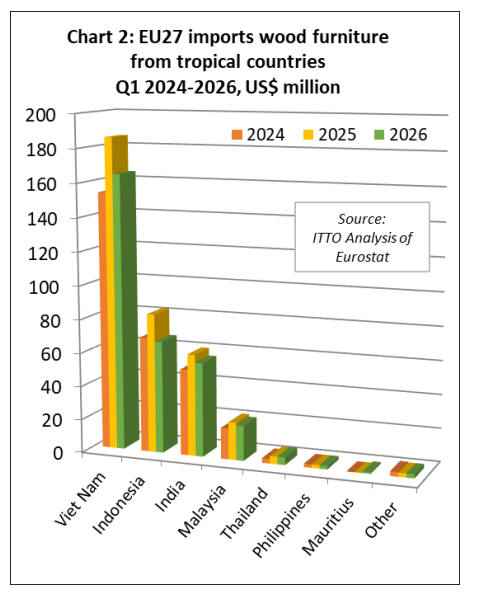
In the first quarter of 2026, EU27 import value of wooden
furniture decreased from all major supply countries
including Vietnam (-11% to US$164.6 million), Indonesia
(-19% to US$66.9 million), India (-8% to US$56.1
million), and Malaysia (-7% to US$20.8 million).
However, there was a small 2% increase in imports from
Thailand to US$4.6 million (Chart 2).
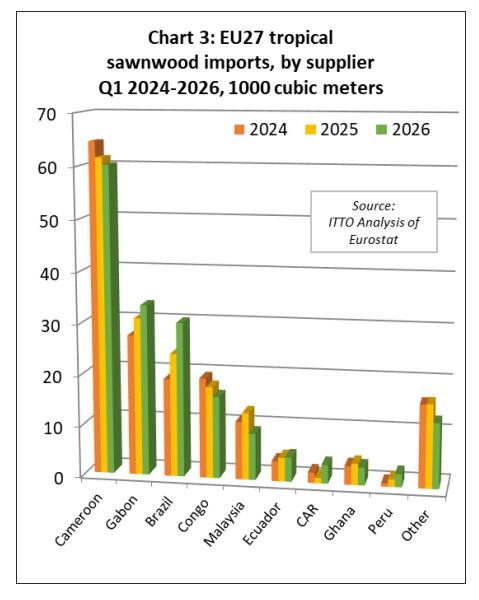
EU27 imports of tropical sawnwood just surpassed
record lows
The EU27 imported 176,000 cu.m of tropical sawnwood
with a total value of US$167.7 million in the first quarter
of 2026, respectively 1% and 5% more than the same
period in 2025 when imports were close to record lows.
Tropical sawnwood imports increased from Gabon (+8%
to 33,400 cu.m), Brazil (+25% to 30,200 cu.m), Peru
(+76% to 2,600 cu.m), and the Central African Republic
(+255% to 3,700 cu.m). However, imports declined from
the Republic of Congo (-10% to 16,100 cu.m), Malaysia (-
31% to 9,100 cu.m), Cameroon (-2% to 60,100 cu.m),
Ghana (-16% to 3,500 cu.m) and the Democratic Republic
of Congo (-35% to 1,200 cu.m) (Chart 3).
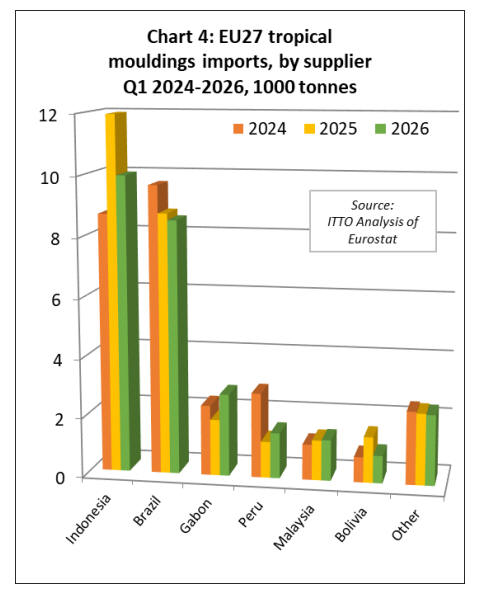
The EU27 imported 27,400 tonnes of tropical mouldings
and decking products with a total value of US$49.4
million in the first quarter of 2026, respectively 6% and
3% less than the same period in 2025. Imports declined
from Indonesia (-17% to 10,000 tonnes), Bolivia (-40% to
900 tonnes), and Brazil (-3% to 8,500 tonnes).
However, imports increased from Gabon (+46% to 2,800
tonnes), Peru (+26% to 1,500 tonnes), and Malaysia (+2%
to 1,400 tonnes) during the period (Chart 4).
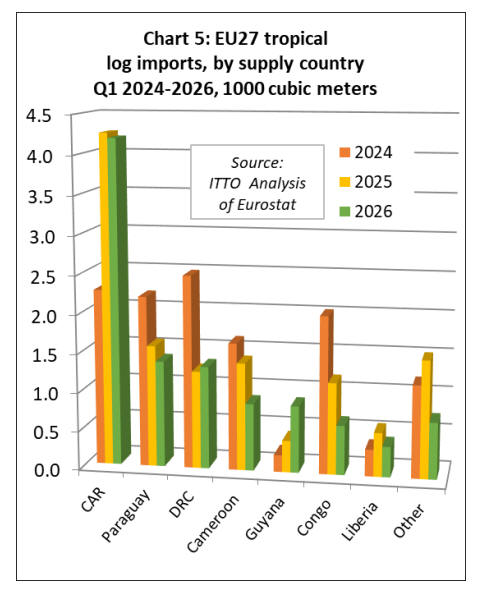
The EU27 imported 10,400 tonnes of tropical logs in the
first quarter of 2026, 15% less than the same period in
2025. Import value was stable at US$6.2 million.
Imports declined from Cameroon (-38% to 900 tonnes),
the Republic of Congo (-46% to 600 tonnes), Paraguay (-
13% to 1,400 tonnes), and Liberia (-31% to 400 tonnes).
However, imports increased from Guyana (+110% to 900
tonnes) and the Democratic Republic of Congo (+5% to
1,300 tonnes).
Imports from the Central African Republic, the largest
supplier during the quarter, were broadly stable at 4,200
tonnes (Chart 5).
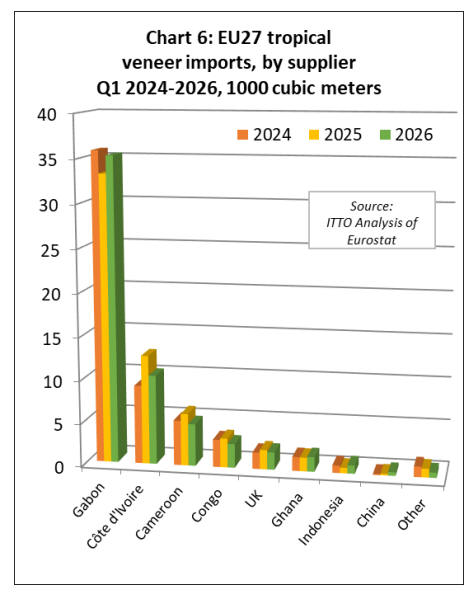
The EU27 imported 58,900 cu.m of tropical veneer in the
first quarter of 2026, 3% less than the same period in
2025. However, import value was up 7% to US$43.7
million.
Import quantity increased from Gabon (+6% to 35,300
cu.m), Indonesia (+53% to 1,000 cu.m), Ghana (+7% to
1,700 cu.m), and China (+140% to 400 cu.m). However,
import quantity declined from Côte d'Ivoire (-18% to
10,300 cu.m), Cameroon (-19% to 4,900 cu.m), the
Republic of Congo (-18% to 2,800 cu.m), and the UK (-
10% to 2,000 cu.m) (Chart 6).
Sharply rising imports of tropical hardwood plywood
in response to anti-dumping measures
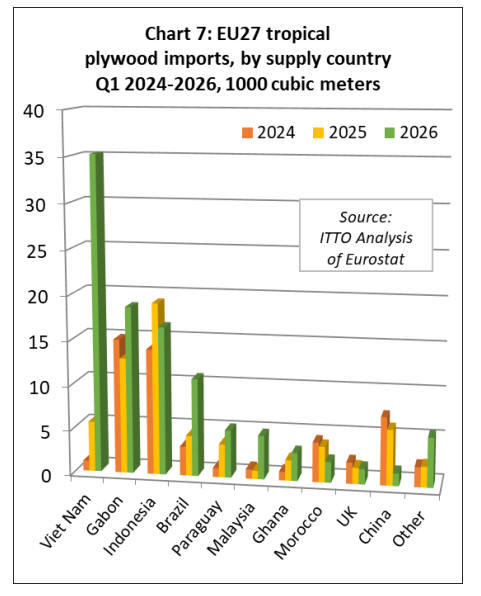
The EU27 imported 105,500 cu.m of tropical plywood
with a total value of US$67 million in the first quarter of
2026, up 67% and 48% respectively compared to the same
period in 2025.
This leap is driven primarily by Vietnam, from which
imports in the first quarter of this year, at 35,200 cu.m,
were up 528% compared to the same period in 2025. This
figure is all the more remarkable because it excludes an
additional 44,200 cu.m of plywood faced with non-tropical
hardwood species imported by the EU from Vietnam in
the same period, a rise from just 3,800 cu.m in the first
quarter of last year.
This is readily explained by the EU anti-dumping duties
on imports of hardwood plywood from China, set since 19
November 2025 at 86.8% for all products except those
from one company that provided additional information
during the EC investigation (set at 43.4% duty).
There were also significant gains in EU27 first quarter
imports of tropical hardwood plywood from Brazil
(+142% to 10,900 cu.m), Malaysia (+428% to 4,900
cu.m), Paraguay (+43% to 5,300 cu.m), Ghana (+37% to
3,100 cu.m), and Gabon (+45% to 18,600 cu.m). However,
imports declined from China (-77% to 1,400 cu.m),
Morocco (-42% to 2,300 cu.m), Indonesia (-14% to 16,500
cu.m), and the UK (-7% to 1,700 cu.m) (Chart 7).
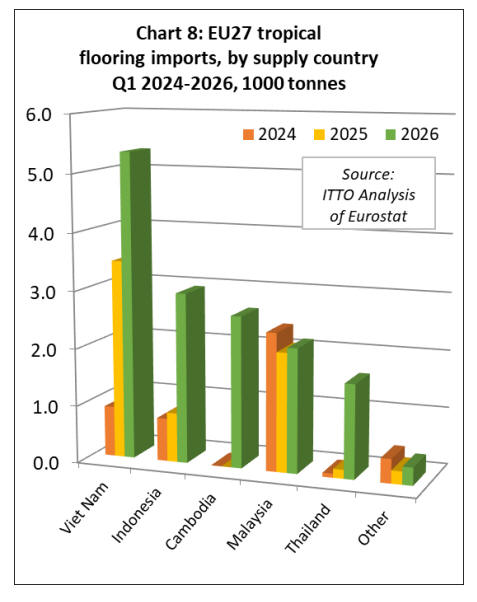
The EU27 imported 15,000 tonnes of tropical wood
flooring with a total value of US$40.3 million in the first
quarter of 2026, up 122% and 160% respectively
compared to the same period in 2025.
Imports increased from all major supply countries
including Indonesia (+244% to 3,000 tonnes), Vietnam
(+54% to 5,300 tonnes), Thailand (+951% to 1,600
tonnes), Malaysia (+4% to 2,200 tonnes), and Cambodia
which supplied 2,600 tonnes compared to negligible
imports during the same period in 2025 (Chart 8).
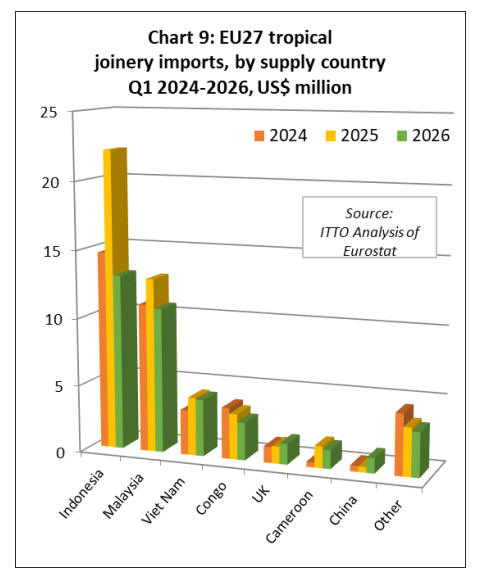
EU27 import value of other joinery products from tropical
countries - mainly laminated window scantlings, kitchen
tops and wood doors – was US$49.3 million in the first
quarter of 2025, 26% more than the same period last year.
Import quantity was up 31% to 21,800 tonnes in the same
period. Import value increased from Indonesia (+51% to
US$22.1 million), Malaysia (+17% to US$12.8 million),
and Vietnam (+29% to US$4.3 million).
EU import value of laminated joinery products increased
from Cameroon in the first quarter this year, rising 324%
to US$1.6 million. However, imports from the Republic of
Congo began this year more slowly than last, being down
11% at US$1.6 million. Indirect imports from the UK also
fell, by 2% to US$1.2 million (Chart 9).
Outlook for 2026
The first quarter trade figures suggest that the EU tropical
wood market remains fragile despite modest improvement
in some sectors. Gains in plywood and flooring imports
were offset by weaker demand for furniture and higher-
value secondary processed products. Much will depend on
whether the wider European economy and construction
sector recover more decisively during the remainder of
2026.
For now, the map of European growth in 2026 is being
redrawn around the southern and eastern periphery rather
than around the bloc's traditional industrial heartland.
Among the four largest eurozone economies, Spain is once
again the clear outperformer, with GDP growing 0.6%
quarter-on-quarter and 2.7% year-on-year in the first
quarter of 2026, slightly accelerating from 2.6% in the
fourth quarter of 2025.
The contrast with the rest of the eurozone heavyweights is
striking. Germany expanded just 0.3% year-on-year over
the same period, France 1.1%, and Italy 0.7%. Spain alone
is matching the United States on the annual measure.
Some countries in Eastern Europe are also performing
reasonably well economically this year, including Poland,
Bulgaria and Hungary, although it has to be said none are
traditionally significant markets for tropical wood.
Elsewhere, a lot is being pinned on expectations of a
strong recovery in Germany this year now that a massive
€500 billion infrastructure and climate package and €100
billion defence fund are being deployed. Real wage
growth and falling inflation are also expected to boost
household spending in Germany this year.
|


