Japan
Wood Products Prices
Dollar Exchange Rates of 25th
May
2026
Japan Yen 159.28
Reports From Japan
Solid GDP growth – supports interest rate rise
Japan’s economy grew much faster than expected at the
start of the year though the outlook remains highly
uncertain due to the Middle East conflict.
Real gross domestic product (GDP) expanded 2.1% on an
annualised basis in the first quarter, according to the
Cabinet Office, exceeding economists’ forecast for a 1.7%
expansion and was a marked acceleration from a
downwardly revised growth pace of 0.8% in the previous
quarter. Stronger-than-expected private consumption and
trade helped power the acceleration in growth.
The expansion may give policymakers encouragement to
raise interest rates as the Bank of Japan (BoJ) moves to
continue its ‘normalisation’ policy and address inflation.
Despite the positive growth figures the yen has weakened
against the dollar.
Private consumption, which accounts for more than 50%
of Japan’s GDP, increased 0.3% on a non-annualised
basis, exceeding a 0.1% forecast. That was likely the result
of government utility subsidies and wage growth which
appears to be finally outpacing inflation. But, consumer
confidence has dropped.
With no end to the conflict in sight the BoJ has lowered its
growth forecast for the current fiscal year to 0.5%, while
raising its inflation forecast to 2.7%.
In related news, the government is preparing a budget to
help households hit by rising energy costs due to the
situation in the Middle East. The aim is to keep electricity
and gas bills lower than last summer.
A plan to allocate about 500 billion yen for the measures is
being discussed and if agreed this will require compilation
of a supplementary budget for this year.
See:
https://www.japantimes.co.jp/business/2026/05/19/economy/gdp
-rise-first-quarter/
and
https://www3.nhk.or.jp/nhkworld/en/news/20260521_B2/
Downward pressure on private consumption forecast
The Daiichi Life Research Institute has suggested, on a
calendar-year basis, growth is projected at +0.5% in 2026
(previously +0.7%) and +0.8% in 2027 (previously
+1.1%). The FY2026 growth forecast has been revised
downward, reflecting persistently high crude oil prices
amid escalating tensions surrounding Iran, the partial
materialisation of adverse effects from supply constraints
and sourcing difficulties in petroleum-related products and
expected downward pressure on private consumption
through higher energy and food prices.
Real GDP growth in the first quarter 2026 was +2.1% on a
quarter-on-quarter annualised basis, marking the second
consecutive quarter of positive growth. Private
consumption and business investment continued to
increase, while exports also posted strong growth.
The data suggest that, prior to the full impact of escalating
Iran-related tensions, Japan’s economy had maintained a
moderate recovery trend.
Looking ahead, however, the Daiichi Life Research
Institute says downward pressure on the economy is likely
to intensify as the effects of worsening geopolitical
tensions involving Iran become more pronounced. The
primary concern is the adverse impact of supply
constraints and sourcing difficulties.
See: https://www.dlri.co.jp/english/report_en/202605YS.html
OECD - concern over plan to cut tax on food
The Secretary-General of the OECD, Mathias Cormann,
has expressed concern over the government’s plan to
temporarily lower the consumption tax on food items to
zero, saying this will not be cost-effective. While
acknowledging the pressure that rising food prices place
on households, particularly those with lower incomes,
Cormann that “a zero rate on food is a blunt and costly
response.”
The government plans to reduce the consumption tax on
food items to zero for two years to help address the impact
of inflation on households.
Amid rising crude oil prices due to the escalating situation
surrounding Iran, prices for a wide range of daily
necessities, including household goods and food are rising.
Cormann, is of the opinion that, “It (a lowering) erodes the
revenue base Japan urgently needs and it actually
disproportionately benefits higher-income households who
spend more in absolute terms.” “The better approach is
well-targeted fiscal support to the households that actually
need that support,” he said.
See:
https://www.japantimes.co.jp/business/2026/05/13/economy/oec
d-chief-consumption-tax-cut/
Machinery orders in March 2026 and forecast
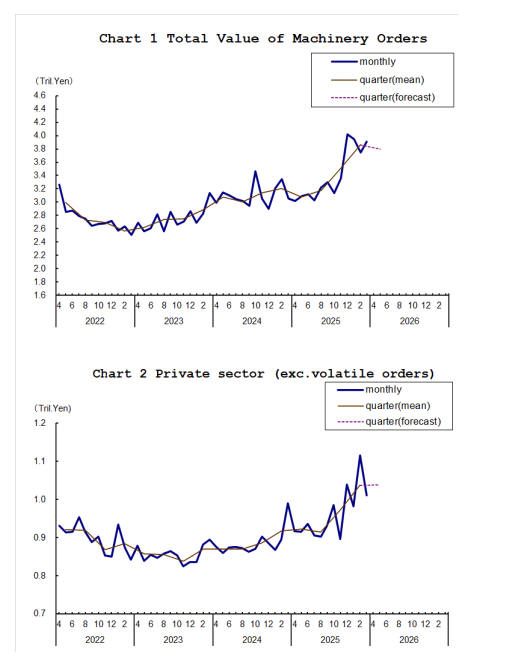
The total value of machinery orders received by 280
manufacturers operating in Japan increased by 4.3% in
March from the previous month. In the January-March
period it increased by 10.3% compared with the previous
quarter.
The Cabinet Office has forecast that in the April-June
period the total amount of machinery orders is expected to
decrease by around 2% and private-sector orders,
excluding volatile ones, are forecast to increase by 0.3%
from the previous quarter.
See: https://www.esri.cao.go.jp/en/stat/juchu/2026/2603juchu-
e.html
See:
https://www.japantimes.co.jp/business/2026/05/21/economy/mac
hinery-orders-march-fall/
Japan’s inflation eases to four-year low
Japan’s key inflation gauge rose at the slowest pace in four
years as government continued to help ease the cost of
living, creating difficult optics for the Bank of Japan to
raise interest rates soon.
Japan’s core consumer price index, which excludes fresh
food, rose 1.4% in April from a year earlier, according to
the Ministry of Internal Affairs. That was lower than all
estimates in a survey of economists.
The figure was eased because of prices of processed food
which grew at a much slower pace than in March and
energy costs fell but at a slower rate than in the previous
month.
See:
https://www.japantimes.co.jp/business/2026/05/22/economy/cpi-
april-rise/
Consumer confidence index tilts higher
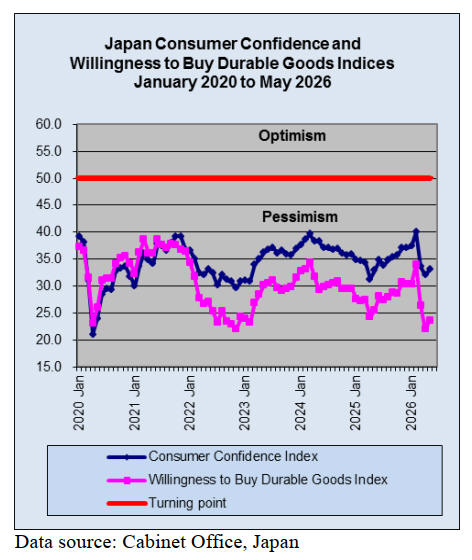
Japan’s Consumer Confidence Index rose to 33.6 in May
2026, up 1.4 points from 32.2 in April, according to the
Cabinet Office. This marked the first improvement in three
months and exceeded market expectations of around 32.0.
Yen remains under pressure
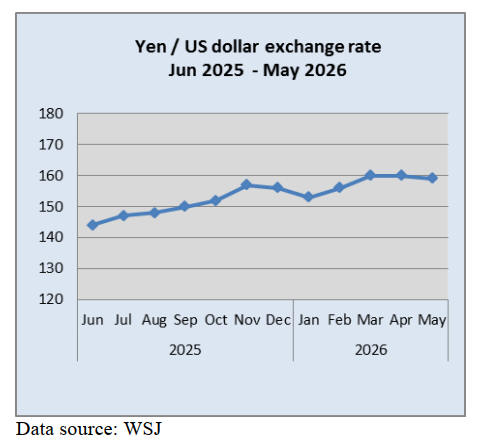
The yen remains under pressure even after the authorities
are assumed to have conducted a series of interventions to
support the currency since late last month.
The Japanese Minister of Finance, Satsuki Katayama,
pledged to “take bold action as needed” on the yen after
meeting with a Group of Seven officials in Paris. The yen
gained against the dollar following her remarks, after it
dropped to around 160 to the US dollar.
See:
https://www.japantimes.co.jp/business/2026/05/20/companies/m
organ-stanley-boj-hike-key/
Real estate loans at record high
Loans within the real estate sector remain at a record high,
driven by rising property prices especially in urban areas,
prompting not only major banks but also regional lenders
to expand their loan portfolios.
According to the Bank of Japan, new lending to the sector
in 2025 climbed 15% from the previous year to ¥17.8
trillion (US$112.6 billion). The annual total is about 70%
higher than the peak recorded during the bubble economy
in 1989 when such lending totalled ¥10.4 trillion.
Amid concerns that a sharp decline in real estate prices
could leave banks with bad loans, financial authorities are
closely monitoring market developments.
See:
https://www.japantimes.co.jp/business/2026/05/18/companies/ba
nk-lending-real-estate/
Import update
Assembled wooden flooring
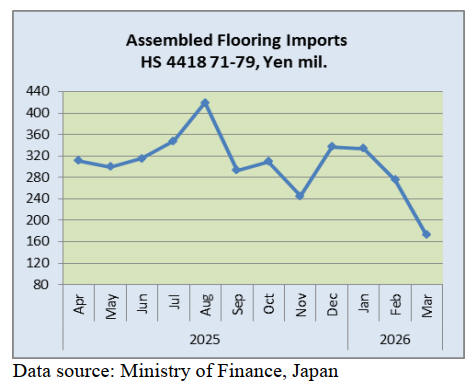
Imports of assembled wooden flooring (HS441871-79)
dropped sharply in February and the downtrend continued
into March. Year on year, the value of March 2026
imports were down 42% and compared to the value in
February there was a 37% decline.
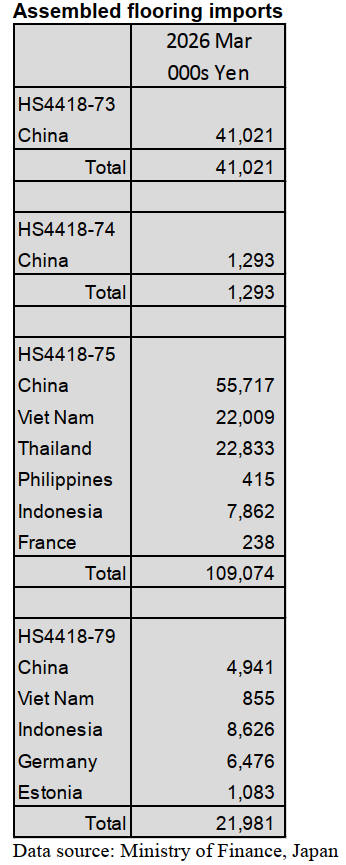
Shippers in China account for most of Japan’s imports of
assembled flooring and shipments. All imports of
HS4418-73 and HS4418-74 originated in China. China
was the main shipper of HS4418-75 followed by Viet Nam
and Thailand. For HS4418-79 the main suppliers in March
were Indonesia, Germany and China.
Of the various categories of assembled flooring imports in
March around 63% was of HS4418-75, a sharp drop
compared to February (75% in February), 23% was of
HS4418-73, a modest rise month on month, 13% of
HS4418- 7, a significant increase compared to February
with the balance being HS4418-73.
Plywood imports
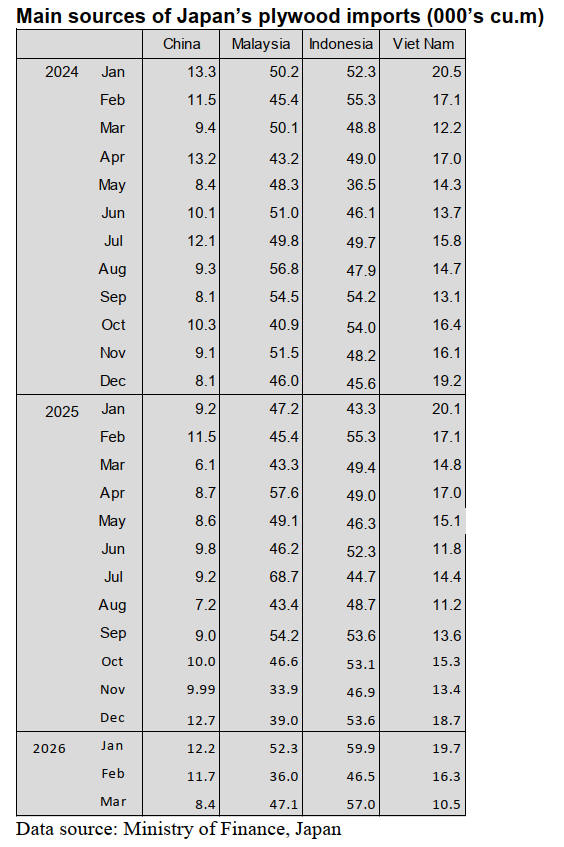
In March 2026 Indonesia and Malaysia continued as the
top suppliers of plywood to Japan with the combined
volume of shipments from the two main shippers
accounting for 84% of March arrivals (74% in February).
March 2026 shipments from Malaysia were at around the
same level as in February 2026 whereas shipments from
Indonesia were up just over 25%.
The other main shippers of plywood to Japan in March
were Viet Nam and China. March arrivals from Viet Nam
were down around 35% from the previous month and
arrivals from China were also down compared to the
volume recorded in February.
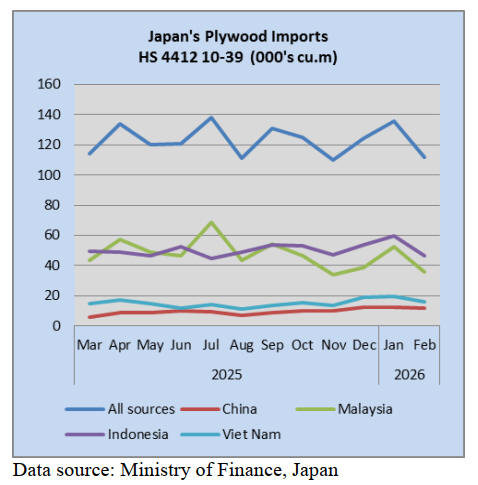
In March 2026 arrivals of HS441210-39 were reported at
123,896 cu.m (111,600 cu.m in February). As in previous
months, of the various categories of plywood imported in
January 2026, HS4412-31 accounted for most (87%)
followed by HS4412-33(7%), HS4412-34 (4%) with the
balance being HS4412-39 and HS4412-10.
Trade news from the Japan Lumber Reports (JLR)
The Japan Lumber Reports (JLR), a subscription trade
journal published every two weeks in English, is
generously allowing the ITTO Tropical Timber Market
Report to reproduce news on the Japanese market
precisely as it appears in the JLR. For the JLR report
please see: https://jfpj.jp/japan_lumber_reports/
Orders for house builders
Order values for major housing manufacturers and
builders for March 2026 showed divergent trends across
companies. For some housing companies, the slight year-
on-year decline reflects a reaction to the surge in orders
seen in March 2025 ahead of revisions to the Building
Standards Act.
Overall, however, March orders appear to have been
relatively solid.
As the fiscal year drew to a close, companies stepped up
their sales efforts, and with a continued shift toward higher
valued products, the average price per unit also increased.
As a result, March performance appears to have been
generally strong.
While visitor traffic to model homes remains sluggish,
some companies are seeing growth in corporate-driven
referrals, which is helping to support individual customer
acquisition. Some companies also reported an increase in
orders for multi-unit housing in March.
Japan unveils new CLT roadmap
On 31 March the government convened the Inter-
Ministerial Meeting on Promoting CLT Utilization and
released the fourth five-year roadmap for expanding the
use of CLT, beginning in fiscal 2026. The annual
production target of 500,000 cubic meters was maintained,
but no deadline was set, with the goal instead positioned as
a medium- to long-term objective. Japan’s domestic CLT
production capacity stands at roughly 100,000 cubic
meters, but actual output in 2024 reached only about
21,000 cubic metres.
The new roadmap adds three initiatives: developing design
manuals for hybrid structures combining CLT with steel
and other materials; promoting visualization of CLT’s
environmental performance through LCCO₂ assessments;
and advancing exports of domestically produced CLT.
The Ministry of Land, Infrastructure, Transport and
Tourism also indicated that it will consider cutting CLT
panels into linear members for use as columns and beams.
Plywood
Demand for domestic softwood structural plywood
including speculative e buying remained firm through
April, allowing manufacturers’ price hikes to stick.
Producers raised 12-mm structural plywood (3×6)to
¥1,100–1,150 per sheet(delivered to wholesalers), with
¥1,100 widely accepted in the Tokyo area and some deals
concluded above that level. For May, major mills are
seeking effective prices above ¥1,300 as adhesive
shortages linked to the Strait of Hormuz disruption force
production cuts and push manufacturing costs higher.
Imported tropical plywood is facing similar cost pressures.
Indonesian producers have issued large price-increase
proposals or halted new offers, while major Sarawak mills
raised Japan-bound 12-mm plywood prices by US$20–30
per cubic metre (C&F) in April.
Export prices remain firm. Indonesian standard plywood
is around US$970/cu.m for 2.4-mm sheets, US$880 for
3.7-mm and US$850 for 5.2-mm. For 12-mm products,
coated formwork plywood is US$600–610, formwork
plywood US$500–510, and structural plywood US$510–
520.
Domestic spot prices in Tokyo also continue to rise.
Coated formwork plywood (12 mm, 3×6) is trading
around ¥1,900 per sheet, formwork plywood around
¥1,620 and structural plywood around ¥1,650–1,700.
Indonesian standard plywood is roughly ¥780 for 2.5 mm,
¥930 for 4mm, and ¥1,150 for 5.5 mm.
Domestic lumber and logs
Domestic cedar products continued to rise through April
as imported competing materials became both scarce and
more expensive, prompting builders to increase pre-cut
orders. This shift strengthened demand for cedar across
regions, with the Kanto area seeing particularly tight
supply for square posts, studs, and 90-mm squares. Prices
for temporary braces (4 m × 30× 105 mm) and 4-metre
105-mm beams firmed, and lots below ¥65,000 have
essentially disappeared.
While hinoki sill plates remained weak at ¥72,000–74,000
per m³, hinoki studs around ¥70,000 began to move as
cedar studs(~¥65,000 became harder to secure and
whitewood studs stayed near ¥75,000, prompting some
buyers to shift toward hinoki as a mid-priced alternative.
Hinoki log prices continued to decline across western
Japan due to high output and weakening demand.
In the Chugoku region, post-grade and sill-grade logs were
¥17,000 per m³ and medium-diameter logs ¥16,000, with
monthly drops of ¥1,000. Kyushu saw post-grade logs fall
¥2,000 to ¥17,00 and sill-grade logs fall ¥1,500 to
¥17,500. Shikoku recorded ¥16,500 for both post-grade
and sill-grade logs, down ¥1,000–3,000. These declines
reflect an unusually loose supply–demand balance, with
abundant log availability and limited downstream
movement.
Cedar logs, by contrast, remained comparatively stable
despite similarly high output. Medium-diameter logs
were ¥15,000 in Akita and ¥14,500 in Tochigi (down
¥500), while post-grade logs held at ¥16,000 in Kyushu
and ¥15,500 in Tochigi.
Steady movement of KD cedar posts and studs continues
to support cedar log demand, preventing the kind of price
erosion seen in hinoki. Overall, the market is characterized
by firm cedar demand driven by substitution from imports,
contrasted with weakening hinoki demand and falling log
prices.
Japan tightens energy-efficiency rules for buildings
The Cabinet approved on 27 March a bill to amend the Act
on the Improvement of Energy Consumption Performance
of Buildings. The amendment designates the
responsibilities of building owners, architects, contractors
and building-material manufacturers regarding life-cycle
carbon (LCC) assessment as non-binding obligations. The
amendment also stipulates that the national government
will formulate guidelines for life-cycle carbon (LCC)
assessment of buildings.
The amendment further stipulates that, when constructing
a building, project owners will be expected to make good-
faith efforts to conduct life-cycle carbon (LCC)
assessments. Architects commissioned for design work
will also be required to cooperate by explaining the
necessary assessment items to the project owner.
The government will establish a new system requiring
building owners to notify the Minister of Land,
Infrastructure, Transport and Tourism of the results of Life
Cycle Cost (LCC) assessments at least 14 days prior to the
commencement of construction for certain large-scale
buildings intended for specified uses.
In addition, the LCC evaluation framework stipulates that
when carbon emission intensity factors related to the
manufacturing of building materials and other components
are calculated in accordance with government-defined
rules, such materials may be labeled to indicate
compliance with those rules.
Another key element of the bill is a ministerial
certification programme that evaluates advanced energy-
saving technologies.
The bill also establishes a certification system under which
buildings employing special structural methods or
equipment may be officially recognized by the Minister of
Land, Infrastructure, Transport and Tourism as having
performance equivalent to the government’s guidance
standards. Such buildings will be made eligible for
certification under the Building Energy Efficiency
Improvement Plan, allowing them to receive benefits such
as floor-area ratio exemptions.
Such buildings will be made eligible for certification
under the Building Energy Efficiency Improvement Plan,
allowing them to receive benefits such as floor-area ratio
exemptions.
The bill also designates major housing suppliers that hold
a leading share of the market as “Top Runner” companies.
These designated companies will be required to formulate
medium-to long-term plans, including specific targets, for
supplying energy-efficient housing and to report their
progress to the Minister of Land, Infrastructure, Transport
and Tourism on an annual basis.
Japan pushes timber use in construction
The government’s Headquarters for Promoting Wood Use
compiled and released the fiscal 2025 implementation
status of measures based on the “Basic Policy for
Promoting the Use of Wood in Buildings.” The
Headquarters for Promoting Wood Use—an organisation
headed by the Minister of Agriculture, Forestry and
Fisheries and composed of relevant cabinet ministers—
oversees comprehensive efforts to expand the use of wood
in the construction sector.
According to the report, the number of inquiries received
by the “Concierge for Supporting the Use of Wood in
Buildings,” which assists users in utilizing subsidy
programs and other schemes related to wooden and wood-
based construction, totaled 103 during fiscal 2025.
The number of agreements concluded under the “Wood
Use Promotion Agreement System” between the
government and organizations or companies stood at 28 as
of the end of last year. As a result, the organsations and
companies involved completed a total of 1,133 wooden or
wood-based buildings, with wood use reaching 44,054
cubic meters in total.
As for agreements with local governments, 192 had been
concluded as of the end of last year. Based on these
agreements, a total of 3,869 wooden or wood-based
buildings were completed, with wood use amounting to
92,284 cubic meters. An additional 25 agreements had
been concluded as of March 16.
The government intends to continue promoting the use of
locally sourced timber and expanding wood utilization in
the construction sector through these agreement
frameworks and support programmes.
|


