|
1.
CENTRAL AND WEST AFRICA
Overview
Market conditions across West and Central Africa remain
relatively stable, although selective price increases are
becoming more visible in both European and Chinese
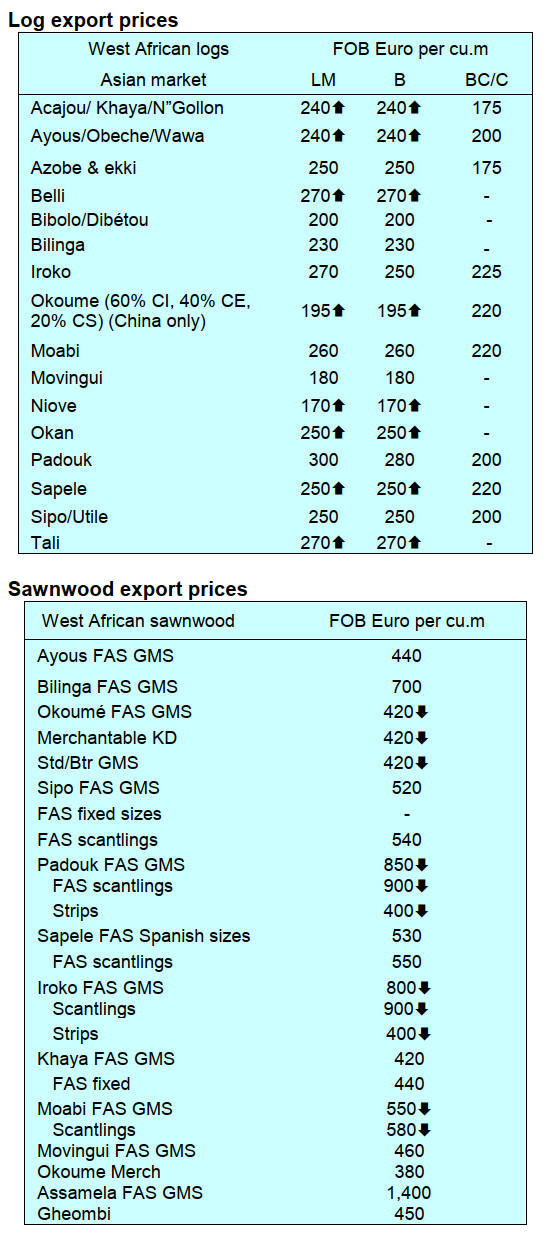
markets. Lower stock levels in Europe are generating
renewed purchasing interest for certain tropical hardwood
species, supporting firmer pricing in some segments.
In Europe it is reported that inventory levels continue to
decline creating some renewed demand. However, overall
construction activity remains subdued due to
environmental regulations, higher compliance costs and a
generally cautious investment climate.
Demand in China has improved for several key species
helping support price increases for selected logs and
sawnwood species. Demand remains mixed in Middle East
markets but generally stable with buyers monitoring
regional geopolitical developments before committing to
larger purchases.
Carbon-related initiatives and forestry conservation
programs are attracting increasing attention throughout the
region. With government finances under pressure in
several countries, carbon projects are increasingly viewed
as a potential source of future revenue and international
funding. At the same time, certification and compliance
requirements continue to create uncertainty.
Weather patterns remain highly variable. Cameroon,
Central African Republic and Northern Congo are
expected to return to wetter conditions in the coming
weeks. Gabon and much of Rep. of Congo are entering
what would normally be the dry season. Coastal areas
have experienced several rain-free days, but significant
rainfall continues in many inland production zones,
affecting transport and harvesting operations.
Overall market conditions remain cautious rather than
optimistic. Demand is improving in selected sectors and
tighter inventories are supporting some price increases.
However, producers continue to face challenges from
certification requirements, environmental regulations,
infrastructure constraints and uncertain global economic
conditions.
For now, most operators are focused on maintaining
production, managing costs and positioning themselves for
a gradual recovery in demand as inventories normalise
across major consuming markets.
Gabon
Heavy rainfall continues across most inland forest regions.
There has effectively been no real dry season upcountry
this year but coastal areas remain comparatively drier.
Harvesting activity is gradually picking up as market
demand begins to improve. The main harvested species
continue to be Okoumé, Okan, Azobé and red hardwoods.
Buyers for the Chinese market have returned with renewed
demand for Okoumé and selected red hardwood species.
European enquiries remain slow, although they have
improved compared to that in the winter months as stocks
are moving. Some producers have reported that the supply
of Azobé is being impacted due to the prolonged rains and
poor forest-road conditions. Demand for Okan is said to be
strengthening, particularly where Azobé supply from
Gabon and Cameroon remains tightly controlled.
Container availability remains sufficient with no reported
shortages. Port operations at Owendo remain under normal
conditions. Road infrastructure remains difficult due to
persistent rain. No major transport disruptions were
reported during the period. A new weighbridge has been
installed but was still not operational as of 23 May 2026.
Forest authorities continue enforcing payment of the 800
FCFA/cu.m social tax intended for local communities as
well as compliance with professional trading and export
regulations.
The Gabonese government is positioning forestry as a
strategic economic sector and is advancing plans to
monetise the country’s carbon absorption capacity. With
around 88% forest cover and low deforestation, Gabon is
studying participation under ART-TREES carbon credit
standards with support from international partners.
Earlier this year the Forest Stewardship Council (FSC)
signed two cooperation agreements with Gabonese
institutions to strengthen conservation through sustainable
forestry and certification. The agreements, one with the
Agence Nationale des Parcs Nationaux (ANPN), National
Parks Authority and another with Université Omar Bongo
(UOB) were concluded.
See: https://africa.fsc.org/en-cd/newsfeed/fsc-signs-twin-accords-
in-gabon-to-boost-conservation
AGOA Update
African exporters have regained duty-free access to the US
market after the African Growth and Opportunity Act
(AGOA) was extended through 2026. Gabon has been
reinstated as a beneficiary of AGOA after making
sufficient progress on governance and eligibility, reversing
its 2023 removal.
The programme briefly lapsed at the end of September
2025 after the US Congress failed to renew it, creating
uncertainty for African exporters. It was restored in
February 2026 when the US President signed the
Consolidated Appropriations Act, extending AGOA
retroactively to the end of 2026.
See: https://africa.businessinsider.com/local/markets/african-
exporters-regain-duty-free-us-access-as-trump-extends-agoa-
framework/nhdhhkd
Cameroon
Operators in Cameroon continue to enjoy favourable
weather with approximately one month of dry season
remaining before rains are expected to return.
Weather conditions are supporting increased harvesting
and transport activity.
It is reported that production is picking up. Most Chinese
operators are now receiving contracts for sawnwood.
Observers say this is positive for the sector as China is
slowly increasing purchases after a long quiet period.
Demand in the Middle East remains stable for red species.
Demand for Ayous remains low in Italy and the
Netherlands. The Philippines market remains weak while
Vietnam continues to perform strongly. Europe demand
remains slow especially for Padouk, largely due to CITES-
related complications.
Container availability remains good with sufficient empty
containers available. Port operations in both Douala and
Kribi are generally normal. No major disruptions have
been reported.
The outlook for the timber sector in Cameroon is
cautiously positive in operational terms. Harvesting and
transport are improving before the return of the rains and
Chinese demand is slowly recovering. However, demand
remains uneven across markets with Europe still slow and
Ayous particularly weak. Compliance checks linked to
FSC, EUTR and CITES will be important issues in the
coming months.
Republic of the Congo
Harvesting activity remains generally stable, supported by
ongoing road maintenance on key laterite forest roads.
Transport operations continue to rely heavily on road
networks linking production areas to export routes through
Douala and Pointe-Noire.
No significant disruptions have been reported within the
milling sector. Spare parts remain available particularly
for logging and harvesting equipment and no major labour
disputes have been noted during the period.
Container availability remains good with no shortages
reported at Pointe-Noire. Port operations continue under
normal conditions and no major disruptions to loading,
vessel movements or exports have been reported. Logistics
chains remain stable overall.
Demand conditions remain mixed but generally stable.
Demand from the Philippines for sawn Okoumé continues
to weaken. In contrast, strong demand for Tali from
Vietnam continues to support mill production, alongside
selected European hardwood requirements.
China remains active in several key species, including
Okoumé, Okan, Ovangkol, Belli and Azobé. This
continued Chinese interest is helping to support production
and exports despite weaker demand in some traditional
markets. No major regulatory changes have been
announced during the reporting period. Forestry
administration continues to maintain strict oversight of
harvesting operations and export activities.
The Congolese forestry sector remains relatively well
organised, with compliance controls actively enforced
throughout the supply chain.
No significant economic or trade disruptions affecting the
timber sector have been reported. Export activity
continues under existing regulations and market sentiment
remains broadly unchanged compared with previous
months.
While no major health-related disruptions to forestry
operations or timber trade have been reported during the
period, operators continue to monitor regional health
developments.
See: https://www.jeuneafrique.com/1798107/economie-
entreprises/ebola-il-y-a-10-pays-africains-a-risque-alerte-
lagence-sanitaire-de-lua/
The 2025 Joint Annual Report of the Forest Law
Enforcement, Governance and Trade Voluntary
Partnership Agreement (FLEGT VPA) between the
Republic of the Congo and the European Union is now
available.
This report highlights both the progress achieved and the
persistent challenges facing the FLEGT VPA process in
Congo in 2025. It reaffirms the joint commitment of the
EU and the Republic of Congo to promoting a forest and
timber sector that is legal, sustainable and conducive to
economic development.
Indonesia and the Republic of Congo strengthened
cooperation on sustainable forest management during a
bilateral meeting at the United Nations Headquarters in
New York between Forestry Minister, Raja Juli Antoni
and Congo’s Minister of Forest Economy, Rosalie
Matondo. The discussions focused on expanding South-
South collaboration in forestry, green economy
development and the transition toward more sustainable
forest management.
Matondo expressed interest in learning from Indonesia’s
forestry governance policies, particularly the Timber
Legality and Sustainability Verification System (SVLK+),
which has helped to improve the credibility of Indonesian
forestry products in international markets. The Minister
from the Congo also showed interest in Indonesia’s
environmental financing mechanisms, including the
Environmental Fund Management Agency (BPDLH), as
well as potential knowledge-sharing programmes in
tropical forest management.
See: https://forestinsights.id/indonesia-dan-kongo-perkuat-
aliansi-kehutanan-berkelanjutan-di-markas-pbb/
Recent reports of Ebola outbreaks in parts of Central
Africa have raised concerns, although no direct impact on
timber production, transport or export activities has been
observed.
See: https://capacity4dev.europa.eu/library/rapport-annuel-
conjoint-2025-apv-congo_en
The Congolese timber sector remains stable, supported by
ongoing Chinese demand and strong Vietnamese
purchases of Tali. While demand in the Philippine for
Okoumé remains weak, overall export activity continues at
a sustainable level.
Attention remains focused on forestry conservation
initiatives and emerging carbon-credit opportunities which
are becoming increasingly important within the broader
Congo Basin forestry strategy.
Through the eyes of industry
The latest GTI report lists the challenges identified by the
private sector in the Republic of Congo and Gabon.
See: chrome-
extension://efaidnbmnnnibpcajpcglclefindmkaj/https://www.itto-
ggsc.org/static/upload/file/20260515/1778810654194472.pdf
2.
GHANA
Camps set up to protects forest reserves
The Forestry Commission (FC) has established ten forest
protection camps located on reserve fringes areas to serve
as permanent bases for armed forest guards. Seven of
these camps are in the Ashanti Region at the Offin
Shelterbelt, Apapraman and Oda River reserves while
three are in the Western Region at Subri River Reserve.
The checkpoints are in Buru, Kintampo and Maluwe near
Wa.
The forest protection camps have been set up as part of a
strategic partnership between the government of the
United Kingdom (UK), through its Foreign
Commonwealth and Development Office (FCDO) and the
Ghana government, through the Forestry Commission.
The initiative aims to strengthen forest governance and
curb encroachment.
This follows findings that almost 9,000 hectares across 45
reserves and a national park were damaged by illegal
mining. There were also severe attacks on guards. 34
Forest Service Division (FSD) officers were injured in the
past 5 years and 23 Wildlife Division staff were killed or
maimed since 2017.
The protection camps are the Commission’s strategy for
moving from solitary guards to team-based operations,
ensuring rapid response and signaling commitment to
ending the widespread illegal mining, illegal logging and
other forest crimes.
See:https://www.graphic.com.gh/news/general-news/ghana-
news-forestry-commission-sets-up-camps-to-protect-forest-
reserves.html
and
https://www.ghanaweb.com/GhanaHomePage/NewsArchive/Ove
r-2-500-guard-shortfall-Forestry-Commission-boss-warns-of-
strained-forest-fight-2036142
Plywood accounted for 20% of first quarter exports
According to the Timber Industry Development Division
(TIDD) report for January to March 2026 wood export
volumes and values dipped by 16% and 20% respectively
to register exports at 48,532 cu.m and Eur 21.96 million
when compared to figures for the previous year. Ghana
earned Eur 27.50 million in 2025.
Of the total eleven wood products exported during the
period, air and kiln-dried sawnwood, plywood and billets
accounted for over 90% (43,942 cu.m) of the total wood
export volume in the first quarter of 2026 compared to
52,165 cu.m recorded for the same period in 2025.
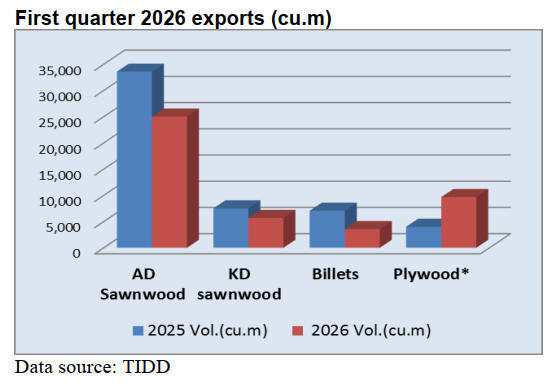
The above shows the top four wood products shipped
during the first quarter of 2026 compared to the same
period in 2025. Except for plywood, which witnessed
significant increases in volume and value, the export
volumes for air and kiln dried sawnwood and billets all
recorded decreases of 26%, 24% and 50% in volume
respectively for the period under review.
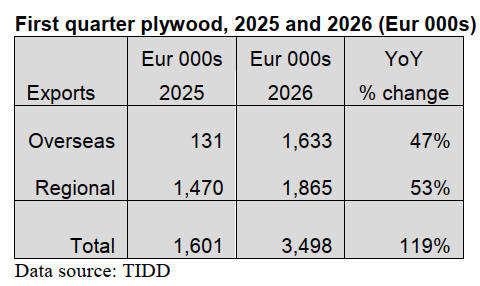
Plywood export volume to regional and overseas markets
registered marked improvements of year-on-year while
revenue also increased. The regional market accounted for
53% (Eur 1.87 million) of the total plywood export
receipts with the overseas market accounting for 47% (Eur
1.63 million).
Ghana’s climate framework to cost US$53.3 billion
Ghana needsUS $53.3 billion to implement its updated
Nationally Determined Contributions (NDCs) for 2025–
2035, a 10-year climate framework to cut greenhouse
emissions and boost resilience. The revised NDCs,
presented in Accra for validation before submission to the
United Nations Framework Convention on Climate
Change, cover energy, transport, industry, agriculture,
forestry, water and health.
At a stakeholder’s workshop for validation, Ms. Suweibah
Adam, the Chief Director of the Ministry of Environment,
Science and Technology (MEST) described the revised
NDC a shift to a comprehensive national strategy built on
five pillars: energy transition, sustainable transport,
circular economy, nature-based solutions and climate
adaptation.
Plans include 1,000 MW of nuclear power, 1,600+ MW of
renewables, green hydrogen, US $4.5 billion rail
expansion, Accra light rail, 1.225 million EVs, recycling,
waste-to-energy, and low-carbon industry. Nature-based
efforts include expanding Ghana’s Cocoa Forest REDD+
Programme while adaptation includes US$9.648 billion
for water infrastructure and US$3.155 billion for coastal
resilience.
Dr. Peter Dery, Director of Environment, Ministry of
Environment, Science and technology (MEST), said
Ghana targets 71% emissions cut in 10 years. The UN
noted full implementation could prevent 2,900 premature
deaths yearly and create one million green jobs.
See: https://www.ghanabusinessnews.com/2026/05/19/ghana-
seeks-53-3b-to-implement-10-year-climate-action-plan/
Project to build capacity and boost accountability
Ghana had 447 active Social Responsibility Agreements
(SRAs) in the timber sector worth GHS4.52 million
nationwide as of May 2026 according to Bright Owusu
Sekyere, Manager of Systems and Data Reconciliation at
the Forestry Commission’s Timber Validation
Department. He shared the data at the inception workshop
for the Agence Française de Développement (AFD)-FC
SRA Project aimed at strengthening SRA implementation.
SRAs require timber companies to allocate 5% of
stumpage fees to forest fringe communities for
development projects, making them the only direct
financial benefit from logging for those communities.
The Forestry Commission ensures SRAs are signed before
issuing timber licences and companies that fail to comply
risk losing their licenses. Legislative Instrument 2254,
enacted December 2017 provides legal backing for SRA
enforcement. SRAs are part of Ghana’s Timber Legality
Assurance System under the FLEGT/VPA framework,
making compliance a requirement for FLEGT licenses.
The one-year AFD-FC project, funded with Eur300,000
under the EU FLEGT VPA Programme, involves Civic
Response, Rights and Advocacy Initiatives Network
(RAIN), DEVNEST Systems and the Forestry
Commission.
According to Civic Response’s Head of Programmes,
Albert Katako, the project will train FC officials and
timber contractors on legal and operational requirements,
promote stakeholder collaboration to monitor and resolve
grievances and support SRA Committees to improve
community engagement, transparency, and accountability
in SRA resource use.
See: https://gna.org.gh/2026/05/ghana-records-447-active-
timber-social-responsibility-agreements-worth-ghs4-52-million/
Ghana now Africa’s 8th largest economy
Ghana has become the eighth-largest economy in Africa
following a significant expansion in Gross Domestic
Product (GDP).
According to the latest April 2026 World Economic
Outlook report by the International Monetary Fund (IMF),
Ghana’s economy grew to an estimatedUS$118.29 billion
in nominal GDP terms, up from US$108.1 billion recorded
in 2025.
The latest figures lifted Ghana two places higher on the
continent’s economic ranking, reinforcing the country’s
growing influence within both the West African sub-
region.mGhana’s improving economic ranking points
derived from the growing diversification of the economy
with growth increasingly being supported by a mix of
natural resources, services and industrial activity.
Meanwhile, the Bank of Ghana has maintained its
Monetary Policy Rate at 14.0%. The decision was
announced by the Governor, Dr. Johnson Pandit Asiama,
at the conclusion of the 130th Monetary Policy Committee
meeting.
See: https://www.citinewsroom.com/2026/05/ghana-rises-to-
africas-8th-largest-economy-as-gdp-expands-to-118bn/
and
https://www.imf.org/en/publications/weo/issues/2026/04/14/worl
d-economic-outlook-april-2026
Through the eyes of industry
The latest GTI report lists the challenges identified by the
private sector in Ghana.
See: chrome-
extension://efaidnbmnnnibpcajpcglclefindmkaj/https://www.itto-
ggsc.org/static/upload/file/20260515/1778810654194472.pdf
3. MALAYSIA
Staggering trade surplus growth
Malaysia’s export trade rose 15% year-on-year to
RM1.127 trillion in the January-April period driven by
surging demand for high-growth, high-value products and
the success in market diversification. This resulted in a
trade surplus of RM91.92 billion, a staggering 99% surge.
Malaysia has demonstrated extraordinary external sector
resilience even amid heightened geopolitical uncertainty in
West Asia
See:
http://theborneopost.pressreader.com/article/282308211750756
Sarawak Forestry Department advancing digital
technologies
The Sarawak timber industry recorded a decline of 10% in
export value in the first quarter of 2026 according to Amar
Awang Tengah Ali Hasan, the Deputy Premier. He said
this decline is closely related to reduced global market
demand which has affected the industry’s export
performance.
“Japan remained the main importer at RM298 million
followed by India at RM106 million, Middle Eastern
countries at RM70 million and the Philippines at RM23
million. The products exported included mainly plywood,
logs, fibreboard, sawnwood, wood chips and wood pellets.
To support the forestry sector, Sarawak is advancing
digital technologies including electronic timber tracking,
drone assisted restoration and Light Detection and
Ranging (LiDAR) based forest assessment to improve
transparency, efficiency and sustainable forest
management. Awang Tengah Ali Hasan said the Sarawak
Forest Department is intensifying the digitalisation of
forestry operations to enhance overall forest management,
with the Electronic Removal Pass system strengthening
digital and transparent traceability in the timber supply
chain.
The Forestry Department is adopting technology-driven
approaches in forest restoration through the Drone Seeding
Ecosystem Restoration System in collaboration with
Universiti Putra Malaysia Sarawak. The innovation in the
implementation of the Drone Seeding Ecosystem
Restoration System has successfully increased the seed
germination rate and reduced operational costs by up to
60%.
Sarawak has exceeded the four million hectares of
permanent forest reserves target and is nearing its target
for Totally Protected Areas (TPAs) as part of its long term
commitment to sustainable forest management, said
Deputy Premier Awang Tengah.
“Out of Sarawak’s total land area of 12.4 million hectares,
more than 62% remains forested through sustainable forest
management practices” he said during the State-level
International Forests Day 2026 celebration. He said,
Sarawak remained committed to combating illegal logging
through stricter monitoring, modern technology and
coordinated enforcement involving multiple agencies.
Awang Tengah stressed that protecting forests required
collective responsibility, urging local communities and
leaders to immediately report encroachment or illegal
logging activities to the Forest Department.
See:
http://theborneopost.pressreader.com/article/281638196850266
and
http://theborneopost.pressreader.com/article/281638196850266
and
http://theborneopost.pressreader.com/article/281608132087129
Sabah 25 year forest development plan
Sabah is drafting a 25-year State-wide Forest Master Plan
to balance socio-economic development with
environmental conservation, said Chief Minister, Hajiji
Noor. He said the Master Plan, being developed by the
Sabah Forestry Department, would serve as a guide for
managing the State’s forest resources while supporting
sustainable land use. He reaffirmed Sabah’s commitment
to maintaining at least 50% forest cover in line with the
Sabah Forest Policy 2018.
“To strengthen forest management and protect biodiversity
treasures, Sabah is also committed to maintaining 2.2
million ha. or 30% of the State’s total land area, as Totally
Protected Areas,” he said.
Hajiji said the State government has identified about
400,000 ha. of degraded forest reserve for forest plantation
development under the Forest Plantation Development
Action Plan 2022-2036.
As part of efforts to balance development and
conservation, Hajiji said the Sabah government, in
collaboration with the United Nations Development
Programme and the Global Environment Facility, would
spearhead the ‘Food Systems, Land Use and Restoration
Impact Programme’.
The programme, which involves integrated landscape
management covering about 2.1 million hectares, aims to
coordinate land-use planning and management to
minimise the environmental impact of palm oil production
while preserving High Conservation Value Forests. This
programme will be implemented in 12 districts in Sabah
and is expected to benefit around 56,000 rural residents.
See: https://www.thestar.com.my/news/nation/2026/05/24/sabah-
mapping-out-25-year-forest-development-master-plan
Smallest FMU, large harvest
Despite being the most recent (established during 2016-18
and the smallest 11,043ha. Forest Management Unit in
Sabah), Jawala Plantations Industries undertook its first
commercial-scale harvest in late March 2026. Jawala
reportedly planted 1.6 million laran (Neolamarckia
cadamba) also known as the Kadam or Bur-flower tree)
and albizia, both fast growing hardwoods.
Rahman Khan, Executive Director of Jawala reported:
“Prior to the commercial harvest in late March this year
we conducted a trial harvest in October 2025. At that time
the albizia and laran were about seven years old. We
achieved a yield of 245 cubic metres per hectare for the
albizia and 209 cubic metres per hectare for the laran.”
The logs were processed in plywood factories and
sawmills.
See: https://www.dailyexpress.com.my/read/6607/smallest-
youngest-fmu-reaps-large-scale-
harvest/?shem=dsdf,sharefoc,agadiscoversdl,,sh/x/discover/m1/4
New MTCC ‘Complaints Handling and Dispute
Resolution Mechanism’
The Malaysian Timber Certification Council (MTCC) has
announced publication of MTCS GD 3003:2026 –
Complaints Handling and Dispute Resolution Mechanism
– Guide for Stakeholders, effective 1 May 2026. The
Guideline and the improvements on the mechanism were
approved by the MTCC Board of Trustees at its 110th
Meeting in April 2026 and supersedes MTCS GD
3003:2023 – Complaint Handling and Dispute Resolution
Procedure.
The Guideline sets out the improved Complaints Handling
and Dispute Resolution Mechanism on how MTCC
receives, manages, escalates and resolves complaints and
disputes arising from the implementation and operation of
the MTCS.
The Guideline also informs stakeholders of their rights and
the process available to them. It is aligned with PEFC GD
1004:2009, Administration of PEFC Scheme, as MTCC is
endorsed by PEFC. The new guidelines are available at:
https://mtcc.com.my/mtcc-launches-new-complaints-
handling-and-dispute-resolution-guideline/
See: https://mtcc.com.my/mtcc-launches-new-complaints-
handling-and-dispute-resolution-guideline/
Through the eyes of industry
The latest GTI report lists the challenges identified by the
private sector in Malaysia.
See: chrome-
extension://efaidnbmnnnibpcajpcglclefindmkaj/https://www.itto-
ggsc.org/static/upload/file/20260515/1778810654194472.pdf
4.
INDONESIA
Expanding forest product exports to the US
Indonesia is intensifying efforts to expand forestry product
exports to the United States by promoting the legality,
sustainability and traceability of its wood products. During
an international forum hosted by Indonesia’s Ministry of
Forestry, the Indonesian Embassy in Washington D.C. and
the Indonesian Forest Concession Holders Association
officials highlighted Indonesia’s long-standing trade
relationship with the U.S. and its commitment to
sustainable forest governance.
Forestry Minister Raja Juli Antoni stated that the
government is seeking to diversify exports into non-
dipterocarp products for construction, furniture and
recreational vehicles.
Indonesia is also strengthening its global competitiveness
by improving compliance with international regulations
such as the US Lacey Act and the European Union
Deforestation Regulation (EUDR).
Director General, Laksmi Wijayanti, said the upgraded
SVLK+ system now incorporates legality, sustainability,
traceability and independent verification supported by
digital monitoring, satellite surveillance, geolocation tools
and QR-code tracking.
The Association of Indonesia Forest Concession Holders
(APHI) chairman, Soewarso, noted that the US remains
one of Indonesia’s key export markets with processed
wood exports reaching around US$1.94 billion in 2025,
accounting for 15% of the country’s total processed wood
exports globally.
See:
https://hijau.bisnis.com/read/20260516/653/1974047/perkuat-
ekspor-produk-hutan-ke-as-indonesia-genjot-kayu-legal-dan-
berkelanjutan#goog_rewarded.
Furniture industry hit by rupiah weakness
Indonesia’s furniture and handicraft industry is facing
mounting pressure from the weakening rupiah which has
increased the cost of imported production inputs such as
hardware, finishing chemicals, machinery, spare parts,
accessories and other supporting materials.
Indonesian Furniture Industry and Craft Association
(HIMKI) said that, while exporters may benefit from
higher conversion values due to the weaker currency,
industries that still rely heavily on imported components
are experiencing rising production costs and tighter profit
margins.
HIMKI Chairman, Abdul Sobur, said exporters with
strong local-content supply chains are better positioned to
benefit from the rupiah’s depreciation but stressed that
exchange rates are not the only factor determining
competitiveness. He emphasised the importance of
maintaining productivity, product quality, timely delivery
and cost efficiency, adding that operational efficiency and
stable production are essential for the industry to remain
competitive amid global uncertainty and currency
volatility.
See: https://www.msn.com/id-id/ekonomi/ekonomi/industri-
mebel-kena-imbas-rupiah-biaya-hardware-hingga-sparepart-
naik/ar-AA23DW5Z?ocid=BingNewsVerp
Showcasing furniture designs in Milan
Indonesia is strengthening efforts to expand furniture
exports to Europe by showcasing its design innovation and
sustainable products in Italy. Through the Ministry of
Trade and the Indonesia Trade Promotion Center,
Indonesia partnered with the Italian Chamber of
Commerce for South East Asia to organise a post-event
networking session following the country’s participation
in Salone del Mobile 2026 and Salone Satellite 2026.
The initiative was aimed at maintaining business
momentum after the exhibitions and transforming buyer
interest into long-term export transactions. Trade Ministry
Director General, Fajarini Puntodewi, said the event serves
as an important gateway for Indonesian furniture products
to expand into the European market.
See: https://rri.co.id/en/national/2410852/indonesia-showcases-
furniture-design-in-milan-to-expand-europe-exports
Indonesia reaffirmed sustainable forest management
pledge
Indonesia reaffirmed its commitment to sustainable forest
management at the 21st session of the United Nations
Forum on Forests in New York, emphasising that forest
governance is a key pillar of the country’s climate action,
biodiversity conservation, economic resilience and
sustainable development agenda.
The Minister of Forestry, Raja Juli Antoni, stated that
under President Prabowo Subianto, Indonesia is
strengthening forest governance as part of its national
development strategy and contribution to global climate
mitigation efforts.
Speaking at the May UN forum Indonesia highlighted its
efforts to balance forest conservation with improving the
welfare of communities living in and around forest areas.
The country also reiterated its long-standing position that
sustainable forest governance should support both
environmental protection and economic development,
while strengthening international cooperation on global
forest management.
See: https://en.antaranews.com/amp/news/415471/indonesia-
reaffirms-forest-pledge-at-un-forum-in-new-york
Indonesia urges global mangrove action at UN Forum
on Forests
Indonesia used the 21st Session of the United Nations
Forum on Forests in New York to reaffirm its commitment
to global mangrove conservation and promote its World
Mangrove Center initiative.
The Minister, Raja Juli Antoni, said Indonesia, which is
home to 23% of the world’s mangroves, is determined to
protect and restore these vital coastal ecosystems while
encouraging stronger international cooperation on
sustainability efforts.
The Minister said the World Mangrove Center is intended
to strengthen global partnerships, expand research and
innovation and support concrete action for sustainable
mangrove management worldwide.
See: https://en.antaranews.com/news/415553/indonesia-urges-
global-mangrove-action-at-un-forum-on-forests
and
https://rri.co.id/en/international/2408594/indonesia-promotes-
global-mangrove-partnership-at-un-forest-forum
Forestry and land use sectors to contribute to
emissions reduction
Indonesia’s forestry and land-use sector is projected to
contribute 60% of the country’s greenhouse gas emission
reduction target by 2030 under the Forestry and Other
Land Use (FOLU) Net Sink programme.
The Ministry of forestry FOLU NC 2 & 3 Project
Manager, Arga Paradita Sutiyono, said Indonesia’s
emissions could rise to 2.8 billion tonnes of CO2
equivalent by 2030 without mitigation measures. Through
FOLU Net Sink initiatives, the government aims to reduce
emissions to 1.2 billion tonnes of CO2 equivalent, cutting
a total of 1.6 billion tonnes, with the forestry sector
expected to provide part of the reductions.
To achieve the target, the government is focusing on tree
planting to increase carbon storage, conserving protected
forests and national parks as carbon sinks and protecting
peatlands.
Sutiyono noted that funding remains a major challenge as
the estimated Rp204 trillion (US$12.71 billion) needed to
meet the 2030 target is far above the ministry’s annual
budget.
He stressed the importance of domestic and
international
funding collaboration to strengthen forest fire prevention,
social forestry and other climate mitigation programs.
See: https://en.antaranews.com/news/415461/forestry-sector-to-
contribute-60-pct-to-indonesias-emissions-cut
and
https://www.metrotvnews.com/read/kBVCMLBl-indonesia-
optimistic-in-achieving-target-of-reduction-in-deforestation
Indonesia/FAO cooperation on forestry and carbon
governance
Indonesia is strengthening cooperation with the Food and
Agriculture Organisation (FAO) to advance sustainable
forestry, carbon governance and the development of its
national forest monitoring system.
During a bilateral meeting in New York, Minister Raja
Juli Antoni and FAO Forestry Division Director Zhimin
Wu discussed expanding collaboration on forest-based
climate solutions, REDD+ and transparent, high-integrity
forestry carbon governance. FAO recognised Indonesia as
one of the world’s most strategic forestry partners due to
its achievements in tropical forest management and carbon
policy development.
FAO also praised Indonesia’s efforts to strengthen the
forestry carbon market and develop a forest carbon credit
roadmap, describing it as a potential model for global
carbon governance.
The Minister of Forestry said Indonesia aims to deepen
international cooperation to support sustainable forest
management while ensuring the forestry sector contributes
to long-term food and energy security. He also highlighted
the potential of social forestry and forest-based food and
energy commodities as part of Indonesia’s broader green
economic development strategy.
In related news, Indonesia is accelerating the development
of integrated forestry carbon trading following the
issuance of Ministerial Regulation P.6/2026, which
provides a clearer framework for greenhouse gas offset
schemes and carbon-credit trading in the forestry sector.
Indonesia is deepening cooperation with Verra, a leading
global carbon standards agency, as many Indonesian
forestry companies are interested in adopting its carbon-
credit methodologies.
The Association of Indonesia Forest Concession Holders
(APHI) Chairman, Soewarso, said 16 APHI member
projects are being accelerated for carbon-credit trading
under Verra’s scheme with collaboration focused on
methodology development, workforce training and high-
integrity forestry carbon projects.
Verra Senior Director, Sinclair Vincent, described
Regulation P.6/2026 as a milestone for expanding
voluntary carbon projects in Indonesia and said the
organisation is speeding up verification, validation and
carbon-credit certification processes while complying with
Indonesia’s latest regulations.
See: https://forestinsights.id/indonesia-dan-fao-perkuat-kerja-
sama-hutan-berkelanjutan-dan-tata-kelola-karbon/
and
https://mediaindonesia.com/humaniora/890089/fao-sebut-
indonesia-mitra-kehutanan-paling-strategis-di-dunia
and
https://lestari.kompas.com/read/2026/05/19/210225986/sektor-
kehutanan-ri-dan-lembaga-verra-percepat-perdagangan-karbon
APHI supports development of carbon initiatives
Association of Indonesia Concession Holders (APHI) has
reaffirmed its support for the development of high-quality
carbon initiatives to help Indonesia achieve its Nationally
Determined Contribution (NDC) targets. APHI Chairman
Soewarso said Forestry Minister Regulation No. 6 of 2026
is an important milestone for accelerating the growth of
Indonesia’s forestry carbon market and providing greater
certainty for businesses developing high-integrity carbon
projects.
APHI Secretary General, Purwadi Soeprihanto,
highlighted the vast potential of Indonesia’s forestry
concession areas for carbon project development,
including 48 million hectares suitable for emission
reduction projects and around 3.5 million hectares for
carbon removal initiatives.
See: https://www.antaranews.com/berita/5565048/aphi-dukung-
pengembangan-inisiatif-karbon-berkualitas
Indonesia and Congo strengthen sustainable forestry
alliance
Indonesia and the Republic of Congo strengthened
cooperation on sustainable forest management during a
bilateral meeting at the United Nations Headquarters in
New York between Forestry Minister, Raja Juli Antoni
and Congo’s Minister of Forest Economy, Rosalie
Matondo. The discussions focused on expanding South-
South collaboration in forestry, green economy
development and the transition toward more sustainable
forest management.
Matondo expressed interest in learning from Indonesia’s
forestry governance policies, particularly the Timber
Legality and Sustainability Verification System (SVLK+),
which has helped improve the credibility of Indonesian
forestry products in international markets.
The Minister from the Congo also showed interest in
Indonesia’s environmental financing mechanisms,
including the Environmental Fund Management Agency
(BPDLH), as well as potential knowledge-sharing
programmes in tropical forest management.
The Congolese Minister praised Indonesia’s success in
shifting its forestry sector from only timber exploitation
toward more sustainable environmental services and non-
timber forest products that provide greater economic value
for communities.
See: https://forestinsights.id/indonesia-dan-kongo-perkuat-
aliansi-kehutanan-berkelanjutan-di-markas-pbb/
5.
MYANMAR
6.
INDIA
Rising inflation
The month on month annual inflation based on the April
WPI stood at 8.3%. The positive rate of inflation in April
2026 was primarily due to increased prices of mineral oils,
crude petroleum and natural gas, basic metals, other
manufacturing and non-food items.
The index for the Manufactured Group increased by
1.40% to 151.6 in April 2026 from 149.5 in March 2026.
Out of the 22 NIC two-digit groups for Manufactured
Products, 21 groups witnessed increased prices and 1
group witnessed a decrease in prices.
Some of the important groups that showed month on
month price increases were manufacture of basic metals,
chemicals and chemical products, textiles, food products
and machinery and equipment. The group that witnessed a
decrease in price in April 2026 was Other Manufacturing.
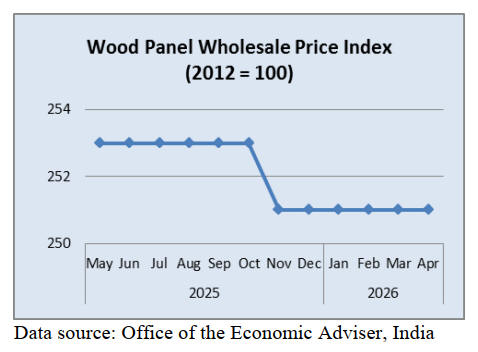
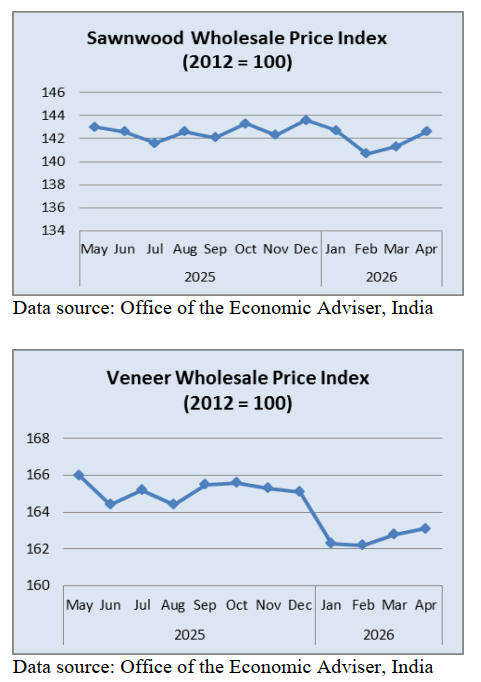
There was a sharp rise in the indices for sawnwood and
veneers in April but the index for wood panels was
unchanged.
See: https://eaindustry.nic.in/
and
chrome-
extension://efaidnbmnnnibpcajpcglclefindmkaj/https://eaindustry
.nic.in/pdf_files/cmonthly.pdf
Supply of inputs for plywood manufacturing disrupted
The plywood industry of Yamunanagar, Northern India is
grappling with rising raw material costs. Imports of
essential chemicals from Middle East have slowed and the
supply of essential inputs for plywood manufacturing have
been disrupted. Products such as formalin, phenol and
melamine have been severely affected.
The shortages are driving up prices of chemicals and other
key inputs including poplar logs. Yamunanagar district,
widely known as a hub of the plywood industry in India, is
home to about 350 plywood factories along with nearly
400 peeling units.
Anil Garg, Senior Executive Member of the Haryana
Plywood Manufacturers Association has said “the price of
the formalin is Rs33 per kg, up from Rs 18 before the
outbreak of conflict between Iran and the United States.
Phenol, which was previously available at Rs85 per kg,
has now reached to Rs160 per kg and the price of
melamine is Rs115 per kg, however, it was Rs80 per kg
before the conflict”.
The shortage of chemicals and rising costs are affecting
the livelihoods of thousands of worker families directly
and indirectly. Workers, transporters and small traders are
among those hit the hardest. The plywood industry
provides a livelihood to thousands of people.
See: https://www.tribuneindia.com/news/haryana/iran-us-
tensions-hit-yamunanagars-plywood-industry/
In related news, delining inventories and delayed
deliveries from manufacturing units have created a
shortage of plywood in Madhya Pradesh, with traders
reporting sales falling over 20% as the Middle East
conflict disrupts raw material supply chains and pushes up
prices.
Narendra Bafna, of the All Bharat Plywood and Laminate
Trade Vyapari Association, said “stocks in the market are
moving fast and it is impossible to replenish these because
shipments from manufacturers and suppliers have dried
up“.
See: https://timesofindia.indiatimes.com/city/indore/west-asia-
conflict-hits-plywood-supply-mp-sales-drop-over-
20/articleshow/129785885.cms
Forest fires across 12 States - Madhya Pradesh hit the
hardest
According to Forest Survey of India (FSI) data large fires
have burnt huge tracts of forest cover in more than 12
Indian states from Uttarakhand in the north, Gujarat in the
west to Andhra Pradesh in the south. Madhya Pradesh in
Central India is the worst-affected Sate according to the
government.
More than 634 “large fire“ events have been detected in
Madhya Pradesh, 465 each in Maharashtra and
Chhattisgarh and over 400 in Andhra Pradesh. In the
Northeast India, where forests are most fire-prone, 190
fires were reported in Assam, followed by 128 in Manipur.
See:
https://www.google.com/search?q=FSI+data%2C+at+least+10+f
orest+fires+were+detected+burning&rlz=1C1GGRV_enJP741JP
741&oq=FSI+data%2C+at+least+10+forest+fires+were+detecte
d+burning+&aqs=chrome..69i57j33i160.827j0j15&sourceid=chr
ome&ie=UTF-8
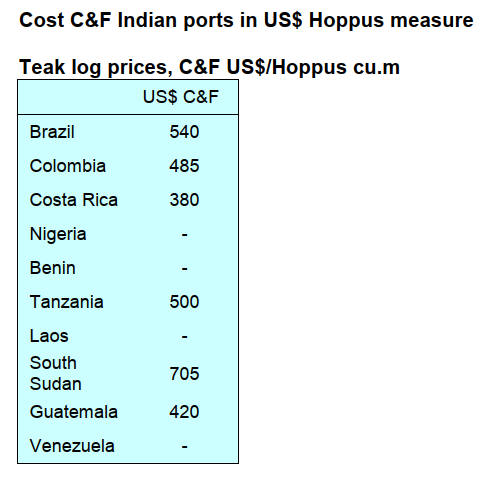
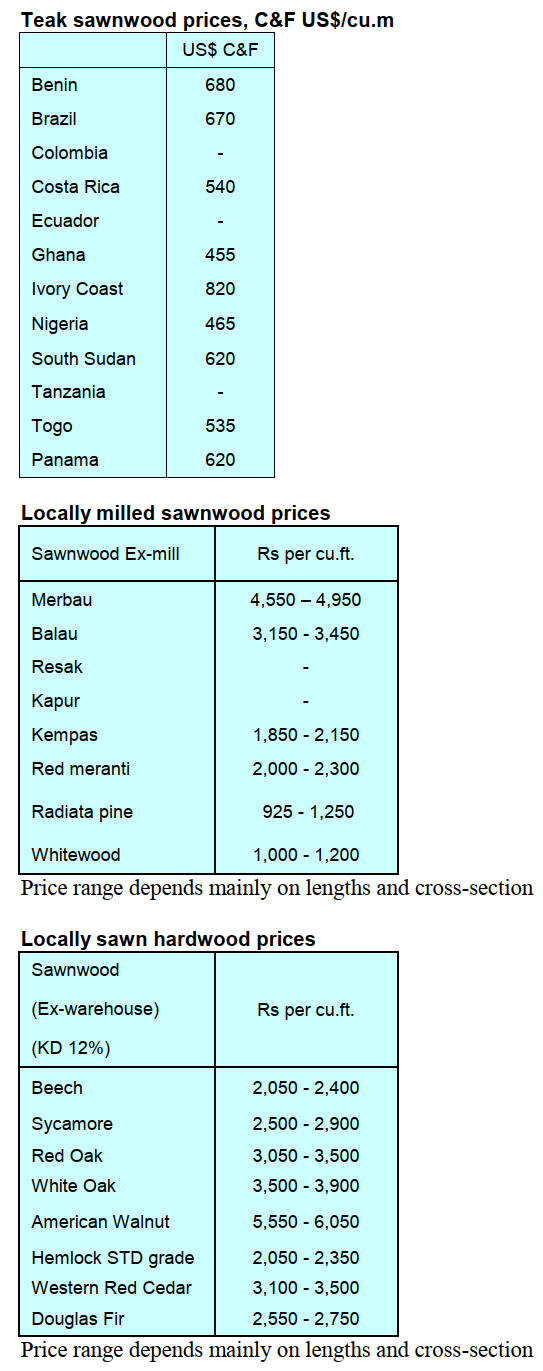
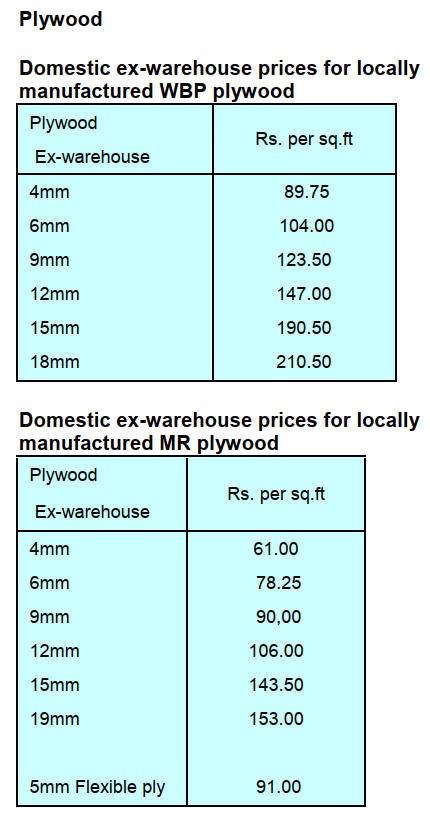
7.
VIETNAM
Wood and wood product (W&WP) trade
highlights
According to statistics from the Viet Nam Customs
Department, Viet Nam’s W&WP exports in April 2026
reached US$1.58 billion, up 12% compared to March
2026 and 8% year-on-year. Of this total WP exports
accounted for US$1.0 billion, increasing by 11% month-
on-month and 2% year-on-year.
Overall, in the first four months of 2026, Viet Nam’s
W&WP exports totalled US$5.57 billion, up 3% compared
to the same period in 2025. WP exports contributed
US$3.57 billion, down 3% year-on-year.
Viet Nam’s office furniture exports in April 2026 were
valued at US$24.7 million, up 13% from March 2026 but
down 31% compared to April 2025. In the first four
months of 2026, office furniture exports reached US$90.2
million, representing a decline of 26% year-on-year.
W&WP exports to the United Kingdom in April 2026
reached US$26.8 million, up 23% compared to April
2025. Cumulatively, in the first four months of 2026,
exports to the UK totalled US$94.3 million, an increase of
16% over the same period in 2025.
Viet Nam’s W&WP imports in April 2026 were estimated
at US$323.2 million, up 31% compared to March 2026
and 13% compared to April 2025. Overall, in the first four
months of 2026, W&WP imports reached US$1.1 billion,
up 22% year-on-year.
Viet Nam’s poplar wood imports in April 2026 amounted
to 63,000 cu.m, valued at US$23.7 million, down 3% in
volume and 8% in value compared to March 2026.
However, compared to April 2025, imports surged by
130% in volume and 93% in value. In the first four months
of 2026, total poplar imports reached 192,900 cu.m, worth
US$72.8 million, up 96% in volume and 81% in value
over the same period in 2025.
W&WP exports to Canada in April 2026 reached US$23.5
million, down 10% compared to April 2025. Nevertheless,
in the first four months of 2026, exports to the Canadian
market totalled approximately US$95 million, up 2% year-
on-year. Despite this growth, Viet Nam’s WP exports to
Canada are facing significant challenges due to a trade
protection investigation initiated in early May 2026.
Viet Nam’s oak wood imports in April 2026 totalled
45,000 cu.m, valued at US$25.4 million, down 24% in
volume and 30% in value compared to March 2026.
However, compared to April 2025, imports increased by
40% in volume and 29% in value. In the first four months
of 2026, oak wood imports reached 204,700 cu.m, worth
US$115.5 million, up 55% in volume and 45% in value
year-on-year. The notable increase in oak imports reflects
rising demand for oak raw materials used in the production
of wooden furniture for both export and domestic markets.
Exports steady even as trade defense pressures
intensify
Viet Nam’s wood product industry is navigating
significant legal and trade defense challenges in key
markets but the sector remains resilient as it has had
success with market diversification.
The United States remains Viet Nam’s largest export
market but exporters are expanding into Japan, China,
South Korea, the EU and Middle East countries. Around
45 new markets are being targeted as a buffer against US
tariffs.
Japan has shown particularly strong growth, becoming
Viet Nam’s second-largest export destination with exports
increasing by more than 23% over the past year. China
remains the third-largest market, driven by rising demand
for Vietnamese wood chips, with exports to China
increasing by around 3.5% this year. In addition exports to
Spain rose 63%, while Canada has become an important
market, especially for bedroom furniture.
Viet Nam’s hardwood and decorative plywood exports to
the United States are under severe pressure following
preliminary anti-dumping and countervailing duties the
exceeding 190% announced in March 2026.
The US Department of Commerce issued preliminary
antidumping duty rates of 196.14% on hardwood and
decorative plywood imports from Viet Nam. Chinese
hardwood plywood faces a 187.27% rate while Indonesian
exporters face rates ranging from 19.98% to 84.94%.
These duties are in addition to countervailing duties
announced in January: 4.37% to 26.75% for Viet Nam,
2.40% to 128.66% for Indonesia and a country-wide
81.34% rate for China.
The investigation scope covered hardwood and decorative
plywood, including veneered panels, furniture-grade
sheets and decorative laminates used in cabinetry, flooring
underlayment and interior fit-out. Structural plywood
products, including film-faced formwork plywood,
construction sheathing and marine-grade structural panels
are not covered under these specific orders.
To maintain timber exports to Europe, Viet Nam is
accelerating the completion of provincial forest boundary
databases and forest mapping systems to support EUDR
compliance before the end of 2026. The country is also
deploying AI, big data and cloud computing to monitor
forest changes through satellite imagery and strengthen
traceability systems.
See:
https://www.fordaq.com/news/Vietnam_wood_exports_hold_fir
m_119003.html
Impressive export growth
Over the past decades, Viet Nam has successfully built an
image as a reliable furniture “manufacturing hub” for the
world. According to Vu Ba Phu, Director of the Trade
Promotion Department (Ministry of Industry and Trade),
by 2025, the wood industry had become one of Viet
Nam’s key export sectors.
Enterprises in Ho Chi Minh City alone exported over
US$9 billion worth of furniture and related products.
Overall, the wood export sector is maintaining an upward
trend, rising from US$14.8 billion in 2021 to US$17.2
billion in 2025 and targeting US$19 billion in 2026.
The 5.7% increase in 2025 and the US$19 billion target
for 2026 reflects high expectations for the international
market, especially for high-value-added processed wood
products.
Currently, Viet Nam ranks second in the world for
furniture exports (after China), with products exported to
166 countries and territories. The US continued to be the
main market at US$9.4 billion in 2025.
However, the wood industry is also facing many
challenges. These include stringent standards on quality,
traceability and sustainable development from major
markets. Furthermore, there is pressure to accelerate the
transition to green production and reduce emissions to
adapt to the global trend of sustainable trade.
Fluctuations in tariff policies, especially in the US are
directly impacting competitiveness and increased
geopolitical risks are destabilising supply chains and
driving up logistics costs.
Vietnamese wood processing enterprises have been
proactively innovating and optimising production and
business processes; investing in advanced machinery and
technology; managing the supply chain of legally sourced
wood more strictly and promoting digital transformation in
management and trade promotion.
From September 3-5, 2026, the Viet Nam International
Sourcing 2026 (VIS) will be held at the Saigon Exhibition
and Convention Center (SECC), 799 Nguyen Van Linh
Street, Tan Phu Ward, District 7, Ho Chi Minh City, Viet
Nam.
The Fair will bring together over 600 Vietnamese
manufacturers/exporters showcasing 12,000 export-
eligible products. This is an annual fair is organised under
the direction of the Ministry of Industry and Trade
(Department of Foreign Market Development) and
implemented by a professional trade exhibition organiser
in Viet Nam.
See: https://vntradesg.org/en/vietnamese-wood-and-furniture-
exports-explode-with-impressive-growth/
Wood chip groups expanding activities
Viet Nam’s wood chip industry sees opportunities in
China’s recovering demand and in developing
opportunities in Indonesia as a new market. Thang Van
Hoa, chairman of the Viet Nam Wood Chips Branch under
the Viet Nam Timber and Forest Product Association, said
that recent declines in wood chip prices had adversely
affected businesses, rural raw material suppliers and
traders.
The woodchip processing and exporting industry has
become an essential component of Viet Nam’s wood
industry. The annual export volume is about 12 million
tonnes, equivalent to 24 million cu.m of raw input logs.
Currently, chip prices have been easing, to an average of
US$162.90 per tonne. According to an August report
released by the Research Group of Wood Associations and
Forest Trends, the export price of Viet Nam’s wood chips
remained stable in the 2013-2021 period and the FOB
export price averaged about US$130-140 per tonne. In
2022, the price surged 40% to an average of US$176 per
tonne due to rising global demand, especially in China.
It is projected that China is likely to be the key export
market for Viet Nam’s wood chip industry in the future.
The report indicates that China accounts for at least 60%
of Viet Nam’s wood chip exports. Viet Nam’s wood chip
exported to China are rebounding in terms of quantity and
export value.
There are signs of a strong demand for wood chips in
China as input materials for papermaking. This presents a
great opportunity for Viet Nam’s wood chip enterprises,
according to Kim Anh, a Senior Analyst at Forest Trends.
Enterprises are not only focus on the traditional markets
but are also venturing into new ones, with Viet Nam
recording a surge in wood chip exports to Indonesia. At
the same time, Taiwan P.o.C also imported a large amount
of wood chips from Viet Nam.
The Research Group of Wood Associations and Forest
Trends suggests competition will become fiercer for log
raw material used in wood chip production. The
competition is not only between wood chip enterprises but
also between wood chip enterprises and enterprises using
the same input materials. The report authors recommend
detailed study of the competing demands in order to
balance and stabilise the source of input materials
See: https://fwpa.com.au/news/asia-region-hardwood-woodchip-
trade-update/
8. BRAZIL
New regulation provides increased
efficiency and
security
The new law, No. 843/2026, is said to modernise the
legislation applicable to the forest-based sector providing
opportunities for greater efficiency, legal security and
transparency in the processes of inspection, control and
commercialisation of forest products in the State of Mato
Grosso.
The Regulation establishes clearer and more objective
criteria for the inspection of forest products, particularly in
interstate transportation, which includes random
inspection based on risk analysis and enforcement
intelligence. This approach allows inspection efforts to be
primarily directed toward operations showing indications
of irregularities.
The legislation also provides for the issuance of technical
reports in cases involving significant discrepancies and
establishes specific administrative procedures for the
verification of divergences related to forest species thereby
reinforcing the technical rigor of inspection activities.
According to the Center of Timber Producing and
Exporting Industries of the State of Mato Grosso
(CIPEM), the new regulation represents a balanced
approach between environmental control and sustainable
development with greater predictability and security for
companies operating in compliance with the law.
CIPEM also emphasised that updating the legislation was
an important effort to make procedures more efficient,
more technical and better aligned with operational reality
of forest-based industries.
Currently, the forest-based sector is one of the main
industrial sectors in Mato Grosso bringing together more
than 1,300 establishments, generating over 10,000 direct
jobs and contributing to the maintenance of more than 5
million hectares of natural forest under sustainable forest
management.
See: https://cipem.org.br/lei-complementar-traz-mais-eficiencia-
e-seguranca-para-o-setor-de-base-florestal/
Eucalyptus cultivation – a challenge in Mato Grosso
The State of Mato Grosso has potential for reforestation
and for reducing pressure on its native forests. Although
crop land and pastures predominate, commercial tree
plantations have been expanding gradually.
Eucalyptus cultivation, once limited by low demand has
become promising with the installation of corn ethanol
plants that use eucalyptus as biomass. Projections indicate
that the State could achieve up to 500,000 hectares of
planted eucalyptus over the next ten years which could
also strengthen integrated crop-livestock-forestry – ICLF
(integração lavoura-pecuária-floresta - ILPF) systems
aimed at biomass production.
Despite the sector’s expansion, producers face challenges
related to cultivation on sandy soils and in areas with
water constraints which reduces the productivity of
commercial clones currently used.
In response, Embrapa and the Mato Grosso State
Reforestation Association (AREFLORESTA) are
undertaking research on clones adapted to the State´s
conditions. The research project plans to undertake clonal
tests (Testes Clonais Ampliados - TCA’s) in seven regions
of Mato Grosso.
The objective is to identify genetic materials that are more
productive and suitable for energy use. In addition to
supporting the expansion of commercial reforestation and
meeting growing agro-industrial demand the initiative
seeks to strengthen genetic improvement programmes,
offer technical capacity building and the establishment of
a forest research programme in Mato Grosso.
See: https://maisfloresta.com.br/plantio-e-validacao-de-clones-
favorecem-sistemas-de-integracao-lavoura-pecuaria-floresta/
Export up-date
In April 2026 exports of wood-based products (except
pulp and paper) decreased 1.8% in value compared to
April 2025 from US$318.0 million to US$312.3 million.
Pine sawnwood exports increased 28% in value between
April 2025 (US$58.0 million) and April 2026 (US$74.0
million). In volume, exports increased 30% over the same
period, from 247,600 cu.m to 320,600 cu.m.
Tropical sawnwood exports decreased 12% in volume,
from 33,700 cu.m in April 2025 to 29,600 cu.m in April
2026. In value, exports increased 11% from US$12.0
million to US$13.3 million over the same period.
Pine plywood exports decreased 17% in value in April
2026 compared to April 2025, from US$83.0 million to
US$69.2 million. In volume, exports decreased 11% over
the same period, from 259,600 cu.m to 231,600 cu.m.
Tropical plywood exports increased 59% in volume, from
3,200 cu.m in April 2025 to 5,100 cu.m in April 2026. In
value, exports increased 71% from US$1.7 million in
April 2025 to US$2.9 million in April 2026.
As for wooden furniture, exports increased 1.8% in value,
from US$48.7 million in April 2025 to US$49.6 million in
April 2026.
Expanding sustainable forest management
The United Nations´ Global Forest Goals Report 2026
shows the world´s forest area declined by more than 40
million hectares between 2015 and 2025 highlighting
continued pressure on forest ecosystems. Although some
countries are strengthening forest protection policies,
financing for sustainable forest management remains far
below estimated needs.
In contrast, Brazil showed significant expansion in
sustainable forest management. Between 2020 and 2025
the country increased areas under federal forest
concessions from 1.05 million to 1.59 million hectares and
expanded the area of forests under long-term management
plans. This advance resulted in the production of more
than 2.15 million cubic metres of traceable timber,
generating over US$41.6 million in revenues.
The initiative, coordinated by the Brazilian Forest Service
in partnership with the Chico Mendes Institute for
Biodiversity Conservation, seeks to reconcile sustainable
use of natural resources, biodiversity conservation and
benefits to local communities.
The report also highlights the Tropical Forests Forever
Fund (TFF) proposed by the government of Brazil, with
the potential to mobilise US$125 billion to finance tropical
forest protection in more than 70 countries.
See:: https://news.un.org/pt/story/2026/05/1853099
Woodflow debate – globalisation increases exposure
of companies to external forces
Brazilian exports of timber products fell by approximately
30% in the first four months of 2026 totalling around
US$770 million compared to roughly US$1 billion in the
same period of 2025. The data from ComexStat and
compiled by STCP reflects an unstable external
environment marked by tariff changes in the United States,
geopolitical tensions, rising logistics costs and fluctuations
in global demand.
Despite the accumulated decline for the year to April there
were signs of recovery in some segments in April
especially pine sawnwood and plywood which recorded
more significant increases in both exported volume and
value compared with March.
Nevertheless, the sector remains in an adjustment phase,
influenced by inventory buildup in the US market ahead of
new tariffs, rising production costs and the slowdown in
the US construction sector.
During a debate promoted by “WoodFlow”, specialists
emphasised that globalisation expands the timber sector’s
access to international markets but also increases exposure
of companies to external economic and geopolitical forces.
Participants noted that strengthened protectionist policies
in the United States tend to generate greater instability for
exporters and requires constant monitoring of economic,
political and geopolitical developments that directly affect
international trade.
At the end of the debate, speakers stressed that uncertainty
is unlikely to dissipate in the short term, reinforcing the
importance of diversifying market and products as a
strategy to reduce vulnerabilities and maintain the
international competitiveness of the Brazil´s timber sector.
See: https://www.woodflow.com.br/blog/comercio-global-exige-
estrategia-do-setor-madeireiro
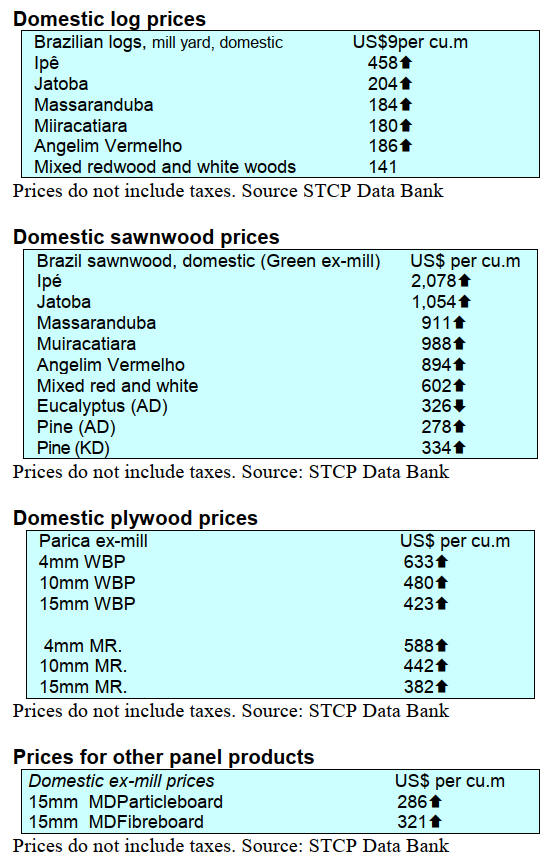
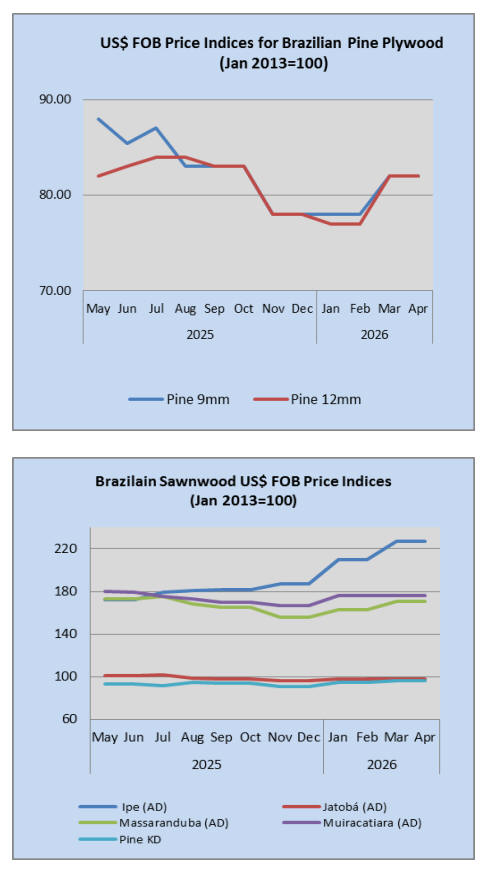
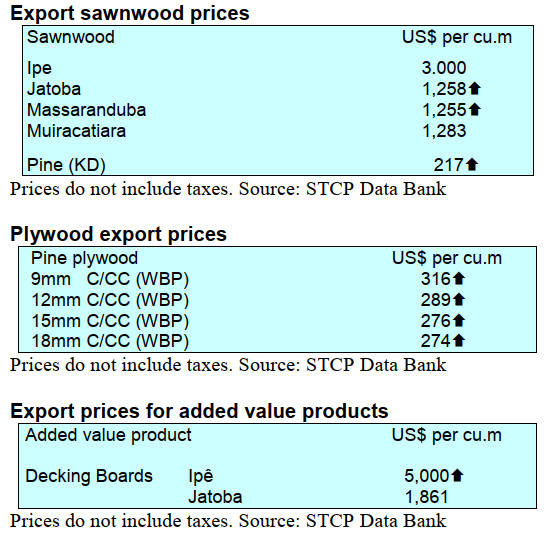
Export prices
Average FOB prices Belém/PA, Paranaguá/PR,
Navegantes/SC and Itajaí/SC Ports.
Through the eyes of industry
The latest GTI report lists the challenges identified by the
private sector in Brazil.
See: chrome-
extension://efaidnbmnnnibpcajpcglclefindmkaj/https://www.itto-
ggsc.org/static/upload/file/20260515/1778810654194472.pdf
9. PERU
Increase in March exports
March 2026 timber exports reached a FOB value of
US$17.4 million, an increase compared to the US$14.2
million achieved in the same period of 2025. This increase
represented a positive rise of almost 23% as reported by
the Center for Research on Global Economics and
Business of the Association of Exporters (CIEN-ADEX).
The products exported were semi-finished goods (US$7.5
million), sawnwood (US$5.9 million), furniture and
furniture parts (US$1.2 million), fuelwood and charcoal
(US$1.0 million) and construction materials
(US$735,000).
The leading destination was France, with exports totalling
US$3.6 million. The United States followed with US$2.5
million, then the Dominican Republic with US$2.3
million, then China with US$2.2 million and finally
Vietnam with US$1.3 million completing the top five
markets.
Exports of semi-manufactured products increased
According to information provided by the Services and
Extractive Industries Management of the Association of
Exporters (ADEX), in March 2026 exports of semi-
manufactured products reached a value of US$7.5 million
FOB, representing a year on year of over 200%.
France was the main importer, accounting for 44% of
exports and the value of March exports were about 3 times
higher compared to the same period in 2025. Denmark
ranked second with a 12% share.
Belgium was the third largest market destination with an
11% share and a year on year doubling of the value of
exports. The United States occupied fourth position with
an 9% share and Mexico accounted for a 4% share of
exports of semi-manufactured products.
SERFOR strengthens forestry competitiveness in
Madre de Dios
The National Forestry and Wildlife Service (SERFOR)
held a working meeting with the Supervisory Agency for
Forest Resources and Wildlife (OSINFOR) where they
agreed to promote a strategic agenda to strengthen
governance, traceability and legal security in the forestry
sector in coordination with the Regional Forestry and
Wildlife Management Office (GERFOR) of Madre de
Dios.
In this context, they agreed to promote the Forest
Concessions 2.0 model through the updating and approval
of the Tahuamanu Forestry Master Plan, as well as to
consolidate the management of forest concessions, the
geospatial traceability of permits and the coordinated
monitoring of renewal processes and registration with the
National Superintendency of Public Registries
(SUNARP).
Likewise, priority will be given to actions related to the
status of Forest Concessions as well as to strengthening
territorial information, contributing to providing greater
predictability, stability and operational continuity to
sustainable forest management.
|