Japan
Wood Products Prices
Dollar Exchange Rates of 10th
May
2026
Japan Yen 157.22
Reports From Japan
Conflict driven inflation impacting Japan faster than
previous oil shocks
The effects of higher crude oil and petrochemical prices
are flowing downstream faster than ever in Japan. As of
May 2026 high crude oil and petrochemical prices, driven
by Middle East tensions are rapidly accelerating
inflation in Japan. This surge is causing widespread
increases in gasoline, electricity and consumer goods such
as food and plastics squeezing households and putting
pressure on manufacturing, with potential to trigger an
economic recession.
March core inflation (i.e. excluding food) accelerated for
the first time in five months, rising to 1.8% as the Middle
East conflicts continues to disrupt oil supply lines and
energy prices. The government intends to take steps to
cushion the economic blow from rising fuel costs,
including curbing gasoline prices.
See: https://www3.nhk.or.jp/nhkworld/en/news/20260309_21/
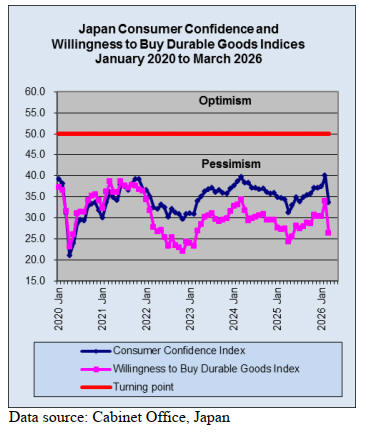
Deep-seated consumer caution and weak domestic
demand
Japanese households cut spending for a third consecutive
month in February 2026, falling 1.8% year-on-year despite
rising real wages, reflecting deep-seated consumer caution
and weak domestic demand. While nominal wages have
improved, high inflation has kept real income gains
minimal, leaving households cautious.
Driven by rising food prices and economic anxiety,
families are prioritising essentials and cutting back on
discretionary items like home furnishings, clothing and
leisure activities. The prolonged slump in consumption is
making it difficult for the government to boost the
economy, particularly with rising costs linked to
geopolitical tensions, according to reports in the Japan
Times.
See:
https://www.japantimes.co.jp/business/2026/04/07/economy/hou
sehold-spending-february-decline/
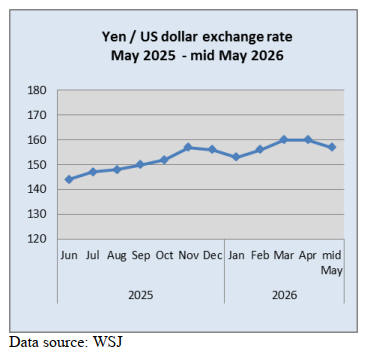
Intervention to support the yen
Japan intervened in currency markets to support the yen
against the US dollar in early May, its first currency action
in nearly two years. It has been reported that around
US$34 billion was injected to drive the yen higher. The
move by Japan came as the yen dropped to 160 to the US
dollar. The yen buying by Japan lifted the yen to 155 to
the US dollar.
Japan it appears is determined to stop the yen’s slide as, if
left unattended, the Japanese currency could fall to levels
that would have massive repercussions for everyday life.
A weak yen and soaring crude oil prices reflecting
unresolved tensions in the Middle East could deliver a
devastating blow to households and smaller companies
through spikes in prices of many products in the country.
Many analysts believe that the impact of the latest
intervention will not last long because there is no change
in the underlying factors that contribute to a weaker yen,
such as safe-haven dollar buying ignited by the Middle
East crisis and the interest rate gap between Japan and the
United States.
With the latest intervention, the Ministry of Finance has
signaled its aim for the yen exchange rate giving
encouragement to the BoJ to reinforce the yen's stability
with an interest rate increase in June.
See:
https://www.japantimes.co.jp/business/2026/05/02/markets/japan
-yen-intervention-focus/
Severe shortages of building materials
Currently, Japan is facing significant construction delays
and surging costs due to a shortage of petrochemical-based
building materials like plastic foam and adhesives
according to a domestic Association. Japan is facing
severe shortages and skyrocketing prices of materials,
particularly naphtha-derived thinners, according to the
sector Association.Describing the current state as
“critical”, the Association warned that a prolonged
disruption of raw material supplies could lead to
significant delays in housing construction and
infrastructure maintenance.
The government has said that while the domestic supply of
naphtha and thinner appears sufficient, bottlenecks are
occurring during distribution.
The housing industry is already seeing disruptions. Toto
Ltd. has suspended its acceptance of new orders for
modular bathrooms while Lixil Corp. said it began
informing customers that delivery dates for certain
products are “undetermined”.
See:
https://japannews.yomiuri.co.jp/business/economy/20260415-
322299/
Japanese group launches online timber market
A Japanese group of forestry organisations has launched
an online timber marketplace to match forest owners in
japan with buyers nationwide. Standing timber is typically
traded through negotiations. In such deals, individuals who
own forests and small forestry cooperatives often have to
sell at depressed prices offered by companies with large
financing resources.
The new platform was set up by the Tokyo-based group
for promoting the use of domestic timber and protecting
forests. It makes it easier for both sellers and buyers to
find transaction partners from around Japan. Organisers
expect that transaction data accumulated on the site will
facilitate the formation of market prices by conditions
such as the tree species, volume and location.
See: https://www.japantimes.co.jp/business/2026/05/10/japan-
online-timber-market/
Furniture sector facing challenges as households limit
discretionary spending
According to IMARC Group's latest research publication
the Japanese furniture market reached US$23.2 billion in
2025 but the sector is facing challenges as households
limit discretionary spending. The Japanese government is
driving furniture industry transformation through strategic
policies focused on sustainability and domestic resource
utilisation.
The Forestry Agency's subsidies cover up to 50% of
processing equipment costs for firms switching from
imports to domestic timber, targeting Japan's forests that
account for roughly 70% of land area yet maintain
utilisation rates below 35%.
The Revised Clean Wood Act, implemented in April 2025,
mandates legality due diligence for importers and
upstream wood-related businesses, strengthening supply
chain transparency for timber and furniture. Government
initiatives promoting wooden structures in public
buildings and Green Purchasing Act requirements for
government procurement are reshaping material sourcing.
Combined with tax incentives for regional revitalisation
and support for young families relocating outside major
cities, these policies could help modernising Japan's
furniture sector while advancing sustainability goals and
domestic manufacturing competitiveness.
The report adds, “e-commerce adoption is fundamentally
changing how Japanese consumers discover and purchase
furniture. Online channels currently capture approximately
25-30% of the market and are expanding rapidly,
particularly among tech-savvy millennials and working
professionals facing time constraints. Major companies
have online stores that integrate augmented reality
visualisation, virtual room planners and customer reviews
to address the traditional hesitation around buying
furniture sight-unseen”.
See: https://vocal.media/futurism/japan-furniture-market-
outlook-growth-drivers-consumer-trends-and-future-
opportunities
Import update – wooden furniture and parts
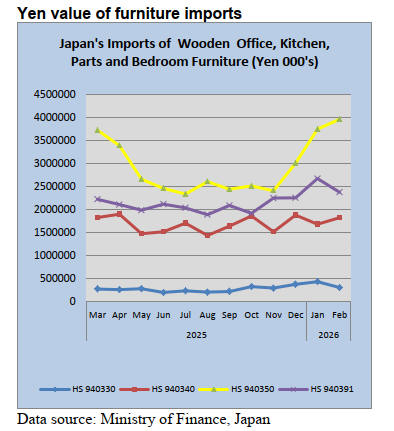
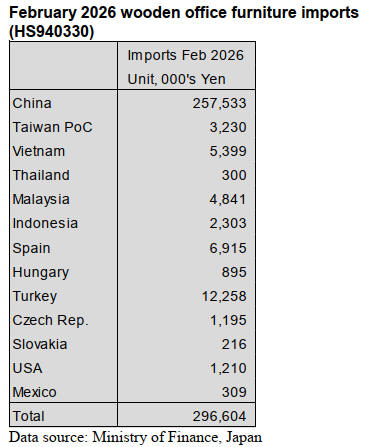
February 2026 wooden office furniture imports
(HS940330)
The top suppliers of wooden office furniture (HS940330)
in February 2026 were China, accounting for 86% of
imports followed by Turkey at 4% (2.5% in January) and
Spain at (2%). The top three shippers accounted for over
90% of Japan’s February 2026 imports of wooden office
furniture.
The value of February 2026 imports of HS940330 was
down 30% from January but sharply higher (45%) than in
February 2025. The value of February imports from Spain
was around four times higher than in January. Viet Nam
posted a slight gain in February compared to a month
earlier.
The combined value of shipments from Malaysia and
Indonesia in February was below that in the previous
month reflecting the impact on output and trade of the
Spring Festival in both countries.
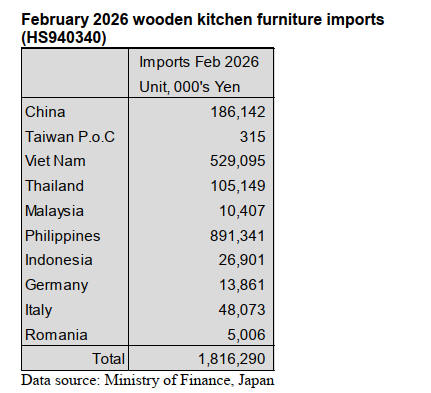
February 2026 wooden kitchen furniture imports
(HS940340)
In February 2026, the top two shippers of wooden kitchen
furniture (HS940340) were the Philippines and Viet Nam.
These two countries accounted for around 80% of Japan’s
imports of wooden kitchen furniture in February.
The value of shipments from the Philippines was the
highest, accounting for 49% of the total value of
shipments of wooden kitchen furniture.
The other main supplier, Viet Nam, accounted for 29% of
February imports. The value of February shipments from
the Philippines was up 10% month on month, there was a
13% increase in shipments from Viet Nam and a 27%
increase in shipments from China, the third largest
supplier.
Year on year the value of February wooden kitchen
furniture imports was up13% and compared to January the
value of imports was higher by 8%.
February 2026 wooden bedroom furniture imports
(HS940350)
The upward trend in the value of wooden bedroom
furniture (HS9403550) which began at the end of 2025
continued through January and February 2026. Just three
countries accounted for 97% of the value of HS940350
imports in February, China, 58% (61% in January), Viet
Nam 36% (28% in January) and Malaysia 3% (5% in
January).
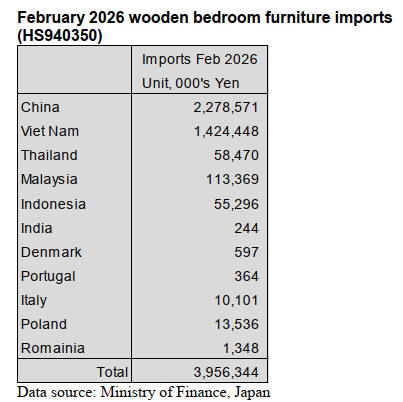
The value of February shipments from Vietnam was
sharply up compared to a month earlier (+35%) while
shipments from Malaysia were down (35%). Shipments to
Japan from China were at around the same level as in
January. The other significant suppliers of wooden
bedroom furniture to Japan in February were Thailand and
Indonesia.
Year on year there was a 43% rise in the value of February
imports with the value of February arrivals being just 6%
up on January.
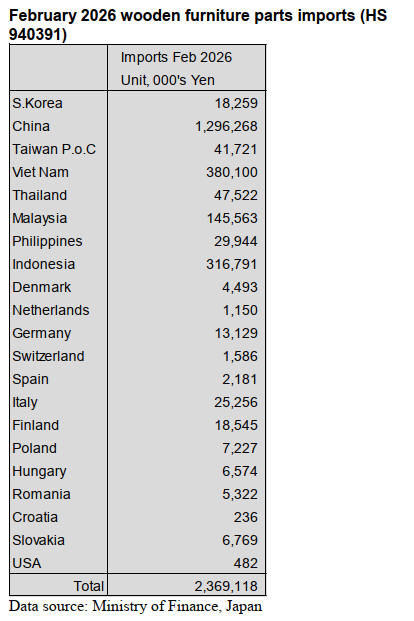
February 2026 wooden furniture parts imports
(HS940391)
Shippers in China and three SE Asian countries, Viet
Nam, Indonesia and Malaysia accounted for 90% of
Japan’s imports of wooden furniture parts (HS940391) in
February 2016.
The main shipper of wooden furniture parts in January was
China at 55% (56% in Jan.) followed by Viet Nam 16%
(12% in Jan.) Indonesia 13% (17% in Jan.) and Malaysia
6% (5% in Jan.). Of the non-Asian suppliers arrivals of
wooden furniture parts from Italy and Finland were
notable.
The value of arrivals of HS940391 in February was 11%
higher than in January 2026 and 16% higher than in
February 2025.
Trade news from the Japan Lumber Reports (JLR)
The Japan Lumber Reports (JLR), a subscription trade
journal published every two weeks in English, is
generously allowing the ITTO Tropical Timber Market
Report to reproduce news on the Japanese market
precisely as it appears in the JLR. For the JLR report
please see: https://jfpj.jp/japan_lumber_reports/
North American logs
The de facto closure of the Strait of Hormuz, combined
with a weakening yen, is driving up import costs for U.S.
Douglas-fir logs.
Against this backdrop, China Timber raised prices for dry
beams and other wood products by ¥5,000 per m³ starting
on the 6th. The company had already increased prices for
dry beams in March, marking two consecutive monthly
hikes.
Domestic producers of Douglas-fir lumber have struggled
with rising procurement costs since last year due to
inflation and the weaker yen. Although weak demand had
prevented them from raising prices earlier, they are now
being forced to pass on not only previous cost increases
but also the latest surge in crude oil prices, prompting
accelerated price hikes.
European R-wood glulam beams, which compete directly
with U.S. KD Douglas-fir square beams, are also on an
upward price trend, further supporting the move toward
higher prices. If crude oil prices climb further, cost
pressures will extend beyond shipping to every stage of
the supply chain from log producers to sawmills through
higher fuel and logistics expenses. Additional price
increases may become unavoidable.
Meanwhile, domestic demand remains uncertain at the
start of the fiscal year. With rising living costs expected to
dampen home-buying sentiment, concerns over the
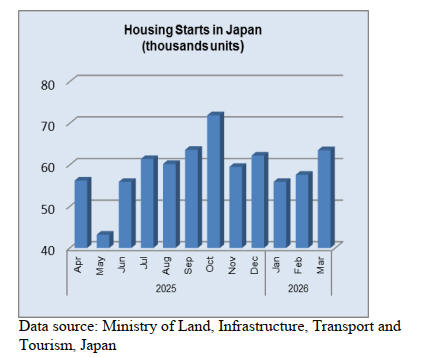
outlook for the housing market are deepening.
Radiata pine logs and lumber
Rising tensions in the Middle East have strengthened
bullish sentiment for wood-based packaging materials.
Chilean radiata pine lumber prices held steady for the
second shipment at US$340 per m³ (C&F), but strong
expectations of further increases pushed sales about 7%
higher than the first shipment. A weaker yen and rising
freight costs mean the third shipment will almost
certainly be more expensive, likely lifting domestic selling
prices around July.
New Zealand radiata pine log prices have also climbed,
mainly due to higher freight charges. In response, the
Japan–New Zealand Sawn Timber Council announced a
¥5,000 per m³ price increase for June orders, bringing
square-cut timber to around ¥69,000 per m³. Some
suppliers had already raised prices earlier.
Producers in New Zealand are limiting harvesting as
soaring diesel prices squeeze margins, raising concerns
about future supply. Vietnamese plywood and LVL are
also expected to rise from May shipments, with adhesive
shortages already causing procurement difficulties and
delivery delays.
South Sea logs and products
Hardwood product trading remains sluggish, with limited
movement in items like tropical hardwood decking and
weak demand across most categories. Buyers continue
relying on existing inventories keeping new orders
minimal and transaction volumes subdued.
Although some suppliers have announced price increases,
the thin level of trading has prevented these adjustments
from influencing domestic prices, and market sentiment
remains cautious across the sector as participants wait for
clearer signs of recovery.
Rising crude oil prices and the risk of petrochemical
supply disruptions after the closure of the Strait of Hormuz
are pushing up logistics costs, especially fuel surcharges,
adding uncertainty to future contract levels and
procurement planning.
Bulk carriers transporting tropical hardwood logs are
expected to feel the impact more acutely, and gasoline
prices in Southeast Asia have already surged, increasing
cost pressures on producers. While production has not yet
been significantly affected, a prolonged situation could
eventually create broader supply strains and affect overall
availability as the market moves into the coming months.
|


