|
Report from
North America
US tropical hardwood imports trended down in early
2026
US imports of tropical hardwood and related products
cooled significantly in the first two months of the year.
Data for January and February show an across-the-board
decline in imports ranging from plywood to furniture and
flooring.
Wooden furniture imports have continued to slide, down
28% in the first two months of the year versus 2025, with
monthly totals falling to less than half those seen during
their peak in 2022. The US is also importing less of
several other products in early 2026.
Imports of hardwood flooring are down 25%, assembled
flooring panels are off 17%, moulding imports are down
16% and imports of hardwood plywood have fallen 20%.
Even in categories where year-to-year comparisons are
favorable, imports are trending downward. For example,
imports of sawn tropical hardwood are up 2% over 2025
so far this year, but month on month imports fell 20% in
January and by another 14% in February.
Figures for both January and February were released in
recent weeks as key US government agencies caught up to
their regular reporting schedules following last autumn’s
43-day government shutdown.
Hardwood plywood imports down in early 2026
After soaring 19% in 2025, US imports of hardwood
plywood have failed to keep pace in the first two months
of 2026. Despite a 10% month on month rise in
Januarythe monthly volume did not meet last year’s pace
and was down 5% from January 2025.
In February, imports fell to 176,629 cubic metres, down
22% from January and 34% below that of the previous
February. Imports from China continued to decline, down
60% for the first two months of the year. Imports from
Viet Nam (down 41%) and Indonesia (down 33%) are also
sluggish.
Although February imports fell from all top suppliers,
strong January imports kept volume from Malaysia on a
pace more than double that of last year. Through February,
total import volume for 2026 is down 20% versus last
year.
Sawn tropical hardwood imports cool
For the first two months of 2026 US imports of sawn
tropical hardwood have also cooled from the strong
growth shown last year. Month on month, imports fell
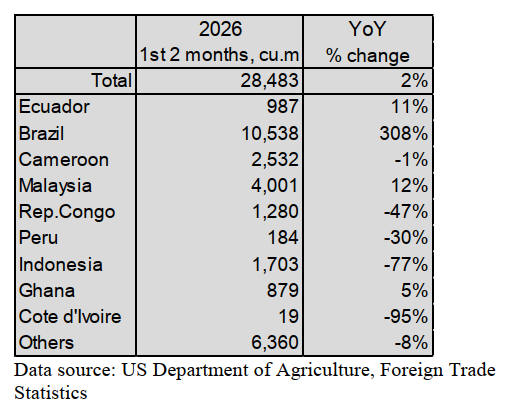
20% in January and another 14% in February. At 13,170
cubic metres February volume was 6% less than that of the
previous February.
Early year imports have been especially sluggish from
Indonesia (down 77% from 2025 through February),
Republic of Congo (down 47%) and Peru (down 30%).
Although imports have fallen from the levels seen in late
2025 volume for the year is up 2% over 2025 through
February.
In Canada imports have fallen at a faster rate than in the
US. February imports were down 25% from the previous
month and 33% versus February 2025. For the first two
months of the year, imports are off by 25% versus 2025.
Veneer imports fall
US imports of tropical hardwood veneer fell 15% in
January and by an additional 34% in February as the surge
seen at the end of 2025 has apparently come to a halt.
Imports, which were well above US$3 million in
November and December, fell below the US$3 million
mark in January and below US$2 million in February.
Imports from the top-supplier, Cameroon, fell 68% in
February while imports from India declined 59%.
Despite not meeting December’s level, January imports
were 52% higher better than the previous January while
February saw imports 34% below those of February 2025.
Together, that puts 2026 imports up 15% from last year
through the first two months of the year.
Moulding imports plunged in January, continue down
in February
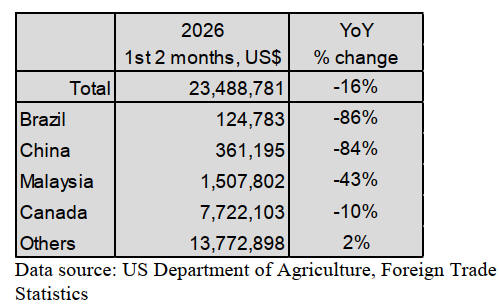
US imports of hardwood moulding slid an additional 5%
in February after falling 23% in January. Imports from
Brazil and China were both down more than 80% through
the first two months of the year while imports from
Malaysia were off by 43%.
Imports from the top-supplier, Canada, rose 20% in
February to help mitigate other losses. Despite the rise,
imports from Canada were down 10% for the year so far.
Through February, total imports of hardwood moulding
were down 16% versus last year.
After a January jump, hardwood flooring and flooring
panel imports dive
US imports of hardwood flooring showed a slight rise in
January, gaining 7% from the previous month. However,
despite the gain, imports for the month were 19% below
that of a strong January 2025 posting.
Then, in February imports dove 36% as shipments from
Malaysia, which had been skyrocketing over the past year,
dropped by 64%. At just above US$3.13 million, imports
for February were the lowest since April 2017. For the
year so far, imports of hardwood flooring were down 25%
versus last year.
Imports of assembled flooring panels followed a similar
pattern. January imports rose 21% only to drop by 29% in
February. February imports were 26% less than those of
February 2025 and imports for the first two months of the
year lagged last year by 17%.
Notably, imports from China were down 86% so far this
year while imports from Indonesia were down 75%.
Imports from Thailand were up 47% for the year so far
despite falling by nearly half in February.
Wooden furniture imports sink
US imports of wooden furniture continued to decline in
early 2026, as month on month imports fell 11% in
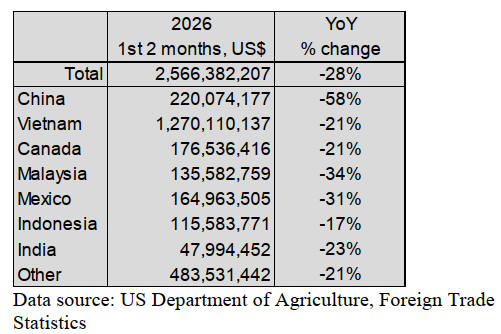
January and another 14% in February. At US$1.84
billion, February imports were at their lowest level since
June 2020.
For the first two months of the year imports from China
were down 58% while imports from Viet Nam and Canada
declined by 21%. Through February, wooden furniture
imports were US$2.57 billion, down 28% from US$3.55
billion in the same period in 2025.
For the US furniture market as a whole, January new
orders were up 1% over the previous month and flat versus
January 2025 according to the March edition of Furniture
Insights.
"Overall, January 2026 didn’t provide the sort of hot start
we were hoping for from our survey participants as a
whole," said Mark Laferriere, assurance partner at Smith
Leonard, the accounting and consulting firm that produces
the monthly report. "Hampered by weather and other
challenges to start the year, new orders were flat and
shipments were down 7% compared to 2025,
respectively."
See:https://www.smith-leonard.com/2026/04/07/march-2026-
furniture-insights/
and
https://www.woodworkingnetwork.com/furniture/residential-
furniture-orders-edge-1-january
Optimism prevails at IWPA's 70th World of Wood
Convention
The International Wood Products Association (IWPA)
celebrated its 70th World of Wood Convention, March
17–19 in Colorado. More than 200 attendees gathered for
three days of industry insights, networking and
collaboration, reinforcing the convention’s role as a
cornerstone event for the global wood products sector.
“This year’s World of Wood Convention showcased both
the resilience and unity of our industry,” said IWPA
Executive Director, Ashley Amidon. “While there is
understandable concern around economic uncertainty and
evolving tariff policies what stood out most was the strong
sense of camaraderie and shared mission among our
members.”
Tariffs and broader economic conditions were central
themes throughout the convention as attendees engaged in
candid discussions about trade policy and the outlook for
global markets. Despite some apprehension, participants
expressed optimism rooted in the strength of industry
relationships and IWPA’s leadership.
The agenda featured sessions on trade policy and tariffs,
regulatory compliance, global market trends and supply
chain dynamics alongside discussions on leadership and
organisational resilience in a period of economic
uncertainty.
See:
https://www.woodworkingnetwork.com/news/woodworking-
industry-news/optimism-prevails-iwpas-70th-world-wood-
convention-despite-trade
The rise of high-performance engineered wood
The landscape of the United States wood products industry
in 2026 is being shaped by evolution from commodity
lumber toward high-performance engineered wood
systems, writes Felipe Martinez, expert contributor on the
mining and construction industries for Mexico Business
News.
In a recent article, Martinez assessed the trend toward
engineered wood writing:
For decades, the industry was a reactive participant in the
boom-and-bust cycles of the domestic housing market, but
the current industrial era is marked by a sophisticated
diversification of end-use applications. As we move
through 2026, the supply and demand dynamics of
engineered wood products and mass timber are being
shaped by a tightening of domestic production capacity
and a simultaneous surge in institutional demand for
prefabricated construction. While traditional sawmills
have faced a turbulent consolidation period, the
emergence of mass timber, specifically glulam and cross
laminated timber, have created a high-growth sector that
is increasingly more independent from the traditional
volatility of the single-family residential market.
The demand for mass timber products like glulam and
cross laminated timber continues to grow within the
broader wood market, maintaining a double-digit annual
growth rate. As of early 2026, there are still thousands of
engineered wood and mass timber projects either
completed or in progress across the United States.
Looking ahead to 2027 and beyond, the market is
preparing for a reacceleration phase. As new mills come
online, the industry is poised to move engineered wood
products and mass timber from a niche specialty to a
standard building practice.
The core business challenge for the next 24 months will
be the development of a more robust domestic supply
chain that can support American builders amid logistics
disruptions. As manufacturing capacity aligns with the
thousands of projects in the United States design pipeline,
the 2026 wood products industry is proving that its future
lies in being a high-tech, precision-manufacturing sector
rather than a harvester of raw materials.
For the complete article see:
https://mexicobusiness.news/infrastructure/news/us-wood-
industry-rise-high-performance-engineered-wood
Court of International Trade amends order to expand
tariff refunds eligibility
The US Court of International Trade (CIT) amended an
order directing US Customs and Border Protection (CBP)
to expand refunds of invalid IEEPA tariffs to include not
just unliquidated, but also some liquidated and previously
excluded "finally liquidated" entries.
On March 27, Senior Judge Richard Eaton of the US Court
of International Trade issued an order in Atmus Filtration
Inc. v. United States, updating his March 20 order
regarding refunds of duties paid under the International
Emergency Economic Powers Act.
"Judge Eaton’s latest order thus clarifies that all entries
subject to IEEPA duties are entitled to refunds," the
analysts wrote on the firm's SmarTrade news and analysis
site. "Previously, Judge Eaton’s March 20, 2026 order
indicated that only “unliquidated entries” and “liquidated
entries for which liquidation is not final” would qualify for
refunds.
Although the March 27 order explains that all entries are
eligible for refunds, it remains suspended “to the extent
that it requires immediate compliance,” meaning refunds
will not be provided for now.
Peter Theran, CEO of the Home Furnishings Association
(HFA), added that this is a positive development for
importers, including furniture retailers.
See:
https://www.woodworkingnetwork.com/news/woodworking-
industry-news/court-international-trade-amends-order-expand-
tariff-refunds
|


