|
1.
CENTRAL AND WEST AFRICA
Sector continues to operate in a cautious environment
Market conditions remain largely unchanged with limited
new developments across the region. Activity levels are
steady but subdued and there are no major shifts in
demand or pricing trends. The sector continues to operate
in a cautious environment, with most developments linked
more to political and economic conditions than to market
fundamentals.
Large-scale infrastructure plans remain a key theme across
the region, including road construction, housing
developments, rail projects and healthcare investments.
However, a common issue persists, a lack of funding.
In Gabon, major office construction projects are
underway, including high-rise developments. At the same
time, infrastructure challenges remain significant. Parts of
the national road network are still in poor condition and
the withdrawal of an Indian contractor has further delayed
improvements.
The supply of electricity continues to be a major issue.
Cameroon is experiencing nearly daily power cuts, a result
of aging infrastructure and insufficient investment in
maintenance and upgrades. Similar challenges remain in
other countries across the region, affecting both industrial
operations and general economic activity.
Recent elections in the region have resulted in leadership
continuity which is seen as providing short-term stability.
In the Republic of the Congo, President Sassou is focusing
heavily on the country’s economic situation, including
increased pressure on companies to contribute more
actively to the national economy.
The forestry sector remains relatively quiet.The overall
outlook remains stable but subdued. With Chinese demand
is stirring operations are normalising but structural
challenges particularly in infrastructure, energy supply and
financing continue to limit growth.
Gabon
The market environment remains stable with gradual
improvements in demand. Sawmills are receiving
increased orders for Okoume, particularly from the Middle
East and China. The supply situation for Okoume logs has
improved with the GSEZ log park in Nkok now holding
sufficient volumes from multiple suppliers.
Operational challenges persist, particularly in inland
logistics. The main road between Okondja and Makokou
has been blocked for over two weeks due to local disputes
with villagers demanding compensation. More than 50
trucks are reportedly stranded and despite official
intervention, no resolution has yet been reached.
Outside of this disruption, road conditions in Central
Regions such as Lastourville and Lopé, are improving due
to ongoing repairs.
Transport times to Owendo Port are currently estimated at
two to three days provided routes remain open.
Infrastructure development remains a key focus. An
Australian company continues to advance plans for the
Baniaka iron ore project in southern Gabon. This includes
proposals for consideration of a new port between Port-
Gentil and Mayumba. However, the project remains at the
study and planning stage.
Container availability remains stable with no reported
shortages. Port operations are functioning under normal
conditions and there are no major disruptions in shipping
or handling.
In a major advance for forest sustainability and timber
traceability, Gabon officially announced the launch of a
national digital timber tracking system with GPS full-
chain tracing for every log from forest to the ports. This,
says SHD Timber, is set to reshape the standard of African
timber trade and bring more secure sourcing for global
buyers”.
See: https://www.shdtimber.com/gabon-launches-gps-timber-
tracking-new-era-for-african-timber-traceability.html
The fiscal environment remains challenging for operators.
Land tax payments were due by 21 March 2026 but many
companies are negotiating instalment arrangements due to
current market pressures, cash flow issues and the
implications of increased export duties on processed
timber.
Trade sources say their understanding is that export duties
will be as follows:
first transformation: increased from 7.5% to 15%
second transformation: increased from 5% to
10%
third transformation: (finished products such as
furniture): remains at 3%
Cameroon
Timber operations in Cameroon are gradually stabilising
with production activity increasing. Weather conditions
have improved with approximately two months of the dry
season remaining. This has allowed harvesting and
transport operations to increase.
Sawmill production is picking up but overall international
demand remains mixed depending on region and species.
Demand from the Middle East remains stable particularly
for redwood species such as Sapelli and for Iroko.
Vietnam continues to show strong demand while the
Philippines market remains weak. European demand is
still slow, especially for Padouk, Azobe and Ayous. Ayous
in particular is under pressure in markets such as Italy and
the Netherlands, largely due to competition from cheaper
Brazilian pine.
Container availability is not an issue with sufficient empty
containers available across the country. However,
operations at the Port of Douala remain under pressure
with congestion leading to vessel waiting times of more
than one week before berthing. This continues to impact
shipment planning and delivery schedules.
The outlook for the timber sector in Cameroon is
cautiously positive in operational terms, supported by dry
weather and the return of Chinese buyers. However, global
demand remains uneven and pressure from competing
materials, particularly Brazilian softwoods. continues to
affect key species such as Ayous. Port congestion and
political developments will remain important factors to
monitor in the coming months.
Republic of the Congo
Harvesting activity is improving supported by the gradual
return of Chinese demand. This has provided some relief
to operators after a slow period early in the year. However,
demand remains uneven across markets. The Philippines
continue to show weak interest in Okoume, while Vietnam
maintains solid demand for species such as Tali, Padouk
and Niové. The Middle East market remains relatively
quiet, particularly for sawn Okoume.
Transport conditions are improving as repairs continue on
laterite roads facilitating better movement from forest
areas to mills and export routes. Northern operators
continue to rely on transport corridors toward Douala Port,
while southern flows are directed toward Pointe-Noire.
Overall logistics are functioning, though still dependent on
seasonal conditions and road quality.
There are no major disruptions reported in milling
operations. The supply of spare parts, particularly for
logging machinery is stable and not considered a
constraint at this time.
Port operations remain steady. Pointe-Noire is functioning
without major issues and container availability is sufficient
with no reported shortages. Shipment flows are stable and
no significant disruptions have been noted in dispatch
operations.
No major new government regulations or policy changes
have been reported during this period. However, ongoing
compliance with CITES regulations and EUTR
requirements remains a key factor influencing trade flows
and operational practices.
The outlook for Congo is moderately positive, driven by
the return of Chinese demand and improved harvesting
conditions. However, overall market sentiment remains
cautious due to continued weakness in several key export
markets. Stability in logistics and port operations provides
a solid base but demand side uncertainty will continue to
shape the market in the coming months.
US$394 million to assist development of Congo Basin
forest economies
Cameroon, the Republic of the Congo and the Central
African Republic have secured US$394.83 million (about
224.06 billion CFA francs) in new financing from the
World Bank Group to develop sustainable forest
economies under the Congo Basin Forest Economic
Programme (SCBFEP) according to a press release from
the Bank.
The package, approved for Phase 1, is designed to improve
forest management, strengthen timber value chains and
generate an estimated 220,000 jobs across the three
countries.
According to the Bank the programme targets both supply-
side and market-side constraints in the forestry sector. It
will place nearly eight million hectares under sustainable
management, while increasing the share of legally
processed timber by 15%.
In parallel, more than 500 small and medium-sized
enterprises are expected to benefit from improved access
to finance, training and value-chain infrastructure,
alongside 20,000 individuals, of whom 40% are women.
The World Bank said the investment is structured to move
beyond conservation-only models by creating economic
conditions that make sustainable forest management viable
at scale. It integrates climate and livelihoods objectives,
with an expected reduction of 17.6 million tonnes of CO₂
equivalent in annual emissions. Marginalised
communities, indigenous populations and
“This new programme marks a milestone for the
Congo Basin, where sustainable forest economies create
jobs, raise incomes, and strengthen resilience for millions
of people," said Chakib Jenane of the World Bank
See:https://www.businessincameroon.com/public-
management/0604-15973-world-bank-allocates-cfa224bn-to-
develop-congo-basin-forest-economies-create-220-000-jobs
and
https://www.worldbank.org/en/news/press-
release/2026/04/01/transform-forest-economies-and-drive-jobs-
opportunities-for-60-million-people-around-the-congo-basin
2.
GHANA
Probing timber allocation concerns
A five-member Timber Allocation Audit Technical
Committee has been inaugurated at the Ministry of Lands
and Natural Resources (MLNR) to review timber
allocations made from 2017 to 2025. Chaired by the
Deputy Minister of MLNR, Yusif Sulemana, the
Committee was directed to begin work immediately due to
growing concerns over forest resource distribution.
Speaking for the Minister, the Chief Director of MLNR,
Innocent Marcus Haligah, called the audit “timely and
necessary,” emphasising that Ghana’s forest resources are
a critical national asset requiring transparent and
accountable management.
The Committee’s mandate is a comprehensive and
impartial audit focusing on legal compliance, identifying
irregularities in allocations and reviewing accountability
processes within the Forestry Commission.
The Chairman of the Committee pledged the team would
deliver, citing members’ experience and integrity. He
urged cooperation from the Forestry Commission and
other stakeholders, noting that access to information will
be essential for the committee’s work.
See: https://mlnr.gov.gh/lands-ministry-sets-up-committee-to-
probe-timber-allocation-concerns/
High average price for sliced veneer
The Timber Industry Development Division (TIDD)
Industry Report for January 2026 indicated that there was
drop in the average unit price (AUP) ranging from 8% -
14% for wood products shipped during the month. These
included major wood products such as rotary veneer, kiln-
dried sawnwood, plywood, billets and air-dried sawnwood
which recorded price decreases.
However, some products recorded significant increases in
average prices such as briquette (increased 1%),
mouldings (increased 4%) and sliced veneer (increased
11%). Countries that contributed to the increased demand
for these products included United Kingdom, Germany,
Estonia, Greece, Belgium and Croatia.
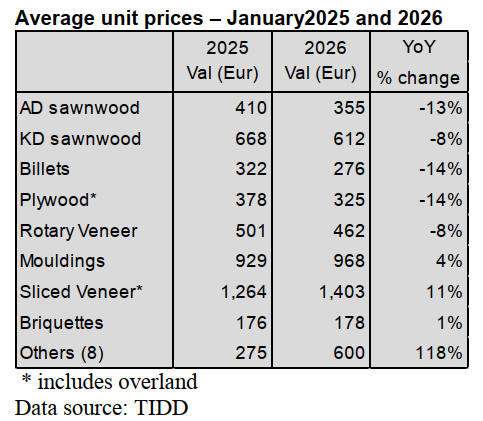
For the period the AUP for briquettes was up to
Eur178/cu.m compared to Eur176/cu.m in 2025. The main
destination for briquettes was the United Kingdom. The
volume of moulding export in January 2026 dropped by
18% to 309 cu.m and the export value was down by 15%
to Eur299,000. However the AUP rose by Eur39/cu.m to
Eur968/cu.m compared to Eur929/cu.m in 2025.
Exports of sliced veneer dropped 8% in January, from 704
cu.m (2025) to 647 cu.m (2026) but revenue increased
from Eur890,000 in 2025 to Eur908,000 in 2026. The
AUP increased from Eur264/cu.m in 2025 to
Eur1,403/cu.m in 2026. The main species of exported
veneer were asanfina, sapele, chenchen, koto and wawa.
Plywood export performance
Plywood remained one of the leading wood products
exported to regional and overseas markets in the first
month of 2026. Export volumes increased by 81% to 2,472
cu.m, from 1,369cu.m of the previous year with a
corresponding 55% increase in value for January 2026.
The United States and Gambia were the major consuming
markets of Ghana’s plywood in January 2026.
Notwithstanding, the export AUP for plywood declined
from Eur378/cu.m in January 2025 to Eur325/cu.m in
January 2026, a 14% decrease.
Wood products exports in January 2026 totalled 15,741
cu.m which earned the country Eur6.85 million. Compared
to January 2025 this resulted in decreases of 24% and 30%
in volume and value respectively.
Local timber sellers appeal for a more flexible permit
regime
Local timber sellers are calling on government for a more
flexible permit regime to facilitate the transport of timber
offcuts to support their business operations. Their
concerns are that the current permit system is restrictive
and affects their businesses making it difficult to move
offcuts efficiently.
According to the traders, the bureaucracy involved in
securing the statutory permits is frustrating and adds to the
heavy burden carried by traders. They have urged the
authorities to simplify permit process documentation to
support their small-scale timber businesses to strike a
balance between regulation and business growth.
In response to their concerns the Director of the National
Timber Monitoring Team, Alhaji Mohammed Kwaku
Doku, assured the woodworkers of government
implementing measures to strengthen the timber industry
that would enable them to contribute their quota to
national development.
See: https://www.modernghana.com/amp/videonews/634799
and
https://citinewsroom.com/2026/04/govt-implementing-measures-
to-strengthen-timber-industry-alhaji-doku/
Major step in national landscape restoration
The Forestry Commission has signed a Memorandum of
Understanding (MOU) with Terraformation Inc., a global
company specialising in biodiverse reforestation to restore
degraded mangrove ecosystems in the Keta Lagoon area
of the Volta Region of Ghana.
The partnership scales up the ongoing Keta Lagoon Blue
Carbon Project, also known as the Regenerative
Development of Anlo Wetlands (ReDAW) initiative.
Terraformation has worked in the area since 2021 with
local partners ReDAW Ltd., Agrointroductions Ghana,
landowners and communities to develop nature-based
solutions. The project targets thousands of hectares of
mangrove wetlands, aiming to sequester carbon, protect
biodiversity and strengthen coastal defenses against
erosion and flooding.
Under the deal, Terraformation will provide technical
expertise, training, technology and access to financing for
community-led restoration. The work is expected to create
jobs, particularly for women and youth, through mangrove
planting, aquaculture and beekeeping.
The Chairman of Forestry Commission (FC) Board, Isaac
Essien, described the project as a timely intervention for
Ghana’s forest degradation. While both the FC Chief
Executive Dr. Hugh C.A. Brown and Terraformation
President Jad Daley emphasised that the model aligns
ecological restoration with social and economic needs.
Meanwhile scientists from Ghana, Brazil and UK met in
Kumasi in the Ashanti Region of Ghana to discuss
tackling a biodiversity crisis with technology. The
workshop targeted postgraduate students, early-career
researchers and biodiversity conservation professionals to
introduce participants to a suite of emerging technologies
transforming conservation science, including Artificial
Intelligence (AI) for biodiversity monitoring, Species
Distribution Models (SDMs) and Environmental DNA
(eDNA) analysis.
See: https://www.modernghana.com/news/1482546/forestry-
commission-terraformation-partner-to.html
and
https://www.myjoyonline.com/scientists-from-ghana-brazil-and-
uk-gather-in-kumasi-to-tackle-biodiversity-crisis-with-cutting-
edge-technology/
3. MALAYSIA
Manufacturers face supply and energy crisis
The Malaysian manufacturing sector is facing a crisis due
to the Middle East conflict with nearly 90% of companies
reporting a direct impact or expected disruption within
four weeks as of early April 2026.
The crisis, characterised by shipping disruptions in the
Strait of Hormuz, rising energy costs and raw material
shortages has caused over 74% of manufacturing firms to
report production cost increases of at least 10%,
threatening the viability of small and medium enterprises
operating on thin margins.
The regional press has picked up on a press release from
the Federation of Malaysian Manufacturers (FMM) which
details the results of a recent survey which shows
Malaysian manufacturers are grappling with severe supply
chain and cost disruptions stemming from the ongoing
Middle East conflict and prolonged blockage of the Strait
of Hormuz and Red Sea shipping lanes.
The survey found that nine in ten companies are either
already affected or expect to be within four weeks, with
raw material shortages, skyrocketing logistics costs and
tightening diesel supplies threatening production
continuity. Sectors producing food, household goods,
packaging, chemicals and consumer products are
particularly exposed, raising the risk of product shortages
and export disruptions.
Production lines are at risk of stoppage, export orders are
being cancelled and the financial capacity of
manufacturers to sustain operations is under direct and
accelerating pressure, said FMM.
It noted that Malaysia's manufacturing relies heavily on
global supply chains, with 83% of companies sourcing
over 30% of raw materials from overseas.
Disruptions across energy, freight, fuel and materials are
affecting domestic supply chains, with knock-on effects on
retail availability and consumer prices. ven if the conflict
ended immediately, delays in restocking, insurance costs
and contract renegotiations would continue to strain
operations for months, according to the survey.
The survey highlighted that 69.5% of manufacturers
expect raw material shortages within a month, while 8%
have less than two weeks of critical stock. Plastics,
specialty chemicals, metals, food additives and rubber
processing inputs are among the most affected, creating
the potential for halted production in essential consumer
goods and industrial products.
Energy and logistics costs have also surged, compounding
operational stress. Nearly half of respondents reported
industrial energy costs rising by 10 to 30%, while 22%
said increases reached 30 to 50% and 12% experienced
hikes above 50%.
Freight and logistics costs have also escalated sharply,
with 53% of firms reporting 20 to 50% increases and 18%
seeing costs jump more than 50%, often outside contract
terms. Diesel shortages for domestic haulage further delay
cargo movement and elevate transport costs.
The impact on output is already visible, 48% of companies
have reduced production or suspended lines, while 52%
are facing export disruptions including delayed shipments,
order cancellations and buyer-initiated renegotiations.
FMM has said “the scale and breadth of disruption
highlighted in this survey requires an immediate and
coordinated Government response. The risk of production
stoppage and export contraction is real and the window to
prevent it is narrowing. FMM has identified twelve
recommendations and calls on the Government to act on
all of them without delay. They span fiscal and tax relief,
energy and fuel supply, raw materials and supply chain
security and logistics, ports, shipping and crisis
governance”.
See: https://www.fmm.org.my/Articles/Details/Press-@-
FMM_Press_Statement-
;_FMM_SURVEY_CONFIRMS_MALAYSIAN_MANUFACT
URING_FACES_ESCALATING_RISKS_FROM_WEST_ASI
A_CONFLICT/c72623f9-42d1-4e37-9ace-f4f44d95d88e
and
https://english.news.cn/20260407/79929e0493cd40f7bf8ba0701e
37c4f9/c.html
Sarawak Timber Association calls for government
support
The Sarawak Timber Association (STA) has appealed to
the government to consider support measures as the
industry continues to face mounting cost pressures and
regulatory challenges amid a volatile global economic
environment.
STA chairman, Henry Lau, said this includes a review of
royalty, cess and premium charges as well as targeted
assistance to both upstream and downstream operations
during the current period of sustained cost pressures.
When delivering his report on the Workings of STA for
2025 at the STA AGM Lau stressed that geopolitical
tensions, particularly ongoing conflicts in the Middle East,
have pushed up global oil prices and created energy
market volatility, resulting in higher diesel costs, a key
component in logging, extraction, transportation and
processing activities.
“These increases have pushed up operating costs across
the value chain, especially in fuel-intensive activities.
Some operators have had to scale down or suspend
operations and there are growing concerns that parts of the
industry may struggle to recover if these conditions
persist,” said Lau.
He noted last year was challenging for the industry, with
annual log production staying low at 1,930,351 cubic
metres. Downstream production also continued to decline,
with plywood output falling sharply from about three
million cubic metres in 2008 to approximately 550,000
cubic metres last year.
Production from planted forests also dropped significantly
from 1,903,526 cubic metres in 2024 to 540,323 cubic
metres in 2025, which he attributed to the cancellation of
Licence for Planted Forest (LPF) without due process.
See:
https://theborneopost.pressreader.com/article/281487872894850
Advance through innovations
According to the Sabah State Minister of Education,
Science and Technology, James Ratib, Sabah must adopt
modern technology and innovation to ensure its timber
industry remains competitive in the global market. He
added that the timber industry has long been a backbone of
Sabah’s economic growth but can no longer rely solely on
traditional practices.
“In today’s era of globalisation and rapid technological
advancement, a paradigm shift is necessary through the
application of modern technology and creative innovation
to ensure our downstream timber products remain
competitive,” James said.
With the adoption of the latest technologies the Minister
said he is confident the industry can grow rapidly,
contribute positively to the State’s economy and create
more job opportunities for the people of Sabah. James
expressed confidence that, with strong support from
educational institutions and industry partners, students
would emerge as future experts and leaders in the timber
sector.
See:
http://theborneopost.pressreader.com/article/281479282975340
4.
INDONESIA
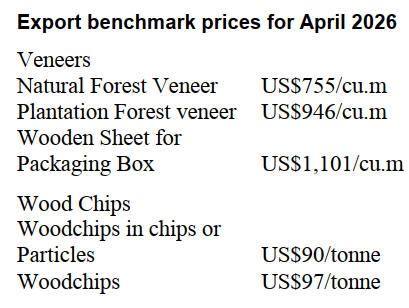
Processed Wood
Processed wood products which are leveled on all four
sides so that the surface becomes even and smooth with
the provisions of a cross-sectional area of 1,000 sq.mm to
4,000 sq.mm (ex 4407.11.00 to ex 4407.99.90)
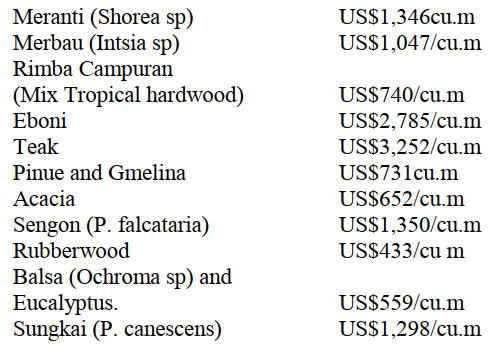
Processed wood products which are leveled on all four
sides so that the surface becomes even and smooth of
Merbau wood with the provisions of a cross-sectional area
of 4,000 sq.mm to 10,000 sq.mm (ex 4407.11.00 to ex
407.99.90) US$1,500/cu.m
See: https://jdih.kemendag.go.id/peraturan/keputusan-menteri-
perdagangan-republik-indonesia-tentang-harga-patokan-ekspor-
dan-harga-referensi-atas-produk-pertanian-dan-kehutanan-yang-
dikenakan-bea-keluar-dan-tarif-layanan-badan-layanan-umum
Almost US$750,000 potential deals at Budapest fair
Indonesian furniture and home décor products generated
potential transactions worth almost US$750,000 at the
Home Design Exhibition in Budapest reflecting rising
demand in Central and Eastern Europe.
The Indonesian Trade Promotion Center (ITPC) in
Budapest highlighted strong interest from Hungarian and
regional buyers pointing to growing trust in Indonesian
craftsmanship and design.
Four Indonesian MSMEs participated in the March 25–29
event, showcasing a diverse range of products including
teak wood furniture with traditional Javanese carvings,
contemporary premium designs, copper and fossilised
wood décor and innovative mycelium-based furniture that
blends local materials with European aesthetics.
See:https://rri.co.id/en/business/2313459/indonesian-msmes-
shine-at-home-design-2026-in-budapest
Proposal for global distribution hubs
The Indonesian Furniture Industry and Craft Association
(HIMKI) has suggested the establishment of marketing
and distribution hubs. HIMKI Chairman, Abdul Sobur,
pointed out that conflicts, such as in the Middle East,
disrupt supply chains, cause shipping delays and
undermine buyer confidence creating structural shifts
demand beyond normal market fluctuations. He stressed
that industrial resilience now depends not just on
production capacity but on the ability to adapt to global
uncertainty.
To address these challenges, HIMKI is focusing on
diversifying export markets and developing alternative
distribution channels. Key initiatives include establishing
hubs in Europe, the United States and Canada to shorten
supply chains, improve market access and boost the
competitiveness of Indonesian products.
Sobur emphasised that these efforts require government
support through policy, financing and trade diplomacy.
HIMKI views the current global pressures as an
opportunity to build a more resilient, flexible and risk-
adaptive industrial system.
See: https://www.antaranews.com/berita/5512425/himki-dorong-
pengembangan-hub-distribusi-sikapi-dinamika-global
and
https://www.merdeka.com/uang/himki-dorong-hub-distribusi-
global-perkuat-ketahanan-industri-mebel-hadapi-dinamika-
geopolitik-558873-mvk.html
Indonesia, Japan to boost forestry and carbon trading
cooperation
Indonesia and Japan have agreed to strengthen their
bilateral cooperation in forestry and climate-related sectors
according to Indonesia’s Forestry Minister Raja Juli
Antoni. The partnership will focus on initiatives such as
sustainable forest management, carbon trading and
wildlife conservation.
The collaboration also aims to enhance conservation areas,
promote knowledge exchange and increase private sector
participation in the carbon economy. Indonesia is offering
investment opportunities through its Carbon Economic
Value (NEK) scheme and voluntary carbon trading
programmes.
The collaboration will be supported by projects with the
Japan International Cooperation Agency (JICA), including
the deployment of Japanese experts to assist in mangrove
management. Indonesia also encouraged further
collaboration through the development of the World
Mangrove Center and the implementation of the Joint
Crediting Mechanism (JCM) scheme to advance shared
climate goals.
See: https://en.antaranews.com/news/410669/indonesia-japan-to-
boost-forestry-and-carbon-trading-cooperation
and
https://en.antaranews.com/news/410502/indonesia-jica-deepen-
forestry-partnership-to-support-climate-action
Carbon and social forestry project integration
Indonesia is strengthening cooperation on carbon projects
and social forestry through a strategic partnership with the
Asia Forest Cooperation Organization (AFoCO). The
Minister of Forestry, Raja Juli Antoni, met AFoCO
Executive Director, Park Chongho, in Seoul to discuss
collaboration in carbon project development, land
rehabilitation and community empowerment under social
forestry programmes.
The initiative is part of Indonesia’s broader “green
diplomacy” agenda and focuses on preparing carbon
projects and certification in national parks and concession
areas.
AFoCO praised Indonesia’s active participation since
joining the organisation in 2019 and highlighted
opportunities for international financing through its
accreditation under the Green Climate Fund.
To strengthen coordination, Indonesia proposed placing a
permanent representative at AFoCO headquarters and
invited the organisation to support the management of 1.4
million hectares of Indigenous Forests, as well as improve
early-stage funding access for social forestry communities.
See: https://www.metrotvnews.com/read/KZmCQovG-proyek-
karbon-dan-perhutanan-sosial-di-indonesia-diperkuat
and
https://www.agrofarm.co.id/2026/04/kemenhut-gandeng-afoco-
dorong-pengembangan-proyek-karbon-dan-perhutanan-sosial/
APHI reinforces dedication to sustainable forest
management
The Association of Indonesia Forest Concession Holders
(APHI) has reaffirmed its commitment to promoting
sustainable forest management, highlighting the forestry
sector’s vital role in supporting sustainable development.
APHI Chairman, Soewarso, noted that the Association is
dedicated to expanding forest cover through planting and
enrichment in both plantation and natural forests while
ensuring responsible utilisation.
He also stressed that optimising forest use through a multi-
business forestry approach, strengthening governance,
enhancing collaboration with the government and
stakeholders and fostering innovation are key strategies for
ensuring sustainable forest management now and in the
future.
See: https://www.antaranews.com/berita/5516560/aphi-perkuat-
komitmen-jaga-kelestarian-hutan
Indonesia, South Korea - strategic ties on forest fire
response
Indonesia and South Korea have agreed to deepen
strategic cooperation in forestry, with a strong focus on
sustainable forest management and forest fire response.
The partnership was formalised through the signing of two
key agreements in Seoul between Indonesia’s Minister,
Raja Juli Antoni and Korea Forest Service Minister Park
Eunsik.
The first agreement outlines collaboration on priority
forestry programmes including climate change mitigation,
mangrove and peatland rehabilitation, ecotourism
development, social forestry and strengthening forest
carbon markets. The second agreement specifically
addresses forest fire management and post-fire recovery,
promoting cooperation in prevention, preparedness,
response and recovery efforts.
See: https://rri.co.id/en/international/2306924/indonesia-and-
korea-boost-strategic-cooperation-in-forest-fire-management
Economic fundamentals steady despite global
pressures
Indonesia’s economic fundamentals remain strong despite
global challenges supported by steady growth of around
5%, controlled inflation and a consistent trade surplus.
Annual inflation reached 3.48% in March 2026 while the
country recorded a US$1.27 billion trade surplus in
February extending a streak of 70 consecutive months.
These indicators reflect stable economic performance and
solid external balances amid ongoing global uncertainty.
To sustain this momentum and avoid the middle-income
trap the government is implementing a targeted
development strategy focused on five priorities: improving
labour productivity through investments in education,
healthcare and social protection; expanding infrastructure
to enhance basic services and strengthen food and energy
security; advancing institutional reforms for more
effective governance; ensuring adaptive macroeconomic
policies; and maintaining political and security stability.
The government also emphasises prudent fiscal and
monetary management to preserve investor confidence,
with credibility seen as a key factor in successfully
executing these policies.
See: https://en.antaranews.com/news/411681/indonesias-
economic-fundamentals-steady-despite-global-pressures
5.
MYANMAR
6.
INDIA
Associations across India issue a flurry
of price
advisories
The Iran-US conflict has compelled Indian wood panel
producers to reorganise their production and sales targets
as costs rise. In a rapidly evolving and complex situation
with no endgame in sight oil prices have shot above
US$110 per barrel following the choking at Strait of
Hormuz. India’s methanol supply is among the hardest-hit
chemicals followed by PVC resin, Acrylic monomer and
imported urea.
India imports about 1.3 million tonnes of methanol
annually of which around 40% comes from the Arabian
Gulf, Iran itself is one of the world’s largest producers and
exporters of methanol and supply through the Strait of
Hormuz accounts for 30% of global methanol trade.
The conflict has disrupted shipping routes, creating
significant uncertainty in Methanol and Urea supply,
which is a critical source for wood panel decorative and
related polymer sheet industries in India. So far the cost of
producing almost every wood panel product and
decorative interior and exterior product has increased. The
rise in the production cost of plywood is estimated to be 4-
6%. Production costs for MDF and particleboard have also
risen around 5% .
Against the backdrop of developments in West Asia the
Federation of Indian Plywood and Panel Industry, South
Indian Plywood Manufacturers Association, North
Malabar Plywood & Doors Manufacturers Association
have written to Ministry of Commerce and Industry and
Department for Promotion of Industry and Internal Trade
(DPIIT) requesting a reduction in the basic Customs duty
(BCD) on key chemical imports such as Technical-grade
urea, Phenol, Melamine, Methanol used in Resin
manufacturing for plywood, MDF, particle board,
laminates and other panel products.
Various plywood and timber associations across India
have issued a flurry of price advisories in the wake of
ongoing tensions between US-Israel and Iran. It is
inevitable that manufacturers will be compelled to increase
panel prices.
The Kandla Timber Association (KTA) has advised
plywood and veneer industries to implement price
adjustments and readjust their commercial decision taking
into account current market conditions and the impact on
raw material prices.
According to the KTA, in view of the current ongoing
geopolitical situation in the Middle East, the overall cost
structure has increased by roughly 8-10% due to
significant uncertainty in the global supply chains and
freight movement and raw material supply stability.
The Haryana Plywood Manufacturers’ Association
(HPMA) has issued a trade advisory to all members in
response to the volatility in raw material import prices
amidst conflicting situations in the Middle East.
The HPMA has said the plywood industry is presently
facing a significant increase in the cost of major raw
materials including Phenol, Formaldehyde, Urea,
Melamine, Face Veneer and Core Veneer. The ongoing
conflict situation in West Asia has also disrupted global
supply chains leading to volatility and irregular
availability of several key inputs. In the face of such
developments the manufacturing cost of plywood products
has increased by around 6 %.
The Punjab Plywood Manufacturers Association (PPMA)
also suggested a price increment of 5% on the plywood
citing increased raw material cost. The Association noted
that, due to the steep increase in prices of various inputs
like timber, Formaldehyde and phenol plywood mills are
running at a loss and the viability of factories has come
under pressure.
The Wood Based Industries Association of Uttar Pradesh
has declared an increase in the price of all wood panel
products of 6% with immediate effect due to the sharp rise
in prices for raw material. The Association also cautioned
all the members to revise their prices accordingly to save
the wood panel industry from further damage.
The Rajasthan Plywood Manufacturers Association
decided to increase prices of Board and Flush Door by
Rs.24 per square foot. Whereas a 5% price increase in the
prices of plywood has been implemented in view of the
sudden increase in the prices of chemicals (Formaldehyde,
Phenol, Melamine), Face Veneer, Pine Raw Board and
Pine timber due to international circumstances.
The Particleboard Manufacturers Association of Kerala
(PBMAK) has decided to implement a price revision for
particleboard in order to sustain production quality and
ensure uninterrupted supply to the market. The PBMAK
noted that manufacturers have been facing continuous cost
increases due to global supply chain disruptions and rising
input costs.
Despite sustained efforts by manufacturers to absorb these
increases, the situation has now reached a point where a
price revision has become unavoidable.
The Gujarat Particle Board Association has suggested at
least a 15% hike on existing product prices due to the
shortage of raw materials and the continuous increase in
production costs mainly caused by the rise in prices of
resin, wood and paper raw materials.
The All India Decorative Veneer Manufacturers
Association issued an advisory on the ongoing challenges
arising from global market changes, the weakening rupee
and rising operational and overhead costs. Based on their
estimate a 12% increase should be implemented
immediately.
The Indian Laminate Manufacturers Association has
issued an advisory because the price of several raw
material used in laminate manufacturing has been
significantly increased. The prices for different varieties of
laminates will be increased in the range of INR35 to 70
per sheet.
The All India Edge band Manufacturers Association also
issued an advisory on price increases due to ongoing
Middle East conflict which has resulted in a shortage of
raw materials used in manufacturing of edge bands. In the
current scenario, members are advised to increase the
prices of edge bands by a minimum 15%.
Conflict could drive down GDP
India‘s real GDP growth for the next fiscal year could be
eroded by around 1 percentage point, while retail inflation
could rise by about 1.5 percentage points from the baseline
estimates if the Middle East conflict persists through the
next fiscal year says a report from a member firm of Ernst
& Young Global Limited (EY).
The EY Economy Watch report said that several sectors,
including employment-intensive sectors like textiles,
paints, chemicals, fertilisers, cement and tirescould be
directly impacted. Any reduction in employment or
incomes in these sectors may further dampen demand.
The report points out the Indian economy, which relies on
nearly 90% of its crude oil imports, is also highly
dependent on imports of natural gas and fertilisers and is
particularly vulnerable to such external shocks.
The ongoing conflict in the Middle East has significantly
disrupted global crude oil and energy markets. Even if the
conflict is resolved in the near term some of these
disruptions may take considerable time to normalise, it
said. The Organisation for Economic Cooperation and
Development (OECD) had only recently projected India‘s
GDP growth to moderate to 6.1% from 7.6% in the current
financial year.
See: https://www.ey.com/en_in/services/tax/economy-watch
and
https://economictimes.indiatimes.com/news/economy/indicators/i
ran-war-shock-middle-east-conflict-could-cut-1-ppt-from-indias-
fy27-gdp-outlook/articleshow/129920336.cms?from=mdr
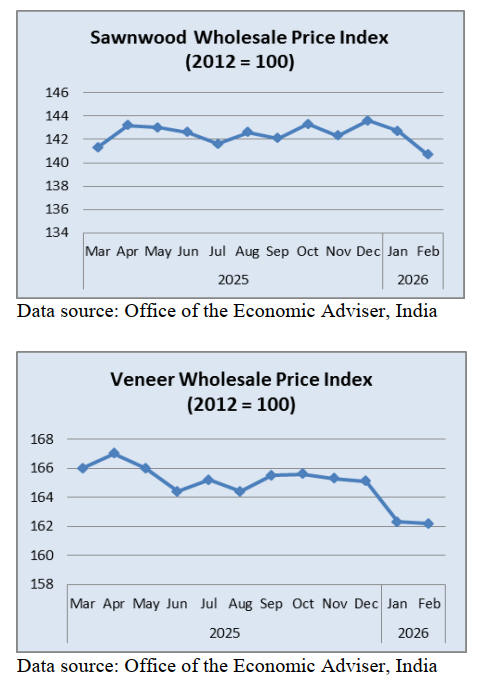
Sawnwood wholesale price nosedives
The annual inflation based on the February WPI was
2.13% (1.81% in January), the positive rate in February,
2026 was primarily due to increased prices for‚ other
manufacturing, manufacture of basic metals, non-food
articles, food articles and textiles.
The index for Manufactured Products rose from 147.5 in
January to 148.2 in February 2026. Out of the 22 NIC two-
digit groups for Manufactured Products, 16 witnessed an
price increases and 5 groups witnessed a decrease in
prices.
Some of the groups that showed month on month increases
in prices were‚ other manufacturing, manufacture, of food
products, textiles; manufacture of electrical equipment and
chemical and chemical products.
Some of the groups that recorded a decrease in price in
February were manufacture of basic metals, computer,
electronic and optical products, fabricated metal products,
except machinery and equipment, wood and products of
wood and cork and leather and related products.
See: https://eaindustry.nic.in/
and
chrome-
extension://efaidnbmnnnibpcajpcglclefindmkaj/https://eaindustry
.nic.in/pdf_files/cmonthly.pdf
7.
VIETNAM
Wood and wood product (W&WP) trade
highlights
According to data provided by Viet Nam Customs Office,
Viet nam’s W&WP exports in March 2026 reached
US$1.15 billion, up 19% compared to February 2026 but
down 22% compared to March 2025.
Of the total the WP export share was US$760 million, up
27% compared to February 2026 but down 25% compared
to March 2025.
In the first 3 months of 2026 W&WP exports earned
US$3.7 billion, down 5% over the same period in 2025 of
which WP exports were valued at US$2.4 billion, down
10% over the same period in 2025.
Viet nam’s W&WP exports to the EU in March 2026
earned US$92 million, up 24% compared to February
2026 and up 61% compared to March 2025. In the first 3
months of 2026 W&WP exports from Viet Nam to the EU
earned to US$252 million 57% over the same period in
2025.
Viet nam's poplar wood imports in March 2026 were
42,100 cu.m, worth US$14.7 million, up 21% in volume
and 25% in value compared to February 2026. Compared
to March 2025 an increase of 46% in volume and 24% in
value was observed. In the first 3 months of 2026 imports
of poplar wood were estimated at 107,200 cu.m, worth
US$37.9 million, up 51% in volume and 36% in value
over the same period in 2025.
Viet nam's imports of raw wood (logs and sawnwood)
in
February 2026 amounted to 381,400 cu.m, worth
US$128.7 million, down 39% in volume and 39% in value
compared to January 2026 and down 17% in volume and
12% in value compared to February 2025. In the first 2
months of 2026 Viet nam's imports of raw wood reached
1.0 million cu.m, worth US$338.1 million, up 16% in
volume and 24% in value over the same period in 2025.
NTFP exports in March 2026 earned around US$80
million, up 44% compared to February 2026 and 2.0%
over the same period in 2025. In the first 3 months of
2026, NTFP exports generated US$235.66 million, up
13% over the same period in 2025.
Plywood redirected to Middle East and South Asia
US tariff pressures and anti-dumping duties accelerated
plywood trade diversification toward the Middle East and
South Asia where construction is booming.
Tariffs on plywood have grown more complex. While
plywood (HTS 4412) was exempted from Section 232
duties it was not excluded from the reciprocal tariff regime
that took effect in April 2025. Vietnamese goods currently
face a 20% reciprocal tariff on US-bound shipments,
reduced from the initial 46% announced in April 2025
through bilateral negotiations concluded in August 2025.
Layered on top are the preliminary anti-dumping duties of
191.85–194.80% and countervailing duties announced in
March 2026 on hardwood and decorative plywood from
Viet Nam with final determinations scheduled for May 11,
2026.
Middle East construction absorbs redirected supply
As access to the US market becomes prohibitively
expensive for Viet namese hardwood plywood exporters
the Middle East has emerged as a critical alternative
destination. Saudi Arabia's construction sector, valued at
US$104.8 billion in 2024 and growing at 8.7% compound
annual rate toward US$174.4 billion by 2030, is the
region's demand anchor.
The kingdom imported US$2.5 billion in wood products in
2023 and envisions 1.5 million new homes by the end of
the decade.
Formwork plywood is particularly well-positioned in this
market. According to PS Market Research, Saudi Arabia's
wooden formwork systems market reached US$94.4
million in 2024, with plywood holding approximately 50%
market share. The UAE adds further scale, importing
US$2.4 billion in timber products annually. Both markets
are structurally import-dependent domestic production
covers only a fraction of demand from mega-projects like
NEOM, The Red Sea development and Abu Dhabi's
infrastructure expansion.
For Viet namese exporters of film-faced formwork
plywood for construction, this demand profile creates an
opportunity to redirect capacity from tariff-constrained US
routes toward markets where duty-free or low-duty access
combines with genuine infrastructure-driven demand
growth.
India's plywood market, valued at INR247.85 billion
(US$29.5 billion) in 2025 according to IMARC Group, is
projected to grow at a 5% compound annual rate through
2034 reaching INR391.90 billion. The construction sector
is the dominant consumer.
Freight costs add margin pressure
Logistics costs are compounding the trade route
restructuring. The Drewry World Container Index held
steady at US$2,287 per 40-foot container as of 2 April
2026 but the headline number masks emerging pressure
points.
Maersk has applied to US regulators for an emergency
bunker surcharge of US$200 per TEU on head-haul routes
and US$100 per TEU on backhaul, citing elevated fuel
costs from tensions in the Strait of Hormuz, a chokepoint
handling nearly 20% of global oil shipments.
For wood product shipments from Southeast Asia these
surcharges directly impact landed costs. A typical
plywood shipment of 25 cubic metres in a 20-foot
container absorbs the surcharge as a per-unit cost increase
of approximately US$8/cu.m for thin-margin commodity
grades but manageable for higher-value film-faced and
formwork panels.
See: https://vinawoodltd.com/blog/plywood-timber-market-brief-
april-2026
Viet nam’s wood chip exports in 2025
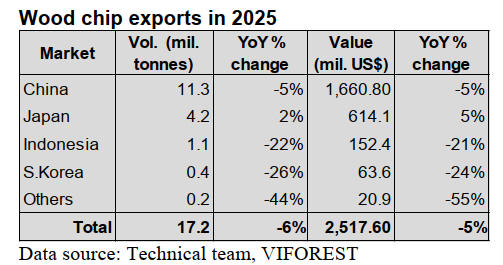
In 2025, Viet Nam exported 17.2 million tonnes of wood
chips, generating US$2.5 billion, down 6% in volume and
5% in value compared to 2024. Despite the decline, wood
chips still accounted for approximately 15% of the total
exports of the wood industry.
This highlights the continued importance of wood chips in
Viet nam’s wood sector while also reflecting the impact of
international market fluctuations, particularly the decline
in demand from China’s paper industry.
Viet nam’s wood pellet exports
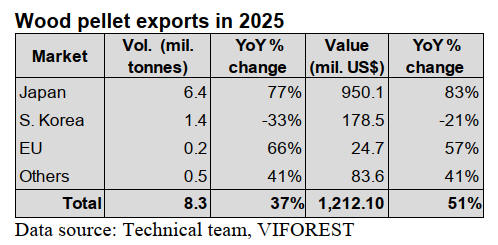
Viet Nam exported nearly 8.3 million tonness of wood
pellets reaching US$1.2 billion in 2025, up 37% in volume
and 51% in value compared to 2024. The export value of
this product now accounts for approximately 7% of the
total exports of the wood industry.
Despite certain challenges in raw material supply, 2025
witnessed strong growth in both export volume and value
of wood pellets. This was driven in particular by surging
demand from Japan, as biomass co-firing power plants
participating in the new FIT/FIP mechanisms came into
operation.
8. BRAZIL
Framework for the use of native forest
biomass
The State of Mato Grosso located in the Amazon Region
has established an innovative regulatory framework for
regulating and certifying the use of biomass derived from
native wood through the Forest and Biomass Development
Plan 2025–2040.
The initiative, jointly developed by the State Secretariat
for Economic Development (Sedec) and the State
Secretariat for the Environment (Sema), sets guidelines for
traceability, legality and the efficient use of forest
biomass, consolidating this resource as a strategic input for
both industry and energy.
The plan promotes the reorganisation of the forest
production chain by transforming vegetation clearing
residues as a source of energy with an economic value,
while strengthening legal certainty and sector
standardisation which improves the investment
environment.
Structured around three pillars (expansion of planted
forests, strengthening of sustainable forest management
and development of the timber and biomass value chain) it
establishes ambitious targets, including the expansion of
planted forest areas to up to 700,000 hectares and areas
under sustainable management to 6.5 million hectares by
2040.
Additionally, the plan foresees a transition toward more
sustainable biomass sources, reducing dependence on raw
materials from authorised vegetation clearing and
encouraging the use of planted forests and industrial
residues.
This measure is expected to enhance the State’s
competitiveness in energy-intensive sectors while
contributing to the reduction of greenhouse gas emissions
thus aligning with the consolidation of a low-carbon
economy.
See: https://matogrossoeconomico.com.br/economia/em-acao-
inedita-no-pais-mt-regulamenta-uso-de-biomassa-de-madeira-
nativa-e-incentiva-a-economia-verde/
Native species silviculture gains momentum
The Brazilian Development Bank (BNDES), in
partnership with the Southern Bahia Science and
Technology Park (PCTSul) and the Brazil Climate, Forests
and Agriculture Coalition has established a strategic
initiative to expand native species silviculture in Brazil.
The agreement provides for an investment of BRL24.9
million in the Research and Development Program on
Native Species Silviculture (PP&D-SEN), operating in the
Atlantic Forest and Amazon biomes over a five-year
period.
The programme will be carried out across 14 research
sites, covering 30 native species, under the technical
coordination of the Federal University of São Carlos
(UFSCar) in the Atlantic Forest and by Embrapa in the
Amazon, while financial and administrative management
led by the Foundation for Institutional Support to
Scientific and Technological Development (FAI).
The initiative aims to boost the sustainable production of
tropical timber, increasing Brazil’s share in the global
market (currently estimated at 10%). The programme
integrates investment, public policies and regulatory
instruments promoting diversification in silviculture with
species such as cumaru, Brazil nut, copaiba, ipê and
andiroba.
In addition, the PP&D-SEN directly contributes to
achieving the goals of the National Plan for the Recovery
of Native Vegetation (Planaveg) by generating
environmental, economic and social benefits. Key
expected outcomes include the restoration of degraded
areas, carbon sequestration and job creation.
In this context, the initiative seeks to establish native
species silviculture as a strategic activity by expanding
scale, productivity, competitiveness and positioning Brazil
as a reference in sustainable production and innovation in
the forestry sector.
See: https://www.portaldoagronegocio.com.br/florestal/mercado-
florestal/noticias/silvicultura-de-especies-nativas-recebe-r-24-9-
milhoes-do-bndes-e-ganha-impulso-no-brasil#17314bbe-0823-
48bc-9e9a-2f24e5093217
Global instability reshaping timber exports
International economic instability, combined with
exchange rate volatility and geopolitical tensions, is
reshaping the dynamics of Brazilian timber exports. This
context increases uncertainty in negotiations and directly
affects companies’ operational planning, particularly
regarding timelines, pricing and logistics.
In response, exporters have been intensifying market
diversification strategies, especially based on progress in
expanding the European Union and Mercosur Agreement
which is expected to open new trade opportunities.
On the other hand, this process also imposes stricter
requirements in terms of competitiveness, organisation and
regulatory compliance, particularly regarding legality
requirements under the EUDR, the regulation on
deforestation-free products.
At the same time, there is a shift in commercial strategies
with greater emphasis on building long term relationships
between partners. Strengthening structured partnerships,
enhancing information exchange, ensuring alignment
between parties and promoting transparency have become
central elements for risk mitigation and increasing the
predictability of operations.
These moves reflect a broader transformation in
international trade in which companies simultaneously
seek transaction security and strategic positioning to
capture new opportunities, reinforcing the need for
resilience and adaptability among Brazilian exporters.
See: https://www.remade.com.br/noticias/21330/cenario-externo-
instavel-muda-dinamica-das-exportacoes-de-madeira-em-2026
US tariff hike and Middle East conflict impacts timber
exports
The increase in tariffs imposed by the United States has
affected timber sector exports in the state of Rio Grande
do Sul. In August of last year, tariffs reached as high as
50%, disrupting negotiations and reducing the
competitiveness of Brazilian products.
Later, in February this year, they were reduced to around
10% for most items but the international environment
remains unstable and uncertain.Players in the timber sector
have sought to diversify its markets to sustain operations.
However, the contraction of the U.S. market has led to
excess supply putting a downward pressure on prices and
margins despite the finding of new buyers.
At the same time, the conflict in the Middle East has
disrupted logistics which, in some cases, has resulted in
order cancellations, route changes and increased costs.
This combination of factors affects not only companies but
also the regional economy particularly in municipalities
where the timber industry represents the main economic
base and a significant provider of employment.
See:
https://gauchazh.clicrbs.com.br/pioneiro/economia/noticia/2026/
04/tarifaco-dos-eua-e-conflito-no-oriente-medio-pressionam-
exportacoes-do-setor-madeireiro-na-serra-
cmnq0886u00j201jyswnqwp6h.html
9. PERU
Timber sector experiencing worst crisis in past 25
years - ADEX
Beginning February the Wood and Wood Industries
Committee of the Association of Exporters (ADEX) has
been holding bi-weekly meetings with the National Forest
and Wildlife Service (SERFOR) as the timber sector is
experiencing a crisis.
In 2025, its exports totalled almost US$70 million, a
contraction of around 18% compared to the US$85 million
of 2024.
This situation, marked by over-regulation that has
increased business costs and excessively extended the
forestry business cycle to the point that various
administrative processes can take more than a year, is
generating growing concern. This weakens
competitiveness compared to other tropical countries,
affects profitability and jeopardises operational continuity
and formal employment.
Some iconic companies in the sector have already
ceased
operations, says ADEX and there is a risk that others will
follow suit if urgent measures are not taken.
The regular meetings aim to address the main bottlenecks,
respond to the adverse situation and contribute to the
recovery of the Peruvian timber industry.
Among the priority issues is the need to implement
incentives to reactivate investment, including tax benefits,
financial mechanisms, guarantees for new plantations and
better coordination with the regulations of the Agrarian
Law and the Amazon Law (Law No. 27037) in order to
provide greater legal certainty in tax matters.
On its part, SERFOR presented the Concessions 2.0
strategy, aimed at modernising forest management. The
new model proposes larger-scale concessions with
operators, who demonstrate technical and financial
capacity, integrating timber, non-timber forest products
and ecosystem services.
It also incorporates digital traceability, remote monitoring,
certification, value-added production and greater
collaboration between forestry and industry, including the
participation of communities as strategic partners.
The Timber and Wood Industries Committee highlighted
the importance of establishing a differentiated regime for
these types of concessions, streamlining the approval of
management instruments and complementing the system
with remote monitoring and performance evaluation
mechanisms.
Finally, the Committee expressed its concern regarding the
implementation of the European Union Deforestation
Regulation (EUDR), emphasising the need to strengthen
cooperation with producing countries to ensure a balanced
application of the regulations to promote sustainability
without affecting trade.
Strengthening technological capacity to combat forest
crimes
In the Amazon, technology has become a key ally in
combating environmental crimes allowing for the
detection of subtle changes in the forest dover.
For this reason, the Supervisory Agency for Forest
Resources and Wildlife (OSINFOR) strengthened the
capacities of 30 justice departments and forest resource
administrative authorities in the use of technologies that
enhance investigations into illegal logging in the
department of Ucayali.
“Technological tools provide us with real-time
information but it is up to us to transform these alerts into
concrete decisions and actions. The next step is to work in
a coordinated manner; to share information and build trust
among institutions to confront increasingly complex
crimes,” stated the Head of OSINFOR.
He also thanked the National Forest Conservation Program
of the Ministry of the Environment and the Peruvian Space
Agency (CONIDA) for their role as facilitators.
See: https://www.gob.pe/institucion/osinfor/noticias/1373645-
ucayali-operadores-de-justicia-y-autoridades-administrativas-
fortalecen-sus-capacidades-tecnologicas-para-enfrentar-delitos-
forestales
San Martín forest zoning updated
As part of the update to the Forest Zoning information in
San Martín, the Ministry of Agrarian Development and
Irrigation, through the National Forest and Wildlife
Service (SERFOR) and the Regional Government of San
Martín reported over 70% progress toward completing this
process which will strengthen the sustainable management
of the territory.
As part of this activity, the team from SERFOR's
Sustainable Productive Forests Program and the San
Martín Regional Environmental Authority are working on
finalising the physiognomic map, a tool that allows for the
identification and classification of different types of
vegetation cover in the territory.
See: https://www.gob.pe/institucion/serfor/noticias/1370294-san-
martin-actualizacion-de-la-informacion-de-la-zonificacion-
forestal-avanza-en-mas-del-70-por-ciento
|