|
Report from
Europe
EU tropical wood procuct imports increased in 2025
but remained at historically low levels
The EU imported 1,608,800 tonnes of tropical wood and
wood furniture in 2025, 10% more than in 2024. Import
value was up 7% to US$3.32 billion in 2025 (Chart 1).
Although a positive trend, the reality is that the gains last
year only just raised EU import quantity above the all-time
low recorded in 2024, while the 7% increase in the
nominal dollar value of imports is less impressive when
set against EU annual inflation of 2.4% in 2025 and 2.7%
the previous year.
Taking account of inflation, the real value of imports last
year was significantly less than during the static trading
years between 2012 and 2019.
It is also very uncertain whether the gains will be
sustained into 2026 as they may be more indicative of
efforts to build stocks in advance of EUDR enforcement,
which was due to start on 30 December 2025 only for the
EU to agree another 12 month delay on 18 December.
There was a significant surge in imports in the weeks
immediately before that announcement, much of it focused
on plywood and wood furniture from Vietnam. The EU’s
decision to impose anti-dumping duties on hardwood
plywood from China in the second half of last year was
another factor driving increased imports of plywood from
tropical countries, again most notably from Vietnam, in
the second half of 2025.
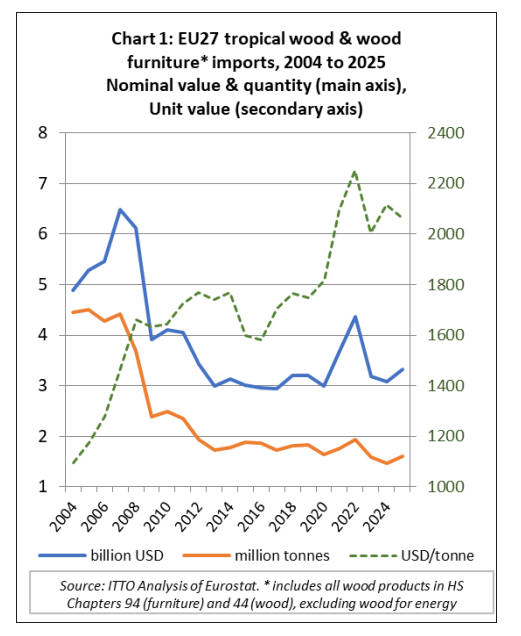
Nominal unit prices (not adjusted for inflation) for tropical
wood and wood furniture imported into the EU decreased
from US$2116 per tonne in 2024 to US$2026 in 2025. As
such they now sit in the middle of the range between the
peak of the post-COVID boom in 2022 and the bust in
2023.
Average unit prices of tropical wood product imports into
the EU are now much higher than before the COVID
pandemic when they never exceeded US$1800 per tonne.
This was partly owing to inflation and partly to a structural
shift in the tropical wood product groups imported into the
EU with a higher proportion now comprising higher value
finished furniture and joinery products rather than
sawnwood, mouldings and logs.
The increase in EU imports of higher value tropical
composite wood products has been one of the few bright
spots for the tropical wood industry in the EU market in
recent years. It remains to be seen if this shift will be
maintained when EUDR is eventually implemented, now
scheduled for 30 December 2026.
The geolocation requirements of EUDR are particularly
challenging for more complex products such as furniture
for which wood is necessarily aggregated from a wide
variety of different sources, including secondary processed
waste streams. Many wood furniture manufacturing
companies in Southeast Asia are SMEs and often
dependent on wood supplies from smallholders,
complicating supply chains even further. They will likely
need significant technical and marketing support to ensure
their conformance to EUDR.
Rise in EU tropical wood imports in last quarter boosts
2025 figures
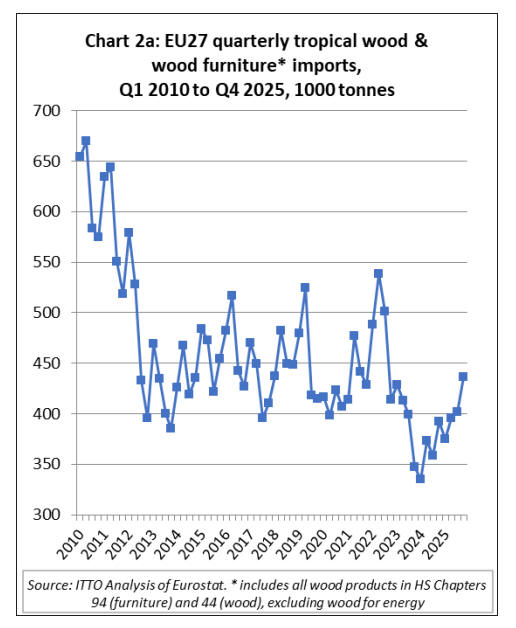
EU import quantity of tropical wood and wood furniture in
the fourth quarter of 2025 was 436,600 tonnes, 9% more
than the previous quarter and 11% more than the same
quarter the previous year. The surge in trade at the end of
last year took import tonnage during the fourth quarter of
2025 to close the long-term quarterly average of around
450,000 tonnes since 2013 (Chart 2a).
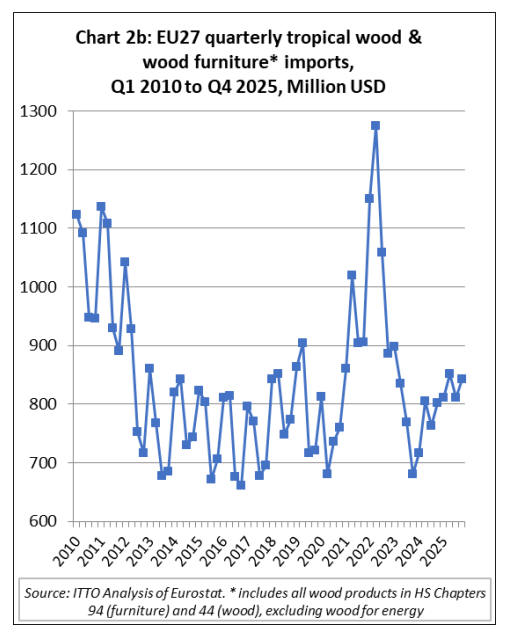
EU import value of tropical wood and wood furniture in
the fourth quarter of 2025 was US$843 million, 4% more
than the previous quarter and 5% more than in the same
quarter in 2024. In nominal US$ value terms (i.e. not
accounting for inflation), import value during the last
quarter of 2025 was well above the pre-pandemic 2013-
2019 quarterly average of around US$750 million (Chart
1b).
EU forecast of continued slow economic growth
In the fourth quarter of 2025, seasonally adjusted GDP
increased by 0.3% in both the euro area and the EU,
compared with the previous quarter, according to a
preliminary flash estimate published by Eurostat, the
statistical office of the European Union. In the third
quarter of 2025, GDP had increased by 0.3% in the euro
area and by 0.4% in the EU. Eurostat preliminary estimate
for the whole of 2025, based on quarterly seasonally and
calendar adjusted data, is that GDP increased by 1.5% in
the euro area and by 1.6% in the EU.
Economic performance varied widely between member
states. Among those for which data are available for the
fourth quarter of 2025, Lithuania (+1.7%) recorded the
highest increase compared to the previous quarter,
followed by Spain and Portugal (both +0.8%). Growth in
other large EU economies was slow in the second half of
last year: Germany posted 0.3% in the last quarter of 2025
after 0% growth the previous quarter; growth in France
was 0.2% in the last quarter after 0.6% the previous
quarter; in Italy, growth was 0.3% in Q4 after 0.2% in Q3.
However, Ireland (-0.6%) was the only Member State that
recorded a decrease in the last quarter of 2025 compared
to the previous quarter. The year-on-year growth rate was
positive for 14 countries and stable for one country.
According to KPMG’s latest European Economic Outlook
published in February, economic growth across Europe is
expected to remain modest over the next two years, with
euro area GDP forecast to grow by 1.1% in 2026 and 1.5%
in 2027. The KPMG forecast for 2026 is lower than the
EC estimate of 1.4% issued in November. KPMG expect
domestic demand to be the main driver of growth as
Europe navigates a more uncertain global trading
environment and continues to realign its trade
relationships.
With external headwinds intensifying, Europe’s growth
outlook increasingly depends on household consumption.
While savings rates remain elevated and consumer
confidence subdued, resilient labour markets and strong
nominal wage growth are expected to support real
disposable incomes and sustain modest consumption
growth through 2026. However, a sharp acceleration in
spending appears unlikely, with households expected to
remain cautious amid lingering economic uncertainty.
Consumer prudence could persist into the second half of
2026, with savings rates remaining elevated.
Although recent trade agreements with India and Mercosur
are important strategic steps for the EU after many years
of talks, they won’t have an immediate significant
economic impact. The amount of trade between countries
is still relatively small and it will take time for existing
tariffs to be removed. As a result, any real boost to
economic growth is likely to happen slowly and over a
longer period.
See:
https://kpmg.com/uk/en/media/press-releases/2026/02/eurozone-
gdp-forecast-to-grow.html
and
https://ec.europa.eu/eurostat/web/products-euro-indicators/w/2-
30012026-ap
Flat EU construction sector shows some signs of life
Latest Eurostat data for EU construction production shows
that region-wide activity has remained broadly flat over
the last four years, although performance varied widely
between EU countries and the latest signals suggest there
may be some improvement ahead (Chart 3).
In the immediate post-COVID period, there was very
strong growth in construction activity in Italy, driven by
generous government incentives for renovation and energy
efficiency upgrades, but the pace slowed in 2024 and 2025
as these were removed. It should be said that the growth in
Italian construction activity after 2020 followed many
years of very slow activity so there was much ground to
make up. Italian construction activity is now growing
more slowly but the core of the industry remains robust,
particularly in infrastructure, industrial construction, and
the fast-growing digital economy.
Construction sector activity in France and Germany was
sliding throughout most of 2024 and 2025. This trend is
widely expected to continue in France but there are more
positive signs emerging in Germany. The confidence
indicator for the construction sector in France remains low
and is not improving. The issuance of housing permits
improved slightly at the beginning of 2025 in France but
has shown signs of decline since August.
According to ING, the Dutch financial services
corporation, the German construction industry is projected
to return to growth in 2026. German construction activity
contracted by more than 10% between 2020 and 2025, but
is expected to grow by 2.5% in 2026, driven by a gradual
recovery in the new residential market and increased
infrastructure investment.
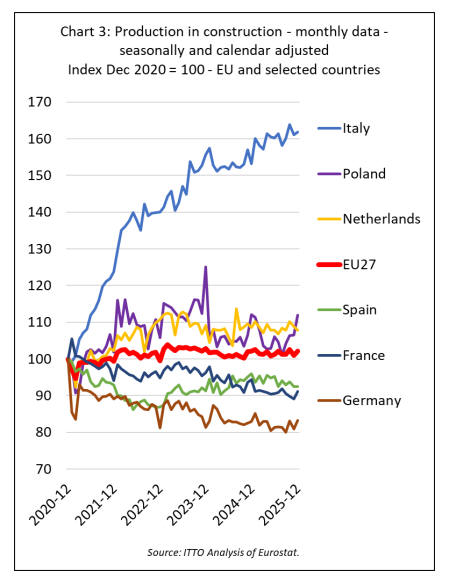
Spain is also showing positive developments. The Spanish
construction sector faced a significant decline between
2019 and 2022, losing more than 25% of its volume.
However, the Spanish market has been recovering since
2023. ING forecast 2.5% growth in 2026. In recent years,
the number of building permits issued in Spain has surged.
Additionally, contractor confidence in Spain is strong, and
the construction industry is benefiting from robust GDP
growth.
The Netherlands has been one of the more buoyant
European construction markets in recent years, but ING
now expect Dutch building volumes to increase by just
0.5% in both 2025 and 2026. Housing construction is
particularly weak. ING highlight several structural
bottlenecks including a shortage of building land, lengthy
and complex permitting requirements, objection
procedures and grid congestion.
Source: https://think.ing.com/articles/2026-outlook-growth-
returns-to-the-european-construction-sector/
Vietnam leads growth in EU tropical wood furniture
imports in 2025
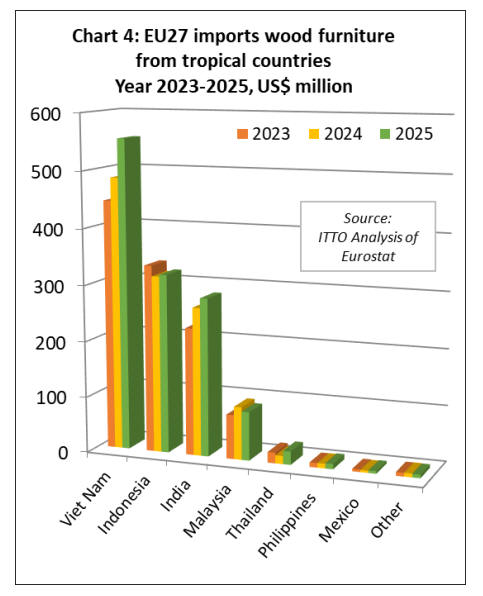
The EU imported 306,200 tonnes of wood furniture from
tropical countries with a total value of US$1286 million in
2025. Import quantity and value were up 7% and 8%
respectively compared to 2024.
Last year, EU import value of wood furniture increased
from the three largest supply countries: Vietnam (+14% to
US$554.2 million), Indonesia (+1% to US$319.1 million),
and India (+7% to US$281.8 million).
There were also large percentage gains in imports from
several smaller suppliers including Thailand (+65% to
US$23.7 million), the Philippines (+12% to US$9.3
million), and Mexico (+21% to US$4.7 million).
However, imports from Malaysia decreased 8% to
US$86.7 million. EU wood furniture imports from all
other tropical countries were negligible last year (Chart 4).
EU imports of tropical sawnwood last year barely
above 2024 record low
The EU imported 741,500 cu.m of tropical sawnwood
with a total value of US$679.6 million in 2025. Quantity
was up 2% while value was unchanged compared to the
record low recorded in 2024.
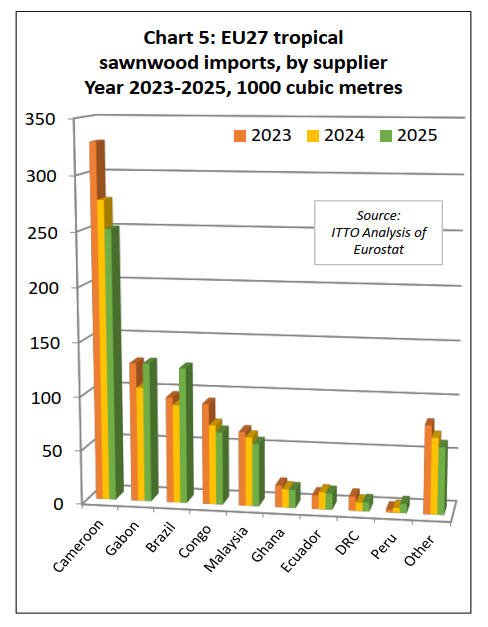
Tropical sawnwood imports were down in 2025 from
Cameroon (-9% to 250,800 cu.m), the Republic of Congo
(-9% to 67,500 cu.m), Malaysia (-9% to 58,200 cu.m),
Ghana (-3% to 16,700 cu.m), Ecuador (-17% to 10,400
cu.m), and Surinam (-25% to 5,400 cu.m).
However, these declines were offset by rising imports
from Gabon (+21% to 128,900 cu.m), Brazil (+38% to
125,600 cu.m), the Democratic Republic of Congo (+11%
to 8,500 cu.m), Peru (+91% to 8,300 cu.m), Indonesia
(+10% to 6,900 cu.m), and the Central African Republic
(+19% to 6,600 cu.m), (Chart 5).
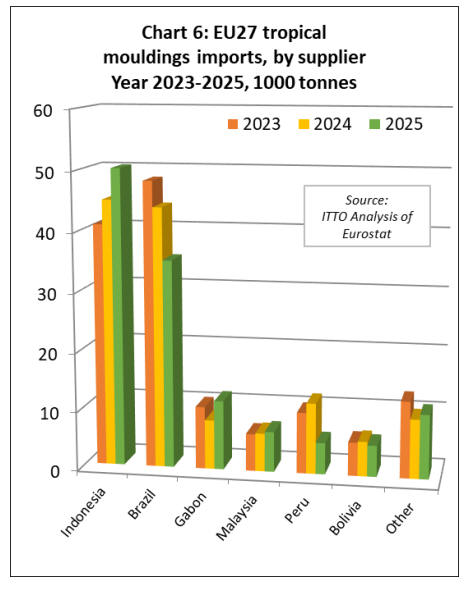
The EU imported 125,200 tonnes of tropical
mouldings/decking with a total value of US$215 million in
2025, respectively 5% and 7% less than in the previous
year. The decrease in imports was mainly due to a steep
decline from Brazil (-20% to 35,100 tonnes), and Peru (-
56% to 5,300 tonnes). Imports were also down 10% from
Bolivia to 5,300 tonnes. However, imports increased from
Indonesia (+12% to 50,200 tonnes), Gabon (+40% to
11,700 tonnes), and Malaysia (+5% to 6,800 tonnes)
during the year (Chart 6).
Rising EU imports of tropical logs from CAR and
Liberia in 2025
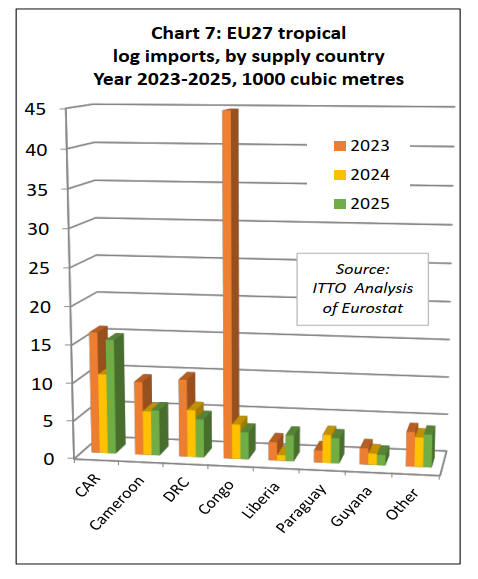
The EU imported 42,200 cu.m of tropical logs with a total
value of US$24.7 million in 2025, respectively 14% and
12% more in 2024.
The rise in trade quantity was particularly driven by sharp
percentage increases from the Central African Republic
(+44% to 15,200 cu.m) and Liberia (+355% to 3,400
cu.m), concentrated in the second quarter of the year.
Imports from Cameroon were also up 3% to 6,000 cu.m,
gaining pace in the third quarter after a slow start to the
year.
However, log imports declined from both the Democratic
Republic of Congo (-19% to 5,100 cu.m) and the Republic
of Congo (-21% to 3,600 cu.m) in 2025, responding to
tighter controls on log exports. EU log imports also fell
from Paraguay, by 10% to 3,300 cu.m, and from Guyana,
by 8% to 1,400 cu.m during year (Chart 7).
EU tropical veneer imports stable in 2025
The EU imported 250,300 cu.m of tropical veneer with a
total value of US$181 million in 2025. Import quantity
was the same as the previous year but value increased 6%.
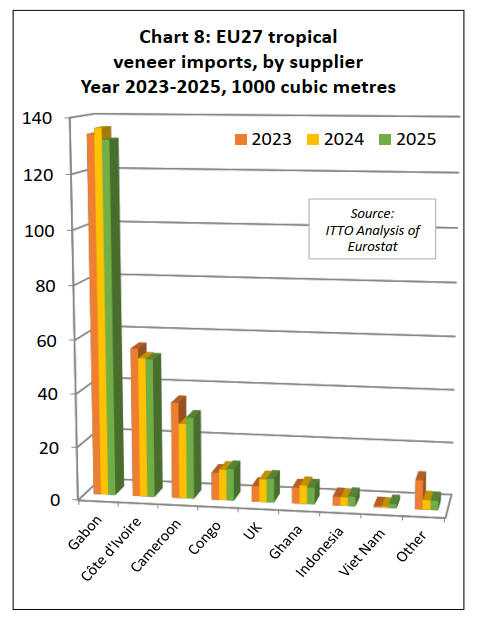
EU imports of tropical veneer decreased during the year
from Gabon (-3% to 131,800 cu.m), Côte d'Ivoire (-0.5%
to 52,000 cu.m), and Ghana (-10% to 6,200 cu.m).
However, imports increased from Cameroon (+9% to
21,900 cu.m), the Republic of Congo (+4% to 12,000
cu.m), the UK (+4% to 8,900 cu.m), Indonesia (+15% to
3,600 cu.m), and Vietnam (+276% to 1,600 cu.m) (Chart 8
above).
EU plywood imports impacted by anti-dumping duties
on Chinese products
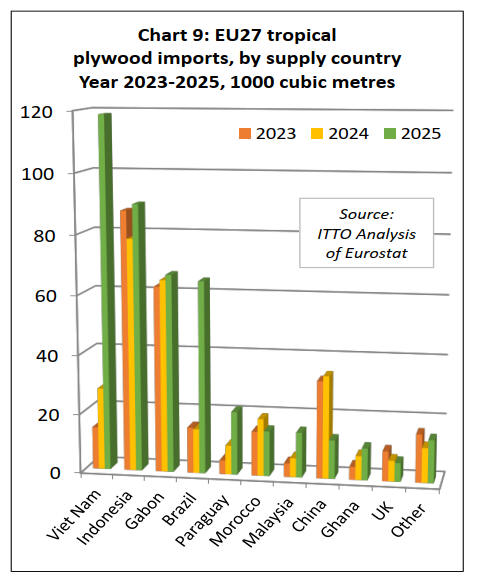
The EU imported 435,900 cu.m of tropical plywood with a
total value of US$272.3 million in 2025, up 54% and 32%
respectively compared to the previous year. The
imposition of EU anti-dumping duties on Chinese
hardwood plywood in 2025, with a provisional rate of
62.4% imposed from 11 June followed by a definitive rate
of 86.8% from 21 November, had a dramatic effect on EU
plywood imports in 2025.
The policy contributed to a very rapid increase in
hardwood plywood imports from several tropical
countries. Imports increased particularly dramatically
from Vietnam last year, by 328% to 118,600 cu.m, thereby
overtaking Indonesia as the largest single supplier of
tropical plywood to the EU.
Hardwood plywood imports also increased sharply last
year from Brazil (+333% to 64,800 cu.m), Paraguay
(+117% to 21,300 cu.m), and Malaysia (+135% to 15,200
cu.m).
Imports increased at a slower rate from Indonesia (+15%
to 89,600 cu.m), Gabon (+3% to 66,700 cu.m), and Ghana
(+33% to 10,700 cu.m). These gains were only partly
offset last year by declining imports of tropical hardwood
plywood from China (-62% to 13,000 cu.m), Morocco (-
21% to 15,200 cu.m), and the UK (-10% to 6,300 cu.m)
(Chart 9).
EU imports of tropical flooring up over 100% in 2025
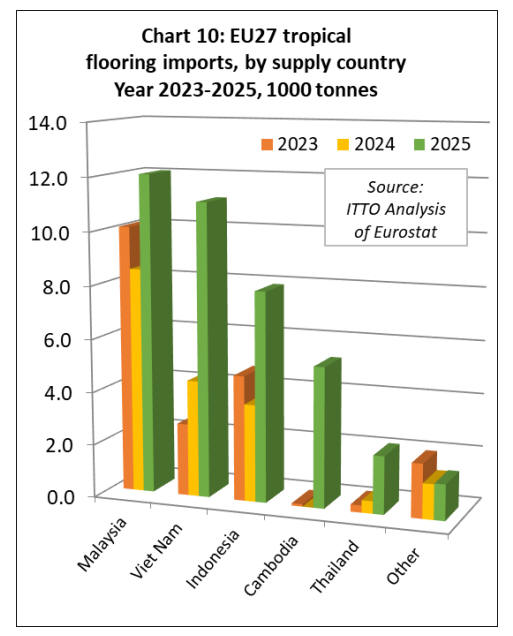
The EU imported 39,900 tonnes of tropical wood flooring
with a total value of US$112.5 million in 2025, up 117%
and 132% respectively compared to the previous year.
Imports increased by 42% from Malaysia to 12,100
tonnes.
Imports of 11,100 tonnes from Vietnam were 152% more
than the previous year. EU imports of this commodity also
increased sharply in percentage terms from Indonesia
(+116% to 7,900 tonnes), and Thailand (+368% to 2,200
tonnes). The EU imported 5,300 tonnes of wood flooring
from Cambodia in 2025, up from near zero in 2024 (Chart
10).
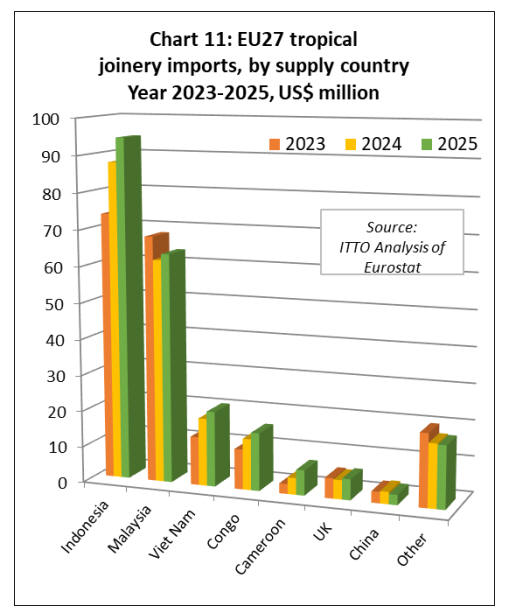
EU import value of other joinery products from tropical
countries - mainly laminated window scantlings, kitchen
tops and wood doors – was US$227.9 million in 2025, 7%
more than in 2024.
Import quantity increased 13% to 103,200 tonnes last year.
Import value increased from Indonesia (+8% to US$94.6
million), Malaysia (+3% to US$63.5 million), Vietnam
(+11% to US$20.8 million), the Republic of Congo (+13%
to US$16.1 million), Cameroon (+51% to US$7.0
million), and the UK (+10% to US$5.8 million).
However, EU import value of joinery products made from
tropical wood was down 17% to US$2.8 million from
! China in 2025 (Chart 11).
|


